Identification
- Summary
Zopiclone is a nonbenzodiazepine hypnotic used for the short-term management of insomnia.
- Brand Names
- Imovane
- Generic Name
- Zopiclone
- DrugBank Accession Number
- DB01198
- Background
Zopiclone is a novel hypnotic agent used in the treatment of insomnia. Its mechanism of action is based on modulating benzodiazepine receptors. In addition to zopiclone's benzodiazepine pharmacological properties it also has some barbiturate-like properties.
- Type
- Small Molecule
- Groups
- Approved
- Structure
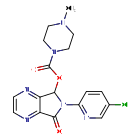
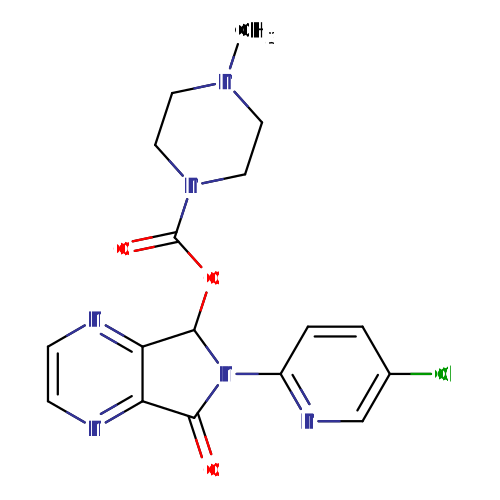
Structure for Zopiclone (DB01198)
- Weight
- Average: 388.808
Monoisotopic: 388.105066147 - Chemical Formula
- C17H17ClN6O3
- Synonyms
- (+-)-zopiclone
- (±)-zopiclone
- 6-(5-Chloro-2-pyridinyl)-7-oxo-6,7-dihydro-5H-pyrrolo[3,4-b]pyrazin-5-yl 4-methyl-1-piperazinecarboxylate
- Zopiclona
- Zopiclone
- Zopiclonum
- External IDs
- RP 27267
- RP-27267

Pharmacology
- Indication
For the short-term treatment of insomnia.
 Reduce drug development failure ratesBuild, train, & validate machine-learning modelswith evidence-based and structured datasets.Build, train, & validate predictive machine-learning models with structured datasets.
- Associated Conditions
Indication Type Indication Combined Product Details Approval Level Age Group Patient Characteristics Dose Form Treatment of Insomnia •••••••••••• - Contraindications & Blackbox Warnings
 Prevent Adverse Drug Events TodayTap into our Clinical API for life-saving information on contraindications & blackbox warnings, population restrictions, harmful risks, & more.Avoid life-threatening adverse drug events with our Clinical API
- Pharmacodynamics
Zopiclone is a nonbenzodiazepine hypnotic from the pyrazolopyrimidine class and is indicated for the short-term treatment of insomnia. While Zopiclone is a hypnotic agent with a chemical structure unrelated to benzodiazepines, barbiturates, or other drugs with known hypnotic properties, it interacts with the gamma-aminobutyric acid-benzodiazepine (GABABZ) receptor complex. Subunit modulation of the GABABZ receptor chloride channel macromolecular complex is hypothesized to be responsible for some of the pharmacological properties of benzodiazepines, which include sedative, anxiolytic, muscle relaxant, and anticonvulsive effects in animal models. Zopiclone binds selectively to the brain alpha subunit of the GABA A omega-1 receptor.
- Mechanism of action
Zopiclone exerts its action by binding on the benzodiazepine receptor complex and modulation of the GABABZ receptor chloride channel macromolecular complex. Both zopiclone and benzodiazepines act indiscriminately at the benzodiazepine binding site on α1, α2, α3 and α5 GABAA containing receptors as full agonists causing an enhancement of the inhibitory actions of GABA to produce the therapeutic (hypnotic and anxiolytic) and adverse effects of zopiclone.
Target Actions Organism AGamma-aminobutyric acid receptor subunit alpha-1 potentiatorHumans AGamma-aminobutyric acid receptor subunit alpha-2 potentiatorHumans AGamma-aminobutyric acid receptor subunit alpha-3 potentiatorHumans AGamma-aminobutyric acid receptor subunit alpha-5 potentiatorHumans UTranslocator protein agonistHumans - Absorption
Rapidly absorbed following oral administration.
- Volume of distribution
Not Available
- Protein binding
Approximately 45%
- Metabolism
Extensively metabolized in the liver via decarboxylation (major pathway), demethylation, and side chain oxidation. Metabolites include an N-oxide derivative (weakly active; approximately 12% of a dose) and an N-desmethyl metabolite (inactive; approximately 16%). Approximately 50% of a dose is converted to other inactive metabolites via decarboxylation. Hepatic microsomal enzymes are apparently not involved in zopiclone clearance.
Hover over products below to view reaction partners
- Route of elimination
Not Available
- Half-life
Elimination half life is approximately 5 hours (range 3.8 to 6.5 hours) and is prolonged to 11.9 hours in patients with hepatic insufficiency.
- Clearance
Not Available
- Adverse Effects
 Improve decision support & research outcomesWith structured adverse effects data, including: blackbox warnings, adverse reactions, warning & precautions, & incidence rates. View sample adverse effects data in our new Data Library!Improve decision support & research outcomes with our structured adverse effects data.
- Toxicity
Rare individual instances of fatal outcomes following overdose with racemic zopiclone have been reported in European postmarketing reports, most often associated with overdose with other CNS-depressant agent. Signs and symptoms of overdose effects of CNS depressants can be expected to present as exaggerations of the pharmacological effects noted in preclinical testing.
- Pathways
- Not Available
- Pharmacogenomic Effects/ADRs
- Not Available
Interactions
- Drug Interactions
- This information should not be interpreted without the help of a healthcare provider. If you believe you are experiencing an interaction, contact a healthcare provider immediately. The absence of an interaction does not necessarily mean no interactions exist.
Drug Interaction Integrate drug-drug
interactions in your software1,2-Benzodiazepine The risk or severity of adverse effects can be increased when 1,2-Benzodiazepine is combined with Zopiclone. Abametapir The serum concentration of Zopiclone can be increased when it is combined with Abametapir. Abatacept The metabolism of Zopiclone can be increased when combined with Abatacept. Abiraterone The metabolism of Zopiclone can be decreased when combined with Abiraterone. Abrocitinib The metabolism of Abrocitinib can be decreased when combined with Zopiclone. - Food Interactions
- Avoid alcohol. Ingesting alcohol may potentiate the CNS depressant actions of zopiclone.
- Avoid grapefruit products. Grapefruit may reduce the CYP3A4 metabolism of zopiclone, increasing its sedative effects.
Products
 Drug product information from 10+ global regionsOur datasets provide approved product information including:dosage, form, labeller, route of administration, and marketing period.Access drug product information from over 10 global regions.
- International/Other Brands
- Amoban / Zimovane
- Brand Name Prescription Products
Name Dosage Strength Route Labeller Marketing Start Marketing End Region Image Act Zopiclone Tablet 5 mg Oral TEVA Canada Limited 2005-11-11 Not applicable Canada 
Act Zopiclone Tablet 7.5 mg Oral TEVA Canada Limited 2005-11-11 Not applicable Canada Imovane Tablet 7.5 mg Oral Sanofi Aventis 1990-12-31 Not applicable Canada Imovane Tablet 5.0 mg Oral Sanofi Aventis 1998-02-10 2022-05-24 Canada M-zopiclone Tablet 3.75 mg Oral Mantra Pharma Inc 2019-02-06 Not applicable Canada - Generic Prescription Products
Name Dosage Strength Route Labeller Marketing Start Marketing End Region Image Ag-zopiclone Tablet 3.75 mg Oral Angita Pharma Inc. 2018-12-21 Not applicable Canada Ag-zopiclone Tablet 7.5 mg Oral Angita Pharma Inc. 2018-07-25 Not applicable Canada Ag-zopiclone Tablet 5 mg Oral Angita Pharma Inc. 2018-07-25 Not applicable Canada Apo-zopiclone Tablet 5 mg Oral Apotex Corporation 2002-06-04 Not applicable Canada Apo-zopiclone Tablet 7.5 mg Oral Apotex Corporation 1996-09-19 Not applicable Canada
Categories
- ATC Codes
- N05CF01 — Zopiclone
- Drug Categories
- Aza Compounds
- Benzodiazepine hypnotics and sedatives
- Central Nervous System Agents
- Central Nervous System Depressants
- Cytochrome P-450 CYP2C8 Substrates
- Cytochrome P-450 CYP2C9 Substrates
- Cytochrome P-450 CYP3A Substrates
- Cytochrome P-450 CYP3A4 Substrates
- Cytochrome P-450 Substrates
- Drugs causing inadvertant photosensitivity
- Hypnotics (Nonbenzodiazepine)
- Hypnotics and Sedatives
- Methemoglobinemia Associated Agents
- Miscellaneous Anxiolytics Sedatives and Hypnotics
- Nervous System
- Photosensitizing Agents
- Psycholeptics
- Sleep Initiation and Maintenance Disorders
- Zopiclone and prodrugs
- Chemical TaxonomyProvided by Classyfire
- Description
- This compound belongs to the class of organic compounds known as cyclopyrrolones. These are compounds belonging to a family of pyridin-2-ylpyrrole based chemicals. The pyrrole is usually fused to a benzene, pyrimidine, or dithiin.
- Kingdom
- Organic compounds
- Super Class
- Organoheterocyclic compounds
- Class
- Pyrrolopyrazines
- Sub Class
- Cyclopyrrolones
- Direct Parent
- Cyclopyrrolones
- Alternative Parents
- Piperazine carboxylic acids / 2-heteroaryl carboxamides / N-methylpiperazines / Pyridines and derivatives / Pyrazines / Aryl chlorides / Imidolactams / Tertiary carboxylic acid amides / Carbamate esters / Heteroaromatic compounds show 9 more
- Substituents
- 1,4-diazinane / 2-heteroaryl carboxamide / Amine / Amino acid or derivatives / Aromatic heteropolycyclic compound / Aryl chloride / Aryl halide / Azacycle / Carbamic acid ester / Carbonic acid derivative show 25 more
- Molecular Framework
- Aromatic heteropolycyclic compounds
- External Descriptors
- pyrrolopyrazine, monochloropyridine (CHEBI:32315)
- Affected organisms
- Humans and other mammals
Chemical Identifiers
- UNII
- 03A5ORL08Q
- CAS number
- 43200-80-2
- InChI Key
- GBBSUAFBMRNDJC-UHFFFAOYSA-N
- InChI
- InChI=1S/C17H17ClN6O3/c1-22-6-8-23(9-7-22)17(26)27-16-14-13(19-4-5-20-14)15(25)24(16)12-3-2-11(18)10-21-12/h2-5,10,16H,6-9H2,1H3
- IUPAC Name
- 6-(5-chloropyridin-2-yl)-7-oxo-5H,6H,7H-pyrrolo[3,4-b]pyrazin-5-yl 4-methylpiperazine-1-carboxylate
- SMILES
- CN1CCN(CC1)C(=O)OC1N(C(=O)C2=NC=CN=C12)C1=NC=C(Cl)C=C1
References
- Synthesis Reference
Thomas Jerussi, "Compositions comprising zopiclone derivatives and methods of making and using the same." U.S. Patent US20040147521, issued July 29, 2004.
US20040147521- General References
- Liu HJ, Sato K, Shih HC, Shibuya T, Kawamoto H, Kitagawa H: Pharmacologic studies of the central action of zopiclone: effects on locomotor activity and brain monoamines in rats. Int J Clin Pharmacol Ther Toxicol. 1985 Mar;23(3):121-8. [Article]
- Sato K, Hong YL, Yang MS, Shibuya T, Kawamoto H, Kitagawa H: Pharmacologic studies of central actions of zopiclone: influence on brain monoamines in rats under stressful condition. Int J Clin Pharmacol Ther Toxicol. 1985 Apr;23(4):204-10. [Article]
- Dundar Y, Dodd S, Strobl J, Boland A, Dickson R, Walley T: Comparative efficacy of newer hypnotic drugs for the short-term management of insomnia: a systematic review and meta-analysis. Hum Psychopharmacol. 2004 Jul;19(5):305-22. [Article]
- Blanchard JC, Julou L: Suriclone: a new cyclopyrrolone derivative recognizing receptors labeled by benzodiazepines in rat hippocampus and cerebellum. J Neurochem. 1983 Mar;40(3):601-7. [Article]
- Julou L, Bardone MC, Blanchard JC, Garret C, Stutzmann JM: Pharmacological studies on zopiclone. Pharmacology. 1983;27 Suppl 2:46-58. [Article]
- External Links
- Human Metabolome Database
- HMDB0015329
- KEGG Drug
- D01372
- PubChem Compound
- 5735
- PubChem Substance
- 46505233
- ChemSpider
- 5533
- BindingDB
- 50054136
- 40001
- ChEBI
- 32315
- ChEMBL
- CHEMBL135400
- Therapeutic Targets Database
- DAP000427
- PharmGKB
- PA10236
- Drugs.com
- Drugs.com Drug Page
- Wikipedia
- Zopiclone
Clinical Trials
Pharmacoeconomics
- Manufacturers
- Not Available
- Packagers
- Centaur Pharmaceuticals Pvt Ltd.
- Dosage Forms
Form Route Strength Tablet Oral Tablet Oral 5 mg Tablet Oral 7.5 mg Tablet Oral 5.0 mg Tablet, film coated Oral 7.5 MG Tablet Oral 3.75 mg Tablet, coated Oral Tablet, film coated Oral 3.75 MG Tablet, coated Oral 7.5 mg Tablet, coated Oral 750000 mg Tablet, film coated Oral - Prices
Unit description Cost Unit Imovane 7.5 mg Tablet 1.41USD tablet Imovane 5 mg Tablet 1.11USD tablet Apo-Zopiclone 7.5 mg Tablet 0.49USD tablet Co Zopiclone 7.5 mg Tablet 0.49USD tablet Mylan-Zopiclone 7.5 mg Tablet 0.49USD tablet Novo-Zopiclone 7.5 mg Tablet 0.49USD tablet Nu-Zopiclone 7.5 mg Tablet 0.49USD tablet Pms-Zopiclone 7.5 mg Tablet 0.49USD tablet Ran-Zopiclone 7.5 mg Tablet 0.49USD tablet Ratio-Zopiclone 7.5 mg Tablet 0.49USD tablet Rhovane 7.5 mg Tablet 0.49USD tablet Sandoz Zopiclone 7.5 mg Tablet 0.49USD tablet Zopiclone 7.5 mg Tablet 0.49USD tablet Apo-Zopiclone 5 mg Tablet 0.23USD tablet Co Zopiclone 5 mg Tablet 0.23USD tablet Mylan-Zopiclone 5 mg Tablet 0.23USD tablet Novo-Zopiclone 5 mg Tablet 0.23USD tablet Pms-Zopiclone 5 mg Tablet 0.23USD tablet Ran-Zopiclone 5 mg Tablet 0.23USD tablet Ratio-Zopiclone 5 mg Tablet 0.23USD tablet Sandoz Zopiclone 5 mg Tablet 0.23USD tablet Zopiclone 5 mg Tablet 0.23USD tablet DrugBank does not sell nor buy drugs. Pricing information is supplied for informational purposes only.- Patents
- Not Available
Properties
- State
- Solid
- Experimental Properties
Property Value Source melting point (°C) 178 °C PhysProp water solubility 0.151 mg/mL at 25 °C MEYLAN,WM et al. (1996) logP 0.8 Not Available - Predicted Properties
Property Value Source Water Solubility 0.885 mg/mL ALOGPS logP 0.97 ALOGPS logP 0.52 Chemaxon logS -2.6 ALOGPS pKa (Strongest Acidic) 8.04 Chemaxon pKa (Strongest Basic) 6.86 Chemaxon Physiological Charge 0 Chemaxon Hydrogen Acceptor Count 6 Chemaxon Hydrogen Donor Count 0 Chemaxon Polar Surface Area 91.76 Å2 Chemaxon Rotatable Bond Count 3 Chemaxon Refractivity 95.89 m3·mol-1 Chemaxon Polarizability 38.22 Å3 Chemaxon Number of Rings 4 Chemaxon Bioavailability 1 Chemaxon Rule of Five Yes Chemaxon Ghose Filter Yes Chemaxon Veber's Rule No Chemaxon MDDR-like Rule No Chemaxon - Predicted ADMET Features
Property Value Probability Human Intestinal Absorption + 1.0 Blood Brain Barrier + 0.9382 Caco-2 permeable + 0.5805 P-glycoprotein substrate Substrate 0.6917 P-glycoprotein inhibitor I Inhibitor 0.6381 P-glycoprotein inhibitor II Inhibitor 0.5 Renal organic cation transporter Non-inhibitor 0.6785 CYP450 2C9 substrate Non-substrate 0.7158 CYP450 2D6 substrate Non-substrate 0.9115 CYP450 3A4 substrate Substrate 0.6775 CYP450 1A2 substrate Non-inhibitor 0.9046 CYP450 2C9 inhibitor Non-inhibitor 0.9071 CYP450 2D6 inhibitor Non-inhibitor 0.923 CYP450 2C19 inhibitor Inhibitor 0.8995 CYP450 3A4 inhibitor Non-inhibitor 0.8309 CYP450 inhibitory promiscuity Low CYP Inhibitory Promiscuity 0.689 Ames test AMES toxic 0.5332 Carcinogenicity Non-carcinogens 0.9174 Biodegradation Not ready biodegradable 0.9941 Rat acute toxicity 2.6411 LD50, mol/kg Not applicable hERG inhibition (predictor I) Weak inhibitor 0.7838 hERG inhibition (predictor II) Non-inhibitor 0.5688
Spectra
- Mass Spec (NIST)
- Not Available
- Spectra
- Chromatographic Properties
Collision Cross Sections (CCS)
Adduct CCS Value (Å2) Source type Source [M-H]- 198.1988232 predictedDarkChem Lite v0.1.0 [M-H]- 185.05937 predictedDeepCCS 1.0 (2019) [M+H]+ 199.0918232 predictedDarkChem Lite v0.1.0 [M+H]+ 187.57133 predictedDeepCCS 1.0 (2019) [M+Na]+ 198.7405232 predictedDarkChem Lite v0.1.0 [M+Na]+ 194.7325 predictedDeepCCS 1.0 (2019)
Targets

- Kind
- Protein
- Organism
- Humans
- Pharmacological action
- Yes
- Actions
- Potentiator
- General Function
- Inhibitory extracellular ligand-gated ion channel activity
- Specific Function
- Component of the heteropentameric receptor for GABA, the major inhibitory neurotransmitter in the vertebrate brain. Functions also as histamine receptor and mediates cellular responses to histamine...
- Gene Name
- GABRA1
- Uniprot ID
- P14867
- Uniprot Name
- Gamma-aminobutyric acid receptor subunit alpha-1
- Molecular Weight
- 51801.395 Da
References
- Nutt DJ, Stahl SM: Searching for perfect sleep: the continuing evolution of GABAA receptor modulators as hypnotics. J Psychopharmacol. 2010 Nov;24(11):1601-12. doi: 10.1177/0269881109106927. Epub 2009 Nov 26. [Article]
- Hanson SM, Morlock EV, Satyshur KA, Czajkowski C: Structural requirements for eszopiclone and zolpidem binding to the gamma-aminobutyric acid type-A (GABAA) receptor are different. J Med Chem. 2008 Nov 27;51(22):7243-52. doi: 10.1021/jm800889m. [Article]
- Sanger DJ: The pharmacology and mechanisms of action of new generation, non-benzodiazepine hypnotic agents. CNS Drugs. 2004;18 Suppl 1:9-15; discussion 41, 43-5. [Article]
- Skerritt JH, Johnston GA: Enhancement of GABA binding by benzodiazepines and related anxiolytics. Eur J Pharmacol. 1983 May 6;89(3-4):193-8. [Article]
- Ramerstorfer J, Furtmuller R, Vogel E, Huck S, Sieghart W: The point mutation gamma 2F77I changes the potency and efficacy of benzodiazepine site ligands in different GABAA receptor subtypes. Eur J Pharmacol. 2010 Jun 25;636(1-3):18-27. doi: 10.1016/j.ejphar.2010.03.015. Epub 2010 Mar 19. [Article]
- Kind
- Protein
- Organism
- Humans
- Pharmacological action
- Yes
- Actions
- Potentiator
- General Function
- Inhibitory extracellular ligand-gated ion channel activity
- Specific Function
- GABA, the major inhibitory neurotransmitter in the vertebrate brain, mediates neuronal inhibition by binding to the GABA/benzodiazepine receptor and opening an integral chloride channel.
- Gene Name
- GABRA2
- Uniprot ID
- P47869
- Uniprot Name
- Gamma-aminobutyric acid receptor subunit alpha-2
- Molecular Weight
- 51325.85 Da
References
- Nutt DJ, Stahl SM: Searching for perfect sleep: the continuing evolution of GABAA receptor modulators as hypnotics. J Psychopharmacol. 2010 Nov;24(11):1601-12. doi: 10.1177/0269881109106927. Epub 2009 Nov 26. [Article]
- Hanson SM, Morlock EV, Satyshur KA, Czajkowski C: Structural requirements for eszopiclone and zolpidem binding to the gamma-aminobutyric acid type-A (GABAA) receptor are different. J Med Chem. 2008 Nov 27;51(22):7243-52. doi: 10.1021/jm800889m. [Article]
- Ramerstorfer J, Furtmuller R, Vogel E, Huck S, Sieghart W: The point mutation gamma 2F77I changes the potency and efficacy of benzodiazepine site ligands in different GABAA receptor subtypes. Eur J Pharmacol. 2010 Jun 25;636(1-3):18-27. doi: 10.1016/j.ejphar.2010.03.015. Epub 2010 Mar 19. [Article]
- Kind
- Protein
- Organism
- Humans
- Pharmacological action
- Yes
- Actions
- Potentiator
- General Function
- Inhibitory extracellular ligand-gated ion channel activity
- Specific Function
- GABA, the major inhibitory neurotransmitter in the vertebrate brain, mediates neuronal inhibition by binding to the GABA/benzodiazepine receptor and opening an integral chloride channel.
- Gene Name
- GABRA3
- Uniprot ID
- P34903
- Uniprot Name
- Gamma-aminobutyric acid receptor subunit alpha-3
- Molecular Weight
- 55164.055 Da
References
- Nutt DJ, Stahl SM: Searching for perfect sleep: the continuing evolution of GABAA receptor modulators as hypnotics. J Psychopharmacol. 2010 Nov;24(11):1601-12. doi: 10.1177/0269881109106927. Epub 2009 Nov 26. [Article]
- Hanson SM, Morlock EV, Satyshur KA, Czajkowski C: Structural requirements for eszopiclone and zolpidem binding to the gamma-aminobutyric acid type-A (GABAA) receptor are different. J Med Chem. 2008 Nov 27;51(22):7243-52. doi: 10.1021/jm800889m. [Article]
- Ramerstorfer J, Furtmuller R, Vogel E, Huck S, Sieghart W: The point mutation gamma 2F77I changes the potency and efficacy of benzodiazepine site ligands in different GABAA receptor subtypes. Eur J Pharmacol. 2010 Jun 25;636(1-3):18-27. doi: 10.1016/j.ejphar.2010.03.015. Epub 2010 Mar 19. [Article]
- Kind
- Protein
- Organism
- Humans
- Pharmacological action
- Yes
- Actions
- Potentiator
- General Function
- Transporter activity
- Specific Function
- GABA, the major inhibitory neurotransmitter in the vertebrate brain, mediates neuronal inhibition by binding to the GABA/benzodiazepine receptor and opening an integral chloride channel.
- Gene Name
- GABRA5
- Uniprot ID
- P31644
- Uniprot Name
- Gamma-aminobutyric acid receptor subunit alpha-5
- Molecular Weight
- 52145.645 Da
References
- Nutt DJ, Stahl SM: Searching for perfect sleep: the continuing evolution of GABAA receptor modulators as hypnotics. J Psychopharmacol. 2010 Nov;24(11):1601-12. doi: 10.1177/0269881109106927. Epub 2009 Nov 26. [Article]
- Hanson SM, Morlock EV, Satyshur KA, Czajkowski C: Structural requirements for eszopiclone and zolpidem binding to the gamma-aminobutyric acid type-A (GABAA) receptor are different. J Med Chem. 2008 Nov 27;51(22):7243-52. doi: 10.1021/jm800889m. [Article]
- Skerritt JH, Johnston GA: Enhancement of GABA binding by benzodiazepines and related anxiolytics. Eur J Pharmacol. 1983 May 6;89(3-4):193-8. [Article]
- Ramerstorfer J, Furtmuller R, Vogel E, Huck S, Sieghart W: The point mutation gamma 2F77I changes the potency and efficacy of benzodiazepine site ligands in different GABAA receptor subtypes. Eur J Pharmacol. 2010 Jun 25;636(1-3):18-27. doi: 10.1016/j.ejphar.2010.03.015. Epub 2010 Mar 19. [Article]
- Kind
- Protein
- Organism
- Humans
- Pharmacological action
- Unknown
- Actions
- Agonist
- Curator comments
- This is a potential target based on the benzodiazepine drug-class mechanism, however, direct evidence is not readily available in the literature.
- General Function
- Cholesterol binding
- Specific Function
- Can bind protoporphyrin IX and may play a role in the transport of porphyrins and heme (By similarity). Promotes the transport of cholesterol across mitochondrial membranes and may play a role in l...
- Gene Name
- TSPO
- Uniprot ID
- P30536
- Uniprot Name
- Translocator protein
- Molecular Weight
- 18827.81 Da
References
- Rupprecht R, Papadopoulos V, Rammes G, Baghai TC, Fan J, Akula N, Groyer G, Adams D, Schumacher M: Translocator protein (18 kDa) (TSPO) as a therapeutic target for neurological and psychiatric disorders. Nat Rev Drug Discov. 2010 Dec;9(12):971-88. doi: 10.1038/nrd3295. [Article]
Enzymes
- Kind
- Protein
- Organism
- Humans
- Pharmacological action
- Unknown
- Actions
- Substrate
- General Function
- Vitamin d3 25-hydroxylase activity
- Specific Function
- Cytochromes P450 are a group of heme-thiolate monooxygenases. In liver microsomes, this enzyme is involved in an NADPH-dependent electron transport pathway. It performs a variety of oxidation react...
- Gene Name
- CYP3A4
- Uniprot ID
- P08684
- Uniprot Name
- Cytochrome P450 3A4
- Molecular Weight
- 57342.67 Da
References
- Lalovic B, Phillips B, Risler LL, Howald W, Shen DD: Quantitative contribution of CYP2D6 and CYP3A to oxycodone metabolism in human liver and intestinal microsomes. Drug Metab Dispos. 2004 Apr;32(4):447-54. [Article]
- Becquemont L, Mouajjah S, Escaffre O, Beaune P, Funck-Brentano C, Jaillon P: Cytochrome P-450 3A4 and 2C8 are involved in zopiclone metabolism. Drug Metab Dispos. 1999 Sep;27(9):1068-73. [Article]
- IMOVANE (Zopiclone) Product Monograph [Link]
- Kind
- Protein
- Organism
- Humans
- Pharmacological action
- Unknown
- Actions
- Substrate
- General Function
- Steroid hydroxylase activity
- Specific Function
- Cytochromes P450 are a group of heme-thiolate monooxygenases. In liver microsomes, this enzyme is involved in an NADPH-dependent electron transport pathway. It oxidizes a variety of structurally un...
- Gene Name
- CYP2C8
- Uniprot ID
- P10632
- Uniprot Name
- Cytochrome P450 2C8
- Molecular Weight
- 55824.275 Da
References
- Zhou SF, Zhou ZW, Yang LP, Cai JP: Substrates, inducers, inhibitors and structure-activity relationships of human Cytochrome P450 2C9 and implications in drug development. Curr Med Chem. 2009;16(27):3480-675. Epub 2009 Sep 1. [Article]
- Lalovic B, Phillips B, Risler LL, Howald W, Shen DD: Quantitative contribution of CYP2D6 and CYP3A to oxycodone metabolism in human liver and intestinal microsomes. Drug Metab Dispos. 2004 Apr;32(4):447-54. [Article]
- Becquemont L, Mouajjah S, Escaffre O, Beaune P, Funck-Brentano C, Jaillon P: Cytochrome P-450 3A4 and 2C8 are involved in zopiclone metabolism. Drug Metab Dispos. 1999 Sep;27(9):1068-73. [Article]
- IMOVANE (Zopiclone) Product Monograph [Link]
- Kind
- Protein
- Organism
- Humans
- Pharmacological action
- Unknown
- Actions
- Substrate
- General Function
- Steroid hydroxylase activity
- Specific Function
- Cytochromes P450 are a group of heme-thiolate monooxygenases. In liver microsomes, this enzyme is involved in an NADPH-dependent electron transport pathway. It oxidizes a variety of structurally un...
- Gene Name
- CYP2C9
- Uniprot ID
- P11712
- Uniprot Name
- Cytochrome P450 2C9
- Molecular Weight
- 55627.365 Da
References
- Rendic S: Summary of information on human CYP enzymes: human P450 metabolism data. Drug Metab Rev. 2002 Feb-May;34(1-2):83-448. [Article]
- Kind
- Protein
- Organism
- Humans
- Pharmacological action
- Unknown
- Actions
- Substrate
- General Function
- Prostaglandin-endoperoxide synthase activity
- Specific Function
- Converts arachidonate to prostaglandin H2 (PGH2), a committed step in prostanoid synthesis. Involved in the constitutive production of prostanoids in particular in the stomach and platelets. In gas...
- Gene Name
- PTGS1
- Uniprot ID
- P23219
- Uniprot Name
- Prostaglandin G/H synthase 1
- Molecular Weight
- 68685.82 Da
References
- Zhou SF, Zhou ZW, Yang LP, Cai JP: Substrates, inducers, inhibitors and structure-activity relationships of human Cytochrome P450 2C9 and implications in drug development. Curr Med Chem. 2009;16(27):3480-675. Epub 2009 Sep 1. [Article]

Drug created at June 13, 2005 13:24 / Updated at April 23, 2024 11:38