Identification
- Summary
Aminoglutethimide is an adrenocortical steroid synthesis inhibitor used in the treatment of Cushing's syndrome.
- Generic Name
- Aminoglutethimide
- DrugBank Accession Number
- DB00357
- Background
An aromatase inhibitor that produces a state of "medical" adrenalectomy by blocking the production of adrenal steroids. It also blocks the conversion of androgens to estrogens. Aminoglutethimide has been used in the treatment of advanced breast and prostate cancer. It was formerly used for its weak anticonvulsant properties. (From Martindale, The Extra Pharmacopoeia, 30th ed, p454)
- Type
- Small Molecule
- Groups
- Approved, Investigational
- Structure
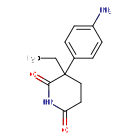
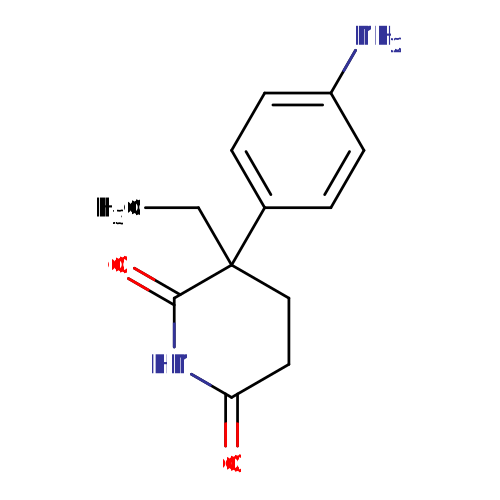
Structure for Aminoglutethimide (DB00357)
- Weight
- Average: 232.2783
Monoisotopic: 232.121177766 - Chemical Formula
- C13H16N2O2
- Synonyms
- 2-(p-Aminophenyl)-2-ethylglutarimide
- 3-Ethyl-3-(p-aminophenyl)-2,6-dioxopiperidine
- Aminoglutethimid
- Aminoglutéthimide
- Aminoglutethimide
- Aminoglutethimidum
- Aminoglutetimida
- Aminoglutetimide
- DL-Aminoglutethimide
- p-Aminoglutethimide
- α-(p-Aminophenyl)-α-ethylglutarimide
- External IDs
- BA 16038
- C 16038-BA

Pharmacology
- Indication
For the suppression of adrenal function in selected patients with Cushing's syndrome, malignant neoplasm of the female breast, and carcinoma in situ of the breast.
 Reduce drug development failure ratesBuild, train, & validate machine-learning modelswith evidence-based and structured datasets.Build, train, & validate predictive machine-learning models with structured datasets.
- Contraindications & Blackbox Warnings
 Prevent Adverse Drug Events TodayTap into our Clinical API for life-saving information on contraindications & blackbox warnings, population restrictions, harmful risks, & more.Avoid life-threatening adverse drug events with our Clinical API
- Pharmacodynamics
Aminoglutethimide inhibits the enzymatic conversion of cholesterol to D5-pregnenolone, resulting in a decrease in the production of adrenal glucocorticoids, mineralocorticoids, estrogens, and androgens.
- Mechanism of action
Aminoglutethimide reduces the production of D5-pregnenolone and blocks several other steps in steroid synthesis, including the C-11, C-18, and C-21 hydroxylations and the hydroxylations required for the aromatization of androgens to estrogens, mediated through the binding of aminoglutethimide to cytochrome P-450 complexes. Specifically, the drug binds to and inhibits aromatase which is essential for the generation of estrogens from androstenedione and testosterone. A decrease in adrenal secretion of cortisol is followed by an increased secretion of pituitary adrenocorticotropic hormone (ACTH), which will overcome the blockade of adrenocortical steroid synthesis by aminoglutethimide. The compensatory increase in ACTH secretion can be suppressed by the simultaneous administration of hydrocortisone. Since aminoglutethimide increases the rate of metabolism of dexamethasone but not that of hydrocortisone, the latter is preferred as the adrenal glucocorticoid replacement. Although aminoglutethimide inhibits the synthesis of thyroxine by the thyroid gland, the compensatory increase in thyroid-stimulating hormone (TSH) is frequently of sufficient magnitude to overcome the inhibition of thyroid synthesis due to aminoglutethimide. In spite of an increase in TSH, aminoglutethimide has not been associated with increased prolactin secretion.
Target Actions Organism ACholesterol side-chain cleavage enzyme, mitochondrial inhibitorHumans ACytochrome P450 19A1 inhibitorHumans - Absorption
Rapidly and completely absorbed from gastrointestinal tract. The bioavailability of tablets is equivalent to equal doses given as a solution.
- Volume of distribution
Not Available
- Protein binding
21-25%
- Metabolism
Hepatic. 34-54% of the administered dose is excreted in the urine as unchanged drug during the first 48 hours, and an additional fraction as an N-acetyl derivative.
- Route of elimination
After ingestion of a single oral dose, 34%-54% is excreted in the urine as unchanged drug during the first 48 hours, and an additional fraction as the N-acetyl derivative.
- Half-life
12.5 ± 1.6 hours
- Clearance
Not Available
- Adverse Effects
 Improve decision support & research outcomesWith structured adverse effects data, including: blackbox warnings, adverse reactions, warning & precautions, & incidence rates. View sample adverse effects data in our new Data Library!Improve decision support & research outcomes with our structured adverse effects data.
- Toxicity
Oral LD50s (mg/kg): rats, 1800; dogs, >100. Intravenous LD50s (mg/kg): rats, 156; dogs, >100. Symptoms of overdose include respiratory depression, hypoventilation, hypotension, hypovolemic shock due to dehydration, somnolence, lethargy, coma, ataxia, dizziness, fatigue, nausea, and vomiting.
- Pathways
- Not Available
- Pharmacogenomic Effects/ADRs
- Not Available
Interactions
- Drug Interactions
- This information should not be interpreted without the help of a healthcare provider. If you believe you are experiencing an interaction, contact a healthcare provider immediately. The absence of an interaction does not necessarily mean no interactions exist.
Drug Interaction Integrate drug-drug
interactions in your softwareAbemaciclib The metabolism of Abemaciclib can be increased when combined with Aminoglutethimide. Acalabrutinib The metabolism of Acalabrutinib can be increased when combined with Aminoglutethimide. Acenocoumarol The metabolism of Acenocoumarol can be increased when combined with Aminoglutethimide. Albendazole The metabolism of Albendazole can be increased when combined with Aminoglutethimide. Alclometasone The therapeutic efficacy of Alclometasone can be decreased when used in combination with Aminoglutethimide. - Food Interactions
- Take with or without food. The absorption is unaffected by food.
Products
 Drug product information from 10+ global regionsOur datasets provide approved product information including:dosage, form, labeller, route of administration, and marketing period.Access drug product information from over 10 global regions.
- International/Other Brands
- Elipten (Ciba) / Mamomit (Pliva Hrvatska) / Orimeten (Novartis) / Rogluten (Actavis)
- Brand Name Prescription Products
Name Dosage Strength Route Labeller Marketing Start Marketing End Region Image Cytadren Tablet 250 mg/1 Oral Novartis 1980-10-29 2008-08-08 US 
Cytadren Tab 250mg Tablet 250 mg / tab Oral Novartis 1983-12-31 1999-08-04 Canada 
Categories
- ATC Codes
- L02BG01 — Aminoglutethimide
- Drug Categories
- Antineoplastic Agents
- Antineoplastic Agents, Hormonal
- Antineoplastic and Immunomodulating Agents
- Aromatase Inhibitors
- Cytochrome P-450 CYP2C19 Inducers
- Cytochrome P-450 CYP2C19 Inducers (strength unknown)
- Cytochrome P-450 CYP3A Inducers
- Cytochrome P-450 CYP3A4 Inducers
- Cytochrome P-450 CYP3A4 Inducers (strength unknown)
- Cytochrome P-450 Enzyme Inducers
- Endocrine Therapy
- Enzyme Inhibitors
- Estrogen Antagonists
- Hormone Antagonists
- Hormone Antagonists and Related Agents
- Hormones, Hormone Substitutes, and Hormone Antagonists
- Narrow Therapeutic Index Drugs
- Piperidines
- Piperidones
- Steroid Synthesis Inhibitors
- Chemical TaxonomyProvided by Classyfire
- Description
- This compound belongs to the class of organic compounds known as aniline and substituted anilines. These are organic compounds containing an aminobenzene moiety.
- Kingdom
- Organic compounds
- Super Class
- Benzenoids
- Class
- Benzene and substituted derivatives
- Sub Class
- Aniline and substituted anilines
- Direct Parent
- Aniline and substituted anilines
- Alternative Parents
- Tetrahydropyridines / N-acylimines / Lactims / Amino acids and derivatives / Propargyl-type 1,3-dipolar organic compounds / Azacyclic compounds / Primary amines / Organopnictogen compounds / Organic oxides / Hydrocarbon derivatives show 1 more
- Substituents
- Amine / Amino acid or derivatives / Aniline or substituted anilines / Aromatic heteromonocyclic compound / Azacycle / Carbonyl group / Carboxylic acid derivative / Hydrocarbon derivative / Hydropyridine / Lactim show 12 more
- Molecular Framework
- Aromatic heteromonocyclic compounds
- External Descriptors
- substituted aniline, dicarboximide, piperidones (CHEBI:2654) / a small molecule (CPD-10532)
- Affected organisms
- Humans and other mammals
Chemical Identifiers
- UNII
- 0O54ZQ14I9
- CAS number
- 125-84-8
- InChI Key
- ROBVIMPUHSLWNV-UHFFFAOYSA-N
- InChI
- InChI=1S/C13H16N2O2/c1-2-13(8-7-11(16)15-12(13)17)9-3-5-10(14)6-4-9/h3-6H,2,7-8,14H2,1H3,(H,15,16,17)
- IUPAC Name
- 3-(4-aminophenyl)-3-ethylpiperidine-2,6-dione
- SMILES
- CCC1(CCC(=O)NC1=O)C1=CC=C(N)C=C1
References
- Synthesis Reference
Hoffmann, K.and Urech, E.; U.S. Patent 2,848,455; August 19,1958; assigned to Ciba Pharmaceutical Products, Inc.
- General References
- Not Available
- External Links
- Human Metabolome Database
- HMDB0014501
- KEGG Drug
- D00574
- KEGG Compound
- C07617
- PubChem Compound
- 2145
- PubChem Substance
- 46506066
- ChemSpider
- 2060
- BindingDB
- 9460
- 677
- ChEBI
- 2654
- ChEMBL
- CHEMBL488
- Therapeutic Targets Database
- DAP000842
- PharmGKB
- PA448375
- RxList
- RxList Drug Page
- Drugs.com
- Drugs.com Drug Page
- Wikipedia
- Aminoglutethimide
- FDA label
- Download (122 KB)
Clinical Trials
- Clinical Trials
Phase Status Purpose Conditions Count 3 Completed Treatment Stage I Breast Cancer 1 2 Terminated Treatment Prostate Cancer 1
Pharmacoeconomics
- Manufacturers
- Novartis pharmaceuticals corp
- Packagers
- Kaiser Foundation Hospital
- Novartis AG
- Patheon Inc.
- Dosage Forms
Form Route Strength Tablet Oral 250 mg/1 Tablet Oral 250 mg / tab Tablet Oral - Prices
- Not Available
- Patents
- Not Available
Properties
- State
- Solid
- Experimental Properties
Property Value Source melting point (°C) 223-225 Hoffmann, K.and Urech, E.; U.S. Patent 2848,455; August 19,1958; assigned to Ciba Pharmaceutical Products, Inc. water solubility Practically insoluble in water Not Available logP 1.3 Not Available - Predicted Properties
Property Value Source Water Solubility 0.371 mg/mL ALOGPS logP 1.49 ALOGPS logP 1.3 Chemaxon logS -2.8 ALOGPS pKa (Strongest Acidic) 11.69 Chemaxon pKa (Strongest Basic) 4.28 Chemaxon Physiological Charge 0 Chemaxon Hydrogen Acceptor Count 3 Chemaxon Hydrogen Donor Count 2 Chemaxon Polar Surface Area 72.19 Å2 Chemaxon Rotatable Bond Count 2 Chemaxon Refractivity 65.35 m3·mol-1 Chemaxon Polarizability 24.69 Å3 Chemaxon Number of Rings 2 Chemaxon Bioavailability 1 Chemaxon Rule of Five Yes Chemaxon Ghose Filter Yes Chemaxon Veber's Rule No Chemaxon MDDR-like Rule No Chemaxon - Predicted ADMET Features
Property Value Probability Human Intestinal Absorption + 0.9811 Blood Brain Barrier + 0.9908 Caco-2 permeable + 0.5 P-glycoprotein substrate Substrate 0.7352 P-glycoprotein inhibitor I Non-inhibitor 0.7439 P-glycoprotein inhibitor II Non-inhibitor 0.9432 Renal organic cation transporter Non-inhibitor 0.8514 CYP450 2C9 substrate Non-substrate 0.8342 CYP450 2D6 substrate Non-substrate 0.9116 CYP450 3A4 substrate Non-substrate 0.5505 CYP450 1A2 substrate Non-inhibitor 0.9045 CYP450 2C9 inhibitor Non-inhibitor 0.9071 CYP450 2D6 inhibitor Non-inhibitor 0.923 CYP450 2C19 inhibitor Non-inhibitor 0.9026 CYP450 3A4 inhibitor Non-inhibitor 0.8309 CYP450 inhibitory promiscuity Low CYP Inhibitory Promiscuity 0.8682 Ames test Non AMES toxic 0.8016 Carcinogenicity Non-carcinogens 0.8401 Biodegradation Not ready biodegradable 1.0 Rat acute toxicity 2.7219 LD50, mol/kg Not applicable hERG inhibition (predictor I) Weak inhibitor 0.99 hERG inhibition (predictor II) Non-inhibitor 0.6295
Spectra
- Mass Spec (NIST)
- Not Available
- Spectra
- Chromatographic Properties
Collision Cross Sections (CCS)
Adduct CCS Value (Å2) Source type Source [M-H]- 161.4176961 predictedDarkChem Lite v0.1.0 [M-H]- 162.39764 predictedDeepCCS 1.0 (2019) [M+H]+ 161.8344961 predictedDarkChem Lite v0.1.0 [M+H]+ 164.75565 predictedDeepCCS 1.0 (2019) [M+Na]+ 161.4583961 predictedDarkChem Lite v0.1.0 [M+Na]+ 170.8488 predictedDeepCCS 1.0 (2019)
Targets

- Kind
- Protein
- Organism
- Humans
- Pharmacological action
- Yes
- Actions
- Inhibitor
- General Function
- Oxidoreductase activity, acting on paired donors, with incorporation or reduction of molecular oxygen, nad(p)h as one donor, and incorporation of one atom of oxygen
- Specific Function
- Catalyzes the side-chain cleavage reaction of cholesterol to pregnenolone.
- Gene Name
- CYP11A1
- Uniprot ID
- P05108
- Uniprot Name
- Cholesterol side-chain cleavage enzyme, mitochondrial
- Molecular Weight
- 60101.87 Da
References
- Slominski A, Semak I, Wortsman J, Zjawiony J, Li W, Zbytek B, Tuckey RC: An alternative pathway of vitamin D metabolism. Cytochrome P450scc (CYP11A1)-mediated conversion to 20-hydroxyvitamin D2 and 17,20-dihydroxyvitamin D2. FEBS J. 2006 Jul;273(13):2891-901. [Article]
- Oka H, Emori Y, Hayashi Y, Nomoto K: Breakdown of Th cell immune responses and steroidogenic CYP11A1 expression in CD4+ T cells in a murine model implanted with B16 melanoma. Cell Immunol. 2000 Nov 25;206(1):7-15. [Article]
- Chen X, Ji ZL, Chen YZ: TTD: Therapeutic Target Database. Nucleic Acids Res. 2002 Jan 1;30(1):412-5. [Article]
- Kind
- Protein
- Organism
- Humans
- Pharmacological action
- Yes
- Actions
- Inhibitor
- General Function
- Oxygen binding
- Specific Function
- Catalyzes the formation of aromatic C18 estrogens from C19 androgens.
- Gene Name
- CYP19A1
- Uniprot ID
- P11511
- Uniprot Name
- Aromatase
- Molecular Weight
- 57882.48 Da
References
- Overington JP, Al-Lazikani B, Hopkins AL: How many drug targets are there? Nat Rev Drug Discov. 2006 Dec;5(12):993-6. [Article]
- Imming P, Sinning C, Meyer A: Drugs, their targets and the nature and number of drug targets. Nat Rev Drug Discov. 2006 Oct;5(10):821-34. [Article]
- Greco F, Vicent MJ, Penning NA, Nicholson RI, Duncan R: HPMA copolymer-aminoglutethimide conjugates inhibit aromatase in MCF-7 cell lines. J Drug Target. 2005 Sep-Nov;13(8-9):459-70. [Article]
- Martinez-Campa C, Gonzalez A, Mediavilla MD, Alonso-Gonzalez C, Sanchez-Barcelo EJ, Cos S: Melatonin enhances the inhibitory effect of aminoglutethimide on aromatase activity in MCF-7 human breast cancer cells. Breast Cancer Res Treat. 2005 Dec;94(3):249-54. Epub 2005 Oct 22. [Article]
- Shirakawa H, Katsuki H, Kume T, Kaneko S, Akaike A: Aminoglutethimide prevents excitotoxic and ischemic injuries in cortical neurons. Br J Pharmacol. 2006 Apr;147(7):729-36. [Article]
- Siraki AG, Bonini MG, Jiang J, Ehrenshaft M, Mason RP: Aminoglutethimide-induced protein free radical formation on myeloperoxidase: a potential mechanism of agranulocytosis. Chem Res Toxicol. 2007 Jul;20(7):1038-45. Epub 2007 Jun 30. [Article]
- Chen X, Ji ZL, Chen YZ: TTD: Therapeutic Target Database. Nucleic Acids Res. 2002 Jan 1;30(1):412-5. [Article]
Enzymes
- Kind
- Protein
- Organism
- Humans
- Pharmacological action
- Unknown
- Actions
- Inducer
- General Function
- Vitamin d3 25-hydroxylase activity
- Specific Function
- Cytochromes P450 are a group of heme-thiolate monooxygenases. In liver microsomes, this enzyme is involved in an NADPH-dependent electron transport pathway. It performs a variety of oxidation react...
- Gene Name
- CYP3A4
- Uniprot ID
- P08684
- Uniprot Name
- Cytochrome P450 3A4
- Molecular Weight
- 57342.67 Da
References
- Kind
- Protein
- Organism
- Humans
- Pharmacological action
- Unknown
- Actions
- Inducer
- General Function
- Steroid hydroxylase activity
- Specific Function
- Responsible for the metabolism of a number of therapeutic agents such as the anticonvulsant drug S-mephenytoin, omeprazole, proguanil, certain barbiturates, diazepam, propranolol, citalopram and im...
- Gene Name
- CYP2C19
- Uniprot ID
- P33261
- Uniprot Name
- Cytochrome P450 2C19
- Molecular Weight
- 55930.545 Da
References
- Santen RJ, Misbin RI: Aminoglutethimide: review of pharmacology and clinical use. Pharmacotherapy. 1981 Sep-Oct;1(2):95-120. [Article]
- Gross BA, Mindea SA, Pick AJ, Chandler JP, Batjer HH: Medical management of Cushing disease. Neurosurg Focus. 2007;23(3):E10. [Article]
- Cancer. gov CTEP protocol developments [File]

Drug created at June 13, 2005 13:24 / Updated at March 03, 2024 02:24