Identification
- Summary
Penciclovir is a topical nucleoside polymerase inhibitor used in the treatment of recurrent herpes labialis.
- Brand Names
- Denavir
- Generic Name
- Penciclovir
- DrugBank Accession Number
- DB00299
- Background
Penciclovir is a synthetic acyclic guanine derivative with antiviral activity used for the treatment of various herpes simplex virus (HSV) infections. Displaying low toxicity and good selectivity, penciclovir is a nucleoside analogue.
- Type
- Small Molecule
- Groups
- Approved
- Structure
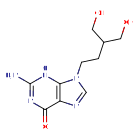
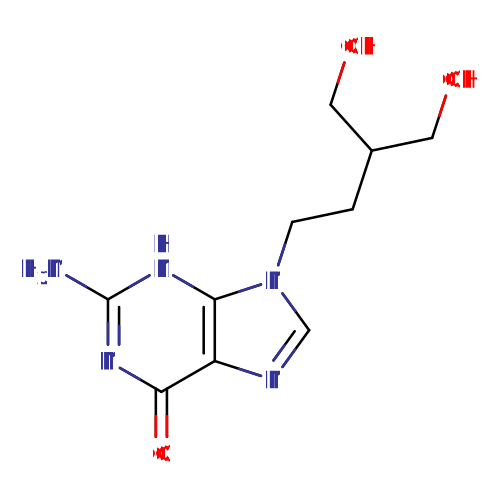
Structure for Penciclovir (DB00299)
- Weight
- Average: 253.2578
Monoisotopic: 253.117489371 - Chemical Formula
- C10H15N5O3
- Synonyms
- 9-(4-hydroxy-3-(hydroxymethyl)butyl)guanine
- 9-(4-hydroxy-3-hydroxymethylbut-1-yl)-guanine
- 9-[2-hydroxy-1-(hydroxymethyl)-ethoxymethyl]guanine
- 9-[4-hydroxy-3-(hydroxymethyl)but-1-yl]guanine
- PCV
- PE2
- Penciclovir
- Penciclovirum
- External IDs
- BRL-39123

Pharmacology
- Indication
Used to treat recurrent cold sores on the lips and face from various herpesvirus invections.
 Reduce drug development failure ratesBuild, train, & validate machine-learning modelswith evidence-based and structured datasets.Build, train, & validate predictive machine-learning models with structured datasets.
- Associated Conditions
Indication Type Indication Combined Product Details Approval Level Age Group Patient Characteristics Dose Form Treatment of Cold sores •••••••••••• - Contraindications & Blackbox Warnings
 Prevent Adverse Drug Events TodayTap into our Clinical API for life-saving information on contraindications & blackbox warnings, population restrictions, harmful risks, & more.Avoid life-threatening adverse drug events with our Clinical API
- Pharmacodynamics
Penciclovir is the active metabolite of the oral product famciclovir. The more favorable results observed with topical penciclovir versus topical acyclovir for the treatment of herpes labialis may be due to the longer intracellular half-life of penciclovir in HSV-infected cells. The activated drug inhibits the viral DNA polymerase. This impairs the ability of the virus to replicate within the cell.
- Mechanism of action
Penciclovir has in vitro activity against herpes simplex virus types 1 (HSV-1) and 2 (HSV-2). In cells infected with HSV-1 or HSV-2, viral thymidine kinase phosphorylates penciclovir to a monophosphate form. The monophosphate form of the drug is then converted to penciclovir triphosphate by cellular kinases. The intracellular triphosphate of penciclovir is retained in vitro inside HSV-infected cells for 10-20 hours, compared with 0.7-1 hour for acyclovir. in vitro studies show that penciclovir triphosphate selectively inhibits viral DNA polymerase by competing with deoxyguanosine triphosphate. Inhibition of DNA synthesis of virus-infected cells inhibits viral replication. In cells not infected with HSV, DNA synthesis is unaltered. Resistant mutants of HSV can occur from qualitative changes in viral thymidine kinase or DNA polymerase. The most commonly encountered acyclovir-resistant mutants that are deficient in viral thymidine kinase are also resistant to penciclovir.
Target Actions Organism ADNA polymerase catalytic subunit inhibitorHHV-1 AThymidine kinase inducer- Absorption
Measurable penciclovir concentrations were not detected in plasma or urine of healthy male volunteers (n= 12) following single or repeat application of the 1% cream at a dose of 180 mg penciclovir daily.
- Volume of distribution
Not Available
- Protein binding
Less than 20%.
- Metabolism
Hepatic
- Route of elimination
Not Available
- Half-life
2 hours
- Clearance
Not Available
- Adverse Effects
 Improve decision support & research outcomesWith structured adverse effects data, including: blackbox warnings, adverse reactions, warning & precautions, & incidence rates. View sample adverse effects data in our new Data Library!Improve decision support & research outcomes with our structured adverse effects data.
- Toxicity
Symptoms of overdose include headache, abdominal pain, increased serum lipase, nausea, dyspepsia, dizziness, and hyperbilirubinemia.
- Pathways
- Not Available
- Pharmacogenomic Effects/ADRs
- Not Available
Interactions
- Drug Interactions
- This information should not be interpreted without the help of a healthcare provider. If you believe you are experiencing an interaction, contact a healthcare provider immediately. The absence of an interaction does not necessarily mean no interactions exist.
Drug Interaction Integrate drug-drug
interactions in your softwareAbametapir The serum concentration of Penciclovir can be increased when it is combined with Abametapir. Abatacept The metabolism of Penciclovir can be increased when combined with Abatacept. Abiraterone The serum concentration of Penciclovir can be increased when it is combined with Abiraterone. Acenocoumarol The metabolism of Acenocoumarol can be decreased when combined with Penciclovir. Acetaminophen The metabolism of Acetaminophen can be decreased when combined with Penciclovir. - Food Interactions
- No interactions found.
Products
 Drug product information from 10+ global regionsOur datasets provide approved product information including:dosage, form, labeller, route of administration, and marketing period.Access drug product information from over 10 global regions.
- Product Ingredients
Ingredient UNII CAS InChI Key Penciclovir sodium P06226385L 97845-62-0 NMQFQBOIHUIALG-UHFFFAOYSA-M - Brand Name Prescription Products
Name Dosage Strength Route Labeller Marketing Start Marketing End Region Image Denavir Cream 10 mg/1g Topical Novartis 2009-12-03 2014-12-31 US 
Denavir Cream 10 mg/1g Topical Prestium Pharma, Inc. 2012-10-23 2020-02-29 US Denavir Cream 10 mg/1g Topical Remedy Repack 2014-05-28 2015-05-28 US Denavir Cream 1 % Topical Novartis 2006-08-14 2013-07-31 Canada 
Denavir Cream 10 mg/1g Topical Mylan Pharmaceuticals Inc. 2018-09-24 Not applicable US - Generic Prescription Products
Name Dosage Strength Route Labeller Marketing Start Marketing End Region Image Penciclovir Cream 10 mg/1g Topical Renaissance Pharma, Inc. 2016-10-01 2019-07-31 US Penciclovir Cream 10 mg/1g Topical Mylan Pharmaceuticals Inc. 2022-11-16 Not applicable US Penciclovir Cream 10 mg/1g Topical Teva Pharmaceuticals USA, Inc. 2022-11-14 Not applicable US Penciclovir Cream 10 mg/1g Topical Torrent Pharmaceuticals Limited 2023-08-07 Not applicable US
Categories
- ATC Codes
- D06BB06 — Penciclovir
- D06BB — Antivirals
- D06B — CHEMOTHERAPEUTICS FOR TOPICAL USE
- D06 — ANTIBIOTICS AND CHEMOTHERAPEUTICS FOR DERMATOLOGICAL USE
- D — DERMATOLOGICALS
- Drug Categories
- Anti-Infective Agents
- Antiinfectives for Systemic Use
- Antiviral Agents
- Antivirals for Systemic Use
- Cytochrome P-450 CYP1A2 Substrates
- Cytochrome P-450 Substrates
- Dermatologicals
- Direct Acting Antivirals
- Herpesvirus Nucleoside Analog DNA Polymerase Inhibitor
- Heterocyclic Compounds, Fused-Ring
- Nucleic Acid Synthesis Inhibitors
- Nucleosides and Nucleotides Excl. Reverse Transcriptase Inhibitors
- Purines
- Purinones
- Reverse Transcriptase Inhibitors
- Chemical TaxonomyProvided by Classyfire
- Description
- This compound belongs to the class of organic compounds known as hypoxanthines. These are compounds containing the purine derivative 1H-purin-6(9H)-one. Purine is a bicyclic aromatic compound made up of a pyrimidine ring fused to an imidazole ring.
- Kingdom
- Organic compounds
- Super Class
- Organoheterocyclic compounds
- Class
- Imidazopyrimidines
- Sub Class
- Purines and purine derivatives
- Direct Parent
- Hypoxanthines
- Alternative Parents
- 6-oxopurines / Pyrimidones / Aminopyrimidines and derivatives / N-substituted imidazoles / Vinylogous amides / Heteroaromatic compounds / Azacyclic compounds / Primary amines / Primary alcohols / Organopnictogen compounds show 2 more
- Substituents
- 6-oxopurine / Alcohol / Amine / Aminopyrimidine / Aromatic heteropolycyclic compound / Azacycle / Azole / Heteroaromatic compound / Hydrocarbon derivative / Hypoxanthine show 13 more
- Molecular Framework
- Aromatic heteropolycyclic compounds
- External Descriptors
- 2-aminopurines, propane-1,3-diols (CHEBI:7956)
- Affected organisms
- Herpes simplex virus
Chemical Identifiers
- UNII
- 359HUE8FJC
- CAS number
- 39809-25-1
- InChI Key
- JNTOCHDNEULJHD-UHFFFAOYSA-N
- InChI
- InChI=1S/C10H15N5O3/c11-10-13-8-7(9(18)14-10)12-5-15(8)2-1-6(3-16)4-17/h5-6,16-17H,1-4H2,(H3,11,13,14,18)
- IUPAC Name
- 2-amino-9-[4-hydroxy-3-(hydroxymethyl)butyl]-6,9-dihydro-3H-purin-6-one
- SMILES
- NC1=NC(=O)C2=C(N1)N(CCC(CO)CO)C=N2
References
- Synthesis Reference
- US5075445
- General References
- FDA Approved Drug Products: DENAVIR (penciclovir) cream [Link]
- External Links
- Human Metabolome Database
- HMDB0014444
- KEGG Drug
- D05407
- KEGG Compound
- C07417
- PubChem Compound
- 4725
- PubChem Substance
- 46506498
- ChemSpider
- 4563
- BindingDB
- 50210804
- 59839
- ChEBI
- 7956
- ChEMBL
- CHEMBL1540
- ZINC
- ZINC000000001899
- Therapeutic Targets Database
- DAP000488
- PharmGKB
- PA450839
- PDBe Ligand
- PE2
- RxList
- RxList Drug Page
- Drugs.com
- Drugs.com Drug Page
- Wikipedia
- Penciclovir
- PDB Entries
- 1ki3
- FDA label
- Download (64.7 KB)
- MSDS
- Download (57.2 KB)
Clinical Trials
- Clinical Trials
Phase Status Purpose Conditions Count 4 Completed Prevention Cold Sore 1 3 Completed Treatment Herpes Labialis 1
Pharmacoeconomics
- Manufacturers
- Novartis consumer health inc
- Packagers
- GlaxoSmithKline Inc.
- Novartis AG
- Dosage Forms
Form Route Strength Powder, for solution Intravenous Cream Topical 1 % Cream Topical 10 mg/1g Cream Topical 10 mg/g Cream Topical Cream Topical 1 g - Prices
Unit description Cost Unit Denavir 1% Cream 1.5 gm Tube 53.8USD tube Denavir 1% cream 43.87USD g DrugBank does not sell nor buy drugs. Pricing information is supplied for informational purposes only.- Patents
Patent Number Pediatric Extension Approved Expires (estimated) Region US5075445 No 1991-12-24 2010-09-24 US CA2113080 No 2003-02-25 2012-07-03 Canada US5840763 Yes 1998-11-24 2016-03-01 US US5916893 Yes 1999-06-29 2016-03-01 US US6469015 No 2002-10-22 2019-10-22 US US6579981 No 2003-06-17 2020-06-17 US
Properties
- State
- Solid
- Experimental Properties
Property Value Source melting point (°C) 275-277 °C Not Available water solubility 1.7mg/ml Not Available logP -1.1 Not Available - Predicted Properties
Property Value Source Water Solubility 7.45 mg/mL ALOGPS logP -0.86 ALOGPS logP -1.5 Chemaxon logS -1.5 ALOGPS pKa (Strongest Acidic) 12 Chemaxon pKa (Strongest Basic) 2.88 Chemaxon Physiological Charge 0 Chemaxon Hydrogen Acceptor Count 7 Chemaxon Hydrogen Donor Count 4 Chemaxon Polar Surface Area 125.76 Å2 Chemaxon Rotatable Bond Count 5 Chemaxon Refractivity 64.59 m3·mol-1 Chemaxon Polarizability 25.11 Å3 Chemaxon Number of Rings 2 Chemaxon Bioavailability 1 Chemaxon Rule of Five Yes Chemaxon Ghose Filter No Chemaxon Veber's Rule No Chemaxon MDDR-like Rule No Chemaxon - Predicted ADMET Features
Property Value Probability Human Intestinal Absorption + 0.9885 Blood Brain Barrier + 0.9386 Caco-2 permeable - 0.8545 P-glycoprotein substrate Substrate 0.6103 P-glycoprotein inhibitor I Non-inhibitor 0.9733 P-glycoprotein inhibitor II Non-inhibitor 0.9532 Renal organic cation transporter Non-inhibitor 0.7342 CYP450 2C9 substrate Non-substrate 0.8231 CYP450 2D6 substrate Non-substrate 0.7926 CYP450 3A4 substrate Non-substrate 0.6681 CYP450 1A2 substrate Non-inhibitor 0.8723 CYP450 2C9 inhibitor Non-inhibitor 0.935 CYP450 2D6 inhibitor Non-inhibitor 0.9398 CYP450 2C19 inhibitor Non-inhibitor 0.9323 CYP450 3A4 inhibitor Non-inhibitor 0.9713 CYP450 inhibitory promiscuity Low CYP Inhibitory Promiscuity 0.9593 Ames test Non AMES toxic 0.549 Carcinogenicity Non-carcinogens 0.9301 Biodegradation Not ready biodegradable 0.9104 Rat acute toxicity 2.1426 LD50, mol/kg Not applicable hERG inhibition (predictor I) Weak inhibitor 0.8811 hERG inhibition (predictor II) Non-inhibitor 0.856
Spectra
- Mass Spec (NIST)
- Not Available
- Spectra
- Chromatographic Properties
Collision Cross Sections (CCS)
Adduct CCS Value (Å2) Source type Source [M-H]- 165.6531483 predictedDarkChem Lite v0.1.0 [M-H]- 167.7940483 predictedDarkChem Lite v0.1.0 [M-H]- 160.31984 predictedDeepCCS 1.0 (2019) [M+H]+ 165.4860483 predictedDarkChem Lite v0.1.0 [M+H]+ 168.6883483 predictedDarkChem Lite v0.1.0 [M+H]+ 162.67786 predictedDeepCCS 1.0 (2019) [M+Na]+ 165.0737483 predictedDarkChem Lite v0.1.0 [M+Na]+ 168.77101 predictedDeepCCS 1.0 (2019)
Targets

- Kind
- Protein
- Organism
- HHV-1
- Pharmacological action
- Yes
- Actions
- Inhibitor
- General Function
- Rna-dna hybrid ribonuclease activity
- Specific Function
- Replicates viral genomic DNA. The replication complex is composed of six viral proteins: the DNA polymerase, processivity factor, primase, primase-associated factor, helicase, and ssDNA-binding pro...
- Gene Name
- Not Available
- Uniprot ID
- P04293
- Uniprot Name
- DNA polymerase catalytic subunit
- Molecular Weight
- 136419.66 Da
References
- Imming P, Sinning C, Meyer A: Drugs, their targets and the nature and number of drug targets. Nat Rev Drug Discov. 2006 Oct;5(10):821-34. [Article]
- Scott GM, Ng HL, Morton CJ, Parker MW, Rawlinson WD: Murine cytomegalovirus resistant to antivirals has genetic correlates with human cytomegalovirus. J Gen Virol. 2005 Aug;86(Pt 8):2141-51. [Article]
- Agut H, Boutolleau D, Deback C, Bonnafous P, Gautheret-Dejean A: Testing the susceptibility of human herpesviruses to antivirals. Future Microbiol. 2009 Nov;4(9):1111-23. doi: 10.2217/fmb.09.83. [Article]
- Deval J: Antimicrobial strategies: inhibition of viral polymerases by 3'-hydroxyl nucleosides. Drugs. 2009;69(2):151-66. doi: 10.2165/00003495-200969020-00002. [Article]
- Chen X, Ji ZL, Chen YZ: TTD: Therapeutic Target Database. Nucleic Acids Res. 2002 Jan 1;30(1):412-5. [Article]
- Kind
- Protein
- Organism
- Not Available
- Pharmacological action
- Yes
- Actions
- Inducer
- General Function
- Thymidine kinase activity
- Specific Function
- In latent infection, may allow the virus to be reactivated and to grow in cells lacking a high concentration of phosphorylated nucleic acid precursors, such as nerve cells that do not replicate the...
- Gene Name
- TK
- Uniprot ID
- P06478
- Uniprot Name
- Thymidine kinase
- Molecular Weight
- 40912.485 Da
References
- Imming P, Sinning C, Meyer A: Drugs, their targets and the nature and number of drug targets. Nat Rev Drug Discov. 2006 Oct;5(10):821-34. [Article]
- Suzutani T, Ishioka K, De Clercq E, Ishibashi K, Kaneko H, Kira T, Hashimoto K, Ogasawara M, Ohtani K, Wakamiya N, Saijo M: Differential mutation patterns in thymidine kinase and DNA polymerase genes of herpes simplex virus type 1 clones passaged in the presence of acyclovir or penciclovir. Antimicrob Agents Chemother. 2003 May;47(5):1707-13. [Article]
- Shaw MM, Gurr WK, Watts PA, Littler E, Field HJ: Ganciclovir and penciclovir, but not acyclovir, induce apoptosis in herpes simplex virus thymidine kinase-transformed baby hamster kidney cells. Antivir Chem Chemother. 2001 May;12(3):175-86. [Article]
- Shaw MM, Gurr WK, McCrimmon RJ, Schorderet DF, Sherwin RS: 5'AMP-activated protein kinase alpha deficiency enhances stress-induced apoptosis in BHK and PC12 cells. J Cell Mol Med. 2007 Mar-Apr;11(2):286-98. [Article]

Drug created at June 13, 2005 13:24 / Updated at March 03, 2024 02:23