Identification
- Summary
Calcium glucoheptonate is a calcium supplement combined with calcium gluconate to treat hypocalcemia and maintain calcium levels.
- Generic Name
- Calcium glucoheptonate
- DrugBank Accession Number
- DB00326
- Background
Calcium supplements such as calcium gluceptate are taken by individuals who are unable to get enough calcium in their regular diet or who have a need for more calcium. They are used to prevent or treat several conditions that may cause hypocalcemia (not enough calcium in the blood). The body needs calcium to make strong bones. Calcium is also needed for the heart, muscles, and nervous system to work properly.
- Type
- Small Molecule
- Groups
- Approved
- Structure
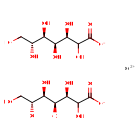
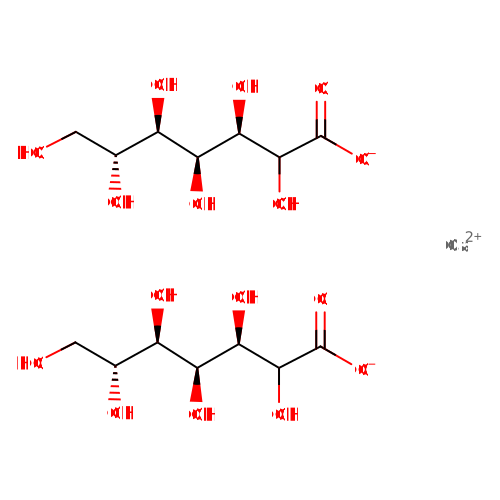
Structure for Calcium glucoheptonate (DB00326)
- Weight
- Average: 490.425
Monoisotopic: 490.084675939 - Chemical Formula
- C14H26CaO16
- Synonyms
- Calcii glucoheptonas
- calcium (2ξ)-D-gluco-heptonate
- calcium bis[(2ξ)-D-glycero-D-gulo-heptonate]
- calcium bis[(2ξ)-D-glycero-D-ido-heptonate]
- calcium bis[(3R,4S,5R,6R)-2,3,4,5,6,7-hexahydroxyheptanoate]
- Calcium gluceptate
- Calcium glucoheptonat
- Calcium glucoheptonate
- Calcium glucoheptonate (1:2)
- Glucoheptonate de calcium
- Glucoheptonato calcico

Pharmacology
- Indication
For treatment of mild hypocalcemia due to neonatal tetany, tetany due to parathyroid deficiency or vitamin D deficiency, and alkalosis, as prophylaxis of hypocalcemia during exchange transfusions, in the treatment of intestinal malabsorption, and to replenish electrolytes.
 Reduce drug development failure ratesBuild, train, & validate machine-learning modelswith evidence-based and structured datasets.Build, train, & validate predictive machine-learning models with structured datasets.
- Contraindications & Blackbox Warnings
 Prevent Adverse Drug Events TodayTap into our Clinical API for life-saving information on contraindications & blackbox warnings, population restrictions, harmful risks, & more.Avoid life-threatening adverse drug events with our Clinical API
- Pharmacodynamics
Calcium supplements such as calcium gluceptate are taken by individuals who are unable to get enough calcium in their regular diet or who have a need for more calcium. They are used to prevent or treat several conditions that may cause hypocalcemia (not enough calcium in the blood). The body needs calcium to make strong bones. Calcium is also needed for the heart, muscles, and nervous system to work properly. The bones serve as a storage site for the body's calcium. They are continuously giving up calcium to the bloodstream and then replacing it as the body's need for calcium changes from day to day. When there is not enough calcium in the blood to be used by the heart and other organs, your body will take the needed calcium from the bones. When you eat foods rich in calcium, the calcium will be restored to the bones and the balance between your blood and bones will be maintained.
- Mechanism of action
Calcium gluceptate replenishes the deminished levels of calcium in the body, returning them to normal levels.
- Absorption
Rapidly absorbed following oral administration.
- Volume of distribution
Not Available
- Protein binding
Not Available
- Metabolism
- Not Available
- Route of elimination
Not Available
- Half-life
Not Available
- Clearance
Not Available
- Adverse Effects
 Improve decision support & research outcomesWith structured adverse effects data, including: blackbox warnings, adverse reactions, warning & precautions, & incidence rates. View sample adverse effects data in our new Data Library!Improve decision support & research outcomes with our structured adverse effects data.
- Toxicity
Symptoms of overdose include confusion, drowsiness (severe), high blood pressure, increased sensitivity of eyes or skin to light, irregular, fast, or slow heartbeat, and unusually large amount of urine or increased frequency of urination.
- Pathways
- Not Available
- Pharmacogenomic Effects/ADRs
- Not Available
Interactions
- Drug Interactions
- This information should not be interpreted without the help of a healthcare provider. If you believe you are experiencing an interaction, contact a healthcare provider immediately. The absence of an interaction does not necessarily mean no interactions exist.
Drug Interaction Integrate drug-drug
interactions in your softwareAcebutolol The therapeutic efficacy of Acebutolol can be decreased when used in combination with Calcium glucoheptonate. Acetyldigitoxin Calcium glucoheptonate may increase the arrhythmogenic and cardiotoxic activities of Acetyldigitoxin. Alendronic acid The serum concentration of Alendronic acid can be decreased when it is combined with Calcium glucoheptonate. Alfacalcidol The risk or severity of adverse effects can be increased when Alfacalcidol is combined with Calcium glucoheptonate. Amiodarone The therapeutic efficacy of Amiodarone can be decreased when used in combination with Calcium glucoheptonate. - Food Interactions
- No interactions found.
Products
 Drug product information from 10+ global regionsOur datasets provide approved product information including:dosage, form, labeller, route of administration, and marketing period.Access drug product information from over 10 global regions.
- Brand Name Prescription Products
Name Dosage Strength Route Labeller Marketing Start Marketing End Region Image Glucoheptonate Injection, powder, lyophilized, for solution 50 mg/1 Intravenous Anazao Health Corporation 2012-05-23 Not applicable US 
- Over the Counter Products
Name Dosage Strength Route Labeller Marketing Start Marketing End Region Image Calcium Liq Alsi Liquid 125 mg / mL Oral Alsi Cie Ltee 1980-12-31 2003-05-21 Canada 
Sirop De Calcium 625mg/5ml Syrup 625 mg / 5 mL Oral Therapex Division De E Z Em Canada Inc 1980-12-31 1997-07-22 Canada - Mixture Products
Name Ingredients Dosage Route Labeller Marketing Start Marketing End Region Image Calcium Liquid Calcium glucoheptonate (132 mg / mL) + Calcium gluconate (112 mg / mL) Liquid Oral Shoppers Drug Mart Inc. 1981-12-31 1997-08-15 Canada Calcium Liquid Calcium glucoheptonate (132 mg / mL) + Calcium gluconate (112 mg / mL) Liquid Oral Vita Health Products Inc 1980-12-31 2002-07-31 Canada Calcium Liquid Calcium glucoheptonate (132 mg / mL) + Calcium gluconate (112 mg / mL) Liquid Oral Ksl Pharmaceuticals 1994-12-31 1996-09-09 Canada Liquid Calcium Calcium glucoheptonate (132 mg / mL) + Calcium gluconate (112 mg / mL) Liquid Oral Wampole Brands, A Division Of Pangeo Pharma (Canada) Inc. 1998-08-12 2000-07-06 Canada - Unapproved/Other Products
Name Ingredients Dosage Route Labeller Marketing Start Marketing End Region Image Glucoheptonate Calcium glucoheptonate (50 mg/1) Injection, powder, lyophilized, for solution Intravenous Anazao Health Corporation 2012-05-23 Not applicable US
Categories
- ATC Codes
- A12AA10 — Calcium glucoheptonate
- Drug Categories
- Chemical TaxonomyProvided by Classyfire
- Description
- This compound belongs to the class of organic compounds known as sugar acids and derivatives. These are compounds containing a saccharide unit which bears a carboxylic acid group.
- Kingdom
- Organic compounds
- Super Class
- Organic oxygen compounds
- Class
- Organooxygen compounds
- Sub Class
- Carbohydrates and carbohydrate conjugates
- Direct Parent
- Sugar acids and derivatives
- Alternative Parents
- Heptoses / Medium-chain hydroxy acids and derivatives / Medium-chain fatty acids / Beta hydroxy acids and derivatives / Hydroxy fatty acids / Secondary alcohols / Carboxylic acid salts / Polyols / Organic calcium salts / Monocarboxylic acids and derivatives show 6 more
- Substituents
- Alcohol / Aliphatic acyclic compound / Beta-hydroxy acid / Carbonyl group / Carboxylic acid / Carboxylic acid derivative / Carboxylic acid salt / Fatty acid / Fatty acyl / Heptose monosaccharide show 15 more
- Molecular Framework
- Not Available
- External Descriptors
- calcium salt (CHEBI:3314)
- Affected organisms
- Humans and other mammals
Chemical Identifiers
- UNII
- L11651398J
- CAS number
- 29039-00-7
- InChI Key
- FATUQANACHZLRT-KMRXSBRUSA-L
- InChI
- InChI=1S/2C7H14O8.Ca/c2*8-1-2(9)3(10)4(11)5(12)6(13)7(14)15;/h2*2-6,8-13H,1H2,(H,14,15);/q;;+2/p-2/t2*2-,3-,4+,5-,6?;/m11./s1
- IUPAC Name
- calcium bis((3R,4S,5R,6R)-2,3,4,5,6,7-hexahydroxyheptanoate)
- SMILES
- [Ca++].OC[C@@H](O)[C@@H](O)[C@H](O)[C@@H](O)C(O)C([O-])=O.OC[C@@H](O)[C@@H](O)[C@H](O)[C@@H](O)C(O)C([O-])=O
References
- General References
- Drop LJ, Cullen DJ: Comparative effects of calcium chloride and calcium gluceptate. Br J Anaesth. 1980 May;52(5):501-5. [Article]
- External Links
- Human Metabolome Database
- HMDB0014471
- KEGG Drug
- D00934
- PubChem Compound
- 62859
- PubChem Substance
- 46507233
- ChemSpider
- 56591
- 47618
- ChEBI
- 3314
- ChEMBL
- CHEMBL1237066
- PharmGKB
- PA164746233
- Wikipedia
- Calcium_glucoheptonate
- MSDS
- Download (68.6 KB)
Clinical Trials
Pharmacoeconomics
- Manufacturers
- Abbott laboratories pharmaceutical products div
- Abraxis pharmaceutical products
- Eli lilly and co
- Packagers
- Draxis Specialty Pharmaceuticals Inc.
- Medi-Physics Inc.
- Spectrum Pharmaceuticals
- Dosage Forms
Form Route Strength Liquid Oral 125 mg / mL Liquid Oral Injection, powder, lyophilized, for solution Intravenous 50 mg/1 Syrup Oral 625 mg / 5 mL - Prices
Unit description Cost Unit Calcium gluceptate powder 12.69USD g DrugBank does not sell nor buy drugs. Pricing information is supplied for informational purposes only.- Patents
- Not Available
Properties
- State
- Solid
- Experimental Properties
Property Value Source water solubility Soluble Not Available - Predicted Properties
Property Value Source Water Solubility 39.8 mg/mL ALOGPS logP -1.9 ALOGPS logP -4 Chemaxon logS -1.1 ALOGPS pKa (Strongest Acidic) 3.38 Chemaxon pKa (Strongest Basic) -3 Chemaxon Physiological Charge -1 Chemaxon Hydrogen Acceptor Count 8 Chemaxon Hydrogen Donor Count 6 Chemaxon Polar Surface Area 161.51 Å2 Chemaxon Rotatable Bond Count 12 Chemaxon Refractivity 55.07 m3·mol-1 Chemaxon Polarizability 19.34 Å3 Chemaxon Number of Rings 0 Chemaxon Bioavailability 0 Chemaxon Rule of Five No Chemaxon Ghose Filter No Chemaxon Veber's Rule No Chemaxon MDDR-like Rule No Chemaxon - Predicted ADMET Features
Property Value Probability Human Intestinal Absorption - 0.9575 Blood Brain Barrier + 0.5646 Caco-2 permeable - 0.8513 P-glycoprotein substrate Non-substrate 0.6616 P-glycoprotein inhibitor I Non-inhibitor 0.9743 P-glycoprotein inhibitor II Non-inhibitor 0.9608 Renal organic cation transporter Non-inhibitor 0.9445 CYP450 2C9 substrate Non-substrate 0.8702 CYP450 2D6 substrate Non-substrate 0.87 CYP450 3A4 substrate Non-substrate 0.7334 CYP450 1A2 substrate Non-inhibitor 0.8579 CYP450 2C9 inhibitor Non-inhibitor 0.9163 CYP450 2D6 inhibitor Non-inhibitor 0.9286 CYP450 2C19 inhibitor Non-inhibitor 0.9106 CYP450 3A4 inhibitor Non-inhibitor 0.9274 CYP450 inhibitory promiscuity Low CYP Inhibitory Promiscuity 0.9873 Ames test Non AMES toxic 0.8429 Carcinogenicity Non-carcinogens 0.838 Biodegradation Ready biodegradable 0.9895 Rat acute toxicity 1.9804 LD50, mol/kg Not applicable hERG inhibition (predictor I) Weak inhibitor 0.9838 hERG inhibition (predictor II) Non-inhibitor 0.938
Spectra
- Mass Spec (NIST)
- Not Available
- Spectra
- Not Available
- Chromatographic Properties
Collision Cross Sections (CCS)
Adduct CCS Value (Å2) Source type Source [M-H]- 153.1361651 predictedDarkChem Lite v0.1.0 [M-H]- 196.38304 predictedDeepCCS 1.0 (2019) [M+H]+ 154.6964651 predictedDarkChem Lite v0.1.0 [M+H]+ 198.27844 predictedDeepCCS 1.0 (2019) [M+Na]+ 154.2837651 predictedDarkChem Lite v0.1.0 [M+Na]+ 203.9958 predictedDeepCCS 1.0 (2019)

Drug created at June 13, 2005 13:24 / Updated at March 03, 2024 02:24