Identification
- Summary
Nitisinone is a hydroxyphenylpyruvate dioxygenase inhibitor used as an adjunct to dietary restrictions for the treatment of hereditary tyrosinemia type 1 (HT-1), which causes intolerance to tyrosine containing foods.
- Brand Names
- Nityr, Orfadin
- Generic Name
- Nitisinone
- DrugBank Accession Number
- DB00348
- Background
Nitisinone is a synthetic reversible inhibitor of 4-hydroxyphenylpyruvate dioxygenase. It is used in the treatment of hereditary tyrosinemia type 1. It is sold under the brand name Orfadin.
- Type
- Small Molecule
- Groups
- Approved, Investigational
- Structure
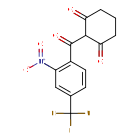
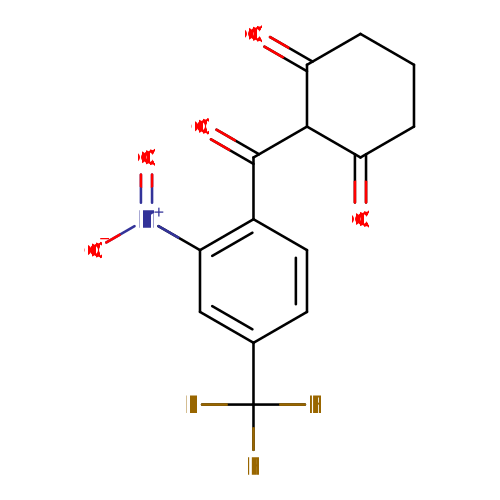
Structure for Nitisinone (DB00348)
- Weight
- Average: 329.2281
Monoisotopic: 329.05110705 - Chemical Formula
- C14H10F3NO5
- Synonyms
- 2-(alpha,alpha,alpha-Trifluoro-2-nitro-p-tuluoyl)-1,3-cyclohexanedione
- Nitisinona
- Nitisinone
- Nitisinonum
- External IDs
- SC-0735

Pharmacology
- Indication
Used as an adjunct to dietary restriction of tyrosine and phenylalanine in the treatment of hereditary tyrosinemia type 1.
 Reduce drug development failure ratesBuild, train, & validate machine-learning modelswith evidence-based and structured datasets.Build, train, & validate predictive machine-learning models with structured datasets.
- Associated Conditions
Indication Type Indication Combined Product Details Approval Level Age Group Patient Characteristics Dose Form Management of Hereditary tyrosinemia type 1 •••••••••••• •••••• ••••••••• •••• ••••••••••• - Contraindications & Blackbox Warnings
 Prevent Adverse Drug Events TodayTap into our Clinical API for life-saving information on contraindications & blackbox warnings, population restrictions, harmful risks, & more.Avoid life-threatening adverse drug events with our Clinical API
- Pharmacodynamics
Hereditary tyrosinemia type 1 occurs due to a deficiency in fumarylacetoacetase (FAH), the final enzyme in the tyrosine catabolic pathway. Nitisinone inhibits catabolism of tyrosine by preventing the catabolic intermediates. In patients with HT-1, these catabolic intermediates are converted to the toxic metabolites succinylacetone and succinylacetoacetate, which are responsible for the observed liver and kidney toxicity. Succinylacetone can also inhibit the porphyrin synthesis pathway leading to the accumulation of 5-aminolevulinate, a neurotoxin responsible for the porphyric crises characteristic of HT-1.
- Mechanism of action
Nitisinone is a competitive inhibitor of 4-hydroxyphenyl-pyruvate dioxygenase, an enzyme upstream of fumarylacetoacetate hydrolyase (FAH) in the tyrosine catabolic pathway. By inhibiting the normal catabolism of tyrosine in patients with hereditary tyrosinemia type 1 (HT-1), nitisinone prevents the accumulation of the catabolic intermediates maleylacetoacetate and fumarylacetoacetate.
Target Actions Organism A4-hydroxyphenylpyruvate dioxygenase inhibitorHumans - Absorption
The capsule and liquid formulations are bioequivalent in both the plasma concentration-time curve and maximum plasma concentration (Cmax).
- Volume of distribution
Not Available
- Protein binding
Not Available
- Metabolism
- Not Available
- Route of elimination
Not Available
- Half-life
~54 hours
- Clearance
Not Available
- Adverse Effects
 Improve decision support & research outcomesWith structured adverse effects data, including: blackbox warnings, adverse reactions, warning & precautions, & incidence rates. View sample adverse effects data in our new Data Library!Improve decision support & research outcomes with our structured adverse effects data.
- Toxicity
Side effects include elevated plasma levels of this amino acid, hepatic and liver failure.
- Pathways
- Not Available
- Pharmacogenomic Effects/ADRs
- Not Available
Interactions
- Drug Interactions
- This information should not be interpreted without the help of a healthcare provider. If you believe you are experiencing an interaction, contact a healthcare provider immediately. The absence of an interaction does not necessarily mean no interactions exist.No interactions found.
- Food Interactions
- Limit the intake of phenylalanine and tyrosine.
- Take separate from meals. Nitisinone capsules should be separated by one hour before or two hours after meals.
- Take with or without food. Nitisinone tablets can be taken with or without food but food may prolong the Tmax by six hours.
Products
 Drug product information from 10+ global regionsOur datasets provide approved product information including:dosage, form, labeller, route of administration, and marketing period.Access drug product information from over 10 global regions.
- Brand Name Prescription Products
Name Dosage Strength Route Labeller Marketing Start Marketing End Region Image Nitisinone Mdk Capsule 10 mg Oral Mendeli Kabs Europe Ltd 2020-12-16 2023-06-14 EU 
Nitisinone Mdk Capsule 5 mg Oral Mendeli Kabs Europe Ltd 2020-12-16 2023-06-14 EU Nitisinone Mdk Capsule 20 mg Oral Mendeli Kabs Europe Ltd 2022-06-08 2023-06-14 EU Nitisinone Mdk Capsule 2 mg Oral Mendeli Kabs Europe Ltd 2020-12-16 2023-06-14 EU Nitisinone Tablets Tablet 10 mg Oral Cycle Pharmaceuticals Ltd. 2016-12-19 Not applicable Canada 
- Generic Prescription Products
Name Dosage Strength Route Labeller Marketing Start Marketing End Region Image Mdk-nitisinone Capsule 20 mg Oral Mendelikabs Inc 2019-02-01 Not applicable Canada Mdk-nitisinone Capsule 10 mg Oral Mendelikabs Inc 2016-10-20 Not applicable Canada Mdk-nitisinone Capsule 5 mg Oral Mendelikabs Inc 2016-10-20 Not applicable Canada Mdk-nitisinone Capsule 2 mg Oral Mendelikabs Inc 2016-10-20 Not applicable Canada Nitisinone Capsule 10 mg/1 Oral Torrent Pharmaceuticals Limited 2023-01-09 Not applicable US 
Categories
- ATC Codes
- A16AX04 — Nitisinone
- Drug Categories
- 4-Hydroxyphenyl-Pyruvate Dioxygenase Inhibitor
- 4-Hydroxyphenylpyruvate Dioxygenase, antagonists & inhibitors
- Acids, Carbocyclic
- Alimentary Tract and Metabolism
- Benzene Derivatives
- Benzoates
- Cyclohexanes
- Cycloparaffins
- Cytochrome P-450 CYP2C9 Inhibitors
- Cytochrome P-450 Enzyme Inhibitors
- Enzyme Inhibitors
- Hydroxyphenylpyruvate Dioxygenase Inhibitors
- Ketones
- Other Miscellaneous Therapeutic Agents
- Various Alimentary Tract and Metabolism Products
- Chemical TaxonomyProvided by Classyfire
- Description
- This compound belongs to the class of organic compounds known as benzoylcyclohexane-1,3-diones. These are alkyl-phenylketones where the alkyl group is a cyclohexane 1,3-dione.
- Kingdom
- Organic compounds
- Super Class
- Organic oxygen compounds
- Class
- Organooxygen compounds
- Sub Class
- Carbonyl compounds
- Direct Parent
- Benzoylcyclohexane-1,3-diones
- Alternative Parents
- Trifluoromethylbenzenes / Nitrobenzenes / Nitroaromatic compounds / Benzoyl derivatives / Aryl alkyl ketones / Beta-diketones / Cyclic ketones / Propargyl-type 1,3-dipolar organic compounds / Organic oxoazanium compounds / Organopnictogen compounds show 5 more
- Substituents
- 1,3-dicarbonyl compound / 1,3-diketone / Alkyl fluoride / Alkyl halide / Allyl-type 1,3-dipolar organic compound / Aromatic homomonocyclic compound / Aryl alkyl ketone / Benzenoid / Benzoyl / Benzoylcyclohexane-1,3-dione show 17 more
- Molecular Framework
- Aromatic homomonocyclic compounds
- External Descriptors
- C-nitro compound, (trifluoromethyl)benzenes, cyclohexanones (CHEBI:50378)
- Affected organisms
- Humans and other mammals
Chemical Identifiers
- UNII
- K5BN214699
- CAS number
- 104206-65-7
- InChI Key
- OUBCNLGXQFSTLU-UHFFFAOYSA-N
- InChI
- InChI=1S/C14H10F3NO5/c15-14(16,17)7-4-5-8(9(6-7)18(22)23)13(21)12-10(19)2-1-3-11(12)20/h4-6,12H,1-3H2
- IUPAC Name
- 2-[2-nitro-4-(trifluoromethyl)benzoyl]cyclohexane-1,3-dione
- SMILES
- [O-][N+](=O)C1=C(C=CC(=C1)C(F)(F)F)C(=O)C1C(=O)CCCC1=O
References
- General References
- Not Available
- External Links
- Human Metabolome Database
- HMDB0014492
- PubChem Compound
- 115355
- PubChem Substance
- 46507380
- ChemSpider
- 103195
- BindingDB
- 50088804
- 61805
- ChEBI
- 50378
- ChEMBL
- CHEMBL1337
- ZINC
- ZINC000100014475
- Therapeutic Targets Database
- DAP000774
- PharmGKB
- PA164777037
- RxList
- RxList Drug Page
- Drugs.com
- Drugs.com Drug Page
- Wikipedia
- Nitisinone
- FDA label
- Download (194 KB)
Clinical Trials
- Clinical Trials
Phase Status Purpose Conditions Count 3 Completed Treatment Tyrosinemia Type 1 1 3 Unknown Status Treatment Alkaptonuria 1 2 Completed Treatment Alkaptonuria 2 2, 3 Completed Treatment Alkaptonuria 1 1 Completed Basic Science Drug Drug Interaction (DDI) 1
Pharmacoeconomics
- Manufacturers
- Rare disease therapeutics inc
- Packagers
- Apoteket Produktion and Laboratorier Ab
- Rare Disease Therapeutics Inc.
- Swedish Orphan International Ab
- Dosage Forms
Form Route Strength Capsule Oral 10 mg Capsule Oral 2 mg Capsule Oral 5 mg Capsule, coated Oral 10 mg Tablet Oral 10 mg Tablet Oral 2 mg Tablet Oral 5 mg Capsule, coated Oral 2 mg Capsule, coated Oral 5 mg Tablet Oral 10 mg/1 Tablet Oral 2 mg/1 Tablet Oral 5 mg/1 Capsule Oral 10 mg/1 Capsule Oral 2 mg/1 Capsule Oral 20 mg/1 Capsule Oral 20 mg Capsule Oral 5 mg/1 Suspension Oral 4 MG/ML Suspension Oral 4 mg/1mL Suspension Oral 4 mg / mL Capsule Oral - Prices
Unit description Cost Unit Orfadin 10 mg capsule 308.68USD capsule Orfadin 5 mg capsule 154.34USD capsule Orfadin 2 mg capsule 61.74USD capsule DrugBank does not sell nor buy drugs. Pricing information is supplied for informational purposes only.- Patents
Patent Number Pediatric Extension Approved Expires (estimated) Region US5550165 No 1996-08-27 2013-08-27 US US9301932 No 2016-04-05 2033-02-02 US US10328029 No 2019-06-25 2035-01-05 US
Properties
- State
- Solid
- Experimental Properties
Property Value Source logP 1.6 Not Available - Predicted Properties
Property Value Source Water Solubility 0.00811 mg/mL ALOGPS logP 2.06 ALOGPS logP 3.13 Chemaxon logS -4.6 ALOGPS pKa (Strongest Acidic) 7.44 Chemaxon pKa (Strongest Basic) -7.3 Chemaxon Physiological Charge 0 Chemaxon Hydrogen Acceptor Count 5 Chemaxon Hydrogen Donor Count 0 Chemaxon Polar Surface Area 94.35 Å2 Chemaxon Rotatable Bond Count 4 Chemaxon Refractivity 71.34 m3·mol-1 Chemaxon Polarizability 26.76 Å3 Chemaxon Number of Rings 2 Chemaxon Bioavailability 1 Chemaxon Rule of Five Yes Chemaxon Ghose Filter Yes Chemaxon Veber's Rule No Chemaxon MDDR-like Rule No Chemaxon - Predicted ADMET Features
Property Value Probability Human Intestinal Absorption + 0.9849 Blood Brain Barrier + 0.87 Caco-2 permeable - 0.5086 P-glycoprotein substrate Non-substrate 0.8491 P-glycoprotein inhibitor I Inhibitor 0.7006 P-glycoprotein inhibitor II Non-inhibitor 0.8517 Renal organic cation transporter Non-inhibitor 0.8355 CYP450 2C9 substrate Non-substrate 0.7862 CYP450 2D6 substrate Non-substrate 0.8292 CYP450 3A4 substrate Substrate 0.5765 CYP450 1A2 substrate Inhibitor 0.5808 CYP450 2C9 inhibitor Non-inhibitor 0.5566 CYP450 2D6 inhibitor Non-inhibitor 0.8867 CYP450 2C19 inhibitor Inhibitor 0.5431 CYP450 3A4 inhibitor Inhibitor 0.6104 CYP450 inhibitory promiscuity Low CYP Inhibitory Promiscuity 0.5347 Ames test Non AMES toxic 0.5612 Carcinogenicity Non-carcinogens 0.6585 Biodegradation Not ready biodegradable 0.9836 Rat acute toxicity 2.6075 LD50, mol/kg Not applicable hERG inhibition (predictor I) Weak inhibitor 0.6292 hERG inhibition (predictor II) Non-inhibitor 0.7814
Spectra
- Mass Spec (NIST)
- Not Available
- Spectra
Spectrum Spectrum Type Splash Key Predicted GC-MS Spectrum - GC-MS Predicted GC-MS splash10-01ox-9453000000-6678c582428855d7d395 Predicted 1H NMR Spectrum 1D NMR Not Applicable Predicted 13C NMR Spectrum 1D NMR Not Applicable - Chromatographic Properties
Collision Cross Sections (CCS)
Adduct CCS Value (Å2) Source type Source [M-H]- 174.2064835 predictedDarkChem Lite v0.1.0 [M-H]- 166.81313 predictedDeepCCS 1.0 (2019) [M+H]+ 174.4965835 predictedDarkChem Lite v0.1.0 [M+H]+ 169.17113 predictedDeepCCS 1.0 (2019) [M+Na]+ 174.1768835 predictedDarkChem Lite v0.1.0 [M+Na]+ 175.53642 predictedDeepCCS 1.0 (2019)
Targets

- Kind
- Protein
- Organism
- Humans
- Pharmacological action
- Yes
- Actions
- Inhibitor
- General Function
- Metal ion binding
- Specific Function
- Key enzyme in the degradation of tyrosine.
- Gene Name
- HPD
- Uniprot ID
- P32754
- Uniprot Name
- 4-hydroxyphenylpyruvate dioxygenase
- Molecular Weight
- 44934.12 Da
References
- Chen X, Ji ZL, Chen YZ: TTD: Therapeutic Target Database. Nucleic Acids Res. 2002 Jan 1;30(1):412-5. [Article]
- Fisher AA, Davis MW: Alkaptonuric ochronosis with aortic valve and joint replacements and femoral fracture: a case report and literature review. Clin Med Res. 2004 Nov;2(4):209-15. [Article]
- Yang DY: 4-Hydroxyphenylpyruvate dioxygenase as a drug discovery target. Drug News Perspect. 2003 Oct;16(8):493-6. [Article]
- Hanauske-Abel HM, Popowicz A, Remotti H, Newfield RS, Levy J: Tyrosinemia I, a model for human diseases mediated by 2-oxoacid-utilizing dioxygenases: hepatotoxin suppression by NTBC does not normalize hepatic collagen metabolism. J Pediatr Gastroenterol Nutr. 2002 Jul;35(1):73-8. [Article]
- Suwannarat P, O'Brien K, Perry MB, Sebring N, Bernardini I, Kaiser-Kupfer MI, Rubin BI, Tsilou E, Gerber LH, Gahl WA: Use of nitisinone in patients with alkaptonuria. Metabolism. 2005 Jun;54(6):719-28. [Article]
- Santra S, Baumann U: Experience of nitisinone for the pharmacological treatment of hereditary tyrosinaemia type 1. Expert Opin Pharmacother. 2008 May;9(7):1229-36. doi: 10.1517/14656566.9.7.1229. [Article]

Drug created at June 13, 2005 13:24 / Updated at March 03, 2024 02:24