Identification
- Summary
Remoxipride is an discontinued atypical antipsychotic selective for dopamine D2 receptors.
- Generic Name
- Remoxipride
- DrugBank Accession Number
- DB00409
- Background
Remoxipride is an atypical antipsychotic agent that is specific for dopamine D2 receptors.1 It gained approval in the UK in 1989 but was withdrawn in 1993 after it was found to be associated with an increased incidence of aplastic anemia.1,5
- Type
- Small Molecule
- Groups
- Approved, Withdrawn
- Structure
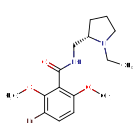
Structure for Remoxipride (DB00409)
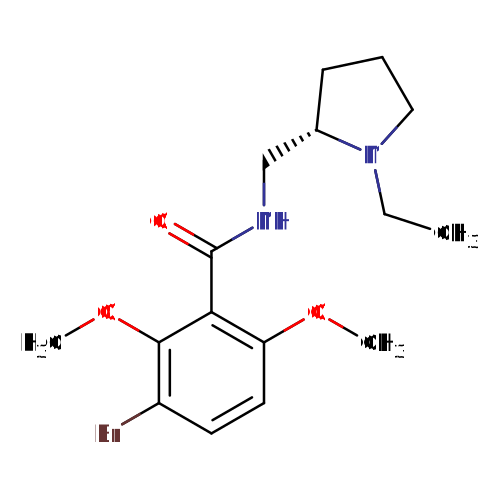
- Weight
- Average: 371.269
Monoisotopic: 370.089205259 - Chemical Formula
- C16H23BrN2O3
- Synonyms
- Remoxiprida
- Remoxipride
- Remoxipridum
- External IDs
- A 33547
- A-33547
- FLA 731
- FLA-731(-)

Pharmacology
- Indication
Remoxipride is an atypical antipsychotic once used for the treatment of schizophrenia.6
 Reduce drug development failure ratesBuild, train, & validate machine-learning modelswith evidence-based and structured datasets.Build, train, & validate predictive machine-learning models with structured datasets.
- Contraindications & Blackbox Warnings
 Prevent Adverse Drug Events TodayTap into our Clinical API for life-saving information on contraindications & blackbox warnings, population restrictions, harmful risks, & more.Avoid life-threatening adverse drug events with our Clinical API
- Pharmacodynamics
Remoxipride is a weak selective dopamine D2 receptor antagonist that was once used in the treatment of schizophrenia.1 It has a moderate therapeutic index and duration of action.8 Remoxipride was withdrawn due to deaths associated with aplastic anemia.5
- Mechanism of action
Remoxipride is an atypical antipsychotic dopamine D2 antagonist.1 Chronic use upregulates the expression of D2 receptors, while downregulating the expression of D1 and D5 receptors in the prefrontal cortex.1 This activity may be related to the antipsychotic activity of remoxipride.1 Remoxipride displays weaker binding to D2 dopaminergic receptors that dopamine.7 This weaker binding is thought to account for the reduced incidence of Parkinsonism.7 Remoxipride also increases expression of the protein Fos in the nucleus accumbens but not the dorsolateral striatum, which may be responsible for a reduced incidence of extrapyramidal symptoms.1
Target Actions Organism ADopamine D2 receptor antagonistHumans UDopamine D4 receptor antagonistHumans UDopamine D3 receptor antagonistHumans U5-hydroxytryptamine receptor 2A other/unknownHumans USigma non-opioid intracellular receptor 1 antagonistHumans - Absorption
Remoxipride is approximately 90% bioavailable.2 In patients with normal creatinine clearance, remoxipride reaches a Cmax of 5.5 ± 1.1 µmol/L, with a Tmax of 0.8 ± 0.2 h, and an AUC of 39 ± 9 µmol*h/L.2 In patients with moderate renal impairment, remoxipride reaches a Cmax of 7.7 ± 2.7 µmol/L, with a Tmax of 0.9 ± 0.4 h, and an AUC of 63 ± 34 µmol*h/L.2 In patients with severe renal impairment, remoxipride reaches a Cmax of 9.3 ± 2.3 µmol/L, with a Tmax of 1.4 ± 0.9 h, and an AUC of 123 ± 60 µmol*h/L.2
- Volume of distribution
The volume of distribution of remoxipride in patients with normal creatinine clearance is 44.3 ± 8.3 L, in patients with moderate renal impairment is 37.4 ± 16.2 L, and in patients with severe renal impairment is 30.2 ± 9.4 L.2
- Protein binding
Remoxipride is approximately 80% protein bound, mainly to α-1-acid glycoprotein.4
- Metabolism
Remoxipride can be N-dealkylated to FLA 853, oxidized to FLA 850, or N-deethylated to FLA 838.3,2 FLA 838 can be oxidized to NCL 118 which is further hydroxylated to NCM 009.3,2 FLA 850 can be N-deethylated to NCL 118 or hydroxylated to NCM 001.3,2 NCM 001 is further N-deethylated to NCM 009.3,2 None of these metabolites have measurable activity on dopamine D2 receptors.2
Hover over products below to view reaction partners
- Route of elimination
A dose of remoxipride is 89% recovered in the urine and 7% in the feces.4 10-40% of a dose of remoxipride is recovered in the urine as the unchanged parent drug.4
- Half-life
The half life of remoxipride in patients with normal creatinine clearance is 5.1 ± 1.6 h, in patients with moderate renal impairment is 6.1 ± 2.6 h, and in patients with severe renal impairment is 9.9 ± 3.8 h.2
- Clearance
The renal clearance of remoxipride in patients with normal creatinine clearance is 23.6 ± 7.0 mL/min, in patients with moderate renal impairment is 9.3 ± 3.8 mL/min, and in patients with severe renal impairment is 3.7 ± 2.9 mL/min.2 The systemic plasma clearance of remoxipride is 120 mL/min.4
- Adverse Effects
 Improve decision support & research outcomesWith structured adverse effects data, including: blackbox warnings, adverse reactions, warning & precautions, & incidence rates. View sample adverse effects data in our new Data Library!Improve decision support & research outcomes with our structured adverse effects data.
- Toxicity
Remoxipride was withdrawn from the market after 8 cases of aplastic anemia were reported.5 Of those 8 cases, 2 were fatal.5
- Pathways
- Not Available
- Pharmacogenomic Effects/ADRs
- Not Available
Interactions
- Drug Interactions
- This information should not be interpreted without the help of a healthcare provider. If you believe you are experiencing an interaction, contact a healthcare provider immediately. The absence of an interaction does not necessarily mean no interactions exist.
Drug Interaction Integrate drug-drug
interactions in your software1,2-Benzodiazepine The risk or severity of CNS depression can be increased when Remoxipride is combined with 1,2-Benzodiazepine. Abatacept The metabolism of Remoxipride can be increased when combined with Abatacept. Abiraterone The metabolism of Remoxipride can be decreased when combined with Abiraterone. Acebutolol The metabolism of Remoxipride can be decreased when combined with Acebutolol. Acetaminophen The metabolism of Remoxipride can be decreased when combined with Acetaminophen. - Food Interactions
- Not Available
Products
 Drug product information from 10+ global regionsOur datasets provide approved product information including:dosage, form, labeller, route of administration, and marketing period.Access drug product information from over 10 global regions.
- Product Ingredients
Ingredient UNII CAS InChI Key Remoxipride hydrochloride MH4OU8RWCW 117591-79-4 SPFVHFBNXPARTR-IDMXKUIJSA-N - International/Other Brands
- Roxiam
Categories
- ATC Codes
- N05AL04 — Remoxipride
- Drug Categories
- Acids, Carbocyclic
- Amides
- Antipsychotic Agents
- Benzamides and benzamide derivatives
- Benzene Derivatives
- Benzoates
- Bromobenzoates
- Central Nervous System Agents
- Central Nervous System Depressants
- Cytochrome P-450 CYP1A2 Inhibitors
- Cytochrome P-450 CYP1A2 Inhibitors (strength unknown)
- Cytochrome P-450 CYP2D6 Substrates
- Cytochrome P-450 CYP3A Inhibitors
- Cytochrome P-450 Enzyme Inhibitors
- Cytochrome P-450 Substrates
- Dopamine Agents
- Dopamine Antagonists
- Dopamine D2 Receptor Antagonists
- Nervous System
- Neurotoxic agents
- Neurotransmitter Agents
- Psycholeptics
- Psychotropic Drugs
- Tranquilizing Agents
- Chemical TaxonomyProvided by Classyfire
- Description
- This compound belongs to the class of organic compounds known as dimethoxybenzenes. These are organic aromatic compounds containing a monocyclic benzene moiety carrying exactly two methoxy groups.
- Kingdom
- Organic compounds
- Super Class
- Benzenoids
- Class
- Benzene and substituted derivatives
- Sub Class
- Methoxybenzenes
- Direct Parent
- Dimethoxybenzenes
- Alternative Parents
- 3-halobenzoic acids and derivatives / Benzamides / Phenoxy compounds / Anisoles / Benzoyl derivatives / Alkyl aryl ethers / Bromobenzenes / Aryl bromides / N-alkylpyrrolidines / Trialkylamines show 7 more
- Substituents
- 3-halobenzoic acid or derivatives / Alkyl aryl ether / Amine / Amino acid or derivatives / Anisole / Aromatic heteromonocyclic compound / Aryl bromide / Aryl halide / Azacycle / Benzamide show 27 more
- Molecular Framework
- Aromatic heteromonocyclic compounds
- External Descriptors
- Not Available
- Affected organisms
- Humans and other mammals
Chemical Identifiers
- UNII
- 0223RD59PE
- CAS number
- 80125-14-0
- InChI Key
- GUJRSXAPGDDABA-NSHDSACASA-N
- InChI
- InChI=1S/C16H23BrN2O3/c1-4-19-9-5-6-11(19)10-18-16(20)14-13(21-2)8-7-12(17)15(14)22-3/h7-8,11H,4-6,9-10H2,1-3H3,(H,18,20)/t11-/m0/s1
- IUPAC Name
- 3-bromo-N-{[(2S)-1-ethylpyrrolidin-2-yl]methyl}-2,6-dimethoxybenzamide
- SMILES
- CCN1CCC[C@H]1CNC(=O)C1=C(OC)C=CC(Br)=C1OC
References
- Synthesis Reference
- US4232037
- General References
- Nadal R: Pharmacology of the atypical antipsychotic remoxipride, a dopamine D2 receptor antagonist. CNS Drug Rev. 2001 Fall;7(3):265-82. doi: 10.1111/j.1527-3458.2001.tb00199.x. [Article]
- Movin-Osswald G, Boelaert J, Hammarlund-Udenaes M, Nilsson LB: The pharmacokinetics of remoxipride and metabolites in patients with various degrees of renal function. Br J Clin Pharmacol. 1993 Jun;35(6):615-22. doi: 10.1111/j.1365-2125.1993.tb04191.x. [Article]
- Mohell N, Sallemark M, Rosqvist S, Malmberg A, Hogberg T, Jackson DM: Binding characteristics of remoxipride and its metabolites to dopamine D2 and D3 receptors. Eur J Pharmacol. 1993 Jul 6;238(1):121-5. doi: 10.1016/0014-2999(93)90515-j. [Article]
- von Bahr C, Movin G, Yisak WA, Jostell KG, Widman M: Clinical pharmacokinetics of remoxipride. Acta Psychiatr Scand Suppl. 1990;358:41-4. doi: 10.1111/j.1600-0447.1990.tb05284.x. [Article]
- King DJ, Wager E: Haematological safety of antipsychotic drugs. J Psychopharmacol. 1998;12(3):283-8. doi: 10.1177/026988119801200309. [Article]
- Subramanian S, Rummel-Kluge C, Hunger H, Schmid F, Schwarz S, Kissling W, Leucht S, Komossa K: Zotepine versus other atypical antipsychotics for schizophrenia. Cochrane Database Syst Rev. 2010 Oct 6;(10):CD006628. doi: 10.1002/14651858.CD006628.pub3. [Article]
- Seeman P, Tallerico T: Antipsychotic drugs which elicit little or no parkinsonism bind more loosely than dopamine to brain D2 receptors, yet occupy high levels of these receptors. Mol Psychiatry. 1998 Mar;3(2):123-34. [Article]
- Farde L, Grind M, Nilsson MI, Ogenstad S, Sedvall G: Remoxipride--a new potential antipsychotic drug. Pharmacological effects and pharmacokinetics following repeated oral administration in male volunteers. Psychopharmacology (Berl). 1988;95(2):157-61. doi: 10.1007/BF00174501. [Article]
- External Links
- Human Metabolome Database
- HMDB0014553
- PubChem Compound
- 54477
- PubChem Substance
- 46508689
- ChemSpider
- 49195
- BindingDB
- 50026045
- 35350
- ChEBI
- 92948
- ChEMBL
- CHEMBL22242
- ZINC
- ZINC000002021799
- Therapeutic Targets Database
- DAP000312
- PharmGKB
- PA164749051
- Wikipedia
- Remoxipride
Clinical Trials
Pharmacoeconomics
- Manufacturers
- Not Available
- Packagers
- Not Available
- Dosage Forms
- Not Available
- Prices
- Not Available
- Patents
- Not Available
Properties
- State
- Solid
- Experimental Properties
Property Value Source logP 2.10 HOEGBERG,T ET AL. 1986 - Predicted Properties
Property Value Source Water Solubility 0.127 mg/mL ALOGPS logP 2.94 ALOGPS logP 2.34 Chemaxon logS -3.5 ALOGPS pKa (Strongest Acidic) 13.06 Chemaxon pKa (Strongest Basic) 8.4 Chemaxon Physiological Charge 1 Chemaxon Hydrogen Acceptor Count 4 Chemaxon Hydrogen Donor Count 1 Chemaxon Polar Surface Area 50.8 Å2 Chemaxon Rotatable Bond Count 6 Chemaxon Refractivity 90.56 m3·mol-1 Chemaxon Polarizability 36.25 Å3 Chemaxon Number of Rings 2 Chemaxon Bioavailability 1 Chemaxon Rule of Five Yes Chemaxon Ghose Filter Yes Chemaxon Veber's Rule No Chemaxon MDDR-like Rule No Chemaxon - Predicted ADMET Features
Property Value Probability Human Intestinal Absorption + 1.0 Blood Brain Barrier + 0.9705 Caco-2 permeable + 0.5835 P-glycoprotein substrate Substrate 0.775 P-glycoprotein inhibitor I Non-inhibitor 0.674 P-glycoprotein inhibitor II Non-inhibitor 0.6462 Renal organic cation transporter Non-inhibitor 0.5402 CYP450 2C9 substrate Non-substrate 0.868 CYP450 2D6 substrate Substrate 0.8919 CYP450 3A4 substrate Substrate 0.5728 CYP450 1A2 substrate Non-inhibitor 0.6776 CYP450 2C9 inhibitor Non-inhibitor 0.9071 CYP450 2D6 inhibitor Inhibitor 0.8932 CYP450 2C19 inhibitor Non-inhibitor 0.9025 CYP450 3A4 inhibitor Non-inhibitor 0.8309 CYP450 inhibitory promiscuity Low CYP Inhibitory Promiscuity 0.5505 Ames test Non AMES toxic 0.6906 Carcinogenicity Non-carcinogens 0.8373 Biodegradation Not ready biodegradable 0.9703 Rat acute toxicity 2.8267 LD50, mol/kg Not applicable hERG inhibition (predictor I) Weak inhibitor 0.802 hERG inhibition (predictor II) Inhibitor 0.7976
Spectra
- Mass Spec (NIST)
- Not Available
- Spectra
Spectrum Spectrum Type Splash Key Predicted GC-MS Spectrum - GC-MS Predicted GC-MS splash10-0005-9021000000-9daaecbf42f2128e1ad4 Predicted MS/MS Spectrum - 10V, Positive (Annotated) Predicted LC-MS/MS splash10-00di-0309000000-b43b41038e679bddb9e5 Predicted MS/MS Spectrum - 10V, Negative (Annotated) Predicted LC-MS/MS splash10-014i-1119000000-852881ae3b2a6eda3f20 Predicted MS/MS Spectrum - 20V, Positive (Annotated) Predicted LC-MS/MS splash10-022a-4948000000-faea0910c99bcc15be02 Predicted MS/MS Spectrum - 20V, Negative (Annotated) Predicted LC-MS/MS splash10-004i-9333000000-3816bf38479b3c04b59d Predicted MS/MS Spectrum - 40V, Positive (Annotated) Predicted LC-MS/MS splash10-01ow-4791000000-5123dff61fedcfecc171 Predicted MS/MS Spectrum - 40V, Negative (Annotated) Predicted LC-MS/MS splash10-0fbd-9043000000-7226e2defabcec6dd95f Predicted 1H NMR Spectrum 1D NMR Not Applicable Predicted 13C NMR Spectrum 1D NMR Not Applicable - Chromatographic Properties
Collision Cross Sections (CCS)
Adduct CCS Value (Å2) Source type Source [M-H]- 185.3565116 predictedDarkChem Lite v0.1.0 [M-H]- 167.17857 predictedDeepCCS 1.0 (2019) [M+H]+ 184.8717116 predictedDarkChem Lite v0.1.0 [M+H]+ 169.53658 predictedDeepCCS 1.0 (2019) [M+Na]+ 185.1654116 predictedDarkChem Lite v0.1.0 [M+Na]+ 175.62971 predictedDeepCCS 1.0 (2019)
Targets

- Kind
- Protein
- Organism
- Humans
- Pharmacological action
- Yes
- Actions
- Antagonist
- General Function
- Potassium channel regulator activity
- Specific Function
- Dopamine receptor whose activity is mediated by G proteins which inhibit adenylyl cyclase.
- Gene Name
- DRD2
- Uniprot ID
- P14416
- Uniprot Name
- D(2) dopamine receptor
- Molecular Weight
- 50618.91 Da
References
- Seeman P: Atypical antipsychotics: mechanism of action. Can J Psychiatry. 2002 Feb;47(1):27-38. [Article]
- Lang AE, Sandor P, Duff J: Remoxipride in Parkinson's disease: differential response in patients with dyskinesias fluctuations versus psychosis. Clin Neuropharmacol. 1995 Feb;18(1):39-45. [Article]
- Chen X, Ji ZL, Chen YZ: TTD: Therapeutic Target Database. Nucleic Acids Res. 2002 Jan 1;30(1):412-5. [Article]
- Mohell N, Sallemark M, Rosqvist S, Malmberg A, Hogberg T, Jackson DM: Binding characteristics of remoxipride and its metabolites to dopamine D2 and D3 receptors. Eur J Pharmacol. 1993 Jul 6;238(1):121-5. doi: 10.1016/0014-2999(93)90515-j. [Article]
- Kind
- Protein
- Organism
- Humans
- Pharmacological action
- Unknown
- Actions
- Antagonist
- General Function
- Sh3 domain binding
- Specific Function
- Dopamine receptor responsible for neuronal signaling in the mesolimbic system of the brain, an area of the brain that regulates emotion and complex behavior. Its activity is mediated by G proteins ...
- Gene Name
- DRD4
- Uniprot ID
- P21917
- Uniprot Name
- D(4) dopamine receptor
- Molecular Weight
- 48359.86 Da
References
- Seeman P, Corbett R, Van Tol HH: Atypical neuroleptics have low affinity for dopamine D2 receptors or are selective for D4 receptors. Neuropsychopharmacology. 1997 Feb;16(2):93-110; discussion 111-35. [Article]
- Kind
- Protein
- Organism
- Humans
- Pharmacological action
- Unknown
- Actions
- Antagonist
- General Function
- G-protein coupled amine receptor activity
- Specific Function
- Dopamine receptor whose activity is mediated by G proteins which inhibit adenylyl cyclase. Promotes cell proliferation.
- Gene Name
- DRD3
- Uniprot ID
- P35462
- Uniprot Name
- D(3) dopamine receptor
- Molecular Weight
- 44224.335 Da
References
- Christian AJ, Goodwin AK, Baker LE: Antagonism of the discriminative stimulus effects of (+)-7-OH-DPAT by remoxipride but not PNU-99194A. Pharmacol Biochem Behav. 2001 Mar;68(3):371-7. [Article]
- Mohell N, Sallemark M, Rosqvist S, Malmberg A, Hogberg T, Jackson DM: Binding characteristics of remoxipride and its metabolites to dopamine D2 and D3 receptors. Eur J Pharmacol. 1993 Jul 6;238(1):121-5. doi: 10.1016/0014-2999(93)90515-j. [Article]
- Kind
- Protein
- Organism
- Humans
- Pharmacological action
- Unknown
- Actions
- Other/unknown
- General Function
- Virus receptor activity
- Specific Function
- G-protein coupled receptor for 5-hydroxytryptamine (serotonin). Also functions as a receptor for various drugs and psychoactive substances, including mescaline, psilocybin, 1-(2,5-dimethoxy-4-iodop...
- Gene Name
- HTR2A
- Uniprot ID
- P28223
- Uniprot Name
- 5-hydroxytryptamine receptor 2A
- Molecular Weight
- 52602.58 Da
References
- Seeman P, Corbett R, Van Tol HH: Atypical neuroleptics have low affinity for dopamine D2 receptors or are selective for D4 receptors. Neuropsychopharmacology. 1997 Feb;16(2):93-110; discussion 111-35. [Article]
- Kind
- Protein
- Organism
- Humans
- Pharmacological action
- Unknown
- Actions
- Antagonist
- General Function
- Opioid receptor activity
- Specific Function
- Functions in lipid transport from the endoplasmic reticulum and is involved in a wide array of cellular functions probably through regulation of the biogenesis of lipid microdomains at the plasma m...
- Gene Name
- SIGMAR1
- Uniprot ID
- Q99720
- Uniprot Name
- Sigma non-opioid intracellular receptor 1
- Molecular Weight
- 25127.52 Da
References
- Lang A, Soosaar A, Koks S, Volke V, Bourin M, Bradwejn J, Vasar E: Pharmacological comparison of antipsychotic drugs and sigma-antagonists in rodents. Pharmacol Toxicol. 1994 Sep-Oct;75(3-4):222-7. [Article]
- Okuyama S: [Atypical antipsychotic profiles of sigma receptor ligands]. Nihon Yakurigaku Zasshi. 1999 Jul;114(1):13-23. [Article]
Enzymes
- Kind
- Protein
- Organism
- Humans
- Pharmacological action
- Unknown
- Actions
- Substrate
- General Function
- Steroid hydroxylase activity
- Specific Function
- Responsible for the metabolism of many drugs and environmental chemicals that it oxidizes. It is involved in the metabolism of drugs such as antiarrhythmics, adrenoceptor antagonists, and tricyclic...
- Gene Name
- CYP2D6
- Uniprot ID
- P10635
- Uniprot Name
- Cytochrome P450 2D6
- Molecular Weight
- 55768.94 Da
References
- Marsh JC, Chowdry J, Parry-Jones N, Ellis SW, Muir KR, Gordon-Smith EC, Tucker GT: Study of the association between cytochromes P450 2D6 and 2E1 genotypes and the risk of drug and chemical induced idiosyncratic aplastic anaemia. Br J Haematol. 1999 Feb;104(2):266-70. [Article]
- Movin-Osswald G, Boelaert J, Hammarlund-Udenaes M, Nilsson LB: The pharmacokinetics of remoxipride and metabolites in patients with various degrees of renal function. Br J Clin Pharmacol. 1993 Jun;35(6):615-22. doi: 10.1111/j.1365-2125.1993.tb04191.x. [Article]
- Kind
- Protein
- Organism
- Humans
- Pharmacological action
- Unknown
- Actions
- Inhibitor
- General Function
- Oxidoreductase activity, acting on paired donors, with incorporation or reduction of molecular oxygen, reduced flavin or flavoprotein as one donor, and incorporation of one atom of oxygen
- Specific Function
- Cytochromes P450 are a group of heme-thiolate monooxygenases. In liver microsomes, this enzyme is involved in an NADPH-dependent electron transport pathway. It oxidizes a variety of structurally un...
- Gene Name
- CYP1A2
- Uniprot ID
- P05177
- Uniprot Name
- Cytochrome P450 1A2
- Molecular Weight
- 58293.76 Da
References
- Rane A, Liu Z, Levol R, Bjelfman C, Thyr C, Ericson H, Hansson T, Henderson C, Wolf CR: Differential effects of neuroleptic agents on hepatic cytochrome P-450 isozymes in the male rat. Biochim Biophys Acta. 1996 Aug 29;1291(1):60-6. doi: 10.1016/0304-4165(96)00046-3. [Article]
- Kind
- Protein
- Organism
- Rat
- Pharmacological action
- Unknown
- Actions
- Inhibitor
- General Function
- Steroid hydroxylase activity
- Specific Function
- Cytochromes P450 are a group of heme-thiolate monooxygenases. In liver microsomes, this enzyme is involved in an NADPH-dependent electron transport pathway. It oxidizes a variety of structurally un...
- Gene Name
- Cyp2b1
- Uniprot ID
- P00176
- Uniprot Name
- Cytochrome P450 2B1
- Molecular Weight
- 55933.06 Da
References
- Rane A, Liu Z, Levol R, Bjelfman C, Thyr C, Ericson H, Hansson T, Henderson C, Wolf CR: Differential effects of neuroleptic agents on hepatic cytochrome P-450 isozymes in the male rat. Biochim Biophys Acta. 1996 Aug 29;1291(1):60-6. doi: 10.1016/0304-4165(96)00046-3. [Article]
- Kind
- Protein group
- Organism
- Humans
- Pharmacological action
- Unknown
- Actions
- Inhibitor
- General Function
- Vitamin d3 25-hydroxylase activity
- Specific Function
- Cytochromes P450 are a group of heme-thiolate monooxygenases. In liver microsomes, this enzyme is involved in an NADPH-dependent electron transport pathway. It performs a variety of oxidation react...
Components:
| Name | UniProt ID |
|---|---|
| Cytochrome P450 3A4 | P08684 |
| Cytochrome P450 3A43 | Q9HB55 |
| Cytochrome P450 3A5 | P20815 |
| Cytochrome P450 3A7 | P24462 |
References
- Rane A, Liu Z, Levol R, Bjelfman C, Thyr C, Ericson H, Hansson T, Henderson C, Wolf CR: Differential effects of neuroleptic agents on hepatic cytochrome P-450 isozymes in the male rat. Biochim Biophys Acta. 1996 Aug 29;1291(1):60-6. doi: 10.1016/0304-4165(96)00046-3. [Article]
Carriers
- Kind
- Protein group
- Organism
- Humans
- Pharmacological action
- Unknown
- Actions
- Binder
- General Function
- Not Available
- Specific Function
- Functions as transport protein in the blood stream. Binds various ligands in the interior of its beta-barrel domain. Also binds synthetic drugs and influences their distribution and availability in...
Components:
References
- Movin-Osswald G, Boelaert J, Hammarlund-Udenaes M, Nilsson LB: The pharmacokinetics of remoxipride and metabolites in patients with various degrees of renal function. Br J Clin Pharmacol. 1993 Jun;35(6):615-22. doi: 10.1111/j.1365-2125.1993.tb04191.x. [Article]

Drug created at June 13, 2005 13:24 / Updated at March 03, 2024 02:25