Identification
- Generic Name
- Metocurine iodide
- DrugBank Accession Number
- DB00416
- Background
Metocurine iodide is a benzylisoquinolinium competitive nondepolarizing neuromuscular blocking agent. It is used as an anesthesia adjunct to induce skeletal muscle relaxation and to reduce the intensity of muscle contractions in convulsive therapy Metocurine iodide has a moderate risk of inducing histamine release and has some ganglion blocking activity. Metocurine iodide can be used most advantageously if muscle twitch response to peripheral nerve stimulation is monitored to assess degree of muscle relaxation. Metocurine Iodide is no longer available on the US market.
- Type
- Small Molecule
- Groups
- Approved, Withdrawn
- Structure
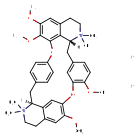
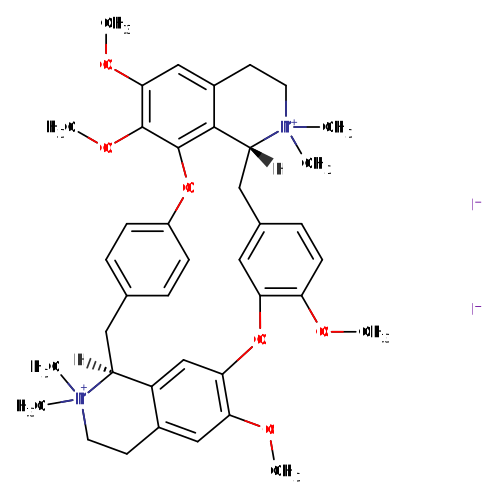
Structure for Metocurine iodide (DB00416)
- Weight
- Average: 906.6279
Monoisotopic: 906.160174118 - Chemical Formula
- C40H48I2N2O6
- Synonyms
- Dimethyl tubocurarine iodide
- Dimethylchondrocurarine iodide
- Dimethyltubocurarinium iodide
- Metocurine iodide
- Metocurini iodidum
- Metubine iodide
- External IDs
- NSC-36388

Pharmacology
- Indication
For use as an anesthesia adjunct to induce skeletal muscle relaxation and to reduce the intensity of muscle contractions in convulsive therapy.
 Reduce drug development failure ratesBuild, train, & validate machine-learning modelswith evidence-based and structured datasets.Build, train, & validate predictive machine-learning models with structured datasets.
- Contraindications & Blackbox Warnings
 Prevent Adverse Drug Events TodayTap into our Clinical API for life-saving information on contraindications & blackbox warnings, population restrictions, harmful risks, & more.Avoid life-threatening adverse drug events with our Clinical API
- Pharmacodynamics
Metocurine iodide is a benzylisoquinolinium competitive nondepolarizing neuromuscular blocking agent. Metocurine iodide has a moderate risk of inducing histamine release and has some ganglion blocking activity. Metocurine iodide can be used most advantageously if muscle twitch response to peripheral nerve stimulation is monitored to assess degree of muscle relaxation. As with other nondepolarizing neuromuscular blockers, the time to onset of paralysis decreases and the duration of maximum effect increases with increasing doses of metocurine iodide. Repeated administration of maintenance doses of metocurine iodide has no cumulative effect on the duration of neuromuscular block if recovery is allowed to begin prior to repeat dosing. Moreover, the time needed to recover from repeat doses does not change with additional doses. Repeat doses can therefore be administered at relatively regular intervals with predictable results.
- Mechanism of action
Metocurine iodide antagonizes the neurotransmitter action of acetylcholine by binding competitively with cholinergic receptor sites on the motor end-plate. This antagonism is inhibited, and neuromuscular block reversed, by acetylcholinesterase inhibitors such as neostigmine, edrophonium, and pyridostigmine.
Target Actions Organism ANeuronal acetylcholine receptor subunit alpha-2 antagonistHumans - Absorption
Not Available
- Volume of distribution
Not Available
- Protein binding
35% in plasma
- Metabolism
- Not Available
- Route of elimination
Not Available
- Half-life
3 to 4 hours
- Clearance
Not Available
- Adverse Effects
 Improve decision support & research outcomesWith structured adverse effects data, including: blackbox warnings, adverse reactions, warning & precautions, & incidence rates. View sample adverse effects data in our new Data Library!Improve decision support & research outcomes with our structured adverse effects data.
- Toxicity
Excessive doses can be expected to produce enhanced pharmacological effects. Overdosage may increase the risk of histamine release and cardiovascular effects, especially hypotension.
- Pathways
- Not Available
- Pharmacogenomic Effects/ADRs
- Not Available
Interactions
- Drug Interactions
- This information should not be interpreted without the help of a healthcare provider. If you believe you are experiencing an interaction, contact a healthcare provider immediately. The absence of an interaction does not necessarily mean no interactions exist.
Drug Interaction Integrate drug-drug
interactions in your software1,2-Benzodiazepine The risk or severity of CNS depression can be increased when Metocurine iodide is combined with 1,2-Benzodiazepine. Acetazolamide The risk or severity of CNS depression can be increased when Metocurine iodide is combined with Acetazolamide. Acetophenazine The risk or severity of CNS depression can be increased when Metocurine iodide is combined with Acetophenazine. Acetyldigitoxin The risk or severity of Cardiac Arrhythmia can be increased when Metocurine iodide is combined with Acetyldigitoxin. Aclidinium The risk or severity of adverse effects can be increased when Metocurine iodide is combined with Aclidinium. - Food Interactions
- Not Available
Products
 Drug product information from 10+ global regionsOur datasets provide approved product information including:dosage, form, labeller, route of administration, and marketing period.Access drug product information from over 10 global regions.
- Brand Name Prescription Products
Name Dosage Strength Route Labeller Marketing Start Marketing End Region Image Metubine Iodide Inj 2mg/ml Liquid 2 mg / mL Intravenous Eli Lilly & Co. Ltd. 1948-12-31 1998-08-04 Canada 
Categories
- Drug Categories
- Alkaloids
- Amines
- Anticholinergic Agents
- Benzylisoquinolines
- Central Nervous System Depressants
- Heterocyclic Compounds, Fused-Ring
- Isoquinolines
- Neuromuscular Agents
- Neuromuscular Blocking Agents
- Neuromuscular-Blocking Agents (Nondepolarizing)
- Nicotinic Antagonists
- Onium Compounds
- Peripheral Nervous System Agents
- Quaternary Ammonium Compounds
- Tetrahydroisoquinolines
- Chemical TaxonomyProvided by Classyfire
- Description
- This compound belongs to the class of organic compounds known as diarylethers. These are organic compounds containing the dialkyl ether functional group, with the formula ROR', where R and R' are aryl groups.
- Kingdom
- Organic compounds
- Super Class
- Organic oxygen compounds
- Class
- Organooxygen compounds
- Sub Class
- Ethers
- Direct Parent
- Diarylethers
- Alternative Parents
- Tetrahydroisoquinolines / Anisoles / Aralkylamines / Alkyl aryl ethers / Tetraalkylammonium salts / Oxacyclic compounds / Azacyclic compounds / Organopnictogen compounds / Organic zwitterions / Organic iodide salts show 1 more
- Substituents
- Alkyl aryl ether / Amine / Anisole / Aralkylamine / Aromatic heteropolycyclic compound / Azacycle / Benzenoid / Diaryl ether / Hydrocarbon derivative / Organic iodide salt show 10 more
- Molecular Framework
- Aromatic heteropolycyclic compounds
- External Descriptors
- Not Available
- Affected organisms
- Humans and other mammals
Chemical Identifiers
- UNII
- O0U0E87X7F
- CAS number
- 7601-55-0
- InChI Key
- DIGFQJFCDPKEPF-OIUSMDOTSA-L
- InChI
- InChI=1S/C40H48N2O6.2HI/c1-41(2)17-15-27-22-34(44-6)36-24-30(27)31(41)19-25-9-12-29(13-10-25)47-40-38-28(23-37(45-7)39(40)46-8)16-18-42(3,4)32(38)20-26-11-14-33(43-5)35(21-26)48-36;;/h9-14,21-24,31-32H,15-20H2,1-8H3;2*1H/q+2;;/p-2/t31-,32+;;/m0../s1
- IUPAC Name
- (1S,16R)-9,10,21,25-tetramethoxy-15,15,30,30-tetramethyl-7,23-dioxa-15,30-diazaheptacyclo[22.6.2.2^{3,6}.1^{8,12}.1^{18,22}.0^{27,31}.0^{16,34}]hexatriaconta-3,5,8(34),9,11,18(33),19,21,24,26,31,35-dodecaene-15,30-diium diiodide
- SMILES
- [I-].[I-].[H][C@@]12CC3=CC=C(OC4=C5C(CC[N+](C)(C)[C@]5([H])CC5=CC(OC6=C(OC)C=C(CC[N+]1(C)C)C2=C6)=C(OC)C=C5)=CC(OC)=C4OC)C=C3
References
- Synthesis Reference
Bray, M.D.; U.S. Patent 2,581,903; January 8, 1952; assigned to Eli Lilly and Company.
- General References
- Not Available
- External Links
- Human Metabolome Database
- HMDB0014560
- KEGG Drug
- D00761
- PubChem Compound
- 24244
- PubChem Substance
- 46507773
- ChemSpider
- 22666
- 203206
- ChEBI
- 6901
- ChEMBL
- CHEMBL1739
- Therapeutic Targets Database
- DAP000824
- PharmGKB
- PA164749507
- Wikipedia
- Metocurine_Iodide
Clinical Trials
Pharmacoeconomics
- Manufacturers
- Eli lilly and co
- Packagers
- Not Available
- Dosage Forms
Form Route Strength Liquid Intravenous 2 mg / mL - Prices
- Not Available
- Patents
- Not Available
Properties
- State
- Solid
- Experimental Properties
Property Value Source melting point (°C) 267-270 Bray, M.D.; U.S. Patent 2,581,903; January 8, 1952; assigned to Eli Lilly and Company. - Predicted Properties
Property Value Source Water Solubility 0.000123 mg/mL ALOGPS logP 0.81 ALOGPS logP -1.8 Chemaxon logS -6.9 ALOGPS pKa (Strongest Acidic) 12.99 Chemaxon pKa (Strongest Basic) -3.4 Chemaxon Physiological Charge 2 Chemaxon Hydrogen Acceptor Count 4 Chemaxon Hydrogen Donor Count 0 Chemaxon Polar Surface Area 55.38 Å2 Chemaxon Rotatable Bond Count 4 Chemaxon Refractivity 211.94 m3·mol-1 Chemaxon Polarizability 73.08 Å3 Chemaxon Number of Rings 7 Chemaxon Bioavailability 1 Chemaxon Rule of Five No Chemaxon Ghose Filter No Chemaxon Veber's Rule No Chemaxon MDDR-like Rule No Chemaxon - Predicted ADMET Features
Property Value Probability Human Intestinal Absorption - 0.9112 Blood Brain Barrier + 0.9374 Caco-2 permeable + 0.6898 P-glycoprotein substrate Substrate 0.8261 P-glycoprotein inhibitor I Non-inhibitor 0.6293 P-glycoprotein inhibitor II Non-inhibitor 0.7474 Renal organic cation transporter Non-inhibitor 0.5766 CYP450 2C9 substrate Non-substrate 0.826 CYP450 2D6 substrate Non-substrate 0.6251 CYP450 3A4 substrate Substrate 0.6945 CYP450 1A2 substrate Non-inhibitor 0.8688 CYP450 2C9 inhibitor Non-inhibitor 0.9391 CYP450 2D6 inhibitor Non-inhibitor 0.8916 CYP450 2C19 inhibitor Non-inhibitor 0.8992 CYP450 3A4 inhibitor Non-inhibitor 0.8879 CYP450 inhibitory promiscuity Low CYP Inhibitory Promiscuity 0.9634 Ames test AMES toxic 0.5764 Carcinogenicity Non-carcinogens 0.8865 Biodegradation Not ready biodegradable 0.9867 Rat acute toxicity 2.7013 LD50, mol/kg Not applicable hERG inhibition (predictor I) Weak inhibitor 0.8502 hERG inhibition (predictor II) Non-inhibitor 0.6006
Spectra
- Mass Spec (NIST)
- Not Available
- Spectra
- Not Available
- Chromatographic Properties
Collision Cross Sections (CCS)
Adduct CCS Value (Å2) Source type Source [M-H]- 258.4249996 predictedDarkChem Lite v0.1.0 [M-H]- 262.08804 predictedDeepCCS 1.0 (2019) [M+H]+ 259.3207996 predictedDarkChem Lite v0.1.0 [M+H]+ 263.98343 predictedDeepCCS 1.0 (2019) [M+Na]+ 258.6441996 predictedDarkChem Lite v0.1.0 [M+Na]+ 269.76135 predictedDeepCCS 1.0 (2019)
Targets

- Kind
- Protein
- Organism
- Humans
- Pharmacological action
- Yes
- Actions
- Antagonist
- General Function
- Drug binding
- Specific Function
- After binding acetylcholine, the AChR responds by an extensive change in conformation that affects all subunits and leads to opening of an ion-conducting channel across the plasma membrane.
- Gene Name
- CHRNA2
- Uniprot ID
- Q15822
- Uniprot Name
- Neuronal acetylcholine receptor subunit alpha-2
- Molecular Weight
- 59764.82 Da
References
- Overington JP, Al-Lazikani B, Hopkins AL: How many drug targets are there? Nat Rev Drug Discov. 2006 Dec;5(12):993-6. [Article]
- Imming P, Sinning C, Meyer A: Drugs, their targets and the nature and number of drug targets. Nat Rev Drug Discov. 2006 Oct;5(10):821-34. [Article]
- Liu M, Dilger JP: Synergy between pairs of competitive antagonists at adult human muscle acetylcholine receptors. Anesth Analg. 2008 Aug;107(2):525-33. doi: 10.1213/ane.0b013e31817b4469. [Article]
- Iwatsuki N, Hashimoto Y, Amaha K, Obara S, Iwatsuki K: Inotropic effects of non-depolarizing muscle relaxants in isolated canine heart muscle. Anesth Analg. 1980 Oct;59(10):717-21. [Article]
- Chen X, Ji ZL, Chen YZ: TTD: Therapeutic Target Database. Nucleic Acids Res. 2002 Jan 1;30(1):412-5. [Article]

Drug created at June 13, 2005 13:24 / Updated at March 03, 2024 02:25