Identification
- Summary
Carboprost tromethamine is a prostaglandin used to treat postpartum uterine hemorrhage due to atony when other methods of management have not been effective.
- Brand Names
- Hemabate
- Generic Name
- Carboprost tromethamine
- DrugBank Accession Number
- DB00429
- Background
A nonsteroidal abortifacient agent that is effective in both the first and second trimesters of pregnancy.
- Type
- Small Molecule
- Groups
- Approved
- Structure
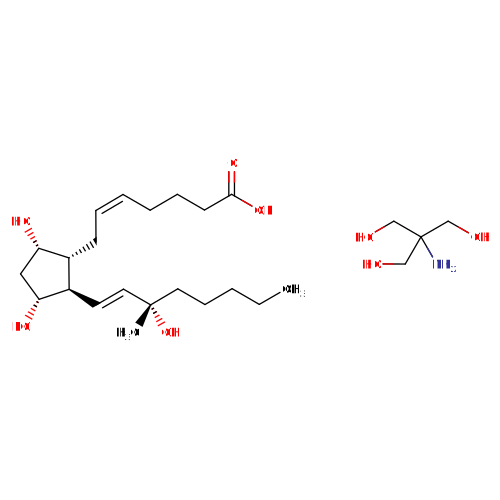
Structure for Carboprost tromethamine (DB00429)
- Weight
- Average: 489.65
Monoisotopic: 489.330167477 - Chemical Formula
- C25H47NO8
- Synonyms
- (15S)-15-methyl-PGF2α tromethamine salt
- (15S)-15-methylprostaglandin F2α tromethamine
- 1,3-dihydroxy-2-(hydroxymethyl)propan-2-aminium (5Z,9α,11β,13E,15S)-9,11,15-trihydroxy-15-methylprosta-5,13-dien-1-oate
- 15(S)-15-methyl-PGF2α tromethamine salt
- 15(S)-15-methylprostaglandin F2α tromethamine
- Carboprost trometamol
- Carboprost tromethamine
- External IDs
- U 32921 E

Pharmacology
- Indication
For aborting pregnancy between the 13th and 20th weeks of gestation as calculated from the first day of the last normal menstrual period and in the following conditions related to second trimester abortion: 1. Failure of expulsion of the fetus during the course of treatment by another method; 2. Premature rupture of membranes in intrauterine methods with loss of drug and insufficient or absent uterine activity; 3. Requirement of a repeat intrauterine instillation of drug for expulsion of the fetus; 4. Inadvertent or spontaneous rupture of membranes in the presence of a previable fetus and absence of adequate activity for expulsion. Also for the treatment of postpartum hemorrhage due to uterine atony which has not responded to conventional methods of management.
 Reduce drug development failure ratesBuild, train, & validate machine-learning modelswith evidence-based and structured datasets.Build, train, & validate predictive machine-learning models with structured datasets.
- Associated Conditions
Indication Type Indication Combined Product Details Approval Level Age Group Patient Characteristics Dose Form Treatment of Unresponsive postpartum haemorrhage (pph) caused by uterine atony •••••••••••• •••••••••• •••••••• - Associated Therapies
- Contraindications & Blackbox Warnings
 Prevent Adverse Drug Events TodayTap into our Clinical API for life-saving information on contraindications & blackbox warnings, population restrictions, harmful risks, & more.Avoid life-threatening adverse drug events with our Clinical API
- Pharmacodynamics
Carboprost tromethamine administered intramuscularly stimulates in the gravid uterus myometrial contractions similar to labor contractions at the end of a full term pregnancy. Whether or not these contractions result from a direct effect of carboprost on the myome-trium has not been determined. Nonetheless, they evacuate the products of conception from the uterus in most cases. Postpartum, the resultant myometrial contractions provide hemostasis at the site of placentation. Carboprost tromethamine also stimulates the smooth muscle of the human gastrointestinal tract. This activity may produce the vomiting or diarrhea or both that is common when carbo-prost tromethamine is used to terminate pregnancy and for use postpartum. In laboratory animals and also in humans carboprost tromethamine can elevate body temperature. With the clinical doses of carboprost trometh-amine used for the termination of pregnancy, and for use postpartum, some patients do experience transient temperature increases. In laboratory animals and in humans large doses of carboprost tromethamine can raise blood pressure, probably by contracting the vascular smooth muscle. With the doses of carboprost tromethamine used for terminating pregnancy, this effect has not been clinically significant. In laboratory animals and also in humans carboprost tromethamine can elevate body temperature. With the clinical doses of carboprost tromethamine used for the termination of pregnancy, some patients do experience temperature increases. In some patients, carboprost tromethamine may cause transient bronchoconstriction.
- Mechanism of action
Carboprost is a synthetic prostaglandin. It binds the prostaglandin E2 receptor, causing myometrial contractions, casuing the induction of labour or the expulsion of the placenta. Prostaglandins occur naturally in the body and act at several sites in the body including the womb (uterus). They act on the muscles of the womb, causing them to contract.
Target Actions Organism AProstaglandin E2 receptor EP1 subtype agonistHumans - Absorption
Not Available
- Volume of distribution
Not Available
- Protein binding
Not Available
- Metabolism
Metabolized in the lungs and liver. Metabolites are excreted in urine.
- Route of elimination
Not Available
- Half-life
Not Available
- Clearance
Not Available
- Adverse Effects
 Improve decision support & research outcomesWith structured adverse effects data, including: blackbox warnings, adverse reactions, warning & precautions, & incidence rates. View sample adverse effects data in our new Data Library!Improve decision support & research outcomes with our structured adverse effects data.
- Toxicity
Symptoms of overdose include irritation, nausea, vomiting, diarrhea, coughing, dyspnea, asthma, hypertension, flushing, and pyrexia.
- Pathways
- Not Available
- Pharmacogenomic Effects/ADRs
- Not Available
Interactions
- Drug Interactions
- This information should not be interpreted without the help of a healthcare provider. If you believe you are experiencing an interaction, contact a healthcare provider immediately. The absence of an interaction does not necessarily mean no interactions exist.
Drug Interaction Integrate drug-drug
interactions in your softwareCarbetocin Carboprost tromethamine may increase the uterotonic activities of Carbetocin. Dinoprost Carboprost tromethamine may increase the uterotonic activities of Dinoprost. Dinoprost tromethamine Carboprost tromethamine may increase the uterotonic activities of Dinoprost tromethamine. Dinoprostone Carboprost tromethamine may increase the uterotonic activities of Dinoprostone. Ergometrine Carboprost tromethamine may increase the uterotonic activities of Ergometrine. - Food Interactions
- No interactions found.
Products
 Drug product information from 10+ global regionsOur datasets provide approved product information including:dosage, form, labeller, route of administration, and marketing period.Access drug product information from over 10 global regions.
- International/Other Brands
- Carboprost / Deviprost (Dr. Reddy's) / Prostin 15M (Pfizer) / Prostinfenem (Pfizer) / Prostodin (AstraZeneca)
- Brand Name Prescription Products
Name Dosage Strength Route Labeller Marketing Start Marketing End Region Image Carboprost Tromethamine Injection USP Solution 250 mcg / mL Intramuscular Juno Pharmaceuticals Corp. Not applicable Not applicable Canada 
Carboprost Tromethamine Injection, USP Solution 250 mcg / mL Intramuscular Dr Reddy's Laboratories Ltd 2023-05-16 Not applicable Canada Hemabate Solution 250 mcg / mL Intramuscular Pfizer Canada Ulc 1997-11-28 Not applicable Canada Hemabate Injection, solution 250 ug/1mL Intramuscular Pharmacia & Upjohn Company LLC 1979-01-09 Not applicable US 
- Generic Prescription Products
Name Dosage Strength Route Labeller Marketing Start Marketing End Region Image Carboprost Tromethamine Injection, solution 250 ug/1mL Intramuscular Amneal Pharmaceuticals LLC 2022-01-30 Not applicable US Carboprost Tromethamine Injection, solution 250 ug/1mL Intramuscular Dr. Reddys Laboratories Inc. 2020-02-04 Not applicable US Carboprost Tromethamine Injection, solution 250 ug/1mL Intramuscular Dr. Reddy's Laboratories Inc. 2024-01-12 Not applicable US Carboprost Tromethamine Injection, solution 250 ug/1mL Intramuscular Gland Pharma Limited 2023-08-07 Not applicable US Carboprost Tromethamine Injection, solution 250 ug/1mL Intramuscular Fresenius Kabi USA, LLC 2023-06-12 Not applicable US
Categories
- ATC Codes
- G02AD04 — Carboprost
- Drug Categories
- Abortifacient Agents
- Abortifacient Agents, Nonsteroidal
- Alcohols
- Autacoids
- Biological Factors
- Eicosanoids
- Fatty Acids
- Fatty Acids, Unsaturated
- Genito Urinary System and Sex Hormones
- Glycols
- Inflammation Mediators
- Lipids
- Pharmaceutical Preparations
- Propylene Glycols
- Prostaglandins
- Prostaglandins F, Synthetic
- Prostaglandins, Synthetic
- Reproductive Control Agents
- Uterotonic agents
- Classification
- Not classified
- Affected organisms
- Humans and other mammals
Chemical Identifiers
- UNII
- U4526F86FJ
- CAS number
- 58551-69-2
- InChI Key
- UMMADZJLZAPZAW-XOWPVRJPSA-N
- InChI
- InChI=1S/C21H36O5.C4H11NO3/c1-3-4-9-13-21(2,26)14-12-17-16(18(22)15-19(17)23)10-7-5-6-8-11-20(24)25;5-4(1-6,2-7)3-8/h5,7,12,14,16-19,22-23,26H,3-4,6,8-11,13,15H2,1-2H3,(H,24,25);6-8H,1-3,5H2/b7-5-,14-12+;/t16-,17-,18+,19-,21+;/m1./s1
- IUPAC Name
- (5Z)-7-[(1R,2R,3R,5S)-3,5-dihydroxy-2-[(1E,3S)-3-hydroxy-3-methyloct-1-en-1-yl]cyclopentyl]hept-5-enoic acid; 2-amino-2-(hydroxymethyl)propane-1,3-diol
- SMILES
- NC(CO)(CO)CO.CCCCC[C@](C)(O)\C=C\[C@H]1[C@H](O)C[C@H](O)[C@@H]1C\C=C/CCCC(O)=O
References
- Synthesis Reference
Ming Li, "CRYSTALS OF CARBOPROST TROMETHAMINE AND THE PREPARATION METHOD AS WELL AS THE USES THEREOF." U.S. Patent US20130190404, issued July 25, 2013.
US20130190404- General References
- FDA Approved Drug Products: Hemabate (carboprost tromethamine) solution for injection [Link]
- External Links
- Human Metabolome Database
- HMDB0014573
- KEGG Drug
- D00682
- PubChem Compound
- 45266502
- PubChem Substance
- 46508118
- ChemSpider
- 4444531
- 2051
- ChEBI
- 3404
- ChEMBL
- CHEMBL1237105
- Therapeutic Targets Database
- DAP001215
- PharmGKB
- PA164754883
- RxList
- RxList Drug Page
- Drugs.com
- Drugs.com Drug Page
- Wikipedia
- Carboprost
- MSDS
- Download (49.2 KB)
Clinical Trials
- Clinical Trials
Phase Status Purpose Conditions Count 4 Active Not Recruiting Treatment Postpartum Haemorrhage (PPH) / Uterine Atony 1 4 Completed Treatment Hypotension / Uterine Atony 1 4 Unknown Status Prevention Gynecological Patient 1 1 Completed Prevention Cesarean Sections 1 0 Recruiting Treatment Fibroid Uterus / Gynecologic Diseases / Uterine Fibroids (Leiomyomas) 1
Pharmacoeconomics
- Manufacturers
- Pharmacia and upjohn co
- Hospira inc
- Packagers
- Hospira Inc.
- Pharmacia Inc.
- Dosage Forms
Form Route Strength Injection Intramuscular 250 ug/1mL Solution Intramuscular 250 ug/1mL Injection, solution Intramuscular 250 ug/1mL Solution Intramuscular 250 mcg / mL Injection Intramuscular 250 mcg/mL - Prices
Unit description Cost Unit Hemabate 250 mcg/ml ampul 92.89USD ml Tham iv solution 0.49USD ml DrugBank does not sell nor buy drugs. Pricing information is supplied for informational purposes only.- Patents
- Not Available
Properties
- State
- Solid
- Experimental Properties
Property Value Source melting point (°C) 95-105 °C Not Available water solubility Carboprost tromethamine dissolves readily in water at room temperature at a concentration greater than 75 mg/mL. Not Available logP 3.3 Not Available - Predicted Properties
Property Value Source Water Solubility 0.0708 mg/mL ALOGPS logP 4.29 ALOGPS logP 2.89 Chemaxon logS -3.7 ALOGPS pKa (Strongest Acidic) 4.36 Chemaxon pKa (Strongest Basic) -1.3 Chemaxon Physiological Charge -1 Chemaxon Hydrogen Acceptor Count 5 Chemaxon Hydrogen Donor Count 4 Chemaxon Polar Surface Area 97.99 Å2 Chemaxon Rotatable Bond Count 15 Chemaxon Refractivity 105.11 m3·mol-1 Chemaxon Polarizability 42.54 Å3 Chemaxon Number of Rings 1 Chemaxon Bioavailability 1 Chemaxon Rule of Five Yes Chemaxon Ghose Filter No Chemaxon Veber's Rule No Chemaxon MDDR-like Rule No Chemaxon - Predicted ADMET Features
Property Value Probability Human Intestinal Absorption + 0.5755 Blood Brain Barrier - 0.5581 Caco-2 permeable - 0.6594 P-glycoprotein substrate Substrate 0.6894 P-glycoprotein inhibitor I Non-inhibitor 0.9445 P-glycoprotein inhibitor II Non-inhibitor 0.9643 Renal organic cation transporter Non-inhibitor 0.8922 CYP450 2C9 substrate Non-substrate 0.8241 CYP450 2D6 substrate Non-substrate 0.7916 CYP450 3A4 substrate Non-substrate 0.5 CYP450 1A2 substrate Non-inhibitor 0.7693 CYP450 2C9 inhibitor Non-inhibitor 0.8874 CYP450 2D6 inhibitor Non-inhibitor 0.7649 CYP450 2C19 inhibitor Non-inhibitor 0.8534 CYP450 3A4 inhibitor Non-inhibitor 0.943 CYP450 inhibitory promiscuity Low CYP Inhibitory Promiscuity 0.933 Ames test Non AMES toxic 0.9008 Carcinogenicity Non-carcinogens 0.9422 Biodegradation Ready biodegradable 0.5 Rat acute toxicity 2.4308 LD50, mol/kg Not applicable hERG inhibition (predictor I) Weak inhibitor 0.9511 hERG inhibition (predictor II) Non-inhibitor 0.9008
Spectra
- Mass Spec (NIST)
- Not Available
- Spectra
Spectrum Spectrum Type Splash Key Predicted 1H NMR Spectrum 1D NMR Not Applicable Predicted 13C NMR Spectrum 1D NMR Not Applicable - Chromatographic Properties
Collision Cross Sections (CCS)
Not Available
Targets

- Kind
- Protein
- Organism
- Humans
- Pharmacological action
- Yes
- Actions
- Agonist
- General Function
- Prostaglandin e receptor activity
- Specific Function
- Receptor for prostaglandin E2 (PGE2). The activity of this receptor is mediated by G(q) proteins which activate a phosphatidylinositol-calcium second messenger system. May play a role as an importa...
- Gene Name
- PTGER1
- Uniprot ID
- P34995
- Uniprot Name
- Prostaglandin E2 receptor EP1 subtype
- Molecular Weight
- 41800.655 Da
References
- Imming P, Sinning C, Meyer A: Drugs, their targets and the nature and number of drug targets. Nat Rev Drug Discov. 2006 Oct;5(10):821-34. [Article]
- Hay A, Wood S, Olson D, Slater DM: Labour is associated with decreased expression of the PGF2alpha receptor (PTGFR) and a novel PTGFR splice variant in human myometrium but not decidua. Mol Hum Reprod. 2010 Oct;16(10):752-60. doi: 10.1093/molehr/gaq046. Epub 2010 Jun 2. [Article]
- Tsuboi K, Ichikawa A: [Reproduction physiology and prostanoids]. Nihon Yakurigaku Zasshi. 2001 Apr;117(4):267-73. [Article]
- Carrasco MP, Asboth G, Phaneuf S, Lopez Bernal A: Activation of the prostaglandin FP receptor in human granulosa cells. J Reprod Fertil. 1997 Nov;111(2):309-17. [Article]

Drug created at June 13, 2005 13:24 / Updated at April 24, 2024 14:30