Identification
- Generic Name
- Loracarbef
- DrugBank Accession Number
- DB00447
- Background
Loracarbef is a carbacephem antibiotic sometimes grouped together with the second-generation cephalosporin antibiotics. It is marketed under the trade name Lorabid.
- Type
- Small Molecule
- Groups
- Approved, Investigational, Withdrawn
- Structure
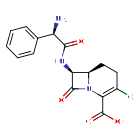
Structure for Loracarbef (DB00447)

- Weight
- Average: 349.769
Monoisotopic: 349.082933722 - Chemical Formula
- C16H16ClN3O4
- Synonyms
- Anhydrous loracarbef
- Loracarbef
- Loracarbef anhydrous
- Loracarbef, anhydrous
- Loracarbefum
- External IDs
- LY 163892

Pharmacology
- Indication
Used to treat upper respiratory tract bacterial infections, chronic bronchitis, pneumonia, sinusitis, pharyntitis and tonsillitis, skin absceses, urinary tract infections and pyelonephritis caused by E. coli, S. pyogenes, S. aureus, S. saprphyticus, S. penumoniae, H. influenzae and M. catarrhalis.
 Reduce drug development failure ratesBuild, train, & validate machine-learning modelswith evidence-based and structured datasets.Build, train, & validate predictive machine-learning models with structured datasets.
- Contraindications & Blackbox Warnings
 Prevent Adverse Drug Events TodayTap into our Clinical API for life-saving information on contraindications & blackbox warnings, population restrictions, harmful risks, & more.Avoid life-threatening adverse drug events with our Clinical API
- Pharmacodynamics
Loracarbef is considered a second generation cephalosporin antibiotic. The advantages of cephalosporin antibiotics include a broad range of activity, a safe record in children with almost no dose-related toxicity, and the lack of need to monitor levels. Adverse reactions are rare and consist primarily of hypersensitivity reactions with urticaria, nonspecific rash, and pruritus. Loracarbef can be used to treat a large number of bacterial infections caused by gram-negative and gram-positive bacteria, including upper respiratory tract bacterial infections, chronic bronchitis, pneumonia, sinusitis, pharyntitis and tonsillitis, skin absceses, urinary tract infections and pyelonephritis caused by E. coli, S. pyogenes, S. aureus, S. saprphyticus, S. penumoniae, H. influenzae and M. catarrhalis.
- Mechanism of action
Loracarbef is an oral, synthetic beta-lactam antibiotic of the carbacephem class. Chemically, carbacephems differ from cephalosporin-class antibiotics in the dihydrothiazine ring where a methylene group has been substituted for a sulfur atom. Loracarbef has a spectrum of activity similar to that of the second generation cephalosporins. It is structurally identical to cefaclor except for a sulfur atom that has been replaced by a methylene group. This change gives greater chemical stability in solution and allows storage at room temperature. Loracarbef, like all b-lactams and cephalosporins, inhibits penicillin binding proteins, enzymes that create the cross-linkage of the peptidoglycan polymer. This binding leads to interference with the formation and remodeling of the cell wall structure.
Target Actions Organism APenicillin-binding protein 3 inhibitorStreptococcus pneumoniae APenicillin-binding protein 1A inhibitorClostridium perfringens (strain 13 / Type A) - Absorption
Well absorbed with approximately 90% absorbed from the gastrointestinal tract after oral ingestion.
- Volume of distribution
Not Available
- Protein binding
25%
- Metabolism
There is no evidence of metabolism in humans.
- Route of elimination
Not Available
- Half-life
1 hour. In subjects with moderate impairment of renal function the plasma half-life was prolonged to approximately 5.6 hours.
- Clearance
Not Available
- Adverse Effects
 Improve decision support & research outcomesWith structured adverse effects data, including: blackbox warnings, adverse reactions, warning & precautions, & incidence rates. View sample adverse effects data in our new Data Library!Improve decision support & research outcomes with our structured adverse effects data.
- Toxicity
Adverse effects include diarrhea, nausea, stomach upset, vomiting, headache, dizziness, rash, bone marrow depression.
- Pathways
- Not Available
- Pharmacogenomic Effects/ADRs
- Not Available
Interactions
- Drug Interactions
- This information should not be interpreted without the help of a healthcare provider. If you believe you are experiencing an interaction, contact a healthcare provider immediately. The absence of an interaction does not necessarily mean no interactions exist.
Drug Interaction Integrate drug-drug
interactions in your softwareAbacavir Loracarbef may decrease the excretion rate of Abacavir which could result in a higher serum level. Abciximab The therapeutic efficacy of Abciximab can be decreased when used in combination with Loracarbef. Aceclofenac The risk or severity of nephrotoxicity can be increased when Loracarbef is combined with Aceclofenac. Acemetacin The risk or severity of nephrotoxicity can be increased when Loracarbef is combined with Acemetacin. Acenocoumarol The risk or severity of bleeding can be increased when Loracarbef is combined with Acenocoumarol. - Food Interactions
- Take on an empty stomach. Food decreases absorption.
Products
 Drug product information from 10+ global regionsOur datasets provide approved product information including:dosage, form, labeller, route of administration, and marketing period.Access drug product information from over 10 global regions.
- Product Ingredients
Ingredient UNII CAS InChI Key Loracarbef monohydrate 3X11EVM5SU 121961-22-6 GPYKKBAAPVOCIW-HSASPSRMSA-N - International/Other Brands
- Lorafem (Pierre Fabre) / Lorbef (Lilly)
- Brand Name Prescription Products
Name Dosage Strength Route Labeller Marketing Start Marketing End Region Image Lorabid Suspension 100 mg/5mL Oral Monarch Pharmaceuticals, Inc. 1991-12-31 2006-09-26 US 
Lorabid Capsule 200 mg/1 Oral Physicians Total Care, Inc. 1991-12-31 2006-09-26 US Lorabid Capsule 400 mg/1 Oral Monarch Pharmaceuticals, Inc. 1996-04-05 2006-09-26 US Lorabid Suspension 200 mg/5mL Oral Monarch Pharmaceuticals, Inc. 1991-12-31 2006-09-26 US Lorabid Capsule 200 mg/1 Oral Monarch Pharmaceuticals, Inc. 1991-12-31 2006-09-26 US
Categories
- ATC Codes
- J01DC08 — Loracarbef
- Drug Categories
- Chemical TaxonomyProvided by Classyfire
- Description
- This compound belongs to the class of organic compounds known as carbacephems. These are a new class of beta-lactam antibiotics similar in structure to the cephalosporins. They differ from cephalosporins, however, in the substitution of a sulfur atom in the dihydrothiazine ring with a methylene group to form a tetrahydropyridine ring.
- Kingdom
- Organic compounds
- Super Class
- Organoheterocyclic compounds
- Class
- Lactams
- Sub Class
- Beta lactams
- Direct Parent
- Carbacephems
- Alternative Parents
- N-acyl-alpha amino acids and derivatives / Alpha amino acid amides / Phenylacetamides / Tetrahydropyridines / Aralkylamines / Vinylogous halides / Tertiary carboxylic acid amides / Secondary carboxylic acid amides / Amino acids / Azetidines show 11 more
- Substituents
- Alpha-amino acid amide / Alpha-amino acid or derivatives / Amine / Amino acid / Amino acid or derivatives / Aralkylamine / Aromatic heteropolycyclic compound / Azacycle / Azetidine / Benzenoid show 28 more
- Molecular Framework
- Aromatic heteropolycyclic compounds
- External Descriptors
- zwitterion, carbacephem (CHEBI:214480)
- Affected organisms
- Various gram-negative and gram-positive eubacteria
- Streptococcus pyogenes
- Streptococcus pneumoniae
- Haemophilus influenzae
- Escherichia coli
- Staphylococcus aureus
Chemical Identifiers
- UNII
- W72I5ZT78Z
- CAS number
- 76470-66-1
- InChI Key
- JAPHQRWPEGVNBT-UTUOFQBUSA-N
- InChI
- InChI=1S/C16H16ClN3O4/c17-9-6-7-10-12(15(22)20(10)13(9)16(23)24)19-14(21)11(18)8-4-2-1-3-5-8/h1-5,10-12H,6-7,18H2,(H,19,21)(H,23,24)/t10-,11-,12+/m1/s1
- IUPAC Name
- (6R,7S)-7-[(2R)-2-amino-2-phenylacetamido]-3-chloro-8-oxo-1-azabicyclo[4.2.0]oct-2-ene-2-carboxylic acid
- SMILES
- N[C@@H](C(=O)N[C@H]1[C@H]2CCC(Cl)=C(N2C1=O)C(O)=O)C1=CC=CC=C1
References
- Synthesis Reference
William C. Henning, Theodore R. Stout, "Process for preparing loracarbef monohydrate." U.S. Patent US5580977, issued May, 1990.
US5580977- General References
- Dantzig AH, Duckworth DC, Tabas LB: Transport mechanisms responsible for the absorption of loracarbef, cefixime, and cefuroxime axetil into human intestinal Caco-2 cells. Biochim Biophys Acta. 1994 Apr 20;1191(1):7-13. [Article]
- Brogden RN, McTavish D: Loracarbef. A review of its antimicrobial activity, pharmacokinetic properties and therapeutic efficacy. Drugs. 1993 May;45(5):716-36. [Article]
- Force RW, Nahata MC: Loracarbef: a new orally administered carbacephem antibiotic. Ann Pharmacother. 1993 Mar;27(3):321-9. [Article]
- Copper RD: The carbacephems: a new beta-lactam antibiotic class. Am J Med. 1992 Jun 22;92(6A):2S-6S. [Article]
- External Links
- Human Metabolome Database
- HMDB0014590
- KEGG Drug
- D00916
- KEGG Compound
- C08109
- PubChem Compound
- 5284585
- PubChem Substance
- 46506369
- ChemSpider
- 4447635
- 28981
- ChEBI
- 47544
- ChEMBL
- CHEMBL1013
- ZINC
- ZINC000001530993
- Therapeutic Targets Database
- DAP000434
- PharmGKB
- PA164754806
- RxList
- RxList Drug Page
- Drugs.com
- Drugs.com Drug Page
- PDRhealth
- PDRhealth Drug Page
- Wikipedia
- Loracarbef
- MSDS
- Download (44.1 KB)
Clinical Trials
- Clinical Trials
Phase Status Purpose Conditions Count 0 Terminated Treatment Osteomyelitis 1
Pharmacoeconomics
- Manufacturers
- King pharmaceuticals inc
- Packagers
- Dispensing Solutions
- Eli Lilly & Co.
- Lilly Del Caribe Inc.
- Murfreesboro Pharmaceutical Nursing Supply
- Physicians Total Care Inc.
- Dosage Forms
Form Route Strength Suspension Oral Capsule Oral Granule, for suspension Oral Capsule Oral 200 mg/1 Capsule Oral 400 mg/1 Suspension Oral 100 mg/5mL Suspension Oral 200 mg/5mL - Prices
- Not Available
- Patents
Patent Number Pediatric Extension Approved Expires (estimated) Region CA2034592 No 2001-06-05 2011-01-18 Canada 
CA1334970 No 1995-03-28 2012-03-28 Canada
Properties
- State
- Solid
- Experimental Properties
Property Value Source logP 0.5 Not Available - Predicted Properties
Property Value Source Water Solubility 0.325 mg/mL ALOGPS logP 0.55 ALOGPS logP -2.4 Chemaxon logS -3 ALOGPS pKa (Strongest Acidic) 2.93 Chemaxon pKa (Strongest Basic) 7.23 Chemaxon Physiological Charge 0 Chemaxon Hydrogen Acceptor Count 5 Chemaxon Hydrogen Donor Count 3 Chemaxon Polar Surface Area 112.73 Å2 Chemaxon Rotatable Bond Count 4 Chemaxon Refractivity 86.64 m3·mol-1 Chemaxon Polarizability 32.13 Å3 Chemaxon Number of Rings 3 Chemaxon Bioavailability 1 Chemaxon Rule of Five Yes Chemaxon Ghose Filter No Chemaxon Veber's Rule No Chemaxon MDDR-like Rule No Chemaxon - Predicted ADMET Features
Property Value Probability Human Intestinal Absorption - 0.6242 Blood Brain Barrier - 0.9659 Caco-2 permeable - 0.8958 P-glycoprotein substrate Substrate 0.7255 P-glycoprotein inhibitor I Non-inhibitor 0.89 P-glycoprotein inhibitor II Non-inhibitor 0.9848 Renal organic cation transporter Non-inhibitor 0.8905 CYP450 2C9 substrate Non-substrate 0.8338 CYP450 2D6 substrate Non-substrate 0.8339 CYP450 3A4 substrate Substrate 0.5199 CYP450 1A2 substrate Non-inhibitor 0.82 CYP450 2C9 inhibitor Non-inhibitor 0.8491 CYP450 2D6 inhibitor Non-inhibitor 0.888 CYP450 2C19 inhibitor Non-inhibitor 0.7748 CYP450 3A4 inhibitor Non-inhibitor 0.6813 CYP450 inhibitory promiscuity Low CYP Inhibitory Promiscuity 0.9341 Ames test Non AMES toxic 0.6788 Carcinogenicity Non-carcinogens 0.929 Biodegradation Not ready biodegradable 0.9959 Rat acute toxicity 2.1829 LD50, mol/kg Not applicable hERG inhibition (predictor I) Weak inhibitor 0.9752 hERG inhibition (predictor II) Non-inhibitor 0.8654
Spectra
- Mass Spec (NIST)
- Not Available
- Spectra
Spectrum Spectrum Type Splash Key Predicted GC-MS Spectrum - GC-MS Predicted GC-MS splash10-0a4i-8901000000-9624c4237beed0fc58b1 Predicted MS/MS Spectrum - 10V, Positive (Annotated) Predicted LC-MS/MS splash10-0fsi-0229000000-f893420c11cdd15c6f8b Predicted MS/MS Spectrum - 10V, Negative (Annotated) Predicted LC-MS/MS splash10-0002-1519000000-32b95926026bbcd17789 Predicted MS/MS Spectrum - 20V, Positive (Annotated) Predicted LC-MS/MS splash10-0a6r-9700000000-a697ffbb198a9c0886d8 Predicted MS/MS Spectrum - 20V, Negative (Annotated) Predicted LC-MS/MS splash10-001i-9301000000-f40ca6db6c505150a883 Predicted MS/MS Spectrum - 40V, Positive (Annotated) Predicted LC-MS/MS splash10-0a4i-4921000000-9939323d7b40c2339873 Predicted MS/MS Spectrum - 40V, Negative (Annotated) Predicted LC-MS/MS splash10-001i-9500000000-b60c7ac90e8f37bda538 Predicted 1H NMR Spectrum 1D NMR Not Applicable Predicted 13C NMR Spectrum 1D NMR Not Applicable - Chromatographic Properties
Collision Cross Sections (CCS)
Adduct CCS Value (Å2) Source type Source [M-H]- 193.1392885 predictedDarkChem Lite v0.1.0 [M-H]- 180.71132 predictedDeepCCS 1.0 (2019) [M+H]+ 193.9441885 predictedDarkChem Lite v0.1.0 [M+H]+ 183.10687 predictedDeepCCS 1.0 (2019) [M+Na]+ 193.9875885 predictedDarkChem Lite v0.1.0 [M+Na]+ 189.18855 predictedDeepCCS 1.0 (2019)
Targets

- Kind
- Protein
- Organism
- Streptococcus pneumoniae
- Pharmacological action
- Yes
- Actions
- Inhibitor
- General Function
- Serine-type d-ala-d-ala carboxypeptidase activity
- Specific Function
- Not Available
- Gene Name
- pbp3
- Uniprot ID
- Q75Y35
- Uniprot Name
- Penicillin-binding protein 3
- Molecular Weight
- 45209.84 Da
References
- Chambers HF, Miick C: Characterization of penicillin-binding protein 2 of Staphylococcus aureus: deacylation reaction and identification of two penicillin-binding peptides. Antimicrob Agents Chemother. 1992 Mar;36(3):656-61. [Article]
- Sato K, Okachi R, Matsukuma I, Mochida K, Hirata T: In vitro and in vivo antibacterial activity of KT3777, a new orally active carbacephem. J Antibiot (Tokyo). 1989 Dec;42(12):1844-53. [Article]
- Kind
- Protein
- Organism
- Clostridium perfringens (strain 13 / Type A)
- Pharmacological action
- Yes
- Actions
- Inhibitor
- General Function
- Transferase activity, transferring glycosyl groups
- Specific Function
- Cell wall formation. Synthesis of cross-linked peptidoglycan from the lipid intermediates. The enzyme has a penicillin-insensitive transglycosylase N-terminal domain (formation of linear glycan str...
- Gene Name
- pbpA
- Uniprot ID
- Q8XJ01
- Uniprot Name
- Penicillin-binding protein 1A
- Molecular Weight
- 75176.35 Da
References
- Overington JP, Al-Lazikani B, Hopkins AL: How many drug targets are there? Nat Rev Drug Discov. 2006 Dec;5(12):993-6. [Article]
- Imming P, Sinning C, Meyer A: Drugs, their targets and the nature and number of drug targets. Nat Rev Drug Discov. 2006 Oct;5(10):821-34. [Article]
- Sato K, Okachi R, Matsukuma I, Mochida K, Hirata T: In vitro and in vivo antibacterial activity of KT3777, a new orally active carbacephem. J Antibiot (Tokyo). 1989 Dec;42(12):1844-53. [Article]
Transporters
- Kind
- Protein
- Organism
- Humans
- Pharmacological action
- Unknown
- Actions
- Inhibitor
- General Function
- Proton-dependent oligopeptide secondary active transmembrane transporter activity
- Specific Function
- Proton-coupled intake of oligopeptides of 2 to 4 amino acids with a preference for dipeptides. May constitute a major route for the absorption of protein digestion end-products.
- Gene Name
- SLC15A1
- Uniprot ID
- P46059
- Uniprot Name
- Solute carrier family 15 member 1
- Molecular Weight
- 78805.265 Da
References
- Wenzel U, Gebert I, Weintraut H, Weber WM, Clauss W, Daniel H: Transport characteristics of differently charged cephalosporin antibiotics in oocytes expressing the cloned intestinal peptide transporter PepT1 and in human intestinal Caco-2 cells. J Pharmacol Exp Ther. 1996 May;277(2):831-9. [Article]
- Kind
- Protein
- Organism
- Humans
- Pharmacological action
- Unknown
- Actions
- Inhibitor
- General Function
- Peptide:proton symporter activity
- Specific Function
- Proton-coupled intake of oligopeptides of 2 to 4 amino acids with a preference for dipeptides.
- Gene Name
- SLC15A2
- Uniprot ID
- Q16348
- Uniprot Name
- Solute carrier family 15 member 2
- Molecular Weight
- 81782.77 Da
References
- Boll M, Herget M, Wagener M, Weber WM, Markovich D, Biber J, Clauss W, Murer H, Daniel H: Expression cloning and functional characterization of the kidney cortex high-affinity proton-coupled peptide transporter. Proc Natl Acad Sci U S A. 1996 Jan 9;93(1):284-9. [Article]

Drug created at June 13, 2005 13:24 / Updated at March 03, 2024 02:25