Identification
- Generic Name
- Levallorphan
- DrugBank Accession Number
- DB00504
- Background
An opioid antagonist with properties similar to those of naloxone; in addition it also possesses some agonist properties. It should be used cautiously; levallorphan reverses severe opioid-induced respiratory depression but may exacerbate respiratory depression such as that induced by alcohol or other non-opioid central depressants. (From Martindale, The Extra Pharmacopoeia, 30th ed, p683)
- Type
- Small Molecule
- Groups
- Approved
- Structure
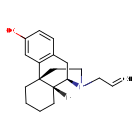
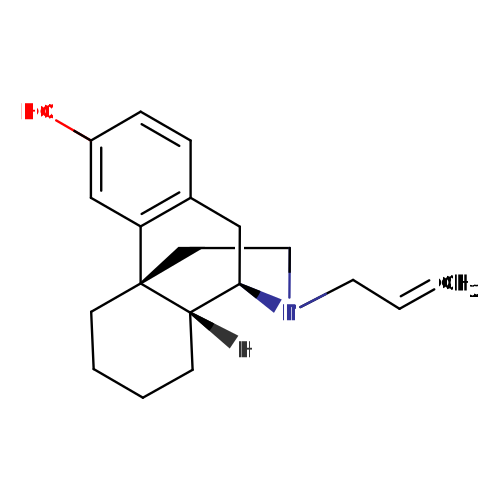
Structure for Levallorphan (DB00504)
- Weight
- Average: 283.4079
Monoisotopic: 283.193614427 - Chemical Formula
- C19H25NO
- Synonyms
- Levallofano
- Levallorphan
- Lévallorphane
- Levallorphanum
- Levalorfano
- External IDs
- HSDB 2148
- Ro-1-7700

Pharmacology
- Indication
For the complete or partial reversal of narcotic depression, including respiratory depression, induced by opioids.
 Reduce drug development failure ratesBuild, train, & validate machine-learning modelswith evidence-based and structured datasets.Build, train, & validate predictive machine-learning models with structured datasets.
- Contraindications & Blackbox Warnings
 Prevent Adverse Drug Events TodayTap into our Clinical API for life-saving information on contraindications & blackbox warnings, population restrictions, harmful risks, & more.Avoid life-threatening adverse drug events with our Clinical API
- Pharmacodynamics
Levallorphan, an opioid antagonist similar to naloxone, is used to treat drug overdoses. Levallorphan differs from naloxone in that it also possesses some agonist properties. It is an analogue of levelorphanol that counteracts the actions of narcotic analgesics such as morphine. It is used especially in the treatment of respiratory depression due to narcotic overdoses. Levallorphan prevents or reverses the effects of opioids including respiratory depression, sedation and hypotension. Also, it can reverse the psychotomimetic and dysphoric effects of agonist-antagonists such as pentazocine.
- Mechanism of action
Levallorphan antagonizes opioid effects by competing for the same receptor sites. It binds to the opioid mu receptor and the nicotinic acetylcholine receptor alpha2/alpha3.
Target Actions Organism AMu-type opioid receptor partial agonistHumans - Absorption
Rapidly absorbed.
- Volume of distribution
Not Available
- Protein binding
Not Available
- Metabolism
Hepatic.
- Route of elimination
Not Available
- Half-life
1 hour
- Clearance
Not Available
- Adverse Effects
 Improve decision support & research outcomesWith structured adverse effects data, including: blackbox warnings, adverse reactions, warning & precautions, & incidence rates. View sample adverse effects data in our new Data Library!Improve decision support & research outcomes with our structured adverse effects data.
- Toxicity
Oral, rat LD50: 109±4 mg/kg
- Pathways
Pathway Category Levallorphan Action Pathway Drug action - Pharmacogenomic Effects/ADRs
- Not Available
Interactions
- Drug Interactions
- This information should not be interpreted without the help of a healthcare provider. If you believe you are experiencing an interaction, contact a healthcare provider immediately. The absence of an interaction does not necessarily mean no interactions exist.
Drug Interaction Integrate drug-drug
interactions in your softwareAlfentanil The therapeutic efficacy of Alfentanil can be decreased when used in combination with Levallorphan. Benzhydrocodone The therapeutic efficacy of Benzhydrocodone can be decreased when used in combination with Levallorphan. Buprenorphine The therapeutic efficacy of Buprenorphine can be decreased when used in combination with Levallorphan. Butorphanol The therapeutic efficacy of Butorphanol can be decreased when used in combination with Levallorphan. Codeine The therapeutic efficacy of Codeine can be decreased when used in combination with Levallorphan. - Food Interactions
- Not Available
Products
 Drug product information from 10+ global regionsOur datasets provide approved product information including:dosage, form, labeller, route of administration, and marketing period.Access drug product information from over 10 global regions.
- Product Ingredients
Ingredient UNII CAS InChI Key Levallorphan tartrate U0VSF7HTN0 71-82-9 FWMLYVACGDQRFU-ZTMWJVNESA-N - International/Other Brands
- Lorfan (Takeda)
Categories
- Drug Categories
- Chemical TaxonomyProvided by Classyfire
- Description
- This compound belongs to the class of organic compounds known as morphinans. These are polycyclic compounds with a four-ring skeleton with three condensed six-member rings forming a partially hydrogenated phenanthrene moiety, one of which is aromatic while the two others are alicyclic.
- Kingdom
- Organic compounds
- Super Class
- Alkaloids and derivatives
- Class
- Morphinans
- Sub Class
- Not Available
- Direct Parent
- Morphinans
- Alternative Parents
- Phenanthrenes and derivatives / Benzazocines / Tetralins / Aralkylamines / 1-hydroxy-2-unsubstituted benzenoids / Piperidines / Trialkylamines / Azacyclic compounds / Organopnictogen compounds / Organooxygen compounds show 1 more
- Substituents
- 1-hydroxy-2-unsubstituted benzenoid / Amine / Aralkylamine / Aromatic heteropolycyclic compound / Azacycle / Benzazocine / Benzenoid / Hydrocarbon derivative / Morphinan / Organic nitrogen compound show 10 more
- Molecular Framework
- Aromatic heteropolycyclic compounds
- External Descriptors
- morphinane alkaloid (CHEBI:6431)
- Affected organisms
- Humans and other mammals
Chemical Identifiers
- UNII
- 353613BU4U
- CAS number
- 152-02-3
- InChI Key
- OZYUPQUCAUTOBP-QXAKKESOSA-N
- InChI
- InChI=1S/C19H25NO/c1-2-10-20-11-9-19-8-4-3-5-16(19)18(20)12-14-6-7-15(21)13-17(14)19/h2,6-7,13,16,18,21H,1,3-5,8-12H2/t16-,18+,19+/m0/s1
- IUPAC Name
- (1R,9R,10R)-17-(prop-2-en-1-yl)-17-azatetracyclo[7.5.3.0^{1,10}.0^{2,7}]heptadeca-2(7),3,5-trien-4-ol
- SMILES
- [H][C@@]12CCCC[C@@]11CCN(CC=C)[C@@H]2CC2=C1C=C(O)C=C2
References
- General References
- Not Available
- External Links
- Human Metabolome Database
- HMDB0014647
- KEGG Compound
- C07069
- PubChem Compound
- 5359371
- PubChem Substance
- 46505682
- ChemSpider
- 10481920
- BindingDB
- 50326673
- 6370
- ChEBI
- 6431
- ChEMBL
- CHEMBL1254682
- ZINC
- ZINC000003875992
- Therapeutic Targets Database
- DAP000348
- PharmGKB
- PA164749284
- Wikipedia
- Levallorphan
Clinical Trials
Pharmacoeconomics
- Manufacturers
- Hoffmann la roche inc
- Packagers
- Not Available
- Dosage Forms
- Not Available
- Prices
- Not Available
- Patents
- Not Available
Properties
- State
- Solid
- Experimental Properties
Property Value Source melting point (°C) 181 °C PhysProp water solubility 633 mg/L Not Available logP 3.48 HANSCH,C ET AL. (1995) - Predicted Properties
Property Value Source Water Solubility 0.0252 mg/mL ALOGPS logP 3.91 ALOGPS logP 3.76 Chemaxon logS -4 ALOGPS pKa (Strongest Acidic) 10.36 Chemaxon pKa (Strongest Basic) 9.41 Chemaxon Physiological Charge 1 Chemaxon Hydrogen Acceptor Count 2 Chemaxon Hydrogen Donor Count 1 Chemaxon Polar Surface Area 23.47 Å2 Chemaxon Rotatable Bond Count 2 Chemaxon Refractivity 87.24 m3·mol-1 Chemaxon Polarizability 32.62 Å3 Chemaxon Number of Rings 4 Chemaxon Bioavailability 1 Chemaxon Rule of Five Yes Chemaxon Ghose Filter Yes Chemaxon Veber's Rule Yes Chemaxon MDDR-like Rule No Chemaxon - Predicted ADMET Features
Property Value Probability Human Intestinal Absorption + 0.9691 Blood Brain Barrier + 0.9948 Caco-2 permeable + 0.7313 P-glycoprotein substrate Substrate 0.7698 P-glycoprotein inhibitor I Inhibitor 0.6659 P-glycoprotein inhibitor II Inhibitor 0.6439 Renal organic cation transporter Inhibitor 0.7978 CYP450 2C9 substrate Non-substrate 0.8101 CYP450 2D6 substrate Substrate 0.5731 CYP450 3A4 substrate Substrate 0.5438 CYP450 1A2 substrate Non-inhibitor 0.5676 CYP450 2C9 inhibitor Non-inhibitor 0.8877 CYP450 2D6 inhibitor Inhibitor 0.8931 CYP450 2C19 inhibitor Non-inhibitor 0.8743 CYP450 3A4 inhibitor Non-inhibitor 0.8409 CYP450 inhibitory promiscuity Low CYP Inhibitory Promiscuity 0.5908 Ames test Non AMES toxic 0.7723 Carcinogenicity Non-carcinogens 0.9563 Biodegradation Not ready biodegradable 0.9973 Rat acute toxicity 2.5065 LD50, mol/kg Not applicable hERG inhibition (predictor I) Strong inhibitor 0.6508 hERG inhibition (predictor II) Non-inhibitor 0.5385
Spectra
- Mass Spec (NIST)
- Not Available
- Spectra
Spectrum Spectrum Type Splash Key Predicted GC-MS Spectrum - GC-MS Predicted GC-MS splash10-052f-2090000000-e1bfcb97bfa878802044 Predicted MS/MS Spectrum - 10V, Positive (Annotated) Predicted LC-MS/MS splash10-001i-0090000000-19e0b5c84211064b0576 Predicted MS/MS Spectrum - 10V, Negative (Annotated) Predicted LC-MS/MS splash10-001i-0090000000-56fea991bd9827135dc2 Predicted MS/MS Spectrum - 20V, Negative (Annotated) Predicted LC-MS/MS splash10-001i-0090000000-e9fd7dff6101f93e7cf8 Predicted MS/MS Spectrum - 20V, Positive (Annotated) Predicted LC-MS/MS splash10-001i-0090000000-0b197c4af0382b2ad1c4 Predicted MS/MS Spectrum - 40V, Negative (Annotated) Predicted LC-MS/MS splash10-000x-0090000000-60057dfabec84ccf4d4a Predicted MS/MS Spectrum - 40V, Positive (Annotated) Predicted LC-MS/MS splash10-01pk-1590000000-db82dce086cd9ee2a078 Predicted 1H NMR Spectrum 1D NMR Not Applicable Predicted 13C NMR Spectrum 1D NMR Not Applicable - Chromatographic Properties
Collision Cross Sections (CCS)
Adduct CCS Value (Å2) Source type Source [M-H]- 176.1367415 predictedDarkChem Lite v0.1.0 [M-H]- 178.8475415 predictedDarkChem Lite v0.1.0 [M-H]- 171.07997 predictedDeepCCS 1.0 (2019) [M+H]+ 176.5932415 predictedDarkChem Lite v0.1.0 [M+H]+ 179.7284415 predictedDarkChem Lite v0.1.0 [M+H]+ 173.43799 predictedDeepCCS 1.0 (2019) [M+Na]+ 175.9332415 predictedDarkChem Lite v0.1.0 [M+Na]+ 179.8711 predictedDeepCCS 1.0 (2019)
Targets

- Kind
- Protein
- Organism
- Humans
- Pharmacological action
- Yes
- Actions
- Partial agonist
- General Function
- Voltage-gated calcium channel activity
- Specific Function
- Receptor for endogenous opioids such as beta-endorphin and endomorphin. Receptor for natural and synthetic opioids including morphine, heroin, DAMGO, fentanyl, etorphine, buprenorphin and methadone...
- Gene Name
- OPRM1
- Uniprot ID
- P35372
- Uniprot Name
- Mu-type opioid receptor
- Molecular Weight
- 44778.855 Da
References
- Picker MJ, Benyas S, Horwitz JA, Thompson K, Mathewson C, Smith MA: Discriminative stimulus effects of butorphanol: influence of training dose on the substitution patterns produced by Mu, Kappa and Delta opioid agonists. J Pharmacol Exp Ther. 1996 Dec;279(3):1130-41. [Article]
- Traynor JR, Nahorski SR: Modulation by mu-opioid agonists of guanosine-5'-O-(3-[35S]thio)triphosphate binding to membranes from human neuroblastoma SH-SY5Y cells. Mol Pharmacol. 1995 Apr;47(4):848-54. [Article]
- Selley DE, Sim LJ, Xiao R, Liu Q, Childers SR: mu-Opioid receptor-stimulated guanosine-5'-O-(gamma-thio)-triphosphate binding in rat thalamus and cultured cell lines: signal transduction mechanisms underlying agonist efficacy. Mol Pharmacol. 1997 Jan;51(1):87-96. [Article]
- Emmerson PJ, Clark MJ, Mansour A, Akil H, Woods JH, Medzihradsky F: Characterization of opioid agonist efficacy in a C6 glioma cell line expressing the mu opioid receptor. J Pharmacol Exp Ther. 1996 Sep;278(3):1121-7. [Article]
- Morgan D, Picker MJ: The mu opioid irreversible antagonist beta-funaltrexamine differentiates the discriminative stimulus effects of opioids with high and low efficacy at the mu opioid receptor. Psychopharmacology (Berl). 1998 Nov;140(1):20-8. [Article]

Drug created at June 13, 2005 13:24 / Updated at March 03, 2024 02:27