Identification
- Summary
Azelaic acid is a saturated dicarboxylic acid used to treat mild to moderate acne vulgaris.
- Brand Names
- Azelex, Finacea
- Generic Name
- Azelaic acid
- DrugBank Accession Number
- DB00548
- Background
Azelaic acid is a saturated dicarboxylic acid found naturally in wheat, rye, and barley. It is also produced by Malassezia furfur, also known as Pityrosporum ovale, which is a species of fungus that is normally found on human skin. Azelaic acid is effective against a number of skin conditions, such as mild to moderate acne, when applied topically in a cream formulation of 20%. It works in part by stopping the growth of skin bacteria that cause acne, and by keeping skin pores clear. Azelaic acid's antimicrobial action may be attributable to inhibition of microbial cellular protein synthesis.
- Type
- Small Molecule
- Groups
- Approved
- Structure
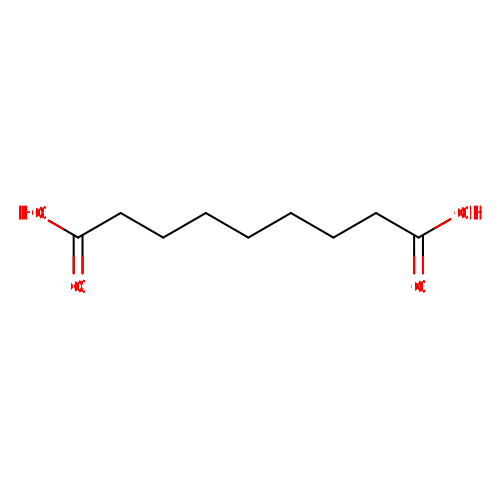
Structure for Azelaic acid (DB00548)
- Weight
- Average: 188.2209
Monoisotopic: 188.104859 - Chemical Formula
- C9H16O4
- Synonyms
- 1,7-dicarboxyheptane
- 1,7-Heptanedicarboxylic acid
- 1,9-nonanedioic acid
- Acide azélaïque
- Ácido azelaico
- Acidum acelaicum
- Acidum azelaicum
- Anchoic acid
- Azelaic acid
- Azelainsäure
- Lepargylic acid
- n-nonanedioic acid
- Nonandisäure
- Nonanedioic acid
- External IDs
- ZK 62498
- ZK-62498

Pharmacology
- Indication
For the topical treatment of mild-to-moderate inflammatory acne vulgaris.
 Reduce drug development failure ratesBuild, train, & validate machine-learning modelswith evidence-based and structured datasets.Build, train, & validate predictive machine-learning models with structured datasets.
- Associated Conditions
Indication Type Indication Combined Product Details Approval Level Age Group Patient Characteristics Dose Form Treatment of Acne vulgaris •••••••••••• ••••• Treatment of Inflammatory lesions caused by rosacea •••••••••••• •••••••• •••• Treatment of Inflammatory lesions caused by rosacea •••••••••••• ••• Treatment of Susceptible bacterial infections •••••••••••• ••••••• •••••• - Associated Therapies
- Contraindications & Blackbox Warnings
 Prevent Adverse Drug Events TodayTap into our Clinical API for life-saving information on contraindications & blackbox warnings, population restrictions, harmful risks, & more.Avoid life-threatening adverse drug events with our Clinical API
- Pharmacodynamics
Azelaic acid is a saturated dicarboxylic acid found naturally in wheat, rye, and barley. It is a natural substance that is produced by Malassezia furfur (also known as Pityrosporum ovale), a yeast that lives on normal skin. It is effective against a number of skin conditions, such as mild to moderate acne, when applied topically in a cream formulation of 20%. It works in part by stopping the growth of skin bacteria that cause acne, and by keeping skin pores clear. Azelaic acid's antimicrobial action may be attributable to inhibition of microbial cellular protein synthesis.
- Mechanism of action
The exact mechanism of action of azelaic acid is not known. It is thought that azelaic acid manifests its antibacterial effects by inhibiting the synthesis of cellular protein in anaerobic and aerobic bacteria, especially Staphylococcus epidermidis and Propionibacterium acnes. In aerobic bacteria, azelaic acid reversibly inhibits several oxidoreductive enzymes including tyrosinase, mitochondrial enzymes of the respiratory chain, thioredoxin reductase, 5-alpha-reductase, and DNA polymerases. In anaerobic bacteria, azelaic acid impedes glycolysis. Along with these actions, azelaic acid also improves acne vulgaris by normalizing the keratin process and decreasing microcomedo formation. Azelaic acid may be effective against both inflamed and noninflamed lesions. Specifically, azelaic acid reduces the thickness of the stratum corneum, shrinks keratohyalin granules by reducing the amount and distribution of filaggrin (a component of keratohyalin) in epidermal layers, and lowers the number of keratohyalin granules.
Target Actions Organism AThioredoxin reductase inhibitorStaphylococcus aureus (strain Mu50 / ATCC 700699) A3-oxo-5-beta-steroid 4-dehydrogenase inhibitorHumans A3-oxo-5-alpha-steroid 4-dehydrogenase 2 inhibitorHumans ATyrosinase inhibitorHumans ADNA polymerase I inhibitorEscherichia coli (strain K12) - Absorption
Approximately 4% of the topically applied azelaic acid is systemically absorbed.
- Volume of distribution
Not Available
- Protein binding
Not Available
- Metabolism
Mainly excreted unchanged in the urine but undergoes some b-oxidation to shorter chain dicarboxylic acids.
- Route of elimination
Azelaic acid is mainly excreted unchanged in the urine, but undergoes some ß-oxidation to shorter chain dicarboxylic acids.
- Half-life
The observed half-lives in healthy subjects are approximately 45 minutes after oral dosing and 12 hours after topical dosing, indicating percutaneous absorption rate-limited kinetics.
- Clearance
Not Available
- Adverse Effects
 Improve decision support & research outcomesWith structured adverse effects data, including: blackbox warnings, adverse reactions, warning & precautions, & incidence rates. View sample adverse effects data in our new Data Library!Improve decision support & research outcomes with our structured adverse effects data.
- Toxicity
Oral LD50 in rat: >5 g/kg
- Pathways
- Not Available
- Pharmacogenomic Effects/ADRs
- Not Available
Interactions
- Drug Interactions
- This information should not be interpreted without the help of a healthcare provider. If you believe you are experiencing an interaction, contact a healthcare provider immediately. The absence of an interaction does not necessarily mean no interactions exist.
Drug Interaction Integrate drug-drug
interactions in your softwareAbacavir Azelaic acid may decrease the excretion rate of Abacavir which could result in a higher serum level. Aceclofenac Aceclofenac may decrease the excretion rate of Azelaic acid which could result in a higher serum level. Acemetacin Acemetacin may decrease the excretion rate of Azelaic acid which could result in a higher serum level. Acetaminophen Acetaminophen may decrease the excretion rate of Azelaic acid which could result in a higher serum level. Acetazolamide Acetazolamide may increase the excretion rate of Azelaic acid which could result in a lower serum level and potentially a reduction in efficacy. - Food Interactions
- Avoid alcohol. Alcohol may cause flushing; therefore, it may worsen rosacea.
- Take with or without food. Food and drink, which have a high temperature or are spicy, may exacerbate flushing and rosacea, avoid if possible.
Products
 Drug product information from 10+ global regionsOur datasets provide approved product information including:dosage, form, labeller, route of administration, and marketing period.Access drug product information from over 10 global regions.
- International/Other Brands
- Acne-Derm (Unia) / Acnean (Newai Chem) / Acnederm (Ego) / Acnesafe (Z-Jans Pharma) / Aknoren (Herbacos Recordati) / Ami (Everest) / Arbonid (Intermed) / Finevin (Berlex) / Skinoren (Bayer) / Zumilin (Farmedia)
- Brand Name Prescription Products
Name Dosage Strength Route Labeller Marketing Start Marketing End Region Image Azelex Cream 0.2 g/1g Cutaneous Almirall, LLC 2018-09-24 Not applicable US 
Azelex Cream 0.2 g/1g Cutaneous Physicians Total Care, Inc. 2007-05-31 Not applicable US Azelex Cream 0.2 g/1g Cutaneous Allergan, Inc. 1996-03-21 Not applicable US Finacea Gel 0.15 g/1g Topical Physicians Total Care, Inc. 2005-03-03 Not applicable US Finacea Gel 0.15 g/1g Topical A-S Medication Solutions 2002-12-24 Not applicable US - Generic Prescription Products
Name Dosage Strength Route Labeller Marketing Start Marketing End Region Image Azelaic Acid Gel 0.15 g/1g Topical Actavis Pharma, Inc. 2018-11-19 Not applicable US Azelaic Acid Gel 0.15 g/1g Topical Alvogen, Inc. 2015-07-08 2018-04-27 US Azelaic Acid Gel 0.15 g/1g Topical Amneal Pharmaceuticals of New York Llc 2018-11-19 Not applicable US Azelaic Acid Gel 0.15 g/1g Topical Taro Pharmaceuticals U.S.A., Inc. 2019-08-23 Not applicable US Azelaic Acid Gel 0.15 g/1g Topical Glenmark Pharmaceuticals Inc., USA 2018-11-19 Not applicable US - Over the Counter Products
Name Dosage Strength Route Labeller Marketing Start Marketing End Region Image ELCURE AC-LEX Serum Liquid 2.5 g/50mL Topical Elcure Co., Ltd. 2011-11-24 2017-04-20 US - Mixture Products
Name Ingredients Dosage Route Labeller Marketing Start Marketing End Region Image 2% Salicylic Acid FACIAL CLEANSER Azelaic acid (10 mg/236mL) + Glycerin (50 mg/236mL) + Kaolin (20 mg/236mL) + Zinc pidolate (10 mg/236mL) + Salicylic acid (20 mg/236mL) Liquid Topical Volans Epic LLC 2023-04-06 Not applicable US AnubisMed Azelaic acid (7 g/50mL) + Ethanol (22.68 mL/50mL) + Isopropyl alcohol (2.7 g/50mL) + Polyethylene glycol 400 (4.9965 g/50mL) + Propylene glycol (10 g/50mL) + Salicylic acid (1 g/50mL) + Water (1.62 mL/50mL) Liquid Topical ANUBIS COSMETICS SL 2022-10-26 2027-09-08 US FIXAMICIN DEXACIPRO GOTAS OTICAS Azelaic acid (3 mg) + Dexamethasone (1 mg) Suspension Auricular (otic) TECNOFAR TQ S.A.S 2009-05-18 Not applicable Colombia 
- Unapproved/Other Products
Name Ingredients Dosage Route Labeller Marketing Start Marketing End Region Image Azelaic Acid 15% / Niacinamide 4% Azelaic acid (15 g/100g) + Nicotinamide (4 g/100g) Cream Topical Sincerus Florida, LLC 2019-05-01 Not applicable US ELCURE AC-LEX Serum Azelaic acid (2.5 g/50mL) Liquid Topical Elcure Co., Ltd. 2011-11-24 2017-04-20 US Tri-Zel Azelaic acid (5 mg/1) + Cupric oxide (1.5 mg/1) + Folic acid (500 ug/1) + Nicotinamide (600 mg/1) + Pyridoxine (5 mg/1) + Zinc oxide (10 mg/1) Tablet Oral Rochester Pharmaceuticals 2012-09-10 2014-03-06 US Vp-zel Azelaic acid (5 mg/1) + Cupric oxide (1.5 mg/1) + Folic acid (500 ug/1) + Nicotinamide (600 mg/1) + Pyridoxine (5 mg/1) + Zinc (10 mg/1) Tablet, coated Oral Virtus Pharmaceuticals 2012-03-01 2016-09-30 US
Categories
- ATC Codes
- D10AX03 — Azelaic acid
- Drug Categories
- Chemical TaxonomyProvided by Classyfire
- Description
- This compound belongs to the class of organic compounds known as medium-chain fatty acids. These are fatty acids with an aliphatic tail that contains between 4 and 12 carbon atoms.
- Kingdom
- Organic compounds
- Super Class
- Lipids and lipid-like molecules
- Class
- Fatty Acyls
- Sub Class
- Fatty acids and conjugates
- Direct Parent
- Medium-chain fatty acids
- Alternative Parents
- Dicarboxylic acids and derivatives / Carboxylic acids / Organic oxides / Hydrocarbon derivatives / Carbonyl compounds
- Substituents
- Aliphatic acyclic compound / Carbonyl group / Carboxylic acid / Carboxylic acid derivative / Dicarboxylic acid or derivatives / Hydrocarbon derivative / Medium-chain fatty acid / Organic oxide / Organic oxygen compound / Organooxygen compound
- Molecular Framework
- Aliphatic acyclic compounds
- External Descriptors
- alpha,omega-dicarboxylic acid (CHEBI:48131) / Dicarboxylic acids (C08261) / Dicarboxylic acids (LMFA01170054)
- Affected organisms
- Various aerobic and anaerobic microorganisms
Chemical Identifiers
- UNII
- F2VW3D43YT
- CAS number
- 123-99-9
- InChI Key
- BDJRBEYXGGNYIS-UHFFFAOYSA-N
- InChI
- InChI=1S/C9H16O4/c10-8(11)6-4-2-1-3-5-7-9(12)13/h1-7H2,(H,10,11)(H,12,13)
- IUPAC Name
- nonanedioic acid
- SMILES
- OC(=O)CCCCCCCC(O)=O
References
- Synthesis Reference
Abdul Malek, Clevys J. Monasterios, G. Ronald Brown, Ved P. Gupta, "Two step oxidation process for the production of carboxylic acids such as azelaic acid from unsaturated substrates." U.S. Patent US5380928, issued October, 1981.
US5380928- General References
- Not Available
- External Links
- Human Metabolome Database
- HMDB0000784
- KEGG Drug
- D03034
- KEGG Compound
- C08261
- PubChem Compound
- 2266
- PubChem Substance
- 46506284
- ChemSpider
- 2179
- 18602
- ChEBI
- 48131
- ChEMBL
- CHEMBL1238
- ZINC
- ZINC000001531036
- Therapeutic Targets Database
- DAP000889
- PharmGKB
- PA164754850
- PDBe Ligand
- AZ1
- RxList
- RxList Drug Page
- Drugs.com
- Drugs.com Drug Page
- PDRhealth
- PDRhealth Drug Page
- Wikipedia
- Azelaic_acid
- PDB Entries
- 1tuf / 5izf / 7oow
- FDA label
- Download (389 KB)
- MSDS
- Download (72.9 KB)
Clinical Trials
- Clinical Trials
Phase Status Purpose Conditions Count 4 Completed Basic Science Rosacea 1 4 Completed Treatment Acne Vulgaris 2 4 Completed Treatment Acne Vulgaris / Postinflammatory Hyperpigmentation 1 4 Completed Treatment Dermal manifestations 2 4 Completed Treatment Papulopustular Rosacea (PPR) 3
Pharmacoeconomics
- Manufacturers
- Allergan inc
- Intendis inc
- Packagers
- Allergan Inc.
- Bayer Healthcare
- Intendis Inc.
- Physicians Total Care Inc.
- Professional Co.
- Dosage Forms
Form Route Strength Cream Topical Liquid Topical Cream 20 % Lotion Cutaneous Cream Topical Gel Topical Cream Cutaneous 0.2 g/1g Tablet, film coated Oral 500 mg Tablet, coated Oral 500 mg Tablet Oral 250 mg Tablet Oral 500 mg Tablet, film coated Oral 250 mg Cream Topical 20 g Liquid Topical 2.5 g/50mL Gel Cutaneous 15.000 g Gel Topical 0.15 g/1g Gel Topical 15 % w/w Gel Topical 15 % Kit Topical 0.15 g/1g Gel Topical 150 mg/g Aerosol, foam Topical .15 g/1g Gel Topical 15 g Suspension Auricular (otic) Solution Auricular (otic) Tablet, coated Oral 250 mg Cream Topical 20 % Cream Cutaneous Cream Topical 20 g/100g Tablet Oral Tablet, coated Oral Cream Cream Topical 20 %w/w - Prices
Unit description Cost Unit Azelex 20% Cream 50 gm Tube 262.74USD tube Azelex 20% Cream 30 gm Tube 181.32USD tube Finacea 15% Gel 50 gm Tube 162.28USD tube Finacea plus kit 143.15USD kit Azelex 20% cream 5.21USD g Finacea 15% gel 2.86USD g Azelaic acid flakes 1.05USD g DrugBank does not sell nor buy drugs. Pricing information is supplied for informational purposes only.- Patents
Patent Number Pediatric Extension Approved Expires (estimated) Region CA2311128 No 2008-01-29 2018-11-18 Canada 
US6730288 No 2004-05-04 2019-09-08 US US6534070 No 2003-03-18 2018-11-18 US US9211259 No 2015-12-15 2029-01-26 US US8435498 No 2013-05-07 2024-03-01 US US9265725 No 2016-02-23 2027-12-08 US US8900554 No 2014-12-02 2023-10-24 US US8722021 No 2014-05-13 2023-10-24 US US7700076 No 2010-04-20 2027-09-18 US US10117812 No 2018-11-06 2027-10-18 US US10322085 No 2019-06-18 2023-10-24 US
Properties
- State
- Solid
- Experimental Properties
Property Value Source melting point (°C) 106.5 °C PhysProp boiling point (°C) 286.5 °C at 1.00E+02 mm Hg PhysProp water solubility 2400 mg/L (at 20 °C) YALKOWSKY,SH & DANNENFELSER,RM (1992) logP 1.57 HANSCH,C ET AL. (1995) logS -1.89 ADME Research, USCD pKa 4.55 (at 25 °C) KORTUM,G ET AL (1961) - Predicted Properties
Property Value Source Water Solubility 2.28 mg/mL ALOGPS logP 1.37 ALOGPS logP 1.82 Chemaxon logS -1.9 ALOGPS pKa (Strongest Acidic) 4.15 Chemaxon Physiological Charge -2 Chemaxon Hydrogen Acceptor Count 4 Chemaxon Hydrogen Donor Count 2 Chemaxon Polar Surface Area 74.6 Å2 Chemaxon Rotatable Bond Count 8 Chemaxon Refractivity 46.54 m3·mol-1 Chemaxon Polarizability 20.5 Å3 Chemaxon Number of Rings 0 Chemaxon Bioavailability 1 Chemaxon Rule of Five Yes Chemaxon Ghose Filter Yes Chemaxon Veber's Rule No Chemaxon MDDR-like Rule No Chemaxon - Predicted ADMET Features
Property Value Probability Human Intestinal Absorption + 0.5731 Blood Brain Barrier + 0.7397 Caco-2 permeable - 0.6412 P-glycoprotein substrate Non-substrate 0.6969 P-glycoprotein inhibitor I Non-inhibitor 0.9845 P-glycoprotein inhibitor II Non-inhibitor 0.9229 Renal organic cation transporter Non-inhibitor 0.9359 CYP450 2C9 substrate Non-substrate 0.8447 CYP450 2D6 substrate Non-substrate 0.905 CYP450 3A4 substrate Non-substrate 0.7534 CYP450 1A2 substrate Non-inhibitor 0.9046 CYP450 2C9 inhibitor Non-inhibitor 0.939 CYP450 2D6 inhibitor Non-inhibitor 0.9729 CYP450 2C19 inhibitor Non-inhibitor 0.9762 CYP450 3A4 inhibitor Non-inhibitor 0.96 CYP450 inhibitory promiscuity Low CYP Inhibitory Promiscuity 0.9927 Ames test Non AMES toxic 0.9132 Carcinogenicity Non-carcinogens 0.8382 Biodegradation Ready biodegradable 0.8506 Rat acute toxicity 1.3577 LD50, mol/kg Not applicable hERG inhibition (predictor I) Weak inhibitor 0.9348 hERG inhibition (predictor II) Non-inhibitor 0.9602
Spectra
- Mass Spec (NIST)
- Download (10.6 KB)
- Spectra
- Chromatographic Properties
Collision Cross Sections (CCS)
Adduct CCS Value (Å2) Source type Source [M-H]- 149.0660438 predictedDarkChem Lite v0.1.0 [M-H]- 134.744286 predictedDarkChem Lite v0.1.0 [M-H]- 148.9474438 predictedDarkChem Lite v0.1.0 [M-H]- 138.19588 predictedDeepCCS 1.0 (2019) [M+H]+ 141.96379 predictedDeepCCS 1.0 (2019) [M+Na]+ 150.78783 predictedDeepCCS 1.0 (2019)
Targets

- Kind
- Protein
- Organism
- Staphylococcus aureus (strain Mu50 / ATCC 700699)
- Pharmacological action
- Yes
- Actions
- Inhibitor
- General Function
- Thioredoxin-disulfide reductase activity
- Specific Function
- Not Available
- Gene Name
- trxB
- Uniprot ID
- P66010
- Uniprot Name
- Thioredoxin reductase
- Molecular Weight
- 33615.84 Da
References
- Overington JP, Al-Lazikani B, Hopkins AL: How many drug targets are there? Nat Rev Drug Discov. 2006 Dec;5(12):993-6. [Article]
- Imming P, Sinning C, Meyer A: Drugs, their targets and the nature and number of drug targets. Nat Rev Drug Discov. 2006 Oct;5(10):821-34. [Article]
- Schallreuter KU, Wood JM: Azelaic acid as a competitive inhibitor of thioredoxin reductase in human melanoma cells. Cancer Lett. 1987 Sep;36(3):297-305. [Article]
- Hojo Y, Saito Y, Tanimoto T, Hoefen RJ, Baines CP, Yamamoto K, Haendeler J, Asmis R, Berk BC: Fluid shear stress attenuates hydrogen peroxide-induced c-Jun NH2-terminal kinase activation via a glutathione reductase-mediated mechanism. Circ Res. 2002 Oct 18;91(8):712-8. [Article]
- Schallreuter KU, Wood JW: A possible mechanism of action for azelaic acid in the human epidermis. Arch Dermatol Res. 1990;282(3):168-71. [Article]
- Kind
- Protein
- Organism
- Humans
- Pharmacological action
- Yes
- Actions
- Inhibitor
- General Function
- Steroid binding
- Specific Function
- Efficiently catalyzes the reduction of progesterone, androstenedione, 17-alpha-hydroxyprogesterone and testosterone to 5-beta-reduced metabolites. The bile acid intermediates 7-alpha,12-alpha-dihyd...
- Gene Name
- AKR1D1
- Uniprot ID
- P51857
- Uniprot Name
- 3-oxo-5-beta-steroid 4-dehydrogenase
- Molecular Weight
- 37376.615 Da
References
- Stamatiadis D, Bulteau-Portois MC, Mowszowicz I: Inhibition of 5 alpha-reductase activity in human skin by zinc and azelaic acid. Br J Dermatol. 1988 Nov;119(5):627-32. [Article]
- Kind
- Protein
- Organism
- Humans
- Pharmacological action
- Yes
- Actions
- Inhibitor
- General Function
- Sterol 5-alpha reductase activity
- Specific Function
- Converts testosterone (T) into 5-alpha-dihydrotestosterone (DHT) and progesterone or corticosterone into their corresponding 5-alpha-3-oxosteroids. It plays a central role in sexual differentiation...
- Gene Name
- SRD5A2
- Uniprot ID
- P31213
- Uniprot Name
- 3-oxo-5-alpha-steroid 4-dehydrogenase 2
- Molecular Weight
- 28393.015 Da
References
- Overington JP, Al-Lazikani B, Hopkins AL: How many drug targets are there? Nat Rev Drug Discov. 2006 Dec;5(12):993-6. [Article]
- Imming P, Sinning C, Meyer A: Drugs, their targets and the nature and number of drug targets. Nat Rev Drug Discov. 2006 Oct;5(10):821-34. [Article]
- Stamatiadis D, Bulteau-Portois MC, Mowszowicz I: Inhibition of 5 alpha-reductase activity in human skin by zinc and azelaic acid. Br J Dermatol. 1988 Nov;119(5):627-32. [Article]
- Kind
- Protein
- Organism
- Humans
- Pharmacological action
- Yes
- Actions
- Inhibitor
- General Function
- Protein homodimerization activity
- Specific Function
- This is a copper-containing oxidase that functions in the formation of pigments such as melanins and other polyphenolic compounds. Catalyzes the rate-limiting conversions of tyrosine to DOPA, DOPA ...
- Gene Name
- TYR
- Uniprot ID
- P14679
- Uniprot Name
- Tyrosinase
- Molecular Weight
- 60392.69 Da
References
- Schallreuter KU, Wood JW: A possible mechanism of action for azelaic acid in the human epidermis. Arch Dermatol Res. 1990;282(3):168-71. [Article]
- Nazzaro-Porro M: Azelaic acid. J Am Acad Dermatol. 1987 Dec;17(6):1033-41. [Article]
- Picardo M, Passi S, Sirianni MC, Fiorilli M, Russo GD, Cortesi E, Barile G, Breathnach AS, Nazzaro-Porro M: Activity of azelaic acid on cultures of lymphoma- and leukemia-derived cell lines, normal resting and stimulated lymphocytes and 3T3 fibroblasts. Biochem Pharmacol. 1985 May 15;34(10):1653-8. [Article]
- Nazzaro-Porro M, Passi S, Balus L, Breathnach A, Martin B, Morpurgo G: Effect of dicarboxylic acids on lentigo maligna. J Invest Dermatol. 1979 Jun;72(6):296-305. [Article]
- Kind
- Protein
- Organism
- Escherichia coli (strain K12)
- Pharmacological action
- Yes
- Actions
- Inhibitor
- General Function
- Dna-directed dna polymerase activity
- Specific Function
- In addition to polymerase activity, this DNA polymerase exhibits 3' to 5' and 5' to 3' exonuclease activity. It is able to utilize nicked circular duplex DNA as a template and can unwind the parent...
- Gene Name
- polA
- Uniprot ID
- P00582
- Uniprot Name
- DNA polymerase I
- Molecular Weight
- 103117.145 Da
References
- Overington JP, Al-Lazikani B, Hopkins AL: How many drug targets are there? Nat Rev Drug Discov. 2006 Dec;5(12):993-6. [Article]
- Imming P, Sinning C, Meyer A: Drugs, their targets and the nature and number of drug targets. Nat Rev Drug Discov. 2006 Oct;5(10):821-34. [Article]
- Galhaup I: Azelaic acid: mode of action at cellular and subcellular levels. Acta Derm Venereol Suppl (Stockh). 1989;143:75-82. [Article]


Drug created at June 13, 2005 13:24 / Updated at April 18, 2024 09:15