Identification
- Summary
Acetohydroxamic acid is a synthetic urea derivative used to treat urea splitting bacterial infections of the urinary tract.
- Brand Names
- Lithostat
- Generic Name
- Acetohydroxamic acid
- DrugBank Accession Number
- DB00551
- Background
Acetohydroxamic Acid, a synthetic drug derived from hydroxylamine and ethyl acetate, is similar in structure to urea. In the urine, it acts as an antagonist of the bacterial enzyme urease. Acetohydroxamic Acid has no direct antimicrobial action and does not acidify urine directly. It is used, in addition to antibiotics or medical procedures, to treat chronic urea-splitting urinary infections.
- Type
- Small Molecule
- Groups
- Approved
- Structure
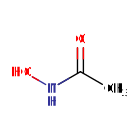
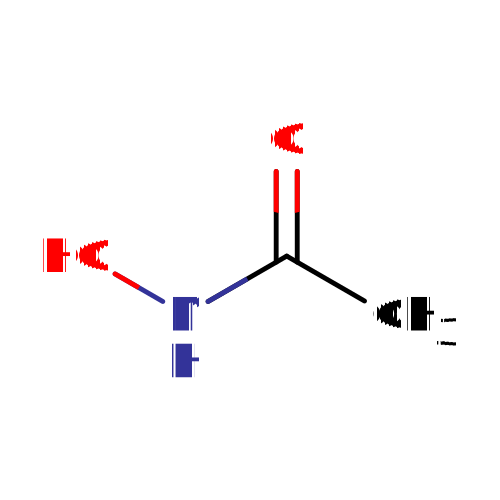
Structure for Acetohydroxamic acid (DB00551)
- Weight
- Average: 75.0666
Monoisotopic: 75.032028409 - Chemical Formula
- C2H5NO2
- Synonyms
- Acethydroxamsaeure
- Acetic acid, oxime
- Acetohydroxamate
- Acetohydroxamic acid
- Acetohydroximic acid
- Acetyl hydroxyamino
- Acetylhydroxamic acid
- Acide acetohydroxamique
- Acido acetohidroxamico
- Acidum acetohydroxamicum
- AHA
- Cetohyroxamic acid
- Methylhydroxamic acid
- N-Acetyl hydroxyacetamide
- N-Acetylhydroxylamine
- N-Hydroxyacetamide

Pharmacology
- Indication
Used, in addition to antibiotics or medical procedures, to treat chronic urea-splitting urinary infections.
 Reduce drug development failure ratesBuild, train, & validate machine-learning modelswith evidence-based and structured datasets.Build, train, & validate predictive machine-learning models with structured datasets.
- Associated Conditions
Indication Type Indication Combined Product Details Approval Level Age Group Patient Characteristics Dose Form Adjunct therapy in treatment of Chronic urea-splitting urinary infection •••••••••••• - Contraindications & Blackbox Warnings
 Prevent Adverse Drug Events TodayTap into our Clinical API for life-saving information on contraindications & blackbox warnings, population restrictions, harmful risks, & more.Avoid life-threatening adverse drug events with our Clinical API
- Pharmacodynamics
Acetohydroxamic Acid, a synthetic drug derived from hydroxylamine and ethyl acetate, is similar in structure to urea. In the urine, it acts as an antagonist of the bacterial enzyme urease. Acetohydroxamic Acid has no direct antimicrobial action and does not acidify urine directly.
- Mechanism of action
Acetohydroxamic Acid reversibly inhibits the bacterial enzyme urease. This inhibits the hydrolysis of urea and production of ammonia in urine infected with urea-splitting organisms, leading to a decrease in pH and ammonia levels. As antimicrobial agents are more effective in such conditions, the effectiveness of these agents is amplified, resulting in a higher cure rate.
Target Actions Organism AUrease subunit alpha inhibitorEnterobacter aerogenes UMacrophage metalloelastase inhibitorHumans - Absorption
Well absorbed from the GI tract following oral administration.
- Volume of distribution
Not Available
- Protein binding
No known binding
- Metabolism
35-65% of oral dose excreted unchanged in urine (which provides the drug's therapeutic effect).
- Route of elimination
Not Available
- Half-life
5-10 hours in patients with normal renal function
- Clearance
Not Available
- Adverse Effects
 Improve decision support & research outcomesWith structured adverse effects data, including: blackbox warnings, adverse reactions, warning & precautions, & incidence rates. View sample adverse effects data in our new Data Library!Improve decision support & research outcomes with our structured adverse effects data.
- Toxicity
Oral, rat: LD50 = 4.8gm/kg. Symptoms of overdose include anorexia, malaise, lethargy, diminished sense of wellbeing, tremor, anxiety, nausea, and vomiting.
- Pathways
- Not Available
- Pharmacogenomic Effects/ADRs
- Not Available
Interactions
- Drug Interactions
- This information should not be interpreted without the help of a healthcare provider. If you believe you are experiencing an interaction, contact a healthcare provider immediately. The absence of an interaction does not necessarily mean no interactions exist.
Drug Interaction Integrate drug-drug
interactions in your softwareEthanol The risk or severity of rash can be increased when Ethanol is combined with Acetohydroxamic acid. - Food Interactions
- Avoid alcohol. Concomitant use of acetohydroxamic acid with alcohol may cause a rash.
- Avoid iron supplements. Acetohydroxamic acid chelates iron, therefore oral supplementation of iron will reduce levels of both iron and acetohydroxamic acid.
- Take on an empty stomach.
Products
 Drug product information from 10+ global regionsOur datasets provide approved product information including:dosage, form, labeller, route of administration, and marketing period.Access drug product information from over 10 global regions.
- Brand Name Prescription Products
Name Dosage Strength Route Labeller Marketing Start Marketing End Region Image Lithostat Tablet 250 mg/1 Oral Mission Pharmacal Company 1983-05-31 Not applicable US 
Categories
- ATC Codes
- G04BX03 — Acetohydroxamic acid
- Drug Categories
- Chemical TaxonomyProvided by Classyfire
- Description
- This compound belongs to the class of organic compounds known as acetohydroxamic acids. These are organic compounds that contain a hydroxamic acid group carrying a methyl group attached to its carbon center.
- Kingdom
- Organic compounds
- Super Class
- Organic acids and derivatives
- Class
- Carboxylic acids and derivatives
- Sub Class
- Carboxylic acid derivatives
- Direct Parent
- Acetohydroxamic acids
- Alternative Parents
- Acetamides / Organopnictogen compounds / Organonitrogen compounds / Organic oxides / Hydrocarbon derivatives / Carbonyl compounds
- Substituents
- Acetamide / Acetohydroxamic acid / Aliphatic acyclic compound / Carbonyl group / Hydrocarbon derivative / Organic nitrogen compound / Organic oxide / Organic oxygen compound / Organonitrogen compound / Organooxygen compound
- Molecular Framework
- Aliphatic acyclic compounds
- External Descriptors
- carbohydroximic acid (CHEBI:49029)
- Affected organisms
- Enteric bacteria and other eubacteria
Chemical Identifiers
- UNII
- 4RZ82L2GY5
- CAS number
- 546-88-3
- InChI Key
- RRUDCFGSUDOHDG-UHFFFAOYSA-N
- InChI
- InChI=1S/C2H5NO2/c1-2(4)3-5/h5H,1H3,(H,3,4)
- IUPAC Name
- N-hydroxyacetamide
- SMILES
- CC(=O)NO
References
- Synthesis Reference
Teresio Tamietto, "Process for the preparation of an indole-3-acetohydroxamic acid." U.S. Patent US4186133, issued November, 1971.
US4186133- General References
- Link [Link]
- External Links
- Human Metabolome Database
- HMDB0014691
- KEGG Drug
- D00220
- KEGG Compound
- C06808
- PubChem Compound
- 1990
- PubChem Substance
- 46508546
- ChemSpider
- 1913
- BindingDB
- 50099857
- 16728
- ChEBI
- 49029
- ChEMBL
- CHEMBL734
- ZINC
- ZINC000004658603
- Therapeutic Targets Database
- DAP001277
- PharmGKB
- PA164749213
- PDBe Ligand
- HAE
- Drugs.com
- Drugs.com Drug Page
- Wikipedia
- Acetohydroxamic_acid
- PDB Entries
- 1am6 / 1e9y / 1fwe / 1os2 / 1utt / 1utz / 1y93 / 2hu6 / 2ow9 / 2ozr … show 17 more
- MSDS
- Download (74 KB)
Clinical Trials
- Clinical Trials
Phase Status Purpose Conditions Count 1, 2 Not Yet Recruiting Treatment Argininosuccinate Synthetase Deficiency (Citrullinemia) / Argininosuccinic Aciduria / Carbamyl-Phosphate Synthase I Deficiency / Ornithine Transcarbamylase Deficiency 1 1, 2 Terminated Treatment Disorders of urea cycle metabolism 1
Pharmacoeconomics
- Manufacturers
- Mission pharmacal co
- Packagers
- Mission Pharmacal
- Dosage Forms
Form Route Strength Solution Auricular (otic) 3 mg Solution Parenteral 200 mg Injection Intravenous 0.1 g Solution Parenteral 100 mg Solution Parenteral 10 mg Solution Intravenous 10 mg Solution Intravenous 100 mg Tablet Oral 250 mg/1 Solution Intravenous 200 mg - Prices
Unit description Cost Unit Lithostat 250 mg tablet 1.66USD tablet DrugBank does not sell nor buy drugs. Pricing information is supplied for informational purposes only.- Patents
- Not Available
Properties
- State
- Solid
- Experimental Properties
Property Value Source melting point (°C) 90.5 °C PhysProp water solubility 1E+006 mg/L Not Available logP -1.59 HANSCH,C ET AL. (1995) pKa 8.7 (at 25 °C) SERJEANT,EP & DEMPSEY,B (1979) - Predicted Properties
Property Value Source Water Solubility 509.0 mg/mL ALOGPS logP -1.5 ALOGPS logP -1 Chemaxon logS 0.83 ALOGPS pKa (Strongest Acidic) 8.94 Chemaxon pKa (Strongest Basic) -5.4 Chemaxon Physiological Charge 0 Chemaxon Hydrogen Acceptor Count 2 Chemaxon Hydrogen Donor Count 2 Chemaxon Polar Surface Area 49.33 Å2 Chemaxon Rotatable Bond Count 0 Chemaxon Refractivity 16.23 m3·mol-1 Chemaxon Polarizability 6.6 Å3 Chemaxon Number of Rings 0 Chemaxon Bioavailability 1 Chemaxon Rule of Five Yes Chemaxon Ghose Filter No Chemaxon Veber's Rule No Chemaxon MDDR-like Rule No Chemaxon - Predicted ADMET Features
Property Value Probability Human Intestinal Absorption + 0.9856 Blood Brain Barrier + 0.9906 Caco-2 permeable - 0.5723 P-glycoprotein substrate Non-substrate 0.8815 P-glycoprotein inhibitor I Non-inhibitor 0.9466 P-glycoprotein inhibitor II Non-inhibitor 0.9824 Renal organic cation transporter Non-inhibitor 0.9583 CYP450 2C9 substrate Non-substrate 0.8167 CYP450 2D6 substrate Non-substrate 0.8386 CYP450 3A4 substrate Non-substrate 0.6646 CYP450 1A2 substrate Non-inhibitor 0.912 CYP450 2C9 inhibitor Non-inhibitor 0.9364 CYP450 2D6 inhibitor Non-inhibitor 0.91 CYP450 2C19 inhibitor Non-inhibitor 0.9083 CYP450 3A4 inhibitor Non-inhibitor 0.9757 CYP450 inhibitory promiscuity Low CYP Inhibitory Promiscuity 0.9735 Ames test AMES toxic 0.9108 Carcinogenicity Carcinogens 0.5892 Biodegradation Not ready biodegradable 0.6152 Rat acute toxicity 1.5791 LD50, mol/kg Not applicable hERG inhibition (predictor I) Weak inhibitor 0.9935 hERG inhibition (predictor II) Non-inhibitor 0.9644
Spectra
- Mass Spec (NIST)
- Download (7.83 KB)
- Spectra
Spectrum Spectrum Type Splash Key Predicted GC-MS Spectrum - GC-MS Predicted GC-MS splash10-0006-9000000000-09c5ca2b46a7bf5a4209 Predicted MS/MS Spectrum - 10V, Positive (Annotated) Predicted LC-MS/MS splash10-056r-9000000000-da71cd9dae37df978687 Predicted MS/MS Spectrum - 20V, Positive (Annotated) Predicted LC-MS/MS splash10-0a6u-9000000000-39e7c214400a505d8140 Predicted MS/MS Spectrum - 10V, Negative (Annotated) Predicted LC-MS/MS splash10-00di-9000000000-6ed9a3c3cfad9fecb23a Predicted MS/MS Spectrum - 40V, Positive (Annotated) Predicted LC-MS/MS splash10-0006-9000000000-bc1b7bdf53b2b576fa44 Predicted MS/MS Spectrum - 20V, Negative (Annotated) Predicted LC-MS/MS splash10-052f-9000000000-71bf318ca117c12681dc Predicted MS/MS Spectrum - 40V, Negative (Annotated) Predicted LC-MS/MS splash10-0006-9000000000-ff836be4e7bbe91123b6 Predicted 1H NMR Spectrum 1D NMR Not Applicable Predicted 13C NMR Spectrum 1D NMR Not Applicable - Chromatographic Properties
Collision Cross Sections (CCS)
Adduct CCS Value (Å2) Source type Source [M-H]- 102.4001112 predictedDarkChem Lite v0.1.0 [M-H]- 102.4157112 predictedDarkChem Lite v0.1.0 [M-H]- 115.6781 predictedDeepCCS 1.0 (2019) [M+H]+ 103.2819112 predictedDarkChem Lite v0.1.0 [M+H]+ 103.6295112 predictedDarkChem Lite v0.1.0 [M+H]+ 117.55885 predictedDeepCCS 1.0 (2019) [M+Na]+ 102.8455112 predictedDarkChem Lite v0.1.0 [M+Na]+ 124.95042 predictedDeepCCS 1.0 (2019)
Targets

- Kind
- Protein
- Organism
- Enterobacter aerogenes
- Pharmacological action
- Yes
- Actions
- Inhibitor
- General Function
- Urease activity
- Specific Function
- Not Available
- Gene Name
- ureC
- Uniprot ID
- P18314
- Uniprot Name
- Urease subunit alpha
- Molecular Weight
- 60304.12 Da
References
- Overington JP, Al-Lazikani B, Hopkins AL: How many drug targets are there? Nat Rev Drug Discov. 2006 Dec;5(12):993-6. [Article]
- Imming P, Sinning C, Meyer A: Drugs, their targets and the nature and number of drug targets. Nat Rev Drug Discov. 2006 Oct;5(10):821-34. [Article]
- Palinska KA, Jahns T, Rippka R, Tandeau De Marsac N: Prochlorococcus marinus strain PCC 9511, a picoplanktonic cyanobacterium, synthesizes the smallest urease. Microbiology. 2000 Dec;146 Pt 12:3099-107. [Article]
- Chen X, Ji ZL, Chen YZ: TTD: Therapeutic Target Database. Nucleic Acids Res. 2002 Jan 1;30(1):412-5. [Article]
- Kind
- Protein
- Organism
- Humans
- Pharmacological action
- Unknown
- Actions
- Inhibitor
- General Function
- Zinc ion binding
- Specific Function
- May be involved in tissue injury and remodeling. Has significant elastolytic activity. Can accept large and small amino acids at the P1' site, but has a preference for leucine. Aromatic or hydropho...
- Gene Name
- MMP12
- Uniprot ID
- P39900
- Uniprot Name
- Macrophage metalloelastase
- Molecular Weight
- 54001.175 Da
References
- Mannino C, Nievo M, Machetti F, Papakyriakou A, Calderone V, Fragai M, Guarna A: Synthesis of bicyclic molecular scaffolds (BTAa): an investigation towards new selective MMP-12 inhibitors. Bioorg Med Chem. 2006 Nov 15;14(22):7392-403. Epub 2006 Aug 8. [Article]
- Bertini I, Calderone V, Cosenza M, Fragai M, Lee YM, Luchinat C, Mangani S, Terni B, Turano P: Conformational variability of matrix metalloproteinases: beyond a single 3D structure. Proc Natl Acad Sci U S A. 2005 Apr 12;102(15):5334-9. Epub 2005 Apr 4. [Article]
- Bertini I, Calderone V, Fragai M, Giachetti A, Loconte M, Luchinat C, Maletta M, Nativi C, Yeo KJ: Exploring the subtleties of drug-receptor interactions: the case of matrix metalloproteinases. J Am Chem Soc. 2007 Mar 7;129(9):2466-75. Epub 2007 Feb 2. [Article]
- Fukuda M, Peppas NA, McGinity JW: Floating hot-melt extruded tablets for gastroretentive controlled drug release system. J Control Release. 2006 Oct 10;115(2):121-9. Epub 2006 Jul 21. [Article]


Drug created at June 13, 2005 13:24 / Updated at April 09, 2024 18:14