Identification
- Summary
Tigecycline is a glycylcycline antibiotic used to treat a number of susceptible bacterial infections.
- Brand Names
- Tygacil
- Generic Name
- Tigecycline
- DrugBank Accession Number
- DB00560
- Background
Tigecycline is a glycylcycline antibiotic developed and marketed by Wyeth under the brand name Tygacil. It was developed in response to the growing prevalence of antibiotic resistance in bacteria such as Staphylococcus aureus. It was granted fast-track approval by the U.S. Food and Drug Administration (FDA) on June 17, 2005.
- Type
- Small Molecule
- Groups
- Approved
- Structure
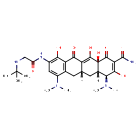
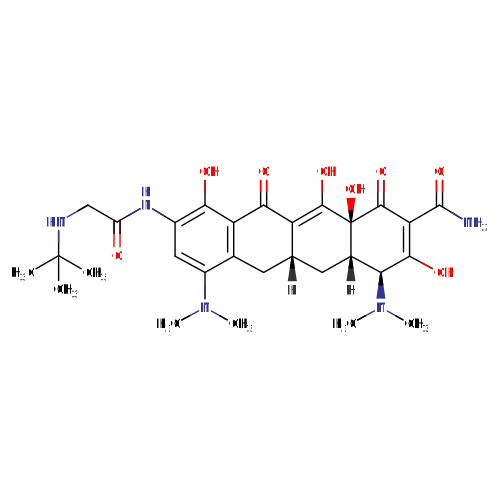
Structure for Tigecycline (DB00560)
- Weight
- Average: 585.6487
Monoisotopic: 585.279863249 - Chemical Formula
- C29H39N5O8
- Synonyms
- (4S,4aS,5aR,12aS)-9-(2-(tert-butylamino)acetamido)-4,7-bis(dimethylamino)-1,4,4a,5,5a,6,11,12a-octahydro-3,10,12,12a-tetrahydroxy-1,11-dioxo-2-naphthacenecarboxamide
- Tigeciclina
- Tigecycline
- Tigecyclinum
- External IDs
- CL-329998
- CL-331002
- DMG-DMDOT
- DMG-MINO
- GAR 936
- GAR-936
- TBG-MINO
- WAY-GAR-936

Pharmacology
- Indication
For the treatment of infections caused by susceptible strains of the designated microorganisms in the following conditions: Complicated skin and skin structure infections caused by Escherichia coli, Enterococcus faecalis (vancomycin-susceptible isolates only), Staphylococcus aureus (methicillin-susceptible and -resistant isolates), Streptococcus agalactiae, Streptococcus anginosus grp. (includes S. anginosus, S. intermedius, and S. constellatus), Streptococcus pyogenes and Bacteroides fragilis. Complicated intra-abdominal infections caused by Citrobacter freundii, Enterobacter cloacae, Escherichia coli, Klebsiella oxytoca, Klebsiella pneumoniae, Enterococcus faecalis (vancomycin-susceptible isolates only), Staphylococcus aureus (methicillin-susceptible isolates only), Streptococcus anginosus grp. (includes S. anginosus, S. intermedius, and S. constellatus), Bacteroides fragilis, Bacteroides thetaiotaomicron, Bacteroides uniformis, Bacteroides vulgatus, Clostridium perfringens, and Peptostreptococcus micros.
 Reduce drug development failure ratesBuild, train, & validate machine-learning modelswith evidence-based and structured datasets.Build, train, & validate predictive machine-learning models with structured datasets.
- Associated Conditions
Indication Type Indication Combined Product Details Approval Level Age Group Patient Characteristics Dose Form Treatment of Bacterial infections •••••••••••• Treatment of Community-acquired pneumonia •••••••••••• Treatment of Complicated intra-abdominal infections •••••••••••• Treatment of Complicated skin and skin structure infection •••••••••••• - Contraindications & Blackbox Warnings
 Prevent Adverse Drug Events TodayTap into our Clinical API for life-saving information on contraindications & blackbox warnings, population restrictions, harmful risks, & more.Avoid life-threatening adverse drug events with our Clinical API
- Pharmacodynamics
Tigecycline is the first clinically-available drug in a new class of antibiotics called the glycylcyclines. Glycylcyclines are a new class of antibiotics derived from tetracycline. These tetracycline analogues are specifically designed to overcome two common mechanisms of tetracycline resistance, namely resistance mediated by acquired efflux pumps and/or ribosomal protection. Glycylcycline antibiotics have a similar mechanism of action as tetracycline antibiotics. Both classes of antibiotics bind to the 30S ribosomal subunit to prevent the amino-acyl tRNA from binding to the A site of the ribosome. However, the glycylcyclines appear to bind more effectively than the tetracyclines.
- Mechanism of action
Tigecycline, a glycylcycline, inhibits protein translation in bacteria by binding to the 30S ribosomal subunit and blocking entry of amino-acyl tRNA molecules into the A site of the ribosome. This prevents incorporation of amino acid residues into elongating peptide chains. Tigecycline carries a glycylamido moiety attached to the 9-position of minocycline. The substitution pattern is not present in any naturally occurring or semisynthetic tetracycline and imparts certain microbiologic properties to tigecycline. Tigecycline is not affected by the two major tetracycline resistance mechanisms, ribosomal protection and efflux. Accordingly, tigecycline has demonstrated in vitro and in vivo activity against a broad spectrum of bacterial pathogens. There has been no cross resistance observed between tigecycline and other antibiotics. Tigecycline is not affected by resistance mechanisms such as beta-lactamases (including extended spectrum beta-lactamases), target site modifications, macrolide efflux pumps or enzyme target changes (e.g. gyrase/topoisomerase). In vitro studies have not demonstrated antagonism between tigecycline and other commonly used antibacterial drugs. In general, tigecycline is considered bacteriostatic.
Target Actions Organism A16S ribosomal RNA binderEnteric bacteria and other eubacteria A30S ribosomal protein S9 binderEscherichia coli (strain K12) A30S ribosomal protein S12 binderEscherichia coli (strain K12) A30S ribosomal protein S13 binderEscherichia coli (strain K12) A30S ribosomal protein S14 binderEscherichia coli (strain K12) A30S ribosomal protein S19 binderEscherichia coli (strain K12) - Absorption
Not Available
- Volume of distribution
Not Available
- Protein binding
71% to 89%
- Metabolism
Tigecycline is not extensively metabolized. In vitro studies with tigecycline using human liver microsomes, liver slices, and hepatocytes led to the formation of only trace amounts of metabolites. A glucuronide, an N-acetyl metabolite, and a tigecycline epimer (each at no more than 10% of the administered dose) are the primary metabolites.
- Route of elimination
Not Available
- Half-life
27-43 hours
- Clearance
Not Available
- Adverse Effects
 Improve decision support & research outcomesWith structured adverse effects data, including: blackbox warnings, adverse reactions, warning & precautions, & incidence rates. View sample adverse effects data in our new Data Library!Improve decision support & research outcomes with our structured adverse effects data.
- Toxicity
Since glycylcyclines are similar to tetracyclines, they share many of the same side effects and contraindications as tetracyclines. These side effects may include nausea/vomiting, headache, photosensitivity, discoloration of growing teeth, and fetal damage.
- Pathways
Pathway Category Tigecycline Action Pathway Drug action - Pharmacogenomic Effects/ADRs
- Not Available
Interactions
- Drug Interactions
- This information should not be interpreted without the help of a healthcare provider. If you believe you are experiencing an interaction, contact a healthcare provider immediately. The absence of an interaction does not necessarily mean no interactions exist.
Drug Interaction Integrate drug-drug
interactions in your softwareAcenocoumarol The serum concentration of Acenocoumarol can be increased when it is combined with Tigecycline. Acitretin The risk or severity of pseudotumor cerebri can be increased when Acitretin is combined with Tigecycline. Alitretinoin The risk or severity of pseudotumor cerebri can be increased when Alitretinoin is combined with Tigecycline. Ambroxol The risk or severity of methemoglobinemia can be increased when Tigecycline is combined with Ambroxol. Amoxicillin The therapeutic efficacy of Amoxicillin can be decreased when used in combination with Tigecycline. - Food Interactions
- No interactions found.
Products
 Drug product information from 10+ global regionsOur datasets provide approved product information including:dosage, form, labeller, route of administration, and marketing period.Access drug product information from over 10 global regions.
- Brand Name Prescription Products
Name Dosage Strength Route Labeller Marketing Start Marketing End Region Image Tigecycline Injection, powder, lyophilized, for solution 50 mg/5mL Intravenous Amneal Pharmaceuticals LLC 2018-01-31 Not applicable US 
Tigecycline Powder, for solution 50 mg / vial Intravenous Apotex Corporation 2014-10-23 Not applicable Canada 
Tigecycline Injection, powder, lyophilized, for solution 50 mg/5mL Intravenous Fresenius Kabi USA, LLC 2016-12-01 Not applicable US Tigecycline Injection, powder, lyophilized, for solution 50 mg/10mL Intravenous Accord Healthcare Inc. 2019-03-28 Not applicable US Tigecycline Accord Injection, powder, for solution 50 mg Intravenous Accord Healthcare S.L.U. 2020-12-16 Not applicable EU 
- Generic Prescription Products
Name Dosage Strength Route Labeller Marketing Start Marketing End Region Image Tigecycline Injection, powder, lyophilized, for solution 50 mg/10mL Intravenous; Parenteral Sandoz Inc 2017-11-30 Not applicable US Tigecycline Injection, powder, lyophilized, for solution 50 mg/1 Intravenous Xellia Pharmaceuticals USA LLC 2020-02-01 Not applicable US Tigecycline Injection, powder, lyophilized, for solution 50 mg/1 Intravenous AuroMedics Pharma LLC 2019-06-11 Not applicable US Tigecycline Injection, powder, lyophilized, for solution 50 mg/5mL Intravenous Meitheal Pharmaceuticals Inc. 2021-05-13 Not applicable US Tigecycline Injection, powder, lyophilized, for solution 50 mg/5mL Intravenous Apotex Corp 2019-04-09 Not applicable US
Categories
- ATC Codes
- J01AA20 — Combinations of tetracyclines
- J01AA — Tetracyclines
- J01A — TETRACYCLINES
- J01 — ANTIBACTERIALS FOR SYSTEMIC USE
- J — ANTIINFECTIVES FOR SYSTEMIC USE
- Drug Categories
- Chemical TaxonomyProvided by Classyfire
- Description
- This compound belongs to the class of organic compounds known as tetracyclines. These are polyketides having an octahydrotetracene-2-carboxamide skeleton, substituted with many hydroxy and other groups.
- Kingdom
- Organic compounds
- Super Class
- Phenylpropanoids and polyketides
- Class
- Tetracyclines
- Sub Class
- Not Available
- Direct Parent
- Tetracyclines
- Alternative Parents
- Naphthacenes / Anthracenecarboxylic acids and derivatives / Alpha amino acid amides / Tetralins / Aryl ketones / Dialkylarylamines / N-arylamides / Aralkylamines / Cyclohexenones / Vinylogous acids show 10 more
- Substituents
- Alcohol / Alpha-amino acid amide / Alpha-amino acid or derivatives / Amine / Amino acid or derivatives / Anthracene carboxylic acid or derivatives / Aralkylamine / Aromatic homopolycyclic compound / Aryl ketone / Benzenoid show 30 more
- Molecular Framework
- Aromatic homopolycyclic compounds
- External Descriptors
- tetracyclines (CHEBI:149836)
- Affected organisms
- Enteric bacteria and other eubacteria
Chemical Identifiers
- UNII
- 70JE2N95KR
- CAS number
- 220620-09-7
- InChI Key
- FPZLLRFZJZRHSY-HJYUBDRYSA-N
- InChI
- InChI=1S/C29H39N5O8/c1-28(2,3)31-11-17(35)32-15-10-16(33(4)5)13-8-12-9-14-21(34(6)7)24(38)20(27(30)41)26(40)29(14,42)25(39)18(12)23(37)19(13)22(15)36/h10,12,14,21,31,36,38-39,42H,8-9,11H2,1-7H3,(H2,30,41)(H,32,35)/t12-,14-,21-,29-/m0/s1
- IUPAC Name
- (4S,4aS,5aR,12aS)-9-[2-(tert-butylamino)acetamido]-4,7-bis(dimethylamino)-3,10,12,12a-tetrahydroxy-1,11-dioxo-1,4,4a,5,5a,6,11,12a-octahydrotetracene-2-carboxamide
- SMILES
- [H][C@@]12CC3=C(C(O)=C(NC(=O)CNC(C)(C)C)C=C3N(C)C)C(=O)C1=C(O)[C@]1(O)C(=O)C(C(N)=O)=C(O)[C@@H](N(C)C)[C@]1([H])C2
References
- Synthesis Reference
Mahdi Fawzi, Tianmin Zhu, Syed Shah, "Tigecycline compositons and methods of preparation." U.S. Patent US20060247181, issued November 02, 2006.
US20060247181- General References
- External Links
- Human Metabolome Database
- HMDB0014700
- KEGG Drug
- D01079
- KEGG Compound
- C12012
- PubChem Compound
- 54686904
- PubChem Substance
- 46509041
- ChemSpider
- 10482314
- BindingDB
- 50247905
- 384455
- ChEBI
- 149836
- ChEMBL
- CHEMBL376140
- ZINC
- ZINC000014879972
- Therapeutic Targets Database
- DAP000880
- PharmGKB
- PA164746412
- RxList
- RxList Drug Page
- Drugs.com
- Drugs.com Drug Page
- Wikipedia
- Tigecycline
- FDA label
- Download (170 KB)
Clinical Trials
- Clinical Trials
Phase Status Purpose Conditions Count 4 Completed Not Available Obesity 1 4 Completed Treatment Abdominal Abscess 1 4 Completed Treatment Abscess, Intra-Abdominal / Appendicitis / Diverticulitis / Gallbladder Inflammation / Intraabdominal Infections / Peritonitis 1 4 Completed Treatment Appendicitis / Crossing Infections / Diverticulitis / Gallbladder Inflammation / Peritonitis 1 4 Completed Treatment Bacterial skin infections 1
Pharmacoeconomics
- Manufacturers
- Wyeth pharmaceuticals inc
- Packagers
- Chongqing Carelife Pharmaceutical Co. Ltd.
- Patheon Inc.
- Wyeth Pharmaceuticals
- Dosage Forms
Form Route Strength Injection, powder, lyophilized, for solution Intravenous 50 mg/1vial Powder 50 mg/1vial Solution Intravenous 50.000 mg Injection, powder, lyophilized, for solution Intravenous 5000000 mg Solution Intravenous 50.00 mg Injection Intravenous 50 mg Injection, solution Intravenous 50 mg Solution Intravenous 50 mg Injection, solution, concentrate Intravenous 50 mg Injection, powder, for solution Intravenous 50 mg Powder, for solution Intravenous 50 MG Powder, for solution Powder, for solution Parenteral 50 MG Powder, for solution 50 MG Injection, powder, for solution Parenteral 50 mg Injection, powder, for solution Parenteral Injection, powder, lyophilized, for solution Intravenous 50 mg/1 Injection, powder, lyophilized, for solution Intravenous 50 mg/5mL Injection, powder, lyophilized, for solution Intravenous 50 mg/10mL Injection, powder, lyophilized, for solution Intravenous; Parenteral 50 mg/10mL Powder, for solution Intravenous 50 mg / vial Injection, powder, lyophilized, for solution Intravenous 50.0 mg Powder Intravenous 50 mg Injection Parenteral 50 mg Injection, powder, for solution Intravenous Solution Parenteral 50.000 mg Injection, powder, lyophilized, for solution Intravenous Injection, powder, lyophilized, for solution Intravenous 50 mg Injection, powder, lyophilized, for solution Intravenous 53 mg Injection, solution Intravenous Injection Intravenous Injection, powder, for solution 50 mg/1vial - Prices
- Not Available
- Patents
Patent Number Pediatric Extension Approved Expires (estimated) Region USRE40086 No 2008-02-19 2013-06-25 US CA2079692 No 2004-06-08 2012-10-02 Canada US8975242 No 2015-03-10 2028-10-24 US US8372995 No 2013-02-12 2030-10-08 US US9254328 No 2016-02-09 2026-03-13 US USRE40183 No 2008-03-25 2016-04-09 US US7879828 No 2011-02-01 2029-02-05 US US9694078 No 2017-07-04 2026-03-13 US US9855355 No 2018-01-02 2033-04-07 US US9855335 No 2018-01-02 2033-04-07 US US10588975 No 2020-03-17 2026-03-13 US
Properties
- State
- Solid
- Experimental Properties
Property Value Source logP 0.8 Not Available - Predicted Properties
Property Value Source Water Solubility 0.45 mg/mL ALOGPS logP 0.66 ALOGPS logP -3.9 Chemaxon logS -3.1 ALOGPS pKa (Strongest Acidic) 3.17 Chemaxon pKa (Strongest Basic) 8.97 Chemaxon Physiological Charge 1 Chemaxon Hydrogen Acceptor Count 11 Chemaxon Hydrogen Donor Count 7 Chemaxon Polar Surface Area 205.76 Å2 Chemaxon Rotatable Bond Count 7 Chemaxon Refractivity 159.34 m3·mol-1 Chemaxon Polarizability 61.56 Å3 Chemaxon Number of Rings 4 Chemaxon Bioavailability 0 Chemaxon Rule of Five No Chemaxon Ghose Filter No Chemaxon Veber's Rule No Chemaxon MDDR-like Rule Yes Chemaxon - Predicted ADMET Features
Property Value Probability Human Intestinal Absorption + 0.8344 Blood Brain Barrier - 0.9836 Caco-2 permeable - 0.5704 P-glycoprotein substrate Substrate 0.9098 P-glycoprotein inhibitor I Non-inhibitor 0.7651 P-glycoprotein inhibitor II Non-inhibitor 0.895 Renal organic cation transporter Non-inhibitor 0.9175 CYP450 2C9 substrate Non-substrate 0.8283 CYP450 2D6 substrate Non-substrate 0.8323 CYP450 3A4 substrate Substrate 0.717 CYP450 1A2 substrate Non-inhibitor 0.8705 CYP450 2C9 inhibitor Non-inhibitor 0.882 CYP450 2D6 inhibitor Non-inhibitor 0.9079 CYP450 2C19 inhibitor Non-inhibitor 0.8592 CYP450 3A4 inhibitor Non-inhibitor 0.9271 CYP450 inhibitory promiscuity Low CYP Inhibitory Promiscuity 0.8863 Ames test Non AMES toxic 0.729 Carcinogenicity Non-carcinogens 0.8718 Biodegradation Not ready biodegradable 1.0 Rat acute toxicity 2.6895 LD50, mol/kg Not applicable hERG inhibition (predictor I) Weak inhibitor 0.9926 hERG inhibition (predictor II) Non-inhibitor 0.6739
Spectra
- Mass Spec (NIST)
- Not Available
- Spectra
- Chromatographic Properties
Collision Cross Sections (CCS)
Adduct CCS Value (Å2) Source type Source [M-H]- 268.5363389 predictedDarkChem Lite v0.1.0 [M-H]- 268.3812389 predictedDarkChem Lite v0.1.0 [M-H]- 229.94513 predictedDeepCCS 1.0 (2019) [M+H]+ 269.6227389 predictedDarkChem Lite v0.1.0 [M+H]+ 267.8347389 predictedDarkChem Lite v0.1.0 [M+H]+ 231.77 predictedDeepCCS 1.0 (2019) [M+Na]+ 269.6271389 predictedDarkChem Lite v0.1.0 [M+Na]+ 266.9590389 predictedDarkChem Lite v0.1.0 [M+Na]+ 237.37584 predictedDeepCCS 1.0 (2019)
Targets

References
- Olson MW, Ruzin A, Feyfant E, Rush TS 3rd, O'Connell J, Bradford PA: Functional, biophysical, and structural bases for antibacterial activity of tigecycline. Antimicrob Agents Chemother. 2006 Jun;50(6):2156-66. [Article]
- da Silva LM, Nunes Salgado HR: Tigecycline: a review of properties, applications, and analytical methods. Ther Drug Monit. 2010 Jun;32(3):282-8. doi: 10.1097/FTD.0b013e3181dda54f. [Article]
- Kind
- Protein
- Organism
- Escherichia coli (strain K12)
- Pharmacological action
- Yes
- Actions
- Binder
- General Function
- Trna binding
- Specific Function
- The C-terminal tail plays a role in the affinity of the 30S P site for different tRNAs. Mutations that decrease this affinity are suppressed in the 70S ribosome.
- Gene Name
- rpsI
- Uniprot ID
- P0A7X3
- Uniprot Name
- 30S ribosomal protein S9
- Molecular Weight
- 14856.105 Da
References
- Olson MW, Ruzin A, Feyfant E, Rush TS 3rd, O'Connell J, Bradford PA: Functional, biophysical, and structural bases for antibacterial activity of tigecycline. Antimicrob Agents Chemother. 2006 Jun;50(6):2156-66. [Article]
- da Silva LM, Nunes Salgado HR: Tigecycline: a review of properties, applications, and analytical methods. Ther Drug Monit. 2010 Jun;32(3):282-8. doi: 10.1097/FTD.0b013e3181dda54f. [Article]
- Kind
- Protein
- Organism
- Escherichia coli (strain K12)
- Pharmacological action
- Yes
- Actions
- Binder
- General Function
- Trna binding
- Specific Function
- With S4 and S5 plays an important role in translational accuracy.Interacts with and stabilizes bases of the 16S rRNA that are involved in tRNA selection in the A site and with the mRNA backbone. Lo...
- Gene Name
- rpsL
- Uniprot ID
- P0A7S3
- Uniprot Name
- 30S ribosomal protein S12
- Molecular Weight
- 13736.995 Da
References
- Olson MW, Ruzin A, Feyfant E, Rush TS 3rd, O'Connell J, Bradford PA: Functional, biophysical, and structural bases for antibacterial activity of tigecycline. Antimicrob Agents Chemother. 2006 Jun;50(6):2156-66. [Article]
- da Silva LM, Nunes Salgado HR: Tigecycline: a review of properties, applications, and analytical methods. Ther Drug Monit. 2010 Jun;32(3):282-8. doi: 10.1097/FTD.0b013e3181dda54f. [Article]
- Kind
- Protein
- Organism
- Escherichia coli (strain K12)
- Pharmacological action
- Yes
- Actions
- Binder
- General Function
- Trna binding
- Specific Function
- Located at the top of the head of the 30S subunit, it contacts several helices of the 16S rRNA.In the E.coli 70S ribosome in the initiation state (PubMed:12809609) was modeled to contact the 23S rR...
- Gene Name
- rpsM
- Uniprot ID
- P0A7S9
- Uniprot Name
- 30S ribosomal protein S13
- Molecular Weight
- 13099.245 Da
References
- Olson MW, Ruzin A, Feyfant E, Rush TS 3rd, O'Connell J, Bradford PA: Functional, biophysical, and structural bases for antibacterial activity of tigecycline. Antimicrob Agents Chemother. 2006 Jun;50(6):2156-66. [Article]
- da Silva LM, Nunes Salgado HR: Tigecycline: a review of properties, applications, and analytical methods. Ther Drug Monit. 2010 Jun;32(3):282-8. doi: 10.1097/FTD.0b013e3181dda54f. [Article]
- Kind
- Protein
- Organism
- Escherichia coli (strain K12)
- Pharmacological action
- Yes
- Actions
- Binder
- General Function
- Structural constituent of ribosome
- Specific Function
- Binds 16S rRNA, required for the assembly of 30S particles and may also be responsible for determining the conformation of the 16S rRNA at the A site.
- Gene Name
- rpsN
- Uniprot ID
- P0AG59
- Uniprot Name
- 30S ribosomal protein S14
- Molecular Weight
- 11580.36 Da
References
- Olson MW, Ruzin A, Feyfant E, Rush TS 3rd, O'Connell J, Bradford PA: Functional, biophysical, and structural bases for antibacterial activity of tigecycline. Antimicrob Agents Chemother. 2006 Jun;50(6):2156-66. [Article]
- da Silva LM, Nunes Salgado HR: Tigecycline: a review of properties, applications, and analytical methods. Ther Drug Monit. 2010 Jun;32(3):282-8. doi: 10.1097/FTD.0b013e3181dda54f. [Article]
- Kind
- Protein
- Organism
- Escherichia coli (strain K12)
- Pharmacological action
- Yes
- Actions
- Binder
- General Function
- Trna binding
- Specific Function
- In the E.coli 70S ribosome in the initiation state (PubMed:12809609) it has been modeled to contact the 23S rRNA of the 50S subunit forming part of bridge B1a; this bridge is broken in the model wi...
- Gene Name
- rpsS
- Uniprot ID
- P0A7U3
- Uniprot Name
- 30S ribosomal protein S19
- Molecular Weight
- 10430.235 Da
References
- Olson MW, Ruzin A, Feyfant E, Rush TS 3rd, O'Connell J, Bradford PA: Functional, biophysical, and structural bases for antibacterial activity of tigecycline. Antimicrob Agents Chemother. 2006 Jun;50(6):2156-66. [Article]
- da Silva LM, Nunes Salgado HR: Tigecycline: a review of properties, applications, and analytical methods. Ther Drug Monit. 2010 Jun;32(3):282-8. doi: 10.1097/FTD.0b013e3181dda54f. [Article]

Drug created at June 13, 2005 13:24 / Updated at April 24, 2024 14:30