Identification
- Summary
Succimer is a mercaptodicarboxylic acid heavy metal chelator used in the treatment of heavy metal poisoning.
- Brand Names
- Chemet
- Generic Name
- Succimer
- DrugBank Accession Number
- DB00566
- Background
A mercaptodicarboxylic acid used as an antidote to heavy metal poisoning because it forms strong chelates with them.
- Type
- Small Molecule
- Groups
- Approved
- Structure
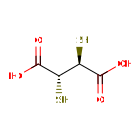
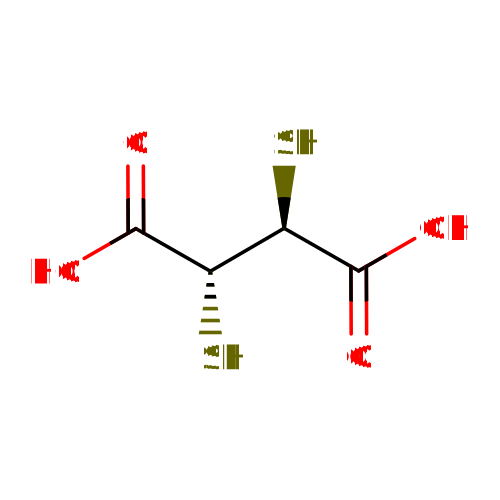
Structure for Succimer (DB00566)
- Weight
- Average: 182.21
Monoisotopic: 181.970751021 - Chemical Formula
- C4H6O4S2
- Synonyms
- DIM-SA
- DMS
- DMS-A
- DMSA
- meso-2,3-Dimercaptobernsteinsäure
- meso-2,3-dimercaptosuccinic acid
- meso-dimercaptosuccinic acid
- Succimer
- succimero
- External IDs
- RO 1-7977

Pharmacology
- Indication
For the treatment of lead poisoning in pediatric patients with blood lead levels above 45 µg/dL. May also be used to treat mercury or arsenic poisoning.
 Reduce drug development failure ratesBuild, train, & validate machine-learning modelswith evidence-based and structured datasets.Build, train, & validate predictive machine-learning models with structured datasets.
- Associated Conditions
Indication Type Indication Combined Product Details Approval Level Age Group Patient Characteristics Dose Form Treatment of Arsenic poisoning ••• ••••• Treatment of Lead poisoning ••• ••••• ••••• Treatment of Mercury poisoning ••• ••••• Treatment of Blood lead levels above 45 mcg/dl lead poisoning •••••••••••• ••••••••• - Contraindications & Blackbox Warnings
 Prevent Adverse Drug Events TodayTap into our Clinical API for life-saving information on contraindications & blackbox warnings, population restrictions, harmful risks, & more.Avoid life-threatening adverse drug events with our Clinical API
- Pharmacodynamics
Succimer is an orally active, heavy metal chelating agent. It forms water soluble chelates and, consequently, increases the urinary excretion of lead. Succimer is not to be used for prophylaxis of lead poisoning in a lead-containing environment. In addition, the use of succimer should always be accompanied by identification and removal of the source of the lead exposure.
- Mechanism of action
Succimer is a heavy metal chelator. It binds with high specificity to ions of lead in the blood to form a water-soluble complex that is subsequently excreted by the kidneys. Succimer can also chelate mercury, cadmium, and arsenic in this manner.
Target Actions Organism ALead chelatorHumans AMercury chelatorHumans ACadmium chelatorHumans AArsenic chelatorHumans - Absorption
Rapid but variable.
- Volume of distribution
Not Available
- Protein binding
Not Available
- Metabolism
Chemical analysis of succimer and its metabolites (primarily mixed disulfides of L-cysteine) in the urine showed that succimer was rapidly and extensively metabolized however the specific site of biotransformation is not known.
- Route of elimination
Unabsorbed drug is excreted primarily in feces and absorbed drug is excreted primarily in the urine as metabolites.
- Half-life
48 hours
- Clearance
Not Available
- Adverse Effects
 Improve decision support & research outcomesWith structured adverse effects data, including: blackbox warnings, adverse reactions, warning & precautions, & incidence rates. View sample adverse effects data in our new Data Library!Improve decision support & research outcomes with our structured adverse effects data.
- Toxicity
Oral LD50 in mice is over 5011 mg/kg. Doses of 2300 mg/kg in the rat and 2400 mg/kg in the mouse produced ataxia, convulsions, labored respiration and frequently death. No case of overdosage has been reported in humans. Limited data indicate that succimer is dialyzable.
- Pathways
- Not Available
- Pharmacogenomic Effects/ADRs
- Not Available
Interactions
- Drug Interactions
- This information should not be interpreted without the help of a healthcare provider. If you believe you are experiencing an interaction, contact a healthcare provider immediately. The absence of an interaction does not necessarily mean no interactions exist.
Drug Interaction Integrate drug-drug
interactions in your softwareTechnetium Tc-99m oxidronate Succimer may decrease effectiveness of Technetium Tc-99m oxidronate as a diagnostic agent. - Food Interactions
- Take with or without food. Capsules may be opened, and contents sprinkled on soft food for individuals with difficulty swallowing.
Products
 Drug product information from 10+ global regionsOur datasets provide approved product information including:dosage, form, labeller, route of administration, and marketing period.Access drug product information from over 10 global regions.
- Brand Name Prescription Products
Name Dosage Strength Route Labeller Marketing Start Marketing End Region Image Chemet Capsule 100 mg/1 Oral RECORDATI RARE DISEASES, INC. 2013-08-21 Not applicable US 
Chemet Capsule 100 mg/1 Oral Lundbeck Inc. 1991-01-30 2013-04-15 US NephroScan Injection, powder, lyophilized, for solution 1 mg/1 Intravenous Theragnostics Inc 2022-02-18 Not applicable US
Categories
- Drug Categories
- Chemical TaxonomyProvided by Classyfire
- Description
- This compound belongs to the class of organic compounds known as thia fatty acids. These are fatty acid derivatives obtained by insertion of a sulfur atom at specific positions in the chain.
- Kingdom
- Organic compounds
- Super Class
- Lipids and lipid-like molecules
- Class
- Fatty Acyls
- Sub Class
- Fatty acids and conjugates
- Direct Parent
- Thia fatty acids
- Alternative Parents
- Dicarboxylic acids and derivatives / alpha-Mercaptocarboxylic acids / Alkylthiols / Organic oxides / Hydrocarbon derivatives / Carbonyl compounds
- Substituents
- 2-mercaptocarboxylic acid / Aliphatic acyclic compound / Alkylthiol / Carbonyl group / Carboxylic acid / Carboxylic acid derivative / Dicarboxylic acid or derivatives / Hydrocarbon derivative / Organic oxide / Organic oxygen compound
- Molecular Framework
- Aliphatic acyclic compounds
- External Descriptors
- dicarboxylic acid, dithiol, sulfur-containing carboxylic acid (CHEBI:63623)
- Affected organisms
- Humans and other mammals
Chemical Identifiers
- UNII
- DX1U2629QE
- CAS number
- 304-55-2
- InChI Key
- ACTRVOBWPAIOHC-XIXRPRMCSA-N
- InChI
- InChI=1S/C4H6O4S2/c5-3(6)1(9)2(10)4(7)8/h1-2,9-10H,(H,5,6)(H,7,8)/t1-,2+
- IUPAC Name
- (2R,3S)-2,3-disulfanylbutanedioic acid
- SMILES
- OC(=O)[C@@H](S)[C@@H](S)C(O)=O
References
- General References
- Miller AL: Dimercaptosuccinic acid (DMSA), a non-toxic, water-soluble treatment for heavy metal toxicity. Altern Med Rev. 1998 Jun;3(3):199-207. [Article]
- Aaseth J, Jacobsen D, Andersen O, Wickstrom E: Treatment of mercury and lead poisonings with dimercaptosuccinic acid and sodium dimercaptopropanesulfonate. A review. Analyst. 1995 Mar;120(3):853-4. [Article]
- Mann KV, Travers JD: Succimer, an oral lead chelator. Clin Pharm. 1991 Dec;10(12):914-22. [Article]
- External Links
- KEGG Drug
- D00572
- KEGG Compound
- C07598
- PubChem Compound
- 2724354
- PubChem Substance
- 46504680
- ChemSpider
- 2006502
- BindingDB
- 50232640
- 3446
- ChEBI
- 63623
- ChEMBL
- CHEMBL1201073
- ZINC
- ZINC000003831475
- PharmGKB
- PA451521
- RxList
- RxList Drug Page
- Drugs.com
- Drugs.com Drug Page
- Wikipedia
- Succimer
- MSDS
- Download (60.1 KB)
Clinical Trials
- Clinical Trials
Pharmacoeconomics
- Manufacturers
- Lundbeck inc
- Ge healthcare
- Packagers
- GE Healthcare Inc.
- Lundbeck Inc.
- Medi-Physics Inc.
- Medisca Inc.
- Sanofi-Aventis Inc.
- Schwarz Pharma Inc.
- Dosage Forms
Form Route Strength Injection, powder, lyophilized, for solution Intravenous 1 mg Capsule Oral 100 mg/1 Injection, powder, lyophilized, for solution Intravenous 1 mg/1 Injection, powder, for solution Intravenous 1 mg Injection, powder, for solution Intravenous - Prices
Unit description Cost Unit Dmsa powder 15.61USD g Chemet 100 mg capsule 8.6USD capsule DrugBank does not sell nor buy drugs. Pricing information is supplied for informational purposes only.- Patents
- Not Available
Properties
- State
- Solid
- Experimental Properties
Property Value Source melting point (°C) 193 °C PhysProp logP -0.3 Not Available - Predicted Properties
Property Value Source Water Solubility 2.43 mg/mL ALOGPS logP 0.56 ALOGPS logP 0.26 Chemaxon logS -1.9 ALOGPS pKa (Strongest Acidic) 3.37 Chemaxon Physiological Charge -2 Chemaxon Hydrogen Acceptor Count 4 Chemaxon Hydrogen Donor Count 4 Chemaxon Polar Surface Area 74.6 Å2 Chemaxon Rotatable Bond Count 3 Chemaxon Refractivity 38.47 m3·mol-1 Chemaxon Polarizability 15.45 Å3 Chemaxon Number of Rings 0 Chemaxon Bioavailability 1 Chemaxon Rule of Five Yes Chemaxon Ghose Filter No Chemaxon Veber's Rule No Chemaxon MDDR-like Rule No Chemaxon - Predicted ADMET Features
Property Value Probability Human Intestinal Absorption + 0.5415 Blood Brain Barrier + 0.7685 Caco-2 permeable - 0.7615 P-glycoprotein substrate Non-substrate 0.8129 P-glycoprotein inhibitor I Non-inhibitor 0.9908 P-glycoprotein inhibitor II Non-inhibitor 0.9968 Renal organic cation transporter Non-inhibitor 0.9721 CYP450 2C9 substrate Non-substrate 0.7885 CYP450 2D6 substrate Non-substrate 0.9109 CYP450 3A4 substrate Non-substrate 0.8136 CYP450 1A2 substrate Non-inhibitor 0.9045 CYP450 2C9 inhibitor Inhibitor 0.5135 CYP450 2D6 inhibitor Non-inhibitor 0.9474 CYP450 2C19 inhibitor Non-inhibitor 0.9566 CYP450 3A4 inhibitor Non-inhibitor 0.9118 CYP450 inhibitory promiscuity Low CYP Inhibitory Promiscuity 0.9873 Ames test Non AMES toxic 0.8945 Carcinogenicity Non-carcinogens 0.6495 Biodegradation Ready biodegradable 0.8332 Rat acute toxicity 1.6901 LD50, mol/kg Not applicable hERG inhibition (predictor I) Weak inhibitor 0.9932 hERG inhibition (predictor II) Non-inhibitor 0.9736
Spectra
- Mass Spec (NIST)
- Not Available
- Spectra
Spectrum Spectrum Type Splash Key Predicted GC-MS Spectrum - GC-MS Predicted GC-MS splash10-000f-8900000000-b26f7b60c3d18010ad82 Predicted MS/MS Spectrum - 10V, Positive (Annotated) Predicted LC-MS/MS splash10-03e9-1900000000-f7a157bbd04bb3071699 Predicted MS/MS Spectrum - 10V, Negative (Annotated) Predicted LC-MS/MS splash10-0udj-0900000000-b2f6e5f8262fe8ae013e Predicted MS/MS Spectrum - 20V, Positive (Annotated) Predicted LC-MS/MS splash10-0076-7900000000-d751aa6514b1ef86f2ba Predicted MS/MS Spectrum - 20V, Negative (Annotated) Predicted LC-MS/MS splash10-0udi-1900000000-d36a93feac580a53708c Predicted MS/MS Spectrum - 40V, Negative (Annotated) Predicted LC-MS/MS splash10-000x-9200000000-b7f641d0ae02060057ba Predicted MS/MS Spectrum - 40V, Positive (Annotated) Predicted LC-MS/MS splash10-0005-9000000000-b8176add9801e23afbc4 Predicted 1H NMR Spectrum 1D NMR Not Applicable Predicted 13C NMR Spectrum 1D NMR Not Applicable - Chromatographic Properties
Collision Cross Sections (CCS)
Adduct CCS Value (Å2) Source type Source [M-H]- 132.7401938 predictedDarkChem Lite v0.1.0 [M-H]- 129.63554 predictedDeepCCS 1.0 (2019) [M+H]+ 132.03111 predictedDeepCCS 1.0 (2019) [M+Na]+ 139.20491 predictedDeepCCS 1.0 (2019)
Targets

References
- Bradberry S, Vale A: Dimercaptosuccinic acid (succimer; DMSA) in inorganic lead poisoning. Clin Toxicol (Phila). 2009 Aug;47(7):617-31. doi: 10.1080/15563650903174828. [Article]
- Gracia RC, Snodgrass WR: Lead toxicity and chelation therapy. Am J Health Syst Pharm. 2007 Jan 1;64(1):45-53. [Article]
- Miller AL: Dimercaptosuccinic acid (DMSA), a non-toxic, water-soluble treatment for heavy metal toxicity. Altern Med Rev. 1998 Jun;3(3):199-207. [Article]
- Jorgensen FM: Succimer: the first approved oral lead chelator. Am Fam Physician. 1993 Dec;48(8):1496-502. [Article]
- Aaseth J, Jacobsen D, Andersen O, Wickstrom E: Treatment of mercury and lead poisonings with dimercaptosuccinic acid and sodium dimercaptopropanesulfonate. A review. Analyst. 1995 Mar;120(3):853-4. [Article]
- Blanusa M, Varnai VM, Piasek M, Kostial K: Chelators as antidotes of metal toxicity: therapeutic and experimental aspects. Curr Med Chem. 2005;12(23):2771-94. [Article]
- Aposhian HV, Maiorino RM, Gonzalez-Ramirez D, Zuniga-Charles M, Xu Z, Hurlbut KM, Junco-Munoz P, Dart RC, Aposhian MM: Mobilization of heavy metals by newer, therapeutically useful chelating agents. Toxicology. 1995 Mar 31;97(1-3):23-38. [Article]
References
- Ozuah PO: Mercury poisoning. Curr Probl Pediatr. 2000 Mar;30(3):91-9. [Article]
- Miller AL: Dimercaptosuccinic acid (DMSA), a non-toxic, water-soluble treatment for heavy metal toxicity. Altern Med Rev. 1998 Jun;3(3):199-207. [Article]
- Aaseth J, Jacobsen D, Andersen O, Wickstrom E: Treatment of mercury and lead poisonings with dimercaptosuccinic acid and sodium dimercaptopropanesulfonate. A review. Analyst. 1995 Mar;120(3):853-4. [Article]
- Blanusa M, Varnai VM, Piasek M, Kostial K: Chelators as antidotes of metal toxicity: therapeutic and experimental aspects. Curr Med Chem. 2005;12(23):2771-94. [Article]
- Aposhian HV, Maiorino RM, Gonzalez-Ramirez D, Zuniga-Charles M, Xu Z, Hurlbut KM, Junco-Munoz P, Dart RC, Aposhian MM: Mobilization of heavy metals by newer, therapeutically useful chelating agents. Toxicology. 1995 Mar 31;97(1-3):23-38. [Article]
References
- Miller AL: Dimercaptosuccinic acid (DMSA), a non-toxic, water-soluble treatment for heavy metal toxicity. Altern Med Rev. 1998 Jun;3(3):199-207. [Article]
- Blanusa M, Varnai VM, Piasek M, Kostial K: Chelators as antidotes of metal toxicity: therapeutic and experimental aspects. Curr Med Chem. 2005;12(23):2771-94. [Article]
- Aposhian HV, Maiorino RM, Gonzalez-Ramirez D, Zuniga-Charles M, Xu Z, Hurlbut KM, Junco-Munoz P, Dart RC, Aposhian MM: Mobilization of heavy metals by newer, therapeutically useful chelating agents. Toxicology. 1995 Mar 31;97(1-3):23-38. [Article]
References
- Miller AL: Dimercaptosuccinic acid (DMSA), a non-toxic, water-soluble treatment for heavy metal toxicity. Altern Med Rev. 1998 Jun;3(3):199-207. [Article]
- Blanusa M, Varnai VM, Piasek M, Kostial K: Chelators as antidotes of metal toxicity: therapeutic and experimental aspects. Curr Med Chem. 2005;12(23):2771-94. [Article]
- Aposhian HV, Maiorino RM, Gonzalez-Ramirez D, Zuniga-Charles M, Xu Z, Hurlbut KM, Junco-Munoz P, Dart RC, Aposhian MM: Mobilization of heavy metals by newer, therapeutically useful chelating agents. Toxicology. 1995 Mar 31;97(1-3):23-38. [Article]

Drug created at June 13, 2005 13:24 / Updated at December 02, 2023 06:52