Identification
- Summary
Fenoprofen is an anti-inflammatory analgesic used to treat mild to moderate pain in addition to the signs and symptoms of rheumatoid arthritis and osteoarthritis.
- Brand Names
- Fenortho, Nalfon
- Generic Name
- Fenoprofen
- DrugBank Accession Number
- DB00573
- Background
An anti-inflammatory analgesic and antipyretic highly bound to plasma proteins. It is pharmacologically similar to aspirin, but causes less gastrointestinal bleeding.
- Type
- Small Molecule
- Groups
- Approved
- Structure
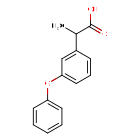
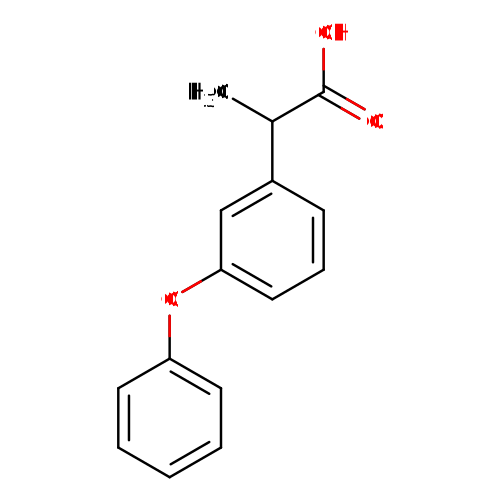
Structure for Fenoprofen (DB00573)
- Weight
- Average: 242.2699
Monoisotopic: 242.094294314 - Chemical Formula
- C15H14O3
- Synonyms
- (+/-)-fenoprofen
- (+/-)-m-phenoxyhydratropic acid
- (±)-2-(3-phenoxyphenyl)propionic acid
- 2-(3-phenoxyphenyl)propionic acid
- 2-(m-phenoxyphenyl)propionic acid
- 3-phenoxyhydratropic acid
- DL-2-(3-phenoxyphenyl)propionic acid
- Fenoprofen
- Fénoprofène
- Fenoprofeno
- Fenoprofenum
- α-(m-phenoxyphenyl)propionic acid
- α-methyl-3-phenoxybenzeneacetic acid
- External IDs
- 69323
- Lilly 53858
- LILLY-53858

Pharmacology
- Indication
For relief of the signs and symptoms of rheumatoid arthritis and osteoarthritis. Also for the relief of mild to moderate pain.
 Reduce drug development failure ratesBuild, train, & validate machine-learning modelswith evidence-based and structured datasets.Build, train, & validate predictive machine-learning models with structured datasets.
- Associated Conditions
Indication Type Indication Combined Product Details Approval Level Age Group Patient Characteristics Dose Form Symptomatic treatment of Osteoarthritis •••••••••••• Symptomatic treatment of Rheumatoid arthritis •••••••••••• Management of Mild pain •••••••••••• ••••• Management of Moderate pain •••••••••••• ••••• - Contraindications & Blackbox Warnings
 Prevent Adverse Drug Events TodayTap into our Clinical API for life-saving information on contraindications & blackbox warnings, population restrictions, harmful risks, & more.Avoid life-threatening adverse drug events with our Clinical API
- Pharmacodynamics
Fenoprofen is a propionic acid derivative with analgesic, antiinflammatory and antipyretic properties. Fenoprofen inhibits prostaglandin synthesis by decreasing the enzyme needed for biosynthesis. In patients with rheumatoid arthritis, the anti-inflammatory action of fenoprofen has been evidenced by relief of pain, increase in grip strength, and reductions in joint swelling, duration of morning stiffness, and disease activity (as assessed by both the investigator and the patient). In patients with osteoarthritis, the anti-inflammatory and analgesic effects of fenoprofen have been demonstrated by reduction in tenderness as a response to pressure and reductions in night pain, stiffness, swelling, and overall disease activity (as assessed by both the patient and the investigator). These effects have also been demonstrated by relief of pain with motion and at rest and increased range of motion in involved joints. In patients with rheumatoid arthritis and osteoarthritis, clinical studies have shown fenoprofen to be comparable to aspirin in controlling the aforementioned measures of disease activity, but mild gastrointestinal reactions (nausea, dyspepsia) and tinnitus occurred less frequently in patients treated with fenoprofen than in aspirin-treated patients. It is not known whether fenoprofen causes less peptic ulceration than does aspirin. In patients with pain, the analgesic action of fenoprofen has produced a reduction in pain intensity, an increase in pain relief, improvement in total analgesia scores, and a sustained analgesic effect.
- Mechanism of action
Fenoprofen's exact mode of action is unknown, but it is thought that prostaglandin synthetase inhibition is involved. Fenoprofen has been shown to inhibit prostaglandin synthetase isolated from bovine seminal vesicles.
Target Actions Organism AProstaglandin G/H synthase 2 inhibitorHumans UPeroxisome proliferator-activated receptor alpha activatorHumans UPeroxisome proliferator-activated receptor gamma Not Available Humans UProstaglandin G/H synthase 1 inhibitorHumans - Absorption
Rapidly absorbed under fasting conditions, and peak plasma levels of 50 µg/mL are achieved within 2 hours after oral administration of 600 mg doses.
- Volume of distribution
Not Available
- Protein binding
99% to albumin.
- Metabolism
About 90% of a single oral dose is eliminated within 24 hours as fenoprofen glucuronide and 4'-hydroxyfenoprofen glucuronide, the major urinary metabolites of fenoprofen.
Hover over products below to view reaction partners
- Route of elimination
Not Available
- Half-life
Plasma half-life is approximately 3 hours.
- Clearance
Not Available
- Adverse Effects
 Improve decision support & research outcomesWith structured adverse effects data, including: blackbox warnings, adverse reactions, warning & precautions, & incidence rates. View sample adverse effects data in our new Data Library!Improve decision support & research outcomes with our structured adverse effects data.
- Toxicity
Symptoms of overdose appear within several hours and generally involve the gastrointestinal and central nervous systems. They include dyspepsia, nausea, vomiting, abdominal pain, dizziness, headache, ataxia, tinnitus, tremor, drowsiness, and confusion. Hyperpyrexia, tachycardia, hypotension, and acute renal failure may occur rarely following overdose. Respiratory depression and metabolic acidosis have also been reported following overdose with certain NSAIDs.
- Pathways
Pathway Category Fenoprofen Action Pathway Drug action - Pharmacogenomic Effects/ADRs
- Not Available
Interactions
- Drug Interactions
- This information should not be interpreted without the help of a healthcare provider. If you believe you are experiencing an interaction, contact a healthcare provider immediately. The absence of an interaction does not necessarily mean no interactions exist.
Drug Interaction Integrate drug-drug
interactions in your softwareAbacavir Fenoprofen may decrease the excretion rate of Abacavir which could result in a higher serum level. Abciximab The risk or severity of bleeding and hemorrhage can be increased when Fenoprofen is combined with Abciximab. Acebutolol Fenoprofen may decrease the antihypertensive activities of Acebutolol. Aceclofenac The risk or severity of adverse effects can be increased when Fenoprofen is combined with Aceclofenac. Acemetacin The risk or severity of adverse effects can be increased when Fenoprofen is combined with Acemetacin. - Food Interactions
- Avoid alcohol.
- Take with food. Food reduces irritation.
Products
 Drug product information from 10+ global regionsOur datasets provide approved product information including:dosage, form, labeller, route of administration, and marketing period.Access drug product information from over 10 global regions.
- Product Ingredients
Ingredient UNII CAS InChI Key Fenoprofen calcium 0X2CW1QABJ 53746-45-5 LZPBLUATTGKZBH-UHFFFAOYSA-L Fenoprofen sodium 869607J16Q 34691-31-1 WVKIYGXHDKTNFO-UHFFFAOYSA-M - International/Other Brands
- Feilin (Hengshan Pharmaceutical) / Fenopron (Typharm) / Fepron (Sheng Chung Tang) / Kimpron (Daewoong) / Nalgésic (Sciencex) / Nonsic (Hasan) / Noprofen (Panion & BF) / Trandor (Biolab)
- Brand Name Prescription Products
Name Dosage Strength Route Labeller Marketing Start Marketing End Region Image Fenoprofen Capsule 200 mg/1 Oral Belcher Pharmaceuticals, LLC 2017-04-19 Not applicable US 
Fenoprofen Capsule 400 mg/1 Oral Mesource Pharmaceuticals 2014-07-14 2016-06-30 US Fenoprofen Capsule 400 mg/1 Oral KLE 2, Inc. 2014-07-14 2015-11-05 US Fenoprofen Capsule 400 mg/1 Oral bryant ranch prepack 2014-07-14 Not applicable US Fenoprofen Capsule 400 mg/1 Oral Preferreed Pharmaceuticals Inc. 2014-08-20 2017-08-09 US - Generic Prescription Products
Name Dosage Strength Route Labeller Marketing Start Marketing End Region Image Fenoprofen Calcium Capsule 400 mg/1 Oral Rising Pharma Holdings, Inc. 2022-08-01 Not applicable US Fenoprofen Calcium Capsule 400 mg/1 Oral Gentex Pharma 2016-05-19 Not applicable US Fenoprofen Calcium Capsule 400 mg/1 Oral bryant ranch prepack 2016-05-19 Not applicable US Fenoprofen Calcium Capsule 400 mg/1 Oral Xspire Pharma 2016-05-19 Not applicable US Fenoprofen Calcium Capsule 400 mg/1 Oral Atland Pharmaceuticals, Llc 2024-03-26 Not applicable US
Categories
- ATC Codes
- M01AE04 — Fenoprofen
- Drug Categories
- Acids, Carbocyclic
- Agents causing hyperkalemia
- Agents that produce hypertension
- Analgesics
- Analgesics, Non-Narcotic
- Anti-Inflammatory Agents
- Anti-Inflammatory Agents, Non-Steroidal
- Anti-Inflammatory Agents, Non-Steroidal (Non-Selective)
- Antiinflammatory and Antirheumatic Products
- Antiinflammatory and Antirheumatic Products, Non-Steroids
- Antirheumatic Agents
- Cyclooxygenase Inhibitors
- Enzyme Inhibitors
- Musculo-Skeletal System
- Nephrotoxic agents
- Non COX-2 selective NSAIDS
- Peripheral Nervous System Agents
- Phenylpropionates
- Propionates
- Sensory System Agents
- Chemical TaxonomyProvided by Classyfire
- Description
- This compound belongs to the class of organic compounds known as diphenylethers. These are aromatic compounds containing two benzene rings linked to each other through an ether group.
- Kingdom
- Organic compounds
- Super Class
- Benzenoids
- Class
- Benzene and substituted derivatives
- Sub Class
- Diphenylethers
- Direct Parent
- Diphenylethers
- Alternative Parents
- Phenylpropanoic acids / Diarylethers / Phenoxy compounds / Phenol ethers / Monocarboxylic acids and derivatives / Carboxylic acids / Organic oxides / Hydrocarbon derivatives / Carbonyl compounds
- Substituents
- 2-phenylpropanoic-acid / Aromatic homomonocyclic compound / Carbonyl group / Carboxylic acid / Carboxylic acid derivative / Diaryl ether / Diphenylether / Ether / Hydrocarbon derivative / Monocarboxylic acid or derivatives
- Molecular Framework
- Aromatic homomonocyclic compounds
- External Descriptors
- monocarboxylic acid (CHEBI:5004)
- Affected organisms
- Humans and other mammals
Chemical Identifiers
- UNII
- RA33EAC7KY
- CAS number
- 29679-58-1
- InChI Key
- RDJGLLICXDHJDY-UHFFFAOYSA-N
- InChI
- InChI=1S/C15H14O3/c1-11(15(16)17)12-6-5-9-14(10-12)18-13-7-3-2-4-8-13/h2-11H,1H3,(H,16,17)
- IUPAC Name
- 2-(3-phenoxyphenyl)propanoic acid
- SMILES
- CC(C(O)=O)C1=CC(OC2=CC=CC=C2)=CC=C1
References
- Synthesis Reference
Marshall, W.S.; U.S. Patent 3,600,437; August 17, 1971; assigned to Eli Lilly and Company.
- General References
- Not Available
- External Links
- Human Metabolome Database
- HMDB0014713
- KEGG Drug
- D00968
- KEGG Compound
- C06997
- PubChem Compound
- 3342
- PubChem Substance
- 46504597
- ChemSpider
- 3225
- BindingDB
- 54705
- 4331
- ChEBI
- 5004
- ChEMBL
- CHEMBL1297
- Therapeutic Targets Database
- DAP000619
- PharmGKB
- PA449597
- RxList
- RxList Drug Page
- Drugs.com
- Drugs.com Drug Page
- Wikipedia
- Fenoprofen
- FDA label
- Download (141 KB)
Clinical Trials
Pharmacoeconomics
- Manufacturers
- American therapeutics inc
- Halsey drug co inc
- Par pharmaceutical inc
- Quantum pharmics ltd
- Sandoz inc
- Warner chilcott div warner lambert co
- Watson laboratories inc
- Pedinol pharmacal inc
- Actavis elizabeth llc
- Clonmel healthcare ltd
- Ivax pharmaceuticals inc sub teva pharmaceuticals usa
- Mutual pharmaceutical co inc
- Mylan pharmaceuticals inc
- Usl pharma inc
- Dista products co div eli lilly and co
- Packagers
- A-S Medication Solutions LLC
- Direct Dispensing Inc.
- Dispensing Solutions
- Eli Lilly & Co.
- H.J. Harkins Co. Inc.
- Ivax Pharmaceuticals
- Major Pharmaceuticals
- Murfreesboro Pharmaceutical Nursing Supply
- Mylan
- Nucare Pharmaceuticals Inc.
- Ohm Laboratories Inc.
- PCA LLC
- PD-Rx Pharmaceuticals Inc.
- PEDiNOL
- Pharmedix
- Physicians Total Care Inc.
- Prescript Pharmaceuticals
- Professional Co.
- Ranbaxy Laboratories
- Southwood Pharmaceuticals
- St Mary's Medical Park Pharmacy
- Dosage Forms
Form Route Strength Capsule Oral 400 mg/1 Tablet, film coated Oral 600 mg/1 Tablet Oral Capsule Oral 200 mg/1 Capsule Oral 300 mg/1 Capsule Oral 300 mg / cap Tablet Oral 600 mg - Prices
Unit description Cost Unit Fenoprofen calcium powder 1.59USD g Fenoprofen Calcium 600 mg tablet 1.01USD tablet Nalfon 200 mg capsule 0.91USD capsule Fenoprofen 600 mg tablet 0.88USD tablet DrugBank does not sell nor buy drugs. Pricing information is supplied for informational purposes only.- Patents
- Not Available
Properties
- State
- Solid
- Experimental Properties
Property Value Source melting point (°C) 168-171 Marshall, W.S.; U.S. Patent 3,600,437; August 17, 1971; assigned to Eli Lilly and Company. water solubility Slight (calcium salt) Not Available logP 3.1 Not Available pKa 4.5 Not Available - Predicted Properties
Property Value Source Water Solubility 0.0811 mg/mL ALOGPS logP 3.87 ALOGPS logP 3.65 Chemaxon logS -3.5 ALOGPS pKa (Strongest Acidic) 3.96 Chemaxon pKa (Strongest Basic) -3.7 Chemaxon Physiological Charge -1 Chemaxon Hydrogen Acceptor Count 2 Chemaxon Hydrogen Donor Count 1 Chemaxon Polar Surface Area 46.53 Å2 Chemaxon Rotatable Bond Count 4 Chemaxon Refractivity 68.18 m3·mol-1 Chemaxon Polarizability 25.3 Å3 Chemaxon Number of Rings 2 Chemaxon Bioavailability 1 Chemaxon Rule of Five Yes Chemaxon Ghose Filter Yes Chemaxon Veber's Rule No Chemaxon MDDR-like Rule No Chemaxon - Predicted ADMET Features
Property Value Probability Human Intestinal Absorption + 0.9948 Blood Brain Barrier + 0.8373 Caco-2 permeable + 0.8876 P-glycoprotein substrate Non-substrate 0.6587 P-glycoprotein inhibitor I Non-inhibitor 0.8897 P-glycoprotein inhibitor II Non-inhibitor 0.9357 Renal organic cation transporter Non-inhibitor 0.8521 CYP450 2C9 substrate Non-substrate 0.6883 CYP450 2D6 substrate Non-substrate 0.9354 CYP450 3A4 substrate Non-substrate 0.6779 CYP450 1A2 substrate Inhibitor 0.5871 CYP450 2C9 inhibitor Non-inhibitor 0.8382 CYP450 2D6 inhibitor Non-inhibitor 0.9769 CYP450 2C19 inhibitor Non-inhibitor 0.7675 CYP450 3A4 inhibitor Non-inhibitor 0.938 CYP450 inhibitory promiscuity Low CYP Inhibitory Promiscuity 0.8169 Ames test Non AMES toxic 0.9558 Carcinogenicity Non-carcinogens 0.7885 Biodegradation Ready biodegradable 0.5267 Rat acute toxicity 1.9985 LD50, mol/kg Not applicable hERG inhibition (predictor I) Weak inhibitor 0.9517 hERG inhibition (predictor II) Non-inhibitor 0.9414
Spectra
- Mass Spec (NIST)
- Not Available
- Spectra
- Chromatographic Properties
Collision Cross Sections (CCS)
Adduct CCS Value (Å2) Source type Source [M-H]- 167.1304103 predictedDarkChem Lite v0.1.0 [M-H]- 152.32225 predictedDeepCCS 1.0 (2019) [M+H]+ 167.4328103 predictedDarkChem Lite v0.1.0 [M+H]+ 154.71782 predictedDeepCCS 1.0 (2019) [M+Na]+ 167.3009103 predictedDarkChem Lite v0.1.0 [M+Na]+ 160.76186 predictedDeepCCS 1.0 (2019)
Targets

- Kind
- Protein
- Organism
- Humans
- Pharmacological action
- Yes
- Actions
- Inhibitor
- General Function
- Prostaglandin-endoperoxide synthase activity
- Specific Function
- Converts arachidonate to prostaglandin H2 (PGH2), a committed step in prostanoid synthesis. Constitutively expressed in some tissues in physiological conditions, such as the endothelium, kidney and...
- Gene Name
- PTGS2
- Uniprot ID
- P35354
- Uniprot Name
- Prostaglandin G/H synthase 2
- Molecular Weight
- 68995.625 Da
References
- Poggi JC, Barissa GR, Donadi EA, Foss MC, Cunha FQ, Lanchote VL, dos Reis ML: Pharmacodynamics, chiral pharmacokinetics, and pharmacokinetic-pharmacodynamic modeling of fenoprofen in patients with diabetes mellitus. J Clin Pharmacol. 2006 Nov;46(11):1328-36. [Article]
- Kind
- Protein
- Organism
- Humans
- Pharmacological action
- Unknown
- Actions
- Activator
- General Function
- Zinc ion binding
- Specific Function
- Ligand-activated transcription factor. Key regulator of lipid metabolism. Activated by the endogenous ligand 1-palmitoyl-2-oleoyl-sn-glycerol-3-phosphocholine (16:0/18:1-GPC). Activated by oleyleth...
- Gene Name
- PPARA
- Uniprot ID
- Q07869
- Uniprot Name
- Peroxisome proliferator-activated receptor alpha
- Molecular Weight
- 52224.595 Da
References
- Lehmann JM, Lenhard JM, Oliver BB, Ringold GM, Kliewer SA: Peroxisome proliferator-activated receptors alpha and gamma are activated by indomethacin and other non-steroidal anti-inflammatory drugs. J Biol Chem. 1997 Feb 7;272(6):3406-10. [Article]
- Kind
- Protein
- Organism
- Humans
- Pharmacological action
- Unknown
- Curator comments
- activator
- General Function
- Zinc ion binding
- Specific Function
- Nuclear receptor that binds peroxisome proliferators such as hypolipidemic drugs and fatty acids. Once activated by a ligand, the nuclear receptor binds to DNA specific PPAR response elements (PPRE...
- Gene Name
- PPARG
- Uniprot ID
- P37231
- Uniprot Name
- Peroxisome proliferator-activated receptor gamma
- Molecular Weight
- 57619.58 Da
References
- Lehmann JM, Lenhard JM, Oliver BB, Ringold GM, Kliewer SA: Peroxisome proliferator-activated receptors alpha and gamma are activated by indomethacin and other non-steroidal anti-inflammatory drugs. J Biol Chem. 1997 Feb 7;272(6):3406-10. [Article]
- Kind
- Protein
- Organism
- Humans
- Pharmacological action
- Unknown
- Actions
- Inhibitor
- General Function
- Prostaglandin-endoperoxide synthase activity
- Specific Function
- Converts arachidonate to prostaglandin H2 (PGH2), a committed step in prostanoid synthesis. Involved in the constitutive production of prostanoids in particular in the stomach and platelets. In gas...
- Gene Name
- PTGS1
- Uniprot ID
- P23219
- Uniprot Name
- Prostaglandin G/H synthase 1
- Molecular Weight
- 68685.82 Da
References
- Poggi JC, Barissa GR, Donadi EA, Foss MC, Cunha FQ, Lanchote VL, dos Reis ML: Pharmacodynamics, chiral pharmacokinetics, and pharmacokinetic-pharmacodynamic modeling of fenoprofen in patients with diabetes mellitus. J Clin Pharmacol. 2006 Nov;46(11):1328-36. [Article]
Carriers
- Kind
- Protein
- Organism
- Humans
- Pharmacological action
- Unknown
- General Function
- Toxic substance binding
- Specific Function
- Serum albumin, the main protein of plasma, has a good binding capacity for water, Ca(2+), Na(+), K(+), fatty acids, hormones, bilirubin and drugs. Its main function is the regulation of the colloid...
- Gene Name
- ALB
- Uniprot ID
- P02768
- Uniprot Name
- Serum albumin
- Molecular Weight
- 69365.94 Da
References
- Bertucci C, Wainer IW: Improved chromatographic performance of a modified human albumin based stationary phase. Chirality. 1997;9(4):335-40. [Article]

Drug created at June 13, 2005 13:24 / Updated at December 02, 2023 07:00