Identification
- Summary
Mazindol is a sympathomimetic used to treat obesity in combination with lifestyle modifications.
- Brand Names
- Sanorex
- Generic Name
- Mazindol
- DrugBank Accession Number
- DB00579
- Background
Mazindol is a tricyclic anorexigenic agent that is unrelated to and less toxic than amphetamine, but with some similar side effects. It inhibits uptake of catecholamines and blocks the binding of cocaine to the dopamine uptake transporter. Mazindol is only approved in the United States for the treatment of Duchenne muscular dystrophy, and is not marketed or available in the United States for use in the treatment of obesity.
- Type
- Small Molecule
- Groups
- Approved, Investigational
- Structure
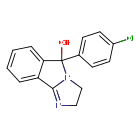
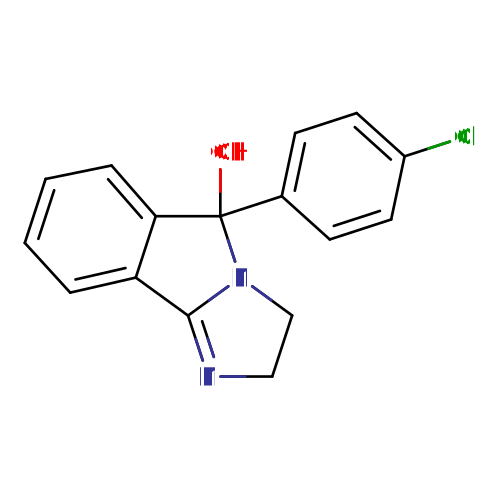
Structure for Mazindol (DB00579)
- Weight
- Average: 284.74
Monoisotopic: 284.071640755 - Chemical Formula
- C16H13ClN2O
- Synonyms
- Mazindol
- Mazindolo
- Mazindolum
- External IDs
- 42-548
- AN 488
- DEA No. 1605

Pharmacology
- Indication
Used in short-term (a few weeks) treatment of exogenous obesity in conjunction with a regimen of weight reduction based on caloric restriction, exercise, and behavior modification in patients with a body mass index of 30 kg of body weight per height in meters squared (kg/m2) or in patients with a body mass index of 27 kg/m2 in the presence of risk factors such as hypertension, diabetes, or hyperlipidemia.
 Reduce drug development failure ratesBuild, train, & validate machine-learning modelswith evidence-based and structured datasets.Build, train, & validate predictive machine-learning models with structured datasets.
- Contraindications & Blackbox Warnings
 Prevent Adverse Drug Events TodayTap into our Clinical API for life-saving information on contraindications & blackbox warnings, population restrictions, harmful risks, & more.Avoid life-threatening adverse drug events with our Clinical API
- Pharmacodynamics
Mazindol is a sympathomimetic amine that stimulates the central nervous system (nerves and brain), leading to increased your heart rate and blood pressure, and decreased appetite. Since the appetite-suppressing effect of the drug tends to decrease after few weeks of treatment, sympathomimetic appetite suppressants are typically used short-term weight-loss program.
- Mechanism of action
Unlike other sympathomimetic appetite suppressants such as phentermine, mazindol is thought to inhibit the reuptake of norepinephrine rather than to cause its release.
Target Actions Organism ASodium-dependent noradrenaline transporter inhibitorHumans ASodium-dependent dopamine transporter inhibitorHumans ASodium-dependent serotonin transporter inhibitorHumans USynaptic vesicular amine transporter Not Available Humans - Absorption
Not Available
- Volume of distribution
Not Available
- Protein binding
Not Available
- Metabolism
Hepatic.
- Route of elimination
Not Available
- Half-life
10-13 hours
- Clearance
Not Available
- Adverse Effects
 Improve decision support & research outcomesWith structured adverse effects data, including: blackbox warnings, adverse reactions, warning & precautions, & incidence rates. View sample adverse effects data in our new Data Library!Improve decision support & research outcomes with our structured adverse effects data.
- Toxicity
Symptoms of mazindol overdose may be associated with restlessness, tremor, rapid breathing, confusion, hallucinations, panic, aggressiveness, nausea, vomiting, diarrhea, an irregular heartbeat, and seizures.
- Pathways
- Not Available
- Pharmacogenomic Effects/ADRs
- Not Available
Interactions
- Drug Interactions
- This information should not be interpreted without the help of a healthcare provider. If you believe you are experiencing an interaction, contact a healthcare provider immediately. The absence of an interaction does not necessarily mean no interactions exist.
Drug Interaction Integrate drug-drug
interactions in your software1,2-Benzodiazepine The risk or severity of CNS depression can be increased when Mazindol is combined with 1,2-Benzodiazepine. Acenocoumarol The risk or severity of adverse effects can be increased when Mazindol is combined with Acenocoumarol. Acetazolamide The risk or severity of CNS depression can be increased when Mazindol is combined with Acetazolamide. Acetophenazine The risk or severity of adverse effects can be increased when Mazindol is combined with Acetophenazine. Agomelatine The risk or severity of CNS depression can be increased when Mazindol is combined with Agomelatine. - Food Interactions
- Take with or without food. Preferably take 1 hour before a meal. Taking with food may reduce GI disturbance.
Products
 Drug product information from 10+ global regionsOur datasets provide approved product information including:dosage, form, labeller, route of administration, and marketing period.Access drug product information from over 10 global regions.
- Product Ingredients
Ingredient UNII CAS InChI Key Mazindol hydrochloride TYC95TXB8Q 58535-70-9 NIUFFPYONFMTAH-UHFFFAOYSA-N - International/Other Brands
- Dimagrir (Gador) / Fagolip Plus (Cetus) / Mazanor (Kwang Dong) / Teronac (Novartis)
- Brand Name Prescription Products
Name Dosage Strength Route Labeller Marketing Start Marketing End Region Image Sanorex Tablet 2 mg Oral Hexim Pharmaceuticals Inc 1975-12-31 Not applicable Canada 
Sanorex Tablet 1 mg Oral Hexim Pharmaceuticals Inc 1980-12-31 Not applicable Canada
Categories
- ATC Codes
- A08AA05 — Mazindol
- Drug Categories
- Adrenergic Agents
- Adrenergic Uptake Inhibitors
- Alimentary Tract and Metabolism
- Anorexigenic Agents & Respiratory and Cerebral Stimulants, Miscellaneous
- Anorexigenic Agents & Respiratory and CNS Stimulants
- Antidepressive Agents
- Antiobesity Preparations, Excl. Diet Products
- Central Nervous System Agents
- Central Nervous System Depressants
- Central Nervous System Stimulants
- Centrally Acting Antiobesity Products
- Combined Inhibitors of Serotonin/Norepinephrine Reuptake
- Dopamine Agents
- Dopamine Uptake Inhibitors
- Heterocyclic Compounds, Fused-Ring
- Isoindoles
- Membrane Transport Modulators
- Neurotransmitter Agents
- Neurotransmitter Uptake Inhibitors
- Serotonergic Drugs Shown to Increase Risk of Serotonin Syndrome
- Serotonin Agents
- Serotonin Modulators
- Chemical TaxonomyProvided by Classyfire
- Description
- This compound belongs to the class of organic compounds known as isoindoles. These are heteropolycyclic compounds with a structure containing isoindole, a benzo-fused pyrrole.
- Kingdom
- Organic compounds
- Super Class
- Organoheterocyclic compounds
- Class
- Isoindoles and derivatives
- Sub Class
- Isoindoles
- Direct Parent
- Isoindoles
- Alternative Parents
- Isoindolines / Chlorobenzenes / Imidolactams / Aryl chlorides / Imidazolines / Propargyl-type 1,3-dipolar organic compounds / Carboximidamides / Carboxamidines / Azacyclic compounds / Alkanolamines show 4 more
- Substituents
- 2-imidazoline / Alkanolamine / Amidine / Aromatic heteropolycyclic compound / Aryl chloride / Aryl halide / Azacycle / Benzenoid / Carboximidamide / Carboxylic acid amidine show 16 more
- Molecular Framework
- Aromatic heteropolycyclic compounds
- External Descriptors
- Not Available
- Affected organisms
- Humans and other mammals
Chemical Identifiers
- UNII
- C56709M5NH
- CAS number
- 22232-71-9
- InChI Key
- ZPXSCAKFGYXMGA-UHFFFAOYSA-N
- InChI
- InChI=1S/C16H13ClN2O/c17-12-7-5-11(6-8-12)16(20)14-4-2-1-3-13(14)15-18-9-10-19(15)16/h1-8,20H,9-10H2
- IUPAC Name
- 5-(4-chlorophenyl)-2H,3H,5H-imidazo[2,1-a]isoindol-5-ol
- SMILES
- OC1(N2CCN=C2C2=CC=CC=C12)C1=CC=C(Cl)C=C1
References
- Synthesis Reference
U.S. Patents 3,597,445 and 3,763,178.
US3597445- General References
- Not Available
- External Links
Clinical Trials
- Clinical Trials
Phase Status Purpose Conditions Count 3 Not Yet Recruiting Treatment Narcolepsy Type 1 (NT 1) / Narcolepsy With Cataplexy 1 2 Completed Treatment Attention Deficit Hyperactivity Disorder (ADHD) 1 2 Completed Treatment Cocaine Related Disorders 1 2 Completed Treatment Excessive Daytime Sleepiness / Narcolepsy / Narcolepsy With Cataplexy 1 2 Completed Treatment Narcolepsy / Narcolepsy With Cataplexy / Narcolepsy Without Cataplexy 1
Pharmacoeconomics
- Manufacturers
- Wyeth ayerst laboratories
- Novartis pharmaceuticals corp
- Packagers
- Not Available
- Dosage Forms
Form Route Strength Tablet Oral 2.000 mg Tablet Oral 1.000 mg Tablet Oral 1.00 mg Tablet Oral 1 mg Tablet Oral 2 mg Capsule Oral 2.000 mg - Prices
- Not Available
- Patents
- Not Available
Properties
- State
- Solid
- Experimental Properties
Property Value Source melting point (°C) 198-199 U.S. Patents 3,597,445 and 3,763,178. logP 3.7 Not Available - Predicted Properties
Property Value Source Water Solubility 0.139 mg/mL ALOGPS logP 2.64 ALOGPS logP 3.44 Chemaxon logS -3.3 ALOGPS pKa (Strongest Acidic) 11.61 Chemaxon pKa (Strongest Basic) 3.86 Chemaxon Physiological Charge 0 Chemaxon Hydrogen Acceptor Count 3 Chemaxon Hydrogen Donor Count 1 Chemaxon Polar Surface Area 35.83 Å2 Chemaxon Rotatable Bond Count 1 Chemaxon Refractivity 79.42 m3·mol-1 Chemaxon Polarizability 29.49 Å3 Chemaxon Number of Rings 4 Chemaxon Bioavailability 1 Chemaxon Rule of Five Yes Chemaxon Ghose Filter Yes Chemaxon Veber's Rule Yes Chemaxon MDDR-like Rule No Chemaxon - Predicted ADMET Features
Property Value Probability Human Intestinal Absorption + 0.9793 Blood Brain Barrier + 0.9757 Caco-2 permeable + 0.5286 P-glycoprotein substrate Substrate 0.5816 P-glycoprotein inhibitor I Non-inhibitor 0.7523 P-glycoprotein inhibitor II Inhibitor 0.7127 Renal organic cation transporter Inhibitor 0.7465 CYP450 2C9 substrate Non-substrate 0.7257 CYP450 2D6 substrate Non-substrate 0.7107 CYP450 3A4 substrate Substrate 0.6461 CYP450 1A2 substrate Inhibitor 0.615 CYP450 2C9 inhibitor Inhibitor 0.5 CYP450 2D6 inhibitor Inhibitor 0.5 CYP450 2C19 inhibitor Inhibitor 0.527 CYP450 3A4 inhibitor Non-inhibitor 0.7389 CYP450 inhibitory promiscuity High CYP Inhibitory Promiscuity 0.542 Ames test Non AMES toxic 0.6859 Carcinogenicity Non-carcinogens 0.8924 Biodegradation Not ready biodegradable 1.0 Rat acute toxicity 3.1216 LD50, mol/kg Not applicable hERG inhibition (predictor I) Weak inhibitor 0.9837 hERG inhibition (predictor II) Inhibitor 0.5621
Spectra
- Mass Spec (NIST)
- Download (8.08 KB)
- Spectra
- Chromatographic Properties
Collision Cross Sections (CCS)
Adduct CCS Value (Å2) Source type Source [M-H]- 165.0911021 predictedDarkChem Lite v0.1.0 [M-H]- 161.05344 predictedDeepCCS 1.0 (2019) [M+H]+ 165.2362021 predictedDarkChem Lite v0.1.0 [M+H]+ 163.44876 predictedDeepCCS 1.0 (2019) [M+Na]+ 164.9343021 predictedDarkChem Lite v0.1.0 [M+Na]+ 169.5046 predictedDeepCCS 1.0 (2019)
Targets

- Kind
- Protein
- Organism
- Humans
- Pharmacological action
- Yes
- Actions
- Inhibitor
- General Function
- Norepinephrine:sodium symporter activity
- Specific Function
- Amine transporter. Terminates the action of noradrenaline by its high affinity sodium-dependent reuptake into presynaptic terminals.
- Gene Name
- SLC6A2
- Uniprot ID
- P23975
- Uniprot Name
- Sodium-dependent noradrenaline transporter
- Molecular Weight
- 69331.42 Da
References
- Raffel DM, Chen W: Binding of [3H]mazindol to cardiac norepinephrine transporters: kinetic and equilibrium studies. Naunyn Schmiedebergs Arch Pharmacol. 2004 Jul;370(1):9-16. Epub 2004 Jul 22. [Article]
- Raffel DM, Chen W, Sherman PS, Gildersleeve DL, Jung YW: Dependence of cardiac 11C-meta-hydroxyephedrine retention on norepinephrine transporter density. J Nucl Med. 2006 Sep;47(9):1490-6. [Article]
- Zhao L, Johnson KM, Zhang M, Flippen-Anderson J, Kozikowski AP: Chemical synthesis and pharmacology of 6- and 7-hydroxylated 2-carbomethoxy-3-(p-tolyl)tropanes: antagonism of cocaine's locomotor stimulant effects. J Med Chem. 2000 Aug 24;43(17):3283-94. [Article]
- Ritz MC, Boja JW, Grigoriadis D, Zaczek R, Carroll FI, Lewis AH, Kuhar MJ: [3H]WIN 35,065-2: a ligand for cocaine receptors in striatum. J Neurochem. 1990 Nov;55(5):1556-62. [Article]
- Sharpe IA, Palant E, Schroeder CI, Kaye DM, Adams DJ, Alewood PF, Lewis RJ: Inhibition of the norepinephrine transporter by the venom peptide chi-MrIA. Site of action, Na+ dependence, and structure-activity relationship. J Biol Chem. 2003 Oct 10;278(41):40317-23. Epub 2003 Jul 28. [Article]
- Tatsumi M, Groshan K, Blakely RD, Richelson E: Pharmacological profile of antidepressants and related compounds at human monoamine transporters. Eur J Pharmacol. 1997 Dec 11;340(2-3):249-58. [Article]
- Kind
- Protein
- Organism
- Humans
- Pharmacological action
- Yes
- Actions
- Inhibitor
- General Function
- Monoamine transmembrane transporter activity
- Specific Function
- Amine transporter. Terminates the action of dopamine by its high affinity sodium-dependent reuptake into presynaptic terminals.
- Gene Name
- SLC6A3
- Uniprot ID
- Q01959
- Uniprot Name
- Sodium-dependent dopamine transporter
- Molecular Weight
- 68494.255 Da
References
- Itzhak Y, Martin JL: Effects of cocaine, nicotine, dizocipline and alcohol on mice locomotor activity: cocaine-alcohol cross-sensitization involves upregulation of striatal dopamine transporter binding sites. Brain Res. 1999 Feb 13;818(2):204-11. [Article]
- Saunders C, Ferrer JV, Shi L, Chen J, Merrill G, Lamb ME, Leeb-Lundberg LM, Carvelli L, Javitch JA, Galli A: Amphetamine-induced loss of human dopamine transporter activity: an internalization-dependent and cocaine-sensitive mechanism. Proc Natl Acad Sci U S A. 2000 Jun 6;97(12):6850-5. [Article]
- Goettl VM, Wemlinger TA, Fong TG, Neff NH, Hadjiconstantinou M: Retinal cholinergic and dopaminergic deficits of aged rats are improved following treatment with GM1 ganglioside. Brain Res. 2000 Sep 15;877(1):1-6. [Article]
- Tidjane Corera A, Do-Rego JC, Costentin J, Bonnet JJ: Differential sensitivity to NaCl for inhibitors and substrates that recognize mutually exclusive binding sites on the neuronal transporter of dopamine in rat striatal membranes. Neurosci Res. 2001 Mar;39(3):319-25. [Article]
- Purkerson-Parker S, McDaniel KL, Moser VC: Dopamine transporter binding in the rat striatum is increased by gestational, perinatal, and adolescent exposure to heptachlor. Toxicol Sci. 2001 Dec;64(2):216-23. [Article]
- Tatsumi M, Groshan K, Blakely RD, Richelson E: Pharmacological profile of antidepressants and related compounds at human monoamine transporters. Eur J Pharmacol. 1997 Dec 11;340(2-3):249-58. [Article]
- Kulkarni SS, Newman AH, Houlihan WJ: Three-dimensional quantitative structure-activity relationships of mazindol analogues at the dopamine transporter. J Med Chem. 2002 Sep 12;45(19):4119-27. [Article]
- Houlihan WJ, Kelly L, Pankuch J, Koletar J, Brand L, Janowsky A, Kopajtic TA: Mazindol analogues as potential inhibitors of the cocaine binding site at the dopamine transporter. J Med Chem. 2002 Sep 12;45(19):4097-109. [Article]
- Kind
- Protein
- Organism
- Humans
- Pharmacological action
- Yes
- Actions
- Inhibitor
- General Function
- Serotonin:sodium symporter activity
- Specific Function
- Serotonin transporter whose primary function in the central nervous system involves the regulation of serotonergic signaling via transport of serotonin molecules from the synaptic cleft back into t...
- Gene Name
- SLC6A4
- Uniprot ID
- P31645
- Uniprot Name
- Sodium-dependent serotonin transporter
- Molecular Weight
- 70324.165 Da
References
- Tatsumi M, Groshan K, Blakely RD, Richelson E: Pharmacological profile of antidepressants and related compounds at human monoamine transporters. Eur J Pharmacol. 1997 Dec 11;340(2-3):249-58. [Article]
- Kind
- Protein
- Organism
- Humans
- Pharmacological action
- Unknown
- General Function
- Monoamine transmembrane transporter activity
- Specific Function
- Involved in the ATP-dependent vesicular transport of biogenic amine neurotransmitters. Pumps cytosolic monoamines including dopamine, norepinephrine, serotonin, and histamine into synaptic vesicles...
- Gene Name
- SLC18A2
- Uniprot ID
- Q05940
- Uniprot Name
- Synaptic vesicular amine transporter
- Molecular Weight
- 55712.075 Da
References
- Gonzalez AM, Walther D, Pazos A, Uhl GR: Synaptic vesicular monoamine transporter expression: distribution and pharmacologic profile. Brain Res Mol Brain Res. 1994 Mar;22(1-4):219-26. [Article]


Drug created at June 13, 2005 13:24 / Updated at December 02, 2023 06:52