Identification
- Summary
Nizatidine is an H2 receptor antagonist used to treat GERD and a variety of ulcers.
- Brand Names
- Axid
- Generic Name
- Nizatidine
- DrugBank Accession Number
- DB00585
- Background
A histamine H2 receptor antagonist with low toxicity that inhibits gastric acid secretion. The drug is used for the treatment of duodenal ulcers.
- Type
- Small Molecule
- Groups
- Approved
- Structure
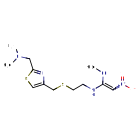
Structure for Nizatidine (DB00585)
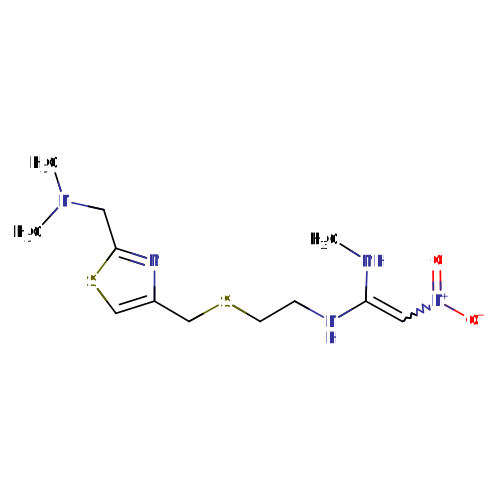
- Weight
- Average: 331.45
Monoisotopic: 331.113667284 - Chemical Formula
- C12H21N5O2S2
- Synonyms
- N-(4-(6-Methylamino-7-nitro-2-thia-5-aza-6-hepten-1-yl)-2-thiazolylmethyl)-N,N-dimethylamine
- Nizatidina
- Nizatidine
- Nizatidinum
- External IDs
- LY-139037

Pharmacology
- Indication
For the treatment of acid-reflux disorders (GERD), peptic ulcer disease, active benign gastric ulcer, and active duodenal ulcer.
 Reduce drug development failure ratesBuild, train, & validate machine-learning modelswith evidence-based and structured datasets.Build, train, & validate predictive machine-learning models with structured datasets.
- Associated Conditions
Indication Type Indication Combined Product Details Approval Level Age Group Patient Characteristics Dose Form Treatment of Duodenal ulcer •••••••••••• Management of Duodenal ulcer •••••••••••• Treatment of Esophagitis •••••••••••• Treatment of Gerd •••••••••••• Treatment of Gastric ulcer •••••••••••• - Contraindications & Blackbox Warnings
 Prevent Adverse Drug Events TodayTap into our Clinical API for life-saving information on contraindications & blackbox warnings, population restrictions, harmful risks, & more.Avoid life-threatening adverse drug events with our Clinical API
- Pharmacodynamics
Nizatidine is a competitive, reversible inhibitor of histamine at the histamine H2-receptors, particularly those in the gastric parietal cells. By inhibiting the action of histamine on stomach cells, nizatidine reduces stomach acid production. Nizatidine had no demonstrable antiandrogenic action. Full-dose therapy for the problems treated by nizatidine lasts no longer than 8 weeks. It has been demonstrated that treatment with a reduced dose of nizatidine is effective as maintenance therapy following healing of active duodenal ulcers.
- Mechanism of action
Nizatidine competes with histamine for binding at the H2-receptors on the gastric basolateral membrane of parietal cells. Competitive inhibition results in reduction of basal and nocturnal gastric acid secretions. The drug also decreases the gastric acid response to stimuli such as food, caffeine, insulin, betazole, or pentagastrin.
Target Actions Organism AHistamine H2 receptor antagonistHumans - Absorption
Rapid (bioavailability of nizatidine exceeds 70%)
- Volume of distribution
- 0.8 to 1.5 L/kg
- Protein binding
35%
- Metabolism
Hepatic. Less than 7% of an oral dose is metabolized as N2-monodes-methylnizatidine, an H2-receptor antagonist, which is the principal metabolite excreted in the urine. Other likely metabolites are the N2-oxide (less than 5% of the dose) and the S-oxide (less than 6% of the dose).
Hover over products below to view reaction partners
- Route of elimination
Not Available
- Half-life
1-2 hours
- Clearance
- 40-60 L/h
- 7 – 14 L/h [functionally anephric patients]
- Adverse Effects
 Improve decision support & research outcomesWith structured adverse effects data, including: blackbox warnings, adverse reactions, warning & precautions, & incidence rates. View sample adverse effects data in our new Data Library!Improve decision support & research outcomes with our structured adverse effects data.
- Toxicity
Oral, rat LD50: 301 mg/kg. Symptoms of overdose include cholinergic-type effects including lacrimation, salivation, emesis, miosis, and diarrhea.
- Pathways
Pathway Category Nizatidine Action Pathway Drug action - Pharmacogenomic Effects/ADRs
- Not Available
Interactions
- Drug Interactions
- This information should not be interpreted without the help of a healthcare provider. If you believe you are experiencing an interaction, contact a healthcare provider immediately. The absence of an interaction does not necessarily mean no interactions exist.
Drug Interaction Integrate drug-drug
interactions in your softwareAcebutolol Nizatidine may increase the bradycardic activities of Acebutolol. Acetylcholine The risk or severity of adverse effects can be increased when Nizatidine is combined with Acetylcholine. Acipimox The risk or severity of myopathy, rhabdomyolysis, and myoglobinuria can be increased when Nizatidine is combined with Acipimox. Aclidinium Nizatidine may increase the neuromuscular blocking activities of Aclidinium. Alendronic acid The risk or severity of myopathy, rhabdomyolysis, and myoglobinuria can be increased when Nizatidine is combined with Alendronic acid. - Food Interactions
- Avoid alcohol.
- Limit caffeine intake.
- Take with or without food. The absorption is unaffected by food.
Products
 Drug product information from 10+ global regionsOur datasets provide approved product information including:dosage, form, labeller, route of administration, and marketing period.Access drug product information from over 10 global regions.
- Product Images
- International/Other Brands
- Acinon / Tazac (Eli Lilly)
- Brand Name Prescription Products
Name Dosage Strength Route Labeller Marketing Start Marketing End Region Image Axid Solution 15 mg/1mL Oral Physicians Total Care, Inc. 2006-12-07 2009-06-30 US 
Axid Capsule 300 mg/1 Oral Glaxosmithkline Inc 2007-03-01 2010-01-01 US Axid Capsule 300 mg Oral Pendopharm Division Of Pharmascience Inc 1988-12-31 Not applicable Canada 
Axid Capsule 150 mg Oral Pendopharm Division Of Pharmascience Inc 1988-12-31 Not applicable Canada Axid Capsule 300 mg/1 Oral Physicians Total Care, Inc. 2000-11-14 2011-05-31 US - Generic Prescription Products
Name Dosage Strength Route Labeller Marketing Start Marketing End Region Image Apo-nizatidine Capsule 150 mg Oral Apotex Corporation 1998-12-31 2019-12-02 Canada Apo-nizatidine Capsule 300 mg Oral Apotex Corporation 1998-12-31 2019-12-02 Canada Dom-nizatidine 150mg Capsules Capsule 150 mg Oral Dominion Pharmacal 2001-10-31 Not applicable Canada Gen-nizatidine Capsule 150 mg Oral Genpharm Ulc 2002-07-12 2010-08-04 Canada Gen-nizatidine Capsule 300 mg Oral Genpharm Ulc 2002-07-12 2010-08-04 Canada - Over the Counter Products
Name Dosage Strength Route Labeller Marketing Start Marketing End Region Image Axid Ar Tablet, film coated 75 mg/1 Oral Wyeth Consumer Healthcare Llc 1996-05-09 2012-08-31 US


Categories
- ATC Codes
- A02BA04 — Nizatidine
- Drug Categories
- Acid Reducers
- Agents Causing Muscle Toxicity
- Alimentary Tract and Metabolism
- Anti-Ulcer Agents
- Cholinesterase Inhibitors
- Drugs for Acid Related Disorders
- Drugs for Peptic Ulcer and Gastro-Oesophageal Reflux Disease (Gord)
- Gastric Acid Lowering Agents
- Gastrointestinal Agents
- Histamine Agents
- Histamine Antagonists
- Histamine H2 Antagonists
- Neurotransmitter Agents
- P-glycoprotein substrates
- Sulfur Compounds
- Thiazoles
- Chemical TaxonomyProvided by Classyfire
- Description
- This compound belongs to the class of organic compounds known as 2,4-disubstituted thiazoles. These are compounds containing a thiazole ring substituted at the positions 2 and 3.
- Kingdom
- Organic compounds
- Super Class
- Organoheterocyclic compounds
- Class
- Azoles
- Sub Class
- Thiazoles
- Direct Parent
- 2,4-disubstituted thiazoles
- Alternative Parents
- Aralkylamines / Heteroaromatic compounds / Trialkylamines / C-nitro compounds / Sulfenyl compounds / Propargyl-type 1,3-dipolar organic compounds / Organic oxoazanium compounds / Dialkylthioethers / Dialkylamines / Azacyclic compounds show 4 more
- Substituents
- 2,4-disubstituted 1,3-thiazole / Allyl-type 1,3-dipolar organic compound / Amine / Aralkylamine / Aromatic heteromonocyclic compound / Azacycle / C-nitro compound / Dialkylthioether / Heteroaromatic compound / Hydrocarbon derivative show 17 more
- Molecular Framework
- Aromatic heteromonocyclic compounds
- External Descriptors
- C-nitro compound, tertiary amino compound, carboxamidine, 1,3-thiazole, organic sulfide (CHEBI:7601)
- Affected organisms
- Humans and other mammals
Chemical Identifiers
- UNII
- P41PML4GHR
- CAS number
- 76963-41-2
- InChI Key
- SGXXNSQHWDMGGP-UHFFFAOYSA-N
- InChI
- InChI=1S/C12H21N5O2S2/c1-13-11(6-17(18)19)14-4-5-20-8-10-9-21-12(15-10)7-16(2)3/h6,9,13-14H,4-5,7-8H2,1-3H3
- IUPAC Name
- dimethyl[(4-{[(2-{[1-(methylamino)-2-nitroethenyl]amino}ethyl)sulfanyl]methyl}-1,3-thiazol-2-yl)methyl]amine
- SMILES
- CNC(NCCSCC1=CSC(CN(C)C)=N1)=C[N+]([O-])=O
References
- Synthesis Reference
Charles W. Ryan, Bruce A. Slomski, "Synthesis of nizatidine intermediate." U.S. Patent US4777260, issued June, 1983.
US4777260- General References
- Not Available
- External Links
- Human Metabolome Database
- HMDB0259636
- KEGG Drug
- D00440
- KEGG Compound
- C07270
- PubChem Compound
- 3033637
- PubChem Substance
- 46507554
- ChemSpider
- 4356
- 42319
- ChEBI
- 7601
- ChEMBL
- CHEMBL3183075
- Therapeutic Targets Database
- DAP000339
- PharmGKB
- PA164752234
- RxList
- RxList Drug Page
- Drugs.com
- Drugs.com Drug Page
- Wikipedia
- Nizatidine
- FDA label
- Download (380 KB)
Clinical Trials
- Clinical Trials
Phase Status Purpose Conditions Count 4 Completed Prevention Aspiration of Gastric Contents 1 4 Completed Treatment Schizophrenia 1 4 Not Yet Recruiting Treatment Gastritis 1 3 Completed Treatment Gastro-esophageal Reflux Disease (GERD) / Heartburn 1 1 Completed Basic Science Gastroparesis 1
Pharmacoeconomics
- Manufacturers
- Smithkline beecham corp dba glaxosmithkline
- Apotex inc
- Dr reddys laboratories ltd
- Genpharm inc
- Ivax pharmaceuticals inc sub teva pharmaceuticals usa
- Mylan pharmaceuticals inc
- Sandoz inc
- Teva pharmaceuticals usa inc
- Watson laboratories inc
- Braintree laboratories inc
- Amneal pharmaceuticals
- Wyeth consumer healthcare
- Packagers
- Affordable Pharmaceuticals LLC
- Amneal Pharmaceuticals
- Apotex Inc.
- Braintree Laboratories Inc.
- Cardinal Health
- Dispensing Solutions
- Diversified Healthcare Services Inc.
- Doctor Reddys Laboratories Ltd.
- Eon Labs
- H.J. Harkins Co. Inc.
- Lyne Laboratories Inc.
- Murfreesboro Pharmaceutical Nursing Supply
- Mylan
- Novopharm Ltd.
- Par Pharmaceuticals
- Patheon Inc.
- PD-Rx Pharmaceuticals Inc.
- Pharmedix
- Physicians Total Care Inc.
- Preferred Pharmaceuticals Inc.
- Prescript Pharmaceuticals
- Promex Medical Inc.
- Rebel Distributors Corp.
- Reliant Pharmaceuticals
- Sandhills Packaging Inc.
- Southwood Pharmaceuticals
- Stat Rx Usa
- Teva Pharmaceutical Industries Ltd.
- Torpharm Inc.
- UDL Laboratories
- Vangard Labs Inc.
- Watson Pharmaceuticals
- Wyeth Pharmaceuticals
- Dosage Forms
Form Route Strength Capsule Oral 150 mg/1 Capsule Oral 300 mg/1 Injection, solution Intravenous Solution Oral 15 mg/1mL Solution Intravenous 25 mg/ml Tablet, film coated Oral 75 mg/1 Solution Parenteral 102 mg Capsule Oral Capsule Oral 150 ug/1 Capsule Oral 300 ug/1 Capsule Oral 150 mg / cap Capsule Oral 300 mg / cap Injection, solution Intravenous 100 MG/4ML Injection, solution Intravenous 150 MG/6ML Injection, solution Intravenous 300 MG/12ML Capsule, coated Oral 150 mg Capsule, coated Oral 300 mg Capsule Oral 150 mg Capsule Oral 300 mg - Prices
Unit description Cost Unit Axid 300 mg pulvule 6.0USD each Nizatidine 300 mg capsule 4.97USD capsule Axid 300 mg Capsule 3.98USD capsule Axid 150 mg pulvule 3.62USD each Nizatidine 150 mg capsule 2.48USD capsule Axid 150 mg Capsule 2.06USD capsule Apo-Nizatidine 300 mg Capsule 0.96USD capsule Novo-Nizatidine 300 mg Capsule 0.96USD capsule Pms-Nizatidine 300 mg Capsule 0.96USD capsule Axid 15 mg/ml Solution 0.84USD ml Nizatidine 15 mg/ml Solution 0.76USD ml Apo-Nizatidine 150 mg Capsule 0.53USD capsule Gen-Nizatidine 150 mg Capsule 0.53USD capsule Novo-Nizatidine 150 mg Capsule 0.53USD capsule Pms-Nizatidine 150 mg Capsule 0.53USD capsule Axid ar 75 mg tablet 0.3USD tablet DrugBank does not sell nor buy drugs. Pricing information is supplied for informational purposes only.- Patents
Patent Number Pediatric Extension Approved Expires (estimated) Region US6930119 No 2005-08-16 2022-07-17 US
Properties
- State
- Solid
- Experimental Properties
Property Value Source melting point (°C) 130-132 °C PhysProp water solubility 10-33mg/mL Not Available logP 1.1 Not Available - Predicted Properties
Property Value Source Water Solubility 0.0386 mg/mL ALOGPS logP 0.7 ALOGPS logP 0.77 Chemaxon logS -3.9 ALOGPS pKa (Strongest Basic) 6.54 Chemaxon Physiological Charge 0 Chemaxon Hydrogen Acceptor Count 6 Chemaxon Hydrogen Donor Count 2 Chemaxon Polar Surface Area 83.33 Å2 Chemaxon Rotatable Bond Count 10 Chemaxon Refractivity 95.84 m3·mol-1 Chemaxon Polarizability 35.54 Å3 Chemaxon Number of Rings 1 Chemaxon Bioavailability 1 Chemaxon Rule of Five Yes Chemaxon Ghose Filter Yes Chemaxon Veber's Rule No Chemaxon MDDR-like Rule No Chemaxon - Predicted ADMET Features
Property Value Probability Human Intestinal Absorption + 0.9572 Blood Brain Barrier + 0.5 Caco-2 permeable - 0.589 P-glycoprotein substrate Substrate 0.8357 P-glycoprotein inhibitor I Non-inhibitor 0.8947 P-glycoprotein inhibitor II Non-inhibitor 0.8861 Renal organic cation transporter Non-inhibitor 0.7832 CYP450 2C9 substrate Non-substrate 0.8108 CYP450 2D6 substrate Non-substrate 0.6721 CYP450 3A4 substrate Non-substrate 0.5916 CYP450 1A2 substrate Non-inhibitor 0.9045 CYP450 2C9 inhibitor Non-inhibitor 0.9072 CYP450 2D6 inhibitor Non-inhibitor 0.9231 CYP450 2C19 inhibitor Non-inhibitor 0.9025 CYP450 3A4 inhibitor Non-inhibitor 0.8508 CYP450 inhibitory promiscuity Low CYP Inhibitory Promiscuity 0.7826 Ames test Non AMES toxic 0.6129 Carcinogenicity Non-carcinogens 0.9182 Biodegradation Not ready biodegradable 0.9295 Rat acute toxicity 2.4350 LD50, mol/kg Not applicable hERG inhibition (predictor I) Strong inhibitor 0.6244 hERG inhibition (predictor II) Non-inhibitor 0.8734
Spectra
- Mass Spec (NIST)
- Not Available
- Spectra
Spectrum Spectrum Type Splash Key Predicted 1H NMR Spectrum 1D NMR Not Applicable Predicted 13C NMR Spectrum 1D NMR Not Applicable - Chromatographic Properties
Collision Cross Sections (CCS)
Adduct CCS Value (Å2) Source type Source [M-H]- 179.2270533 predictedDarkChem Lite v0.1.0 [M-H]- 182.5691533 predictedDarkChem Lite v0.1.0 [M-H]- 160.2686 predictedDeepCCS 1.0 (2019) [M+H]+ 179.2759533 predictedDarkChem Lite v0.1.0 [M+H]+ 182.2996533 predictedDarkChem Lite v0.1.0 [M+H]+ 163.72098 predictedDeepCCS 1.0 (2019) [M+Na]+ 179.2014533 predictedDarkChem Lite v0.1.0 [M+Na]+ 182.7331533 predictedDarkChem Lite v0.1.0 [M+Na]+ 171.79808 predictedDeepCCS 1.0 (2019)
Targets

- Kind
- Protein
- Organism
- Humans
- Pharmacological action
- Yes
- Actions
- Antagonist
- General Function
- Histamine receptor activity
- Specific Function
- The H2 subclass of histamine receptors mediates gastric acid secretion. Also appears to regulate gastrointestinal motility and intestinal secretion. Possible role in regulating cell growth and diff...
- Gene Name
- HRH2
- Uniprot ID
- P25021
- Uniprot Name
- Histamine H2 receptor
- Molecular Weight
- 40097.65 Da
References
- Chen X, Ji ZL, Chen YZ: TTD: Therapeutic Target Database. Nucleic Acids Res. 2002 Jan 1;30(1):412-5. [Article]
- Enriz RD, Jauregui EA: [Theoretical conformation study of tiotidine and nizatidine, two strong histamine H2-receptor antagonists]. Acta Cient Venez. 1991;42(2):70-6. [Article]
- Meredith CG, Speeg KV Jr, Schenker S: Nizatidine, a new histamine H2-receptor antagonist, and hepatic oxidative drug metabolism in the rat: a comparison with structurally related compounds. Toxicol Appl Pharmacol. 1985 Feb;77(2):315-24. [Article]
- Lin TM, Evans DC, Warrick MW, Pioch RP: Actions of nizatidine, a selective histamine H2-receptor antagonist, on gastric acid secretion in dogs, rats and frogs. J Pharmacol Exp Ther. 1986 Nov;239(2):406-10. [Article]
- Okabe S, Takeuchi K, Okada M, Kumadaki Y, Nakata M, Nakata H: [Effects of nizatidine, a new histamine H2-receptor antagonist, on gastric acid secretion and various gastric and duodenal lesions in rats: comparison with cimetidine]. Nihon Yakurigaku Zasshi. 1989 Mar;93(3):133-44. [Article]
- Kounenis G, Koutsoviti-Papadopoulou M, Elezoglou V: The excitatory effect of the new histamine H2-receptor antagonist nizatidine (LY 139037) on the guinea pig ileum. J Pharmacobiodyn. 1987 Nov;10(11):669-72. [Article]
Enzymes
- Kind
- Protein
- Organism
- Humans
- Pharmacological action
- Unknown
- Actions
- Inhibitor
- General Function
- Identical protein binding
- Specific Function
- Esterase with broad substrate specificity. Contributes to the inactivation of the neurotransmitter acetylcholine. Can degrade neurotoxic organophosphate esters.
- Gene Name
- BCHE
- Uniprot ID
- P06276
- Uniprot Name
- Cholinesterase
- Molecular Weight
- 68417.575 Da
References
- Laine-Cessac P, Turcant A, Premel-Cabic A, Boyer J, Allain P: Inhibition of cholinesterases by histamine 2 receptor antagonist drugs. Res Commun Chem Pathol Pharmacol. 1993 Feb;79(2):185-93. [Article]
Transporters
- Kind
- Protein
- Organism
- Humans
- Pharmacological action
- Unknown
- Actions
- Substrate
- General Function
- Xenobiotic-transporting atpase activity
- Specific Function
- Energy-dependent efflux pump responsible for decreased drug accumulation in multidrug-resistant cells.
- Gene Name
- ABCB1
- Uniprot ID
- P08183
- Uniprot Name
- Multidrug resistance protein 1
- Molecular Weight
- 141477.255 Da
References
- Dahan A, Sabit H, Amidon GL: The H2 receptor antagonist nizatidine is a P-glycoprotein substrate: characterization of its intestinal epithelial cell efflux transport. AAPS J. 2009 Jun;11(2):205-13. doi: 10.1208/s12248-009-9092-5. Epub 2009 Mar 25. [Article]

Drug created at June 13, 2005 13:24 / Updated at April 23, 2024 11:38