Identification
- Summary
Ethionamide is a second line antitubercular agent used to treat tuberculosis when other treatments have failed.
- Brand Names
- Trecator
- Generic Name
- Ethionamide
- DrugBank Accession Number
- DB00609
- Background
A second-line antitubercular agent that inhibits mycolic acid synthesis. It also may be used for treatment of leprosy. (From Smith and Reynard, Textbook of Pharmacology, 1992, p868)
- Type
- Small Molecule
- Groups
- Approved
- Structure
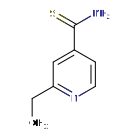
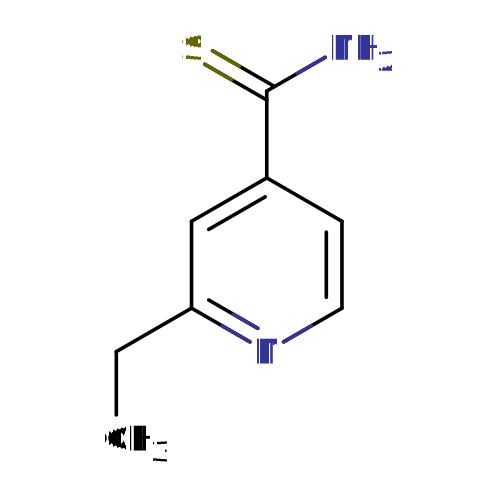
Structure for Ethionamide (DB00609)
- Weight
- Average: 166.243
Monoisotopic: 166.05646902 - Chemical Formula
- C8H10N2S
- Synonyms
- 2-ethyl-4-thiopyridylamide
- 2-ethylthioisonicotinamide
- ETH
- Ethinamide
- Ethionamide
- Ethionamidum
- Ethioniamide
- Ethylisothiamide
- Ethyonomide
- Etionamid
- Etionamida
- Etionamide
- Etioniamid
- ETP
- External IDs
- 1314 TH
- 1314-TH
- Bayer 5312
- NSC-255115

Pharmacology
- Indication
For use in the treatment of pulmonary and extrapulmonary tuberculosis when other antitubercular drugs have failed.
 Reduce drug development failure ratesBuild, train, & validate machine-learning modelswith evidence-based and structured datasets.Build, train, & validate predictive machine-learning models with structured datasets.
- Associated Conditions
Indication Type Indication Combined Product Details Approval Level Age Group Patient Characteristics Dose Form Used in combination to treat Active tuberculosis •••••••••••• - Contraindications & Blackbox Warnings
 Prevent Adverse Drug Events TodayTap into our Clinical API for life-saving information on contraindications & blackbox warnings, population restrictions, harmful risks, & more.Avoid life-threatening adverse drug events with our Clinical API
- Pharmacodynamics
Ethinamate is bacteriostatic against M. tuberculosis. In a study examining ethionamide resistance, ethionamide administered orally initially decreased the number of culturable Mycobacterium tuberculosis organisms from the lungs of H37Rv infected mice. Drug resistance developed with continued ethionamide monotherapy, but did not occur when mice received ethionamide in combination with streptomycin or isoniazid.
- Mechanism of action
Ethionamide may be bacteriostatic or bactericidal in action, depending on the concentration of the drug attained at the site of infection and the susceptibility of the infecting organism. Ethionamide, like prothionamide and pyrazinamide, is a nicotinic acid derivative related to isoniazid. It is thought that ethionamide undergoes intracellular modification and acts in a similar fashion to isoniazid. Isoniazid inhibits the synthesis of mycoloic acids, an essential component of the bacterial cell wall. Specifically isoniazid inhibits InhA, the enoyl reductase from Mycobacterium tuberculosis, by forming a covalent adduct with the NAD cofactor. It is the INH-NAD adduct that acts as a slow, tight-binding competitive inhibitor of InhA.
Target Actions Organism AEnoyl-[acyl-carrier-protein] reductase [NADH] inhibitorMycobacterium tuberculosis UCatalase-peroxidase other/unknownMycobacterium tuberculosis - Absorption
Essentially completely absorbed following oral administration and not subjected to any appreciable first pass metabolism. Bioavailability approximately 100%.
- Volume of distribution
- 93.5 L [healthy volunteers]
- Protein binding
Approximately 30% bound to proteins.
- Metabolism
Hepatic and extensive. Metabolized to the active metabolite sulfoxide, and several inactive metabolites. The sulphoxide metabolite has been demonstrated to have antimicrobial activity against Mycobacterium tuberculosis.
Hover over products below to view reaction partners
- Route of elimination
Less than 1% of the oral dose is excreted as ethionamide in urine. Ethionamide is extensively metabolized to active and inactive metabolites.
- Half-life
2 to 3 hours
- Clearance
Not Available
- Adverse Effects
 Improve decision support & research outcomesWith structured adverse effects data, including: blackbox warnings, adverse reactions, warning & precautions, & incidence rates. View sample adverse effects data in our new Data Library!Improve decision support & research outcomes with our structured adverse effects data.
- Toxicity
Symptoms of overdose include convulsions, nausea, and vomiting.
- Pathways
- Not Available
- Pharmacogenomic Effects/ADRs
- Not Available
Interactions
- Drug Interactions
- This information should not be interpreted without the help of a healthcare provider. If you believe you are experiencing an interaction, contact a healthcare provider immediately. The absence of an interaction does not necessarily mean no interactions exist.
Drug Interaction Integrate drug-drug
interactions in your softwareAcenocoumarol The risk or severity of bleeding can be increased when Ethionamide is combined with Acenocoumarol. Ambroxol The risk or severity of methemoglobinemia can be increased when Ethionamide is combined with Ambroxol. Articaine The risk or severity of methemoglobinemia can be increased when Ethionamide is combined with Articaine. Bacillus calmette-guerin substrain russian BCG-I live antigen The therapeutic efficacy of Bacillus calmette-guerin substrain russian BCG-I live antigen can be decreased when used in combination with Ethionamide. BCG vaccine The therapeutic efficacy of BCG vaccine can be decreased when used in combination with Ethionamide. - Food Interactions
- Take with or without food. Taking Ethionamide with food may reduce gastrointestinal upset.
Products
 Drug product information from 10+ global regionsOur datasets provide approved product information including:dosage, form, labeller, route of administration, and marketing period.Access drug product information from over 10 global regions.
- International/Other Brands
- Ethatyl (Sanofi) / Ethide (Lupin) / Ethiokox (Radicura) / Ethomid (Vesalius Pharma) / Etionamida (AC Farma) / Etomid (Macleods) / Eton (Umeda) / Etyomid (Koçak) / Myobid (Panacea) / Trecator-SC / Tubermin (Meiji Seika Kaisha)
- Brand Name Prescription Products
Name Dosage Strength Route Labeller Marketing Start Marketing End Region Image Trecator Tablet, film coated 250 mg/1 Oral Wyeth Pharmaceuticals Llc, a Subsidiary of Pfizer Inc. 2004-11-08 Not applicable US 
Categories
- ATC Codes
- J04AD03 — Ethionamide
- Drug Categories
- Anti-Bacterial Agents
- Anti-Infective Agents
- Antiinfectives for Systemic Use
- Antimycobacterials
- Drugs causing inadvertant photosensitivity
- Drugs for Treatment of Tuberculosis
- Fatty Acid Synthesis Inhibitors
- Hypolipidemic Agents
- Isonicotinic Acids
- Photosensitizing Agents
- Pyridines
- Thiocarbamide Derivatives
- Chemical TaxonomyProvided by Classyfire
- Description
- This compound belongs to the class of organic compounds known as pyridines and derivatives. These are compounds containing a pyridine ring, which is a six-member aromatic heterocycle which consists of one nitrogen atom and five carbon atoms.
- Kingdom
- Organic compounds
- Super Class
- Organoheterocyclic compounds
- Class
- Pyridines and derivatives
- Sub Class
- Not Available
- Direct Parent
- Pyridines and derivatives
- Alternative Parents
- Thioamides / Heteroaromatic compounds / Thiocarboxylic acid amides / Azacyclic compounds / Thiocarbonyl compounds / Organopnictogen compounds / Organonitrogen compounds / Hydrocarbon derivatives
- Substituents
- Aromatic heteromonocyclic compound / Azacycle / Heteroaromatic compound / Hydrocarbon derivative / Organic nitrogen compound / Organonitrogen compound / Organopnictogen compound / Organosulfur compound / Pyridine / Thioamide
- Molecular Framework
- Aromatic heteromonocyclic compounds
- External Descriptors
- pyridines, thiocarboxamide (CHEBI:4885)
- Affected organisms
- Mycobacteria
Chemical Identifiers
- UNII
- OAY8ORS3CQ
- CAS number
- 536-33-4
- InChI Key
- AEOCXXJPGCBFJA-UHFFFAOYSA-N
- InChI
- InChI=1S/C8H10N2S/c1-2-7-5-6(8(9)11)3-4-10-7/h3-5H,2H2,1H3,(H2,9,11)
- IUPAC Name
- 2-ethylpyridine-4-carbothioamide
- SMILES
- CCC1=NC=CC(=C1)C(N)=S
References
- Synthesis Reference
Chimie et Atomistique, France: British Patent 800,250: August 20, 1958.
- General References
- FDA Approved Drugs: Trecator® oral tablets [Link]
- External Links
- Human Metabolome Database
- HMDB0014747
- KEGG Drug
- D00591
- KEGG Compound
- C07665
- PubChem Compound
- 2761171
- PubChem Substance
- 46506077
- ChemSpider
- 2041901
- BindingDB
- 50239976
- 4127
- ChEBI
- 4885
- ChEMBL
- CHEMBL1441
- ZINC
- ZINC000003872520
- Therapeutic Targets Database
- DAP001141
- PharmGKB
- PA164768738
- PDBe Ligand
- 1JA
- RxList
- RxList Drug Page
- Drugs.com
- Drugs.com Drug Page
- Wikipedia
- Ethionamide
- PDB Entries
- 7f72
- FDA label
- Download (79.3 KB)
- MSDS
- Download (50.3 KB)
Clinical Trials
- Clinical Trials
Phase Status Purpose Conditions Count 2 Recruiting Treatment Rifampicin- and Isoniazid-Susceptible Pulmonary Tuberculosis (TB) 1 2, 3 Completed Treatment Extensively Drug Resistant Tuberculosis / Multidrug Resistant Tuberculosis / Tuberculosis (TB) 1 0 Terminated Treatment Osteomyelitis 1 Not Available Completed Not Available Coronavirus Disease 2019 (COVID‑19) / Human Immunodeficiency Virus (HIV) Infections 1 Not Available Completed Treatment Human Immunodeficiency Virus (HIV) Infections / Tuberculosis (TB) 1
Pharmacoeconomics
- Manufacturers
- Wyeth pharmaceuticals inc
- Packagers
- Belgomex Sprl
- Dept Health Central Pharmacy
- Norwich Pharmaceuticals Inc.
- Wyeth Pharmaceuticals
- Dosage Forms
Form Route Strength Tablet Oral Tablet Oral 250 mg Tablet, film coated Oral 250 mg/1 Tablet, coated Oral 250 mg Tablet, film coated Oral 250 mg - Prices
Unit description Cost Unit Trecator 250 mg tablet 4.31USD tablet Trecator-SC 250 mg tablet 3.21USD tablet DrugBank does not sell nor buy drugs. Pricing information is supplied for informational purposes only.- Patents
- Not Available
Properties
- State
- Solid
- Experimental Properties
Property Value Source melting point (°C) 166 Chimie et Atomistique, France: British Patent 800,250: August 20, 1958. water solubility Practically insoluble Not Available logP 0.5 Not Available - Predicted Properties
Property Value Source Water Solubility 0.839 mg/mL ALOGPS logP 1.88 ALOGPS logP 1.33 Chemaxon logS -2.3 ALOGPS pKa (Strongest Acidic) 11.89 Chemaxon pKa (Strongest Basic) 5 Chemaxon Physiological Charge 0 Chemaxon Hydrogen Acceptor Count 1 Chemaxon Hydrogen Donor Count 1 Chemaxon Polar Surface Area 38.91 Å2 Chemaxon Rotatable Bond Count 2 Chemaxon Refractivity 50.19 m3·mol-1 Chemaxon Polarizability 17.99 Å3 Chemaxon Number of Rings 1 Chemaxon Bioavailability 1 Chemaxon Rule of Five Yes Chemaxon Ghose Filter Yes Chemaxon Veber's Rule Yes Chemaxon MDDR-like Rule No Chemaxon - Predicted ADMET Features
Property Value Probability Human Intestinal Absorption + 0.9797 Blood Brain Barrier + 0.9476 Caco-2 permeable + 0.6962 P-glycoprotein substrate Non-substrate 0.7714 P-glycoprotein inhibitor I Non-inhibitor 0.9646 P-glycoprotein inhibitor II Non-inhibitor 1.0 Renal organic cation transporter Non-inhibitor 0.8178 CYP450 2C9 substrate Non-substrate 0.8459 CYP450 2D6 substrate Non-substrate 0.7439 CYP450 3A4 substrate Non-substrate 0.8278 CYP450 1A2 substrate Inhibitor 0.9107 CYP450 2C9 inhibitor Non-inhibitor 0.907 CYP450 2D6 inhibitor Non-inhibitor 0.923 CYP450 2C19 inhibitor Non-inhibitor 0.9025 CYP450 3A4 inhibitor Non-inhibitor 0.8309 CYP450 inhibitory promiscuity Low CYP Inhibitory Promiscuity 0.7557 Ames test Non AMES toxic 0.9132 Carcinogenicity Non-carcinogens 0.8337 Biodegradation Not ready biodegradable 0.994 Rat acute toxicity 2.1316 LD50, mol/kg Not applicable hERG inhibition (predictor I) Weak inhibitor 0.9735 hERG inhibition (predictor II) Non-inhibitor 0.9115
Spectra
- Mass Spec (NIST)
- Not Available
- Spectra
- Chromatographic Properties
Collision Cross Sections (CCS)
Adduct CCS Value (Å2) Source type Source [M-H]- 139.177024 predictedDarkChem Lite v0.1.0 [M-H]- 147.7627803 predictedDarkChem Lite v0.1.0 [M-H]- 139.204524 predictedDarkChem Lite v0.1.0 [M-H]- 135.28444 predictedDeepCCS 1.0 (2019) [M+H]+ 139.904524 predictedDarkChem Lite v0.1.0 [M+H]+ 143.1335988 predictedDarkChem Lite v0.1.0 [M+H]+ 139.780524 predictedDarkChem Lite v0.1.0 [M+H]+ 137.90884 predictedDeepCCS 1.0 (2019) [M+Na]+ 139.235624 predictedDarkChem Lite v0.1.0 [M+Na]+ 155.985993 predictedDarkChem Lite v0.1.0 [M+Na]+ 139.432924 predictedDarkChem Lite v0.1.0 [M+Na]+ 146.88191 predictedDeepCCS 1.0 (2019)
Targets

- Kind
- Protein
- Organism
- Mycobacterium tuberculosis
- Pharmacological action
- Yes
- Actions
- Inhibitor
- General Function
- Enoyl-ACP reductase of the type II fatty acid syntase (FAS-II) system, which is involved in the biosynthesis of mycolic acids, a major component of mycobacterial cell walls (PubMed:25227413). Catalyzes the NADH-dependent reduction of the double bond of 2-trans-enoyl-[acyl-carrier protein], an essential step in the fatty acid elongation cycle of the FAS-II pathway (PubMed:7599116). Shows preference for long-chain fatty acyl thioester substrates (>C16), and can also use 2-trans-enoyl-CoAs as alternative substrates (PubMed:7599116). The mycobacterial FAS-II system utilizes the products of the FAS-I system as primers to extend fatty acyl chain lengths up to C56, forming the meromycolate chain that serves as the precursor for final mycolic acids (PubMed:25227413).
- Specific Function
- Enoyl-[acyl-carrier-protein] reductase (nadh) activity
- Gene Name
- inhA
- Uniprot ID
- P9WGR1
- Uniprot Name
- Enoyl-[acyl-carrier-protein] reductase [NADH]
- Molecular Weight
- 28527.55 Da
References
- Morlock GP, Metchock B, Sikes D, Crawford JT, Cooksey RC: ethA, inhA, and katG loci of ethionamide-resistant clinical Mycobacterium tuberculosis isolates. Antimicrob Agents Chemother. 2003 Dec;47(12):3799-805. [Article]
- Banerjee A, Dubnau E, Quemard A, Balasubramanian V, Um KS, Wilson T, Collins D, de Lisle G, Jacobs WR Jr: inhA, a gene encoding a target for isoniazid and ethionamide in Mycobacterium tuberculosis. Science. 1994 Jan 14;263(5144):227-30. [Article]
- Larsen MH, Vilcheze C, Kremer L, Besra GS, Parsons L, Salfinger M, Heifets L, Hazbon MH, Alland D, Sacchettini JC, Jacobs WR Jr: Overexpression of inhA, but not kasA, confers resistance to isoniazid and ethionamide in Mycobacterium smegmatis, M. bovis BCG and M. tuberculosis. Mol Microbiol. 2002 Oct;46(2):453-66. [Article]
- Vilcheze C, Weisbrod TR, Chen B, Kremer L, Hazbon MH, Wang F, Alland D, Sacchettini JC, Jacobs WR Jr: Altered NADH/NAD+ ratio mediates coresistance to isoniazid and ethionamide in mycobacteria. Antimicrob Agents Chemother. 2005 Feb;49(2):708-20. [Article]
- Chen X, Ji ZL, Chen YZ: TTD: Therapeutic Target Database. Nucleic Acids Res. 2002 Jan 1;30(1):412-5. [Article]
- Kind
- Protein
- Organism
- Mycobacterium tuberculosis
- Pharmacological action
- Unknown
- Actions
- Other/unknown
- General Function
- Bifunctional enzyme with both catalase and broad-spectrum peroxidase activity, oxidizing various electron donors including NADP(H) (PubMed:9006925, PubMed:18178143). Protects M.tuberculosis against toxic reactive oxygen species (ROS) including hydrogen peroxide as well as organic peroxides and thus contributes to its survival within host macrophages by countering the phagocyte oxidative burst (PubMed:8658136, PubMed:15165233). Also displays efficient peroxynitritase activity, which may help the bacterium to persist in macrophages (PubMed:10080924).
- Specific Function
- Catalase activity
- Gene Name
- katG
- Uniprot ID
- P9WIE5
- Uniprot Name
- Catalase-peroxidase
- Molecular Weight
- 80604.275 Da
References
- Morlock GP, Metchock B, Sikes D, Crawford JT, Cooksey RC: ethA, inhA, and katG loci of ethionamide-resistant clinical Mycobacterium tuberculosis isolates. Antimicrob Agents Chemother. 2003 Dec;47(12):3799-805. [Article]
- Guo H, Seet Q, Denkin S, Parsons L, Zhang Y: Molecular characterization of isoniazid-resistant clinical isolates of Mycobacterium tuberculosis from the USA. J Med Microbiol. 2006 Nov;55(Pt 11):1527-31. [Article]
- Lavender C, Globan M, Sievers A, Billman-Jacobe H, Fyfe J: Molecular characterization of isoniazid-resistant Mycobacterium tuberculosis isolates collected in Australia. Antimicrob Agents Chemother. 2005 Oct;49(10):4068-74. [Article]
- DeBarber AE, Mdluli K, Bosman M, Bekker LG, Barry CE 3rd: Ethionamide activation and sensitivity in multidrug-resistant Mycobacterium tuberculosis. Proc Natl Acad Sci U S A. 2000 Aug 15;97(17):9677-82. [Article]

Drug created at June 13, 2005 13:24 / Updated at December 02, 2023 06:53