Identification
- Summary
Astemizole is a second generation antihistamine used to treat allergy symptoms.
- Generic Name
- Astemizole
- DrugBank Accession Number
- DB00637
- Background
Astemizole is a long-acting, non-sedating second generation antihistamine used in the treatment of allergy symptoms. It was withdrawn from market by the manufacturer in 1999 due to the potential to cause arrhythmias at high doses, especially when when taken with CYP inhibitors or grapefruit juice.
- Type
- Small Molecule
- Groups
- Approved, Withdrawn
- Structure
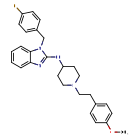
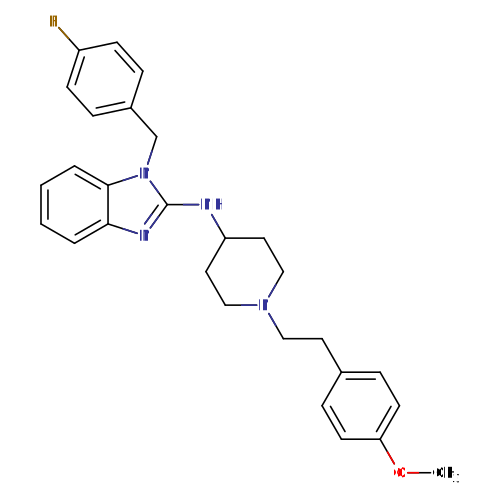
Structure for Astemizole (DB00637)
- Weight
- Average: 458.5703
Monoisotopic: 458.248189839 - Chemical Formula
- C28H31FN4O
- Synonyms
- 1-(p-Fluorobenzyl)-2-((1-(2-(p-methoxyphenyl)ethyl)piperid-4-yl)amino)benzimidazole
- 1-(p-Fluorobenzyl)-2-((1-(p-methoxyphenethyl)-4-piperidyl)amino)benzimidazole
- Astemizol
- Astémizole
- Astemizole
- Astemizolum
- External IDs
- BRN 4830190
- R 42512
- R 43,512
- R43512

Pharmacology
- Indication
Astemizole was indicated for use in the relieving allergy symptoms, particularly rhinitis and conjunctivitis. It has been withdrawn from the market however due to concerns of arrhythmias.
 Reduce drug development failure ratesBuild, train, & validate machine-learning modelswith evidence-based and structured datasets.Build, train, & validate predictive machine-learning models with structured datasets.
- Contraindications & Blackbox Warnings
 Prevent Adverse Drug Events TodayTap into our Clinical API for life-saving information on contraindications & blackbox warnings, population restrictions, harmful risks, & more.Avoid life-threatening adverse drug events with our Clinical API
- Pharmacodynamics
Astemizole is a second generation H1-receptor antagonist. It does not significantly cross the blood brain barrier and therefore does not cause drowsiness or CNS depression at normal doses.
- Mechanism of action
Astemizole competes with histamine for binding at H1-receptor sites in the GI tract, uterus, large blood vessels, and bronchial muscle. This reversible binding of astemizole to H1-receptors suppresses the formation of edema, flare, and pruritus resulting from histaminic activity. As the drug does not readily cross the blood-brain barrier and preferentially binds at H1 receptors in the peripehery rather than within the brain, CNS depression is minimal. Astemizole may also act on H3-receptors, producing adverse effects.
Target Actions Organism AHistamine H1 receptor antagonistHumans UPotassium voltage-gated channel subfamily H member 2 inhibitorHumans UPotassium voltage-gated channel subfamily H member 1 Not Available Humans UMicrotubule-associated protein tau Not Available Humans - Absorption
Rapidly absorbed from the gastrointestinal tract.
- Volume of distribution
Not Available
- Protein binding
96.7%
- Metabolism
Almost completely metabolized in the liver and primarily excreted in the feces.
Hover over products below to view reaction partners
- Route of elimination
Not Available
- Half-life
1 day
- Clearance
Not Available
- Adverse Effects
 Improve decision support & research outcomesWith structured adverse effects data, including: blackbox warnings, adverse reactions, warning & precautions, & incidence rates. View sample adverse effects data in our new Data Library!Improve decision support & research outcomes with our structured adverse effects data.
- Toxicity
LD50=2052mg/kg in mice
- Pathways
Pathway Category Astemizole H1-Antihistamine Action Drug action - Pharmacogenomic Effects/ADRs
- Not Available
Interactions
- Drug Interactions
- This information should not be interpreted without the help of a healthcare provider. If you believe you are experiencing an interaction, contact a healthcare provider immediately. The absence of an interaction does not necessarily mean no interactions exist.
Drug Interaction Integrate drug-drug
interactions in your softwareAbametapir The serum concentration of Astemizole can be increased when it is combined with Abametapir. Abatacept The metabolism of Astemizole can be increased when combined with Abatacept. Abemaciclib The serum concentration of Abemaciclib can be increased when it is combined with Astemizole. Abiraterone The metabolism of Astemizole can be decreased when combined with Abiraterone. Acalabrutinib The metabolism of Astemizole can be decreased when combined with Acalabrutinib. - Food Interactions
- Take on an empty stomach. Food decreases absorption.
Products
 Drug product information from 10+ global regionsOur datasets provide approved product information including:dosage, form, labeller, route of administration, and marketing period.Access drug product information from over 10 global regions.
- International/Other Brands
- Acemiz (Lupin) / Alerkin (Incobra) / Astemison / Astesen (Senosiain) / Hismanal (Janssen) / Histalong (Biofarma) / Lergibrumizol (Bruluart) / Stemiz (Cadila HC)
- Brand Name Prescription Products
Name Dosage Strength Route Labeller Marketing Start Marketing End Region Image Hismanal - Tab 10mg Tablet 10 mg / tab Oral Johnson & Johnson Merck Consumer Pharmaceuticals Of Canada 1997-01-21 1999-03-04 Canada 
Hismanal Suspension 2mg/ml Suspension 2 mg / mL Oral Janssen Pharmaceutica, Division Of Janssen Ortho Inc. 1984-12-31 1997-08-12 Canada Hismanal Tab 10mg Tablet 10 mg / tab Oral Janssen Pharmaceutica, Division Of Janssen Ortho Inc. 1984-12-31 1997-08-12 Canada
Categories
- ATC Codes
- R06AX11 — Astemizole
- Drug Categories
- Anti-Allergic Agents
- Antihistamines for Systemic Use
- Benzimidazoles
- BSEP/ABCB11 Substrates
- BSEP/ABCB11 Substrates with a Narrow Therapeutic Index
- Cytochrome P-450 CYP2D6 Substrates
- Cytochrome P-450 CYP2D6 Substrates with a Narrow Therapeutic Index
- Cytochrome P-450 CYP3A Inhibitors
- Cytochrome P-450 CYP3A Substrates
- Cytochrome P-450 CYP3A4 Inhibitors
- Cytochrome P-450 CYP3A4 Inhibitors (strength unknown)
- Cytochrome P-450 CYP3A4 Substrates
- Cytochrome P-450 CYP3A4 Substrates (strength unknown)
- Cytochrome P-450 CYP3A4 Substrates with a Narrow Therapeutic Index
- Cytochrome P-450 CYP3A5 Substrates
- Cytochrome P-450 CYP3A5 Substrates with a Narrow Therapeutic Index
- Cytochrome P-450 CYP3A7 Substrates
- Cytochrome P-450 CYP3A7 Substrates with a Narrow Therapeutic Index
- Cytochrome P-450 Enzyme Inhibitors
- Cytochrome P-450 Substrates
- Heterocyclic Compounds, Fused-Ring
- Highest Risk QTc-Prolonging Agents
- Histamine Agents
- Histamine Antagonists
- Histamine H1 Antagonists
- Histamine H1 Antagonists, Non-Sedating
- Narrow Therapeutic Index Drugs
- Neurotransmitter Agents
- P-glycoprotein inhibitors
- QTc Prolonging Agents
- Chemical TaxonomyProvided by Classyfire
- Description
- This compound belongs to the class of organic compounds known as benzimidazoles. These are organic compounds containing a benzene ring fused to an imidazole ring (five member ring containing a nitrogen atom, 4 carbon atoms, and two double bonds).
- Kingdom
- Organic compounds
- Super Class
- Organoheterocyclic compounds
- Class
- Benzimidazoles
- Sub Class
- Not Available
- Direct Parent
- Benzimidazoles
- Alternative Parents
- Phenethylamines / Anisoles / Methoxybenzenes / Phenoxy compounds / Alkyl aryl ethers / Fluorobenzenes / Aralkylamines / N-substituted imidazoles / Aryl fluorides / Piperidines show 6 more
- Substituents
- Alkyl aryl ether / Amine / Anisole / Aralkylamine / Aromatic heteropolycyclic compound / Aryl fluoride / Aryl halide / Azacycle / Azole / Benzenoid show 23 more
- Molecular Framework
- Aromatic heteropolycyclic compounds
- External Descriptors
- piperidines, benzimidazoles (CHEBI:2896)
- Affected organisms
- Humans and other mammals
Chemical Identifiers
- UNII
- 7HU6337315
- CAS number
- 68844-77-9
- InChI Key
- GXDALQBWZGODGZ-UHFFFAOYSA-N
- InChI
- InChI=1S/C28H31FN4O/c1-34-25-12-8-21(9-13-25)14-17-32-18-15-24(16-19-32)30-28-31-26-4-2-3-5-27(26)33(28)20-22-6-10-23(29)11-7-22/h2-13,24H,14-20H2,1H3,(H,30,31)
- IUPAC Name
- 1-[(4-fluorophenyl)methyl]-N-{1-[2-(4-methoxyphenyl)ethyl]piperidin-4-yl}-1H-1,3-benzodiazol-2-amine
- SMILES
- COC1=CC=C(CCN2CCC(CC2)NC2=NC3=CC=CC=C3N2CC2=CC=C(F)C=C2)C=C1
References
- Synthesis Reference
Godelieve Irma Christine Maria Heylen, Cornelus Gerardus Maria Janssen, Jurzak Mirek, Henricus Petrus Martinus Maria Van Assouw, "Radiolabeled astemizole and method of making." U.S. Patent US07541476, issued June 02, 2009.
US07541476- General References
- Wang X, Hockerman GH, Green HW 3rd, Babbs CF, Mohammad SI, Gerrard D, Latour MA, London B, Hannon KM, Pond AL: Merg1a K+ channel induces skeletal muscle atrophy by activating the ubiquitin proteasome pathway. FASEB J. 2006 Jul;20(9):1531-3. Epub 2006 May 24. [Article]
- Chong CR, Chen X, Shi L, Liu JO, Sullivan DJ Jr: A clinical drug library screen identifies astemizole as an antimalarial agent. Nat Chem Biol. 2006 Aug;2(8):415-6. Epub 2006 Jul 2. [Article]
- External Links
- Human Metabolome Database
- HMDB0014775
- KEGG Drug
- D00234
- KEGG Compound
- C06832
- PubChem Compound
- 2247
- PubChem Substance
- 46508569
- ChemSpider
- 2160
- BindingDB
- 24226
- 42328
- ChEBI
- 2896
- ChEMBL
- CHEMBL296419
- ZINC
- ZINC000000601274
- Therapeutic Targets Database
- DAP000326
- PharmGKB
- PA448498
- Guide to Pharmacology
- GtP Drug Page
- PDBe Ligand
- XB7
- RxList
- RxList Drug Page
- Drugs.com
- Drugs.com Drug Page
- Wikipedia
- Astemizole
- PDB Entries
- 7kxt / 8x5y
- MSDS
- Download (57.2 KB)
Clinical Trials
Pharmacoeconomics
- Manufacturers
- Not Available
- Packagers
- Not Available
- Dosage Forms
Form Route Strength Suspension Oral 0.1 g Tablet Oral Tablet Oral 10.2 mg Tablet Oral 100 mg Tablet Oral 0.01 g Suspension Oral 100 mg Powder, for solution Oral Tablet Oral 10 mg Tablet Oral 10 mg / tab Suspension Oral 2 mg / mL Solution Oral 5 mg Suspension Oral Tablet Oral Solution Oral 100 mg Capsule, coated Oral - Prices
- Not Available
- Patents
- Not Available
Properties
- State
- Solid
- Experimental Properties
Property Value Source melting point (°C) 149.1 °C PhysProp water solubility 432 mg/L Not Available logP 5.8 Not Available - Predicted Properties
Property Value Source Water Solubility 0.0012 mg/mL ALOGPS logP 5.92 ALOGPS logP 5.39 Chemaxon logS -5.6 ALOGPS pKa (Strongest Basic) 8.73 Chemaxon Physiological Charge 1 Chemaxon Hydrogen Acceptor Count 4 Chemaxon Hydrogen Donor Count 1 Chemaxon Polar Surface Area 42.32 Å2 Chemaxon Rotatable Bond Count 8 Chemaxon Refractivity 135.64 m3·mol-1 Chemaxon Polarizability 52.08 Å3 Chemaxon Number of Rings 5 Chemaxon Bioavailability 1 Chemaxon Rule of Five No Chemaxon Ghose Filter No Chemaxon Veber's Rule No Chemaxon MDDR-like Rule Yes Chemaxon - Predicted ADMET Features
Property Value Probability Human Intestinal Absorption + 1.0 Blood Brain Barrier + 0.765 Caco-2 permeable + 0.5217 P-glycoprotein substrate Substrate 0.8162 P-glycoprotein inhibitor I Inhibitor 0.8563 P-glycoprotein inhibitor II Inhibitor 0.8995 Renal organic cation transporter Inhibitor 0.7708 CYP450 2C9 substrate Non-substrate 0.8732 CYP450 2D6 substrate Substrate 0.8918 CYP450 3A4 substrate Substrate 0.6777 CYP450 1A2 substrate Inhibitor 0.9107 CYP450 2C9 inhibitor Non-inhibitor 0.9071 CYP450 2D6 inhibitor Inhibitor 0.8932 CYP450 2C19 inhibitor Inhibitor 0.8994 CYP450 3A4 inhibitor Non-inhibitor 0.5127 CYP450 inhibitory promiscuity High CYP Inhibitory Promiscuity 0.9096 Ames test Non AMES toxic 0.6444 Carcinogenicity Non-carcinogens 0.9553 Biodegradation Not ready biodegradable 1.0 Rat acute toxicity 2.2847 LD50, mol/kg Not applicable hERG inhibition (predictor I) Strong inhibitor 0.9267 hERG inhibition (predictor II) Inhibitor 0.8575
Spectra
- Mass Spec (NIST)
- Not Available
- Spectra
Spectrum Spectrum Type Splash Key Predicted GC-MS Spectrum - GC-MS Predicted GC-MS splash10-0a4i-1922000000-2742ecd8a8c6af4db428 Predicted MS/MS Spectrum - 10V, Positive (Annotated) Predicted LC-MS/MS splash10-0a4i-0000900000-77d2d1e2fe36c043d63c Predicted MS/MS Spectrum - 10V, Negative (Annotated) Predicted LC-MS/MS splash10-0a4i-0041900000-9f877d4bf52858e41220 Predicted MS/MS Spectrum - 20V, Positive (Annotated) Predicted LC-MS/MS splash10-0a4i-0010900000-8af638ce17c135918f44 Predicted MS/MS Spectrum - 20V, Negative (Annotated) Predicted LC-MS/MS splash10-0a6r-0222900000-a6bc7d01670a90307570 Predicted MS/MS Spectrum - 40V, Positive (Annotated) Predicted LC-MS/MS splash10-092c-1457900000-e2895a845d23ade904e4 Predicted MS/MS Spectrum - 40V, Negative (Annotated) Predicted LC-MS/MS splash10-0939-0394400000-a63203113e881f321dbb Predicted 1H NMR Spectrum 1D NMR Not Applicable Predicted 13C NMR Spectrum 1D NMR Not Applicable - Chromatographic Properties
Collision Cross Sections (CCS)
Adduct CCS Value (Å2) Source type Source [M-H]- 236.0935611 predictedDarkChem Lite v0.1.0 [M-H]- 228.1650611 predictedDarkChem Lite v0.1.0 [M-H]- 205.75719 predictedDeepCCS 1.0 (2019) [M+H]+ 234.9121611 predictedDarkChem Lite v0.1.0 [M+H]+ 228.4828611 predictedDarkChem Lite v0.1.0 [M+H]+ 208.11519 predictedDeepCCS 1.0 (2019) [M+Na]+ 235.1411611 predictedDarkChem Lite v0.1.0 [M+Na]+ 228.4488611 predictedDarkChem Lite v0.1.0 [M+Na]+ 214.20833 predictedDeepCCS 1.0 (2019)
Targets

- Kind
- Protein
- Organism
- Humans
- Pharmacological action
- Yes
- Actions
- Antagonist
- General Function
- Histamine receptor activity
- Specific Function
- In peripheral tissues, the H1 subclass of histamine receptors mediates the contraction of smooth muscles, increase in capillary permeability due to contraction of terminal venules, and catecholamin...
- Gene Name
- HRH1
- Uniprot ID
- P35367
- Uniprot Name
- Histamine H1 receptor
- Molecular Weight
- 55783.61 Da
References
- Salata JJ, Jurkiewicz NK, Wallace AA, Stupienski RF 3rd, Guinosso PJ Jr, Lynch JJ Jr: Cardiac electrophysiological actions of the histamine H1-receptor antagonists astemizole and terfenadine compared with chlorpheniramine and pyrilamine. Circ Res. 1995 Jan;76(1):110-9. [Article]
- Howarth PH, Emanuel MB, Holgate ST: Astemizole, a potent histamine H1-receptor antagonist: effect in allergic rhinoconjunctivitis, on antigen and histamine induced skin weal responses and relationship to serum levels. Br J Clin Pharmacol. 1984 Jul;18(1):1-8. [Article]
- Kaliner MA, Check WA: Non-sedating antihistamines. Allergy Proc. 1988 Nov-Dec;9(6):649-63. [Article]
- Cavero I, Mestre M, Guillon JM, Heuillet E, Roach AG: Preclinical in vitro cardiac electrophysiology: a method of predicting arrhythmogenic potential of antihistamines in humans? Drug Saf. 1999;21 Suppl 1:19-31; discussion 81-7. [Article]
- Llenas J, Cardelus I, Heredia A, de Mora F, Gristwood RW: Cardiotoxicity of histamine and the possible role of histamine in the arrhythmogenesis produced by certain antihistamines. Drug Saf. 1999;21 Suppl 1:33-8; discussion 81-7. [Article]
- Richards DM, Brogden RN, Heel RC, Speight TM, Avery GS: Astemizole. A review of its pharmacodynamic properties and therapeutic efficacy. Drugs. 1984 Jul;28(1):38-61. [Article]
- Krstenansky PM, Cluxton RJ Jr: Astemizole: a long-acting, nonsedating antihistamine. Drug Intell Clin Pharm. 1987 Dec;21(12):947-53. [Article]
- Chen X, Ji ZL, Chen YZ: TTD: Therapeutic Target Database. Nucleic Acids Res. 2002 Jan 1;30(1):412-5. [Article]
- Kind
- Protein
- Organism
- Humans
- Pharmacological action
- Unknown
- Actions
- Inhibitor
- General Function
- Voltage-gated potassium channel activity involved in ventricular cardiac muscle cell action potential repolarization
- Specific Function
- Pore-forming (alpha) subunit of voltage-gated inwardly rectifying potassium channel. Channel properties are modulated by cAMP and subunit assembly. Mediates the rapidly activating component of the ...
- Gene Name
- KCNH2
- Uniprot ID
- Q12809
- Uniprot Name
- Potassium voltage-gated channel subfamily H member 2
- Molecular Weight
- 126653.52 Da
References
- Zhou Z, Vorperian VR, Gong Q, Zhang S, January CT: Block of HERG potassium channels by the antihistamine astemizole and its metabolites desmethylastemizole and norastemizole. J Cardiovasc Electrophysiol. 1999 Jun;10(6):836-43. [Article]
- Chachin M, Katayama Y, Yamada M, Horio Y, Ohmura T, Kitagawa H, Uchida S, Kurachi Y: Epinastine, a nonsedating histamine H1 receptor antagonist, has a negligible effect on HERG channel. Eur J Pharmacol. 1999 Jun 25;374(3):457-60. [Article]
- Taglialatela M, Castaldo P, Pannaccione A, Giorgio G, Genovese A, Marone G, Annunziato L: Cardiac ion channels and antihistamines: possible mechanisms of cardiotoxicity. Clin Exp Allergy. 1999 Jul;29 Suppl 3:182-9. [Article]
- Grzelewska-Rzymowska I, Pietrzkowicz M, Gorska M: [The effect of second generation histamine antagonists on the heart]. Pneumonol Alergol Pol. 2001;69(3-4):217-26. [Article]
- Chiu PJ, Marcoe KF, Bounds SE, Lin CH, Feng JJ, Lin A, Cheng FC, Crumb WJ, Mitchell R: Validation of a [3H]astemizole binding assay in HEK293 cells expressing HERG K+ channels. J Pharmacol Sci. 2004 Jul;95(3):311-9. [Article]
- Kind
- Protein
- Organism
- Humans
- Pharmacological action
- Unknown
- General Function
- Phosphorelay sensor kinase activity
- Specific Function
- Pore-forming (alpha) subunit of a voltage-gated delayed rectifier potassium channel (PubMed:22732247). Channel properties may be modulated by subunit assembly, but not by cyclic nucleotides (By sim...
- Gene Name
- KCNH1
- Uniprot ID
- O95259
- Uniprot Name
- Potassium voltage-gated channel subfamily H member 1
- Molecular Weight
- 111421.76 Da
References
- Garcia-Ferreiro RE, Kerschensteiner D, Major F, Monje F, Stuhmer W, Pardo LA: Mechanism of block of hEag1 K+ channels by imipramine and astemizole. J Gen Physiol. 2004 Oct;124(4):301-17. Epub 2004 Sep 13. [Article]
- Kind
- Protein
- Organism
- Humans
- Pharmacological action
- Unknown
- General Function
- Structural constituent of cytoskeleton
- Specific Function
- Promotes microtubule assembly and stability, and might be involved in the establishment and maintenance of neuronal polarity. The C-terminus binds axonal microtubules while the N-terminus binds neu...
- Gene Name
- MAPT
- Uniprot ID
- P10636
- Uniprot Name
- Microtubule-associated protein tau
- Molecular Weight
- 78927.025 Da
References
- Rojo LE, Alzate-Morales J, Saavedra IN, Davies P, Maccioni RB: Selective interaction of lansoprazole and astemizole with tau polymers: potential new clinical use in diagnosis of Alzheimer's disease. J Alzheimers Dis. 2010;19(2):573-89. doi: 10.3233/JAD-2010-1262. [Article]
Enzymes
- Kind
- Protein
- Organism
- Humans
- Pharmacological action
- Unknown
- Actions
- SubstrateInhibitor
- General Function
- Vitamin d3 25-hydroxylase activity
- Specific Function
- Cytochromes P450 are a group of heme-thiolate monooxygenases. In liver microsomes, this enzyme is involved in an NADPH-dependent electron transport pathway. It performs a variety of oxidation react...
- Gene Name
- CYP3A4
- Uniprot ID
- P08684
- Uniprot Name
- Cytochrome P450 3A4
- Molecular Weight
- 57342.67 Da
References
- Nicolas JM, Whomsley R, Collart P, Roba J: In vitro inhibition of human liver drug metabolizing enzymes by second generation antihistamines. Chem Biol Interact. 1999 Nov 15;123(1):63-79. [Article]
- Matsumoto S, Yamazoe Y: Involvement of multiple human cytochromes P450 in the liver microsomal metabolism of astemizole and a comparison with terfenadine. Br J Clin Pharmacol. 2001 Feb;51(2):133-42. [Article]
- Cvetkovic RS, Goa KL: Lopinavir/ritonavir: a review of its use in the management of HIV infection. Drugs. 2003;63(8):769-802. [Article]
- Goto A, Adachi Y, Inaba A, Nakajima H, Kobayashi H, Sakai K: Identification of human p450 isoforms involved in the metabolism of the antiallergic drug, oxatomide, and its inhibitory effect on enzyme activity. Biol Pharm Bull. 2004 May;27(5):684-90. [Article]
- Goto A, Ueda K, Inaba A, Nakajima H, Kobayashi H, Sakai K: Identification of human P450 isoforms involved in the metabolism of the antiallergic drug, oxatomide, and its kinetic parameters and inhibition constants. Biol Pharm Bull. 2005 Feb;28(2):328-34. [Article]
- Zhou S, Yung Chan S, Cher Goh B, Chan E, Duan W, Huang M, McLeod HL: Mechanism-based inhibition of cytochrome P450 3A4 by therapeutic drugs. Clin Pharmacokinet. 2005;44(3):279-304. doi: 10.2165/00003088-200544030-00005. [Article]
- Flockhart Table of Drug Interactions [Link]
- Kind
- Protein
- Organism
- Humans
- Pharmacological action
- Unknown
- Actions
- Substrate
- General Function
- Oxygen binding
- Specific Function
- Cytochromes P450 are a group of heme-thiolate monooxygenases. In liver microsomes, this enzyme is involved in an NADPH-dependent electron transport pathway. It oxidizes a variety of structurally un...
- Gene Name
- CYP3A5
- Uniprot ID
- P20815
- Uniprot Name
- Cytochrome P450 3A5
- Molecular Weight
- 57108.065 Da
References
- Flockhart Table of Drug Interactions [Link]
- Kind
- Protein
- Organism
- Humans
- Pharmacological action
- Unknown
- Actions
- Substrate
- General Function
- Oxygen binding
- Specific Function
- Cytochromes P450 are a group of heme-thiolate monooxygenases. In liver microsomes, this enzyme is involved in an NADPH-dependent electron transport pathway. It oxidizes a variety of structurally un...
- Gene Name
- CYP3A7
- Uniprot ID
- P24462
- Uniprot Name
- Cytochrome P450 3A7
- Molecular Weight
- 57525.03 Da
References
- Flockhart Table of Drug Interactions [Link]
- Kind
- Protein
- Organism
- Humans
- Pharmacological action
- Unknown
- Actions
- Substrate
- General Function
- Steroid hydroxylase activity
- Specific Function
- Responsible for the metabolism of many drugs and environmental chemicals that it oxidizes. It is involved in the metabolism of drugs such as antiarrhythmics, adrenoceptor antagonists, and tricyclic...
- Gene Name
- CYP2D6
- Uniprot ID
- P10635
- Uniprot Name
- Cytochrome P450 2D6
- Molecular Weight
- 55768.94 Da
References
- Matsumoto S, Yamazoe Y: Involvement of multiple human cytochromes P450 in the liver microsomal metabolism of astemizole and a comparison with terfenadine. Br J Clin Pharmacol. 2001 Feb;51(2):133-42. [Article]
- Kind
- Protein
- Organism
- Humans
- Pharmacological action
- Unknown
- Actions
- Substrate
- General Function
- Steroid hydroxylase activity
- Specific Function
- This enzyme metabolizes arachidonic acid predominantly via a NADPH-dependent olefin epoxidation to all four regioisomeric cis-epoxyeicosatrienoic acids. One of the predominant enzymes responsible f...
- Gene Name
- CYP2J2
- Uniprot ID
- P51589
- Uniprot Name
- Cytochrome P450 2J2
- Molecular Weight
- 57610.165 Da
References
- Matsumoto S, Hirama T, Matsubara T, Nagata K, Yamazoe Y: Involvement of CYP2J2 on the intestinal first-pass metabolism of antihistamine drug, astemizole. Drug Metab Dispos. 2002 Nov;30(11):1240-5. [Article]
- Lee SS, Jeong HE, Liu KH, Ryu JY, Moon T, Yoon CN, Oh SJ, Yun CH, Shin JG: Identification and functional characterization of novel CYP2J2 variants: G312R variant causes loss of enzyme catalytic activity. Pharmacogenet Genomics. 2005 Feb;15(2):105-13. [Article]
- Matsumoto S, Hirama T, Kim HJ, Nagata K, Yamazoe Y: In vitro inhibition of human small intestinal and liver microsomal astemizole O-demethylation: different contribution of CYP2J2 in the small intestine and liver. Xenobiotica. 2003 Jun;33(6):615-23. doi: 10.1080/0049825031000105778 . [Article]
Transporters
- Kind
- Protein
- Organism
- Humans
- Pharmacological action
- Unknown
- Actions
- Inhibitor
- General Function
- Xenobiotic-transporting atpase activity
- Specific Function
- Energy-dependent efflux pump responsible for decreased drug accumulation in multidrug-resistant cells.
- Gene Name
- ABCB1
- Uniprot ID
- P08183
- Uniprot Name
- Multidrug resistance protein 1
- Molecular Weight
- 141477.255 Da
References
- Schwab D, Fischer H, Tabatabaei A, Poli S, Huwyler J: Comparison of in vitro P-glycoprotein screening assays: recommendations for their use in drug discovery. J Med Chem. 2003 Apr 24;46(9):1716-25. [Article]
- Ishikawa M, Fujita R, Takayanagi M, Takayanagi Y, Sasaki K: Reversal of acquired resistance to doxorubicin in K562 human leukemia cells by astemizole. Biol Pharm Bull. 2000 Jan;23(1):112-5. [Article]
- Kind
- Protein
- Organism
- Humans
- Pharmacological action
- No
- Actions
- Substrate
- General Function
- Transporter activity
- Specific Function
- Involved in the ATP-dependent secretion of bile salts into the canaliculus of hepatocytes.
- Gene Name
- ABCB11
- Uniprot ID
- O95342
- Uniprot Name
- Bile salt export pump
- Molecular Weight
- 146405.83 Da
References
- Pedersen JM, Matsson P, Bergstrom CA, Hoogstraate J, Noren A, LeCluyse EL, Artursson P: Early identification of clinically relevant drug interactions with the human bile salt export pump (BSEP/ABCB11). Toxicol Sci. 2013 Dec;136(2):328-43. doi: 10.1093/toxsci/kft197. Epub 2013 Sep 6. [Article]

Drug created at June 13, 2005 13:24 / Updated at December 02, 2023 06:53