Identification
- Summary
Pralidoxime is a cholinesterase reactivator used to treat organophosphate poisoning.
- Brand Names
- Atnaa, Duodote, Protopam
- Generic Name
- Pralidoxime
- DrugBank Accession Number
- DB00733
- Background
Pralidoxime is an antidote to organophosphate pesticides and chemicals. Organophosphates bind to the esteratic site of acetylcholinesterase, which results initially in reversible inactivation of the enzyme. If given within 24 hours,after organophosphate exposure, pralidoxime reactivates the enzyme cholinesterase by cleaving the phosphate-ester bond formed between the organophosphate and acetylcholinesterase.
- Type
- Small Molecule
- Groups
- Approved, Vet approved
- Structure
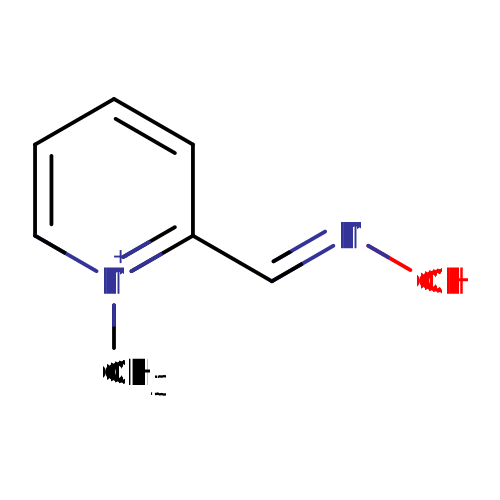
Structure for Pralidoxime (DB00733)
- Weight
- Average: 137.1592
Monoisotopic: 137.07148792 - Chemical Formula
- C7H9N2O
- Synonyms
- 2-PAM
- Pralidoxim
- Pralidoxima
- Pralidoxime
- Pralidoximum
- External IDs
- NSC 164614

Pharmacology
- Indication
For the treatment of poisoning due to those pesticides and chemicals of the organophosphate class which have anticholinesterase activity and in the control of overdosage by anticholinesterase drugs used in the treatment of myasthenia gravis.
 Reduce drug development failure ratesBuild, train, & validate machine-learning modelswith evidence-based and structured datasets.Build, train, & validate predictive machine-learning models with structured datasets.
- Associated Conditions
Indication Type Indication Combined Product Details Approval Level Age Group Patient Characteristics Dose Form Used in combination to treat Toxic effect of organophosphate and carbamate Regimen in combination with: Atropine (DB00572) •••••••••••• Used in combination for symptomatic treatment of Anticholinesterase overdose Combination Product in combination with: Atropine (DB00572) •••••••••••• ••••••••• Used in combination to reverse Anticholinesterase overdose Combination Product in combination with: Atropine (DB00572) •••••••••••• ••••••••• - Contraindications & Blackbox Warnings
 Prevent Adverse Drug Events TodayTap into our Clinical API for life-saving information on contraindications & blackbox warnings, population restrictions, harmful risks, & more.Avoid life-threatening adverse drug events with our Clinical API
- Pharmacodynamics
Pralidoxime is to reactivate cholinesterase (mainly outside of the central nervous system) which has been inactivated by phosphorylation due to an organophosphate pesticide or related compound. The destruction of accumulated acetylcholine can then proceed, and neuromuscular junctions will again function normally. Pralidoxime also slows the process of "aging" of phosphorylated cholinesterase to a nonreactivatable form, and detoxifies certain organophosphates by direct chemical reaction. The drug has its most critical effect in relieving paralysis of the muscles of respiration. Because pralidoxime is less effective in relieving depression of the respiratory center, atropine is always required concomitantly to block the effect of accumulated acetylcholine at this site. Pralidoxime relieves muscarinic signs and symptoms, salivation, bronchospasm, etc., but this action is relatively unimportant since atropine is adequate for this purpose.
- Mechanism of action
Pralidoxime is an antidote to organophosphate pesticides and chemicals. Organophosphates bind to the esteratic site of acetylcholinesterase, which results initially in reversible inactivation of the enzyme. Acetylcholinesterase inhibition causes acetylcholine to accumulate in synapses, producing continuous stimulation of cholinergic fibers throughout the nervous systems. If given within 24 hours after organophosphate exposure, pralidoxime reactivates the acetylcholinesterase by cleaving the phosphate-ester bond formed between the organophosphate and acetylcholinesterase.
Target Actions Organism AAcetylcholinesterase activatorHumans ACholinesterase activatorHumans - Absorption
Not Available
- Volume of distribution
Not Available
- Protein binding
No binding to plasma proteins
- Metabolism
Hepatic
- Route of elimination
The drug is rapidly excreted in the urine partly unchanged, and partly as a metabolite produced by the liver.
- Half-life
74-77 minutes
- Clearance
Not Available
- Adverse Effects
 Improve decision support & research outcomesWith structured adverse effects data, including: blackbox warnings, adverse reactions, warning & precautions, & incidence rates. View sample adverse effects data in our new Data Library!Improve decision support & research outcomes with our structured adverse effects data.
- Toxicity
Not Available
- Pathways
- Not Available
- Pharmacogenomic Effects/ADRs
- Not Available
Interactions
- Drug Interactions
- This information should not be interpreted without the help of a healthcare provider. If you believe you are experiencing an interaction, contact a healthcare provider immediately. The absence of an interaction does not necessarily mean no interactions exist.
Drug Interaction Integrate drug-drug
interactions in your softwareAbacavir Pralidoxime may decrease the excretion rate of Abacavir which could result in a higher serum level. Aceclofenac Aceclofenac may decrease the excretion rate of Pralidoxime which could result in a higher serum level. Acemetacin Acemetacin may decrease the excretion rate of Pralidoxime which could result in a higher serum level. Acetaminophen Acetaminophen may decrease the excretion rate of Pralidoxime which could result in a higher serum level. Acetazolamide Acetazolamide may increase the excretion rate of Pralidoxime which could result in a lower serum level and potentially a reduction in efficacy. - Food Interactions
- No interactions found.
Products
 Drug product information from 10+ global regionsOur datasets provide approved product information including:dosage, form, labeller, route of administration, and marketing period.Access drug product information from over 10 global regions.
- Product Ingredients
Ingredient UNII CAS InChI Key Pralidoxime chloride 38X7XS076H 51-15-0 HIGSLXSBYYMVKI-UHFFFAOYSA-N Pralidoxime methyl sulfate FQO9PAV523 1200-55-1 OVPHBYQAKDEEBD-UHFFFAOYSA-N - International/Other Brands
- ComboPen / Contrathion (Sanofi-Aventis) / Nispam (Neiss) / Pamcl (Oriental) / Pampara (Siu Guan) / Pamu (Choong Wae) / Protopam (Baxter Healthcare Corp.)
- Brand Name Prescription Products
Name Dosage Strength Route Labeller Marketing Start Marketing End Region Image Pralidoxime Chloride Injection 600 mg/2mL Intramuscular Meridian Medical Technologies , Inc. 1983-04-26 Not applicable US 
Protopam Chloride Injection, powder, lyophilized, for solution 1 g/20mL Intramuscular; Intravenous; Subcutaneous Baxter Healthcare Corporation 1965-03-10 Not applicable US Protopam Chloride - (pws 1g/vial) Powder, for solution 1 g / vial Intramuscular; Intravenous; Subcutaneous Wyeth Ltd. 1996-10-25 2007-05-23 Canada 
Protopam Chloride Inj 1gm Powder, for solution 1 g / vial Intramuscular; Intravenous; Subcutaneous Ayerst Laboratories 1966-12-31 1997-08-15 Canada - Mixture Products
Name Ingredients Dosage Route Labeller Marketing Start Marketing End Region Image ATNAA atropine and pralidoxime chloride Auto-Injector Pralidoxime chloride (600 mg/2mL) + Atropine (2.1 mg/0.7mL) Kit Intramuscular Meridian Medical Technologies, LLC 2002-01-17 Not applicable US DuoDote Pralidoxime chloride (600 mg/2mL) + Atropine (2.1 mg/0.7mL) Kit Intramuscular Meridian Medical Technologies® LLC 2006-09-28 Not applicable US
Categories
- ATC Codes
- V03AB04 — Pralidoxime
- Drug Categories
- Chemical TaxonomyProvided by Classyfire
- Description
- This compound belongs to the class of organic compounds known as n-methylpyridinium compounds. These are methylpyridines that carry a methyl group at the 1-position.
- Kingdom
- Organic compounds
- Super Class
- Organoheterocyclic compounds
- Class
- Pyridines and derivatives
- Sub Class
- Methylpyridines
- Direct Parent
- N-methylpyridinium compounds
- Alternative Parents
- Pyridinium derivatives / Heteroaromatic compounds / Aldoximes / Azacyclic compounds / Organopnictogen compounds / Organic oxygen compounds / Hydrocarbon derivatives / Organic cations
- Substituents
- Aldoxime / Aromatic heteromonocyclic compound / Azacycle / Heteroaromatic compound / Hydrocarbon derivative / N-methylpyridinium / Organic cation / Organic nitrogen compound / Organic oxygen compound / Organonitrogen compound
- Molecular Framework
- Aromatic heteromonocyclic compounds
- External Descriptors
- pyridinium ion (CHEBI:8354)
- Affected organisms
- Humans and other mammals
Chemical Identifiers
- UNII
- P7MU9UTP52
- CAS number
- 6735-59-7
- InChI Key
- JBKPUQTUERUYQE-UHFFFAOYSA-O
- InChI
- InChI=1S/C7H8N2O/c1-9-5-3-2-4-7(9)6-8-10/h2-6H,1H3/p+1
- IUPAC Name
- 2-[(E)-(hydroxyimino)methyl]-1-methylpyridin-1-ium
- SMILES
- C[N+]1=C(\C=N\O)C=CC=C1
References
- General References
- Not Available
- External Links
- Human Metabolome Database
- HMDB0014871
- KEGG Compound
- C07400
- PubChem Compound
- 5353894
- PubChem Substance
- 46509152
- ChemSpider
- 5193737
- BindingDB
- 234367
- 34345
- ChEBI
- 8354
- ChEMBL
- CHEMBL1420
- ZINC
- ZINC000004577910
- PharmGKB
- PA164744926
- RxList
- RxList Drug Page
- Drugs.com
- Drugs.com Drug Page
- Wikipedia
- Pralidoxime
- FDA label
- Download (147 KB)
- MSDS
- Download (74.1 KB)
Clinical Trials
- Clinical Trials
Phase Status Purpose Conditions Count 3 Completed Treatment Organophosphate Poisoning 1 2 Recruiting Treatment Organophosphorus Poisoning 1 1 Completed Treatment Death 1 Not Available Completed Treatment Acute Organophosphorus Pesticide Poisoning 1
Pharmacoeconomics
- Manufacturers
- Baxter healthcare corp anesthesia critical care
- Meridian medical technologies inc
- Wyeth ayerst laboratories
- Packagers
- Baxter International Inc.
- Meridian Medical Technologies Inc.
- Dosage Forms
Form Route Strength Kit Intramuscular Injection, powder, for solution Intravenous bolus 200 MG/10ML Solution Intramuscular; Intravenous; Oral; Subcutaneous 2 % Injection, powder, lyophilized, for solution Intravenous 2 g Powder 1000 mg/1vial Injection Intravenous 500 mg/ampoule Injection, solution Intramuscular Injection Intramuscular 600 mg/2mL Injection, powder, lyophilized, for solution Intramuscular; Intravenous; Subcutaneous 1 g/20mL Powder, for solution Intramuscular; Intravenous; Subcutaneous 1 g / vial - Prices
Unit description Cost Unit Protopam chloride 1 gm vial 104.04USD tablet DrugBank does not sell nor buy drugs. Pricing information is supplied for informational purposes only.- Patents
- Not Available
Properties
- State
- Solid
- Experimental Properties
Property Value Source melting point (°C) 215-225 °C Not Available logP 1.564 Not Available - Predicted Properties
Property Value Source Water Solubility 0.149 mg/mL ALOGPS logP -3 ALOGPS logP -3.3 Chemaxon logS -3.1 ALOGPS pKa (Strongest Acidic) 7.63 Chemaxon pKa (Strongest Basic) -1.1 Chemaxon Physiological Charge 1 Chemaxon Hydrogen Acceptor Count 2 Chemaxon Hydrogen Donor Count 1 Chemaxon Polar Surface Area 36.47 Å2 Chemaxon Rotatable Bond Count 1 Chemaxon Refractivity 40.33 m3·mol-1 Chemaxon Polarizability 14.44 Å3 Chemaxon Number of Rings 1 Chemaxon Bioavailability 1 Chemaxon Rule of Five Yes Chemaxon Ghose Filter No Chemaxon Veber's Rule Yes Chemaxon MDDR-like Rule No Chemaxon - Predicted ADMET Features
Property Value Probability Human Intestinal Absorption - 0.8407 Blood Brain Barrier + 0.9544 Caco-2 permeable + 0.6113 P-glycoprotein substrate Non-substrate 0.7408 P-glycoprotein inhibitor I Non-inhibitor 0.9154 P-glycoprotein inhibitor II Non-inhibitor 0.9824 Renal organic cation transporter Non-inhibitor 0.7049 CYP450 2C9 substrate Non-substrate 0.7624 CYP450 2D6 substrate Non-substrate 0.8025 CYP450 3A4 substrate Non-substrate 0.6683 CYP450 1A2 substrate Non-inhibitor 0.9045 CYP450 2C9 inhibitor Non-inhibitor 0.9463 CYP450 2D6 inhibitor Non-inhibitor 0.9231 CYP450 2C19 inhibitor Non-inhibitor 0.9025 CYP450 3A4 inhibitor Non-inhibitor 0.9289 CYP450 inhibitory promiscuity Low CYP Inhibitory Promiscuity 0.9238 Ames test Non AMES toxic 0.7247 Carcinogenicity Non-carcinogens 0.7872 Biodegradation Not ready biodegradable 0.9737 Rat acute toxicity 2.4000 LD50, mol/kg Not applicable hERG inhibition (predictor I) Weak inhibitor 0.8628 hERG inhibition (predictor II) Non-inhibitor 0.858
Spectra
- Mass Spec (NIST)
- Not Available
- Spectra
- Chromatographic Properties
Collision Cross Sections (CCS)
Adduct CCS Value (Å2) Source type Source [M-H]- 127.4452886 predictedDarkChem Lite v0.1.0 [M-H]- 125.12056 predictedDeepCCS 1.0 (2019) [M+H]+ 127.5794886 predictedDarkChem Lite v0.1.0 [M+H]+ 127.43648 predictedDeepCCS 1.0 (2019) [M+Na]+ 127.4593886 predictedDarkChem Lite v0.1.0 [M+Na]+ 135.05608 predictedDeepCCS 1.0 (2019)
Targets

- Kind
- Protein
- Organism
- Humans
- Pharmacological action
- Yes
- Actions
- Activator
- General Function
- Serine hydrolase activity
- Specific Function
- Terminates signal transduction at the neuromuscular junction by rapid hydrolysis of the acetylcholine released into the synaptic cleft. Role in neuronal apoptosis.
- Gene Name
- ACHE
- Uniprot ID
- P22303
- Uniprot Name
- Acetylcholinesterase
- Molecular Weight
- 67795.525 Da
References
- Jokanovic M, Prostran M: Pyridinium oximes as cholinesterase reactivators. Structure-activity relationship and efficacy in the treatment of poisoning with organophosphorus compounds. Curr Med Chem. 2009;16(17):2177-88. [Article]
- Kovacic P: Mechanism of organophosphates (nerve gases and pesticides) and antidotes: electron transfer and oxidative stress. Curr Med Chem. 2003 Dec;10(24):2705-9. [Article]
- Jokanovic M: Medical treatment of acute poisoning with organophosphorus and carbamate pesticides. Toxicol Lett. 2009 Oct 28;190(2):107-15. doi: 10.1016/j.toxlet.2009.07.025. Epub 2009 Aug 3. [Article]
- Wong L, Radic Z, Bruggemann RJ, Hosea N, Berman HA, Taylor P: Mechanism of oxime reactivation of acetylcholinesterase analyzed by chirality and mutagenesis. Biochemistry. 2000 May 16;39(19):5750-7. [Article]
- Kind
- Protein
- Organism
- Humans
- Pharmacological action
- Yes
- Actions
- Activator
- General Function
- Identical protein binding
- Specific Function
- Esterase with broad substrate specificity. Contributes to the inactivation of the neurotransmitter acetylcholine. Can degrade neurotoxic organophosphate esters.
- Gene Name
- BCHE
- Uniprot ID
- P06276
- Uniprot Name
- Cholinesterase
- Molecular Weight
- 68417.575 Da
References
- Pohanka M, Jun D, Kuca K: In vitro reactivation of trichlorfon-inhibited butyrylcholinesterase using HI-6, obidoxime, pralidoxime and K048. J Enzyme Inhib Med Chem. 2009 Jun;24(3):680-3. doi: 10.1080/14756360802328315. [Article]
- Khan S, Hemalatha R, Jeyaseelan L, Oommen A, Zachariah A: Neuroparalysis and oxime efficacy in organophosphate poisoning: a study of butyrylcholinesterase. Hum Exp Toxicol. 2001 Apr;20(4):169-74. [Article]

Drug created at June 13, 2005 13:24 / Updated at April 09, 2024 18:23