Identification
- Generic Name
- Hetacillin
- DrugBank Accession Number
- DB00739
- Background
Hetacillin is a penicillin beta-lactam antibiotic used in the treatment of bacterial infections caused by susceptible, usually gram-positive, organisms. The name "penicillin" can either refer to several variants of penicillin available, or to the group of antibiotics derived from the penicillins. Hetacillin has in vitro activity against gram-positive and gram-negative aerobic and anaerobic bacteria. The bactericidal activity of Hetacillin results from the inhibition of cell wall synthesis and is mediated through Hetacillin binding to penicillin binding proteins (PBPs). Hetacillin has been withdrawn from the market since it has been discovered that it has no therapeutic advantage compared to non-ester derivatives like ampicillin.
- Type
- Small Molecule
- Groups
- Approved, Vet approved, Withdrawn
- Structure

Structure for Hetacillin (DB00739)
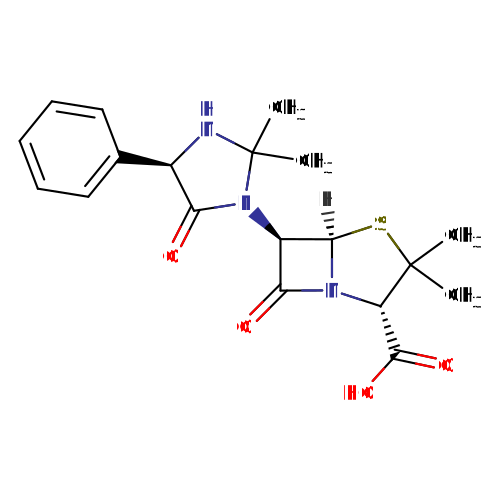
- Weight
- Average: 389.469
Monoisotopic: 389.140926929 - Chemical Formula
- C19H23N3O4S
- Synonyms
- (2S,5R,6R)-6-[(4R)-2,2-dimethyl-5-oxo-4-phenylimidazolidin-1-yl]-3,3-dimethyl-7-oxo-4-thia-1-azabicyclo[3.2.0]heptane-2-carboxylic acid
- 6β-[(4R)-2,2-dimethyl-5-oxo-4-phenylimidazolidin-1-yl]penicillanic acid
- Hetacilina
- Hetacillin
- Hétacilline
- Hetacillinum
- External IDs
- BL-P 804
- BL-P-804
- BRL 804
- BRL-804

Pharmacology
- Indication
Hetacillin is a beta-lactam antibiotic prodrug used to treat bacterial infections. In the body it gets converted to ampicillin.
 Reduce drug development failure ratesBuild, train, & validate machine-learning modelswith evidence-based and structured datasets.Build, train, & validate predictive machine-learning models with structured datasets.
- Contraindications & Blackbox Warnings
 Prevent Adverse Drug Events TodayTap into our Clinical API for life-saving information on contraindications & blackbox warnings, population restrictions, harmful risks, & more.Avoid life-threatening adverse drug events with our Clinical API
- Pharmacodynamics
Hetacillin is a penicillin beta-lactam antibiotic used in the treatment of bacterial infections caused by susceptible, usually gram-positive, organisms. The name "penicillin" can either refer to several variants of penicillin available, or to the group of antibiotics derived from the penicillins. Hetacillin has in vitro activity against gram-positive and gram-negative aerobic and anaerobic bacteria. The bactericidal activity of Hetacillin results from the inhibition of cell wall synthesis and is mediated through Hetacillin binding to penicillin binding proteins (PBPs).
- Mechanism of action
Hetacillin is a semisynthetic penicillin prodrug which itself has no antibacterial activity, but is converted in the body to ampicillin and has actions and uses similar to those of ampicillin. Hetacillin is prepared by reacting ampicillin with acetone. Ampicillin rapidly decomposes because of the intramolecular attack of the side chain amino group on the lactam ring. In vitro studies have shown that hetacillin is resistant to beta lactamase activity.1 However, this effect is transient, as the hydrolysis product, ampicillin, is readily inactivated by beta lactamase.1 Hetacillin locks up the offending amino group and prevents the decomposition of Hetacillin. Once hydrolyzed to ampicillin (and acetone), ampicillin binds to the penicillin binding proteins found in susceptible bacteria. This inhibits the third and last stage of bacterial cell wall synthesis. Cell lysis is then mediated by bacterial cell wall autolytic enzymes such as autolysins.
Target Actions Organism APenicillin-binding protein 2a inhibitorStreptococcus pneumoniae (strain ATCC BAA-255 / R6) APenicillin-binding protein 1b inhibitorStreptococcus pneumoniae (strain ATCC BAA-255 / R6) APenicillin-binding protein 3 inhibitorStreptococcus pneumoniae APenicillin-binding protein 1A inhibitorStreptococcus pneumoniae (strain ATCC BAA-255 / R6) APenicillin-binding protein 2B inhibitorStreptococcus pneumoniae (strain ATCC BAA-255 / R6) - Absorption
Not Available
- Volume of distribution
Not Available
- Protein binding
Not Available
- Metabolism
Hydrolyzed to active ampicillin via esterases
- Route of elimination
Not Available
- Half-life
Not Available
- Clearance
Not Available
- Adverse Effects
 Improve decision support & research outcomesWith structured adverse effects data, including: blackbox warnings, adverse reactions, warning & precautions, & incidence rates. View sample adverse effects data in our new Data Library!Improve decision support & research outcomes with our structured adverse effects data.
- Toxicity
Not Available
- Pathways
- Not Available
- Pharmacogenomic Effects/ADRs
- Not Available
Interactions
- Drug Interactions
- This information should not be interpreted without the help of a healthcare provider. If you believe you are experiencing an interaction, contact a healthcare provider immediately. The absence of an interaction does not necessarily mean no interactions exist.
Drug Interaction Integrate drug-drug
interactions in your softwareAcemetacin Acemetacin may decrease the excretion rate of Hetacillin which could result in a higher serum level. Acenocoumarol Hetacillin may increase the anticoagulant activities of Acenocoumarol. Ambroxol The risk or severity of methemoglobinemia can be increased when Hetacillin is combined with Ambroxol. Amikacin The serum concentration of Amikacin can be decreased when it is combined with Hetacillin. Articaine The risk or severity of methemoglobinemia can be increased when Hetacillin is combined with Articaine. - Food Interactions
- Not Available
Products
 Drug product information from 10+ global regionsOur datasets provide approved product information including:dosage, form, labeller, route of administration, and marketing period.Access drug product information from over 10 global regions.
- Product Ingredients
Ingredient UNII CAS InChI Key Hetacillin potassium 95PFX5932Y 5321-32-4 QRSPJBLLJXVPDD-XFAPPKAWSA-M - International/Other Brands
- Natacillin (Bristol-Myers Squibb) / Versapen (Bristol-Myers Squibb)
Categories
- ATC Codes
- J01CA18 — Hetacillin
- J01CA — Penicillins with extended spectrum
- J01C — BETA-LACTAM ANTIBACTERIALS, PENICILLINS
- J01 — ANTIBACTERIALS FOR SYSTEMIC USE
- J — ANTIINFECTIVES FOR SYSTEMIC USE
- Drug Categories
- Chemical TaxonomyProvided by Classyfire
- Description
- This compound belongs to the class of organic compounds known as penicillins. These are organic compounds containing the penicillin core structure, which is structurally characterized by a penam ring bearing two methyl groups at position 2, and an amide group at position 6 [starting from the sulfur atom at position 1].
- Kingdom
- Organic compounds
- Super Class
- Organoheterocyclic compounds
- Class
- Lactams
- Sub Class
- Beta lactams
- Direct Parent
- Penicillins
- Alternative Parents
- Phenylimidazolidines / Alpha amino acids and derivatives / Imidazolidinones / Benzene and substituted derivatives / Thiazolidines / Tertiary carboxylic acid amides / Amino acids / Azetidines / Thiohemiaminal derivatives / Monocarboxylic acids and derivatives show 8 more
- Substituents
- Alpha-amino acid or derivatives / Amine / Amino acid / Amino acid or derivatives / Aromatic heteropolycyclic compound / Azacycle / Azetidine / Benzenoid / Carbonyl group / Carboxamide group show 22 more
- Molecular Framework
- Aromatic heteropolycyclic compounds
- External Descriptors
- penicillin (CHEBI:5683)
- Affected organisms
- Enteric bacteria and other eubacteria
Chemical Identifiers
- UNII
- TN4JSC48CV
- CAS number
- 3511-16-8
- InChI Key
- DXVUYOAEDJXBPY-NFFDBFGFSA-N
- InChI
- InChI=1S/C19H23N3O4S/c1-18(2)13(17(25)26)21-15(24)12(16(21)27-18)22-14(23)11(20-19(22,3)4)10-8-6-5-7-9-10/h5-9,11-13,16,20H,1-4H3,(H,25,26)/t11-,12-,13+,16-/m1/s1
- IUPAC Name
- (2S,5R,6R)-6-[(4R)-2,2-dimethyl-5-oxo-4-phenylimidazolidin-1-yl]-3,3-dimethyl-7-oxo-4-thia-1-azabicyclo[3.2.0]heptane-2-carboxylic acid
- SMILES
- [H][C@]12SC(C)(C)[C@@H](N1C(=O)[C@H]2N1C(=O)[C@H](NC1(C)C)C1=CC=CC=C1)C(O)=O
References
- Synthesis Reference
U.S. Patent 3,198,804.
- General References
- Faine S, Harper M: Independent antibiotic actions of hetacillin and ampicillin revealed by fast methods. Antimicrob Agents Chemother. 1973 Jan;3(1):15-8. doi: 10.1128/aac.3.1.15. [Article]
- External Links
- Human Metabolome Database
- HMDB0014877
- KEGG Drug
- D01074
- KEGG Compound
- C11729
- PubChem Compound
- 443387
- PubChem Substance
- 46504545
- ChemSpider
- 391616
- 26797
- ChEBI
- 5683
- ChEMBL
- CHEMBL1201116
- ZINC
- ZINC000004102186
- Therapeutic Targets Database
- DAP001167
- PharmGKB
- PA164746559
- Wikipedia
- Hetacillin
Clinical Trials
Pharmacoeconomics
- Manufacturers
- Bristol laboratories inc div bristol myers co
- Packagers
- Not Available
- Dosage Forms
- Not Available
- Prices
- Not Available
- Patents
- Not Available
Properties
- State
- Solid
- Experimental Properties
Property Value Source melting point (°C) 190 °C PhysProp logP 1.3 Not Available - Predicted Properties
Property Value Source Water Solubility 0.512 mg/mL ALOGPS logP 0.85 ALOGPS logP 0.056 Chemaxon logS -2.9 ALOGPS pKa (Strongest Acidic) 3.33 Chemaxon pKa (Strongest Basic) 4.79 Chemaxon Physiological Charge -1 Chemaxon Hydrogen Acceptor Count 5 Chemaxon Hydrogen Donor Count 2 Chemaxon Polar Surface Area 89.95 Å2 Chemaxon Rotatable Bond Count 3 Chemaxon Refractivity 99.9 m3·mol-1 Chemaxon Polarizability 39.46 Å3 Chemaxon Number of Rings 4 Chemaxon Bioavailability 1 Chemaxon Rule of Five Yes Chemaxon Ghose Filter Yes Chemaxon Veber's Rule No Chemaxon MDDR-like Rule No Chemaxon - Predicted ADMET Features
Property Value Probability Human Intestinal Absorption - 0.5 Blood Brain Barrier - 0.991 Caco-2 permeable - 0.7602 P-glycoprotein substrate Substrate 0.5297 P-glycoprotein inhibitor I Non-inhibitor 0.8922 P-glycoprotein inhibitor II Non-inhibitor 0.8607 Renal organic cation transporter Non-inhibitor 0.9695 CYP450 2C9 substrate Non-substrate 0.7048 CYP450 2D6 substrate Non-substrate 0.8347 CYP450 3A4 substrate Non-substrate 0.5571 CYP450 1A2 substrate Non-inhibitor 0.8481 CYP450 2C9 inhibitor Non-inhibitor 0.8427 CYP450 2D6 inhibitor Non-inhibitor 0.913 CYP450 2C19 inhibitor Non-inhibitor 0.8219 CYP450 3A4 inhibitor Non-inhibitor 0.8176 CYP450 inhibitory promiscuity Low CYP Inhibitory Promiscuity 0.9624 Ames test Non AMES toxic 0.8363 Carcinogenicity Non-carcinogens 0.6271 Biodegradation Not ready biodegradable 0.8103 Rat acute toxicity 1.8514 LD50, mol/kg Not applicable hERG inhibition (predictor I) Weak inhibitor 0.9997 hERG inhibition (predictor II) Non-inhibitor 0.8314
Spectra
- Mass Spec (NIST)
- Not Available
- Spectra
Spectrum Spectrum Type Splash Key Predicted GC-MS Spectrum - GC-MS Predicted GC-MS splash10-0597-7943000000-e629ee26cef364aec2d7 Predicted MS/MS Spectrum - 10V, Positive (Annotated) Predicted LC-MS/MS splash10-0006-0119000000-d6fc673e000a450211fb Predicted MS/MS Spectrum - 10V, Negative (Annotated) Predicted LC-MS/MS splash10-03di-0009000000-163b82817f3d8530cebd Predicted MS/MS Spectrum - 20V, Positive (Annotated) Predicted LC-MS/MS splash10-03e9-0695000000-7928c9098fb167955b31 Predicted MS/MS Spectrum - 20V, Negative (Annotated) Predicted LC-MS/MS splash10-0f76-0479000000-8863c99f023e6556d8b2 Predicted MS/MS Spectrum - 40V, Positive (Annotated) Predicted LC-MS/MS splash10-0k96-2950000000-d33bd63245b60234228a Predicted MS/MS Spectrum - 40V, Negative (Annotated) Predicted LC-MS/MS splash10-0kmj-2592000000-569417cc656136f63ba7 Predicted 1H NMR Spectrum 1D NMR Not Applicable Predicted 13C NMR Spectrum 1D NMR Not Applicable - Chromatographic Properties
Collision Cross Sections (CCS)
Adduct CCS Value (Å2) Source type Source [M-H]- 201.1170137 predictedDarkChem Lite v0.1.0 [M-H]- 183.78575 predictedDeepCCS 1.0 (2019) [M+H]+ 202.4439137 predictedDarkChem Lite v0.1.0 [M+H]+ 186.18134 predictedDeepCCS 1.0 (2019) [M+Na]+ 201.4497137 predictedDarkChem Lite v0.1.0 [M+Na]+ 192.09386 predictedDeepCCS 1.0 (2019)
Targets

- Kind
- Protein
- Organism
- Streptococcus pneumoniae (strain ATCC BAA-255 / R6)
- Pharmacological action
- Yes
- Actions
- Inhibitor
- General Function
- Transferase activity, transferring acyl groups
- Specific Function
- Not Available
- Gene Name
- pbp2a
- Uniprot ID
- Q8DNB6
- Uniprot Name
- Penicillin-binding protein 2a
- Molecular Weight
- 80797.94 Da
References
- Neu HC: Aminopenicillins - clinical pharmacology and use in disease states. Int J Clin Pharmacol Biopharm. 1975 Mar;11(2):132-44. [Article]
- Williamson R, Hakenbeck R, Tomasz A: In vivo interaction of beta-lactam antibiotics with the penicillin-binding proteins of Streptococcus pneumoniae. Antimicrob Agents Chemother. 1980 Oct;18(4):629-37. [Article]
- Kind
- Protein
- Organism
- Streptococcus pneumoniae (strain ATCC BAA-255 / R6)
- Pharmacological action
- Yes
- Actions
- Inhibitor
- General Function
- Transferase activity, transferring acyl groups
- Specific Function
- Not Available
- Gene Name
- pbp1b
- Uniprot ID
- Q7CRA4
- Uniprot Name
- Penicillin-binding protein 1b
- Molecular Weight
- 89479.92 Da
References
- Neu HC: Aminopenicillins - clinical pharmacology and use in disease states. Int J Clin Pharmacol Biopharm. 1975 Mar;11(2):132-44. [Article]
- Williamson R, Hakenbeck R, Tomasz A: In vivo interaction of beta-lactam antibiotics with the penicillin-binding proteins of Streptococcus pneumoniae. Antimicrob Agents Chemother. 1980 Oct;18(4):629-37. [Article]
- Kind
- Protein
- Organism
- Streptococcus pneumoniae
- Pharmacological action
- Yes
- Actions
- Inhibitor
- General Function
- Serine-type d-ala-d-ala carboxypeptidase activity
- Specific Function
- Not Available
- Gene Name
- pbp3
- Uniprot ID
- Q75Y35
- Uniprot Name
- Penicillin-binding protein 3
- Molecular Weight
- 45209.84 Da
References
- Neu HC: Aminopenicillins - clinical pharmacology and use in disease states. Int J Clin Pharmacol Biopharm. 1975 Mar;11(2):132-44. [Article]
- Williamson R, Hakenbeck R, Tomasz A: In vivo interaction of beta-lactam antibiotics with the penicillin-binding proteins of Streptococcus pneumoniae. Antimicrob Agents Chemother. 1980 Oct;18(4):629-37. [Article]
- Kind
- Protein
- Organism
- Streptococcus pneumoniae (strain ATCC BAA-255 / R6)
- Pharmacological action
- Yes
- Actions
- Inhibitor
- General Function
- Penicillin binding
- Specific Function
- Cell wall formation.
- Gene Name
- pbpA
- Uniprot ID
- Q8DR59
- Uniprot Name
- Penicillin-binding protein 1A
- Molecular Weight
- 79700.9 Da
References
- Neu HC: Aminopenicillins - clinical pharmacology and use in disease states. Int J Clin Pharmacol Biopharm. 1975 Mar;11(2):132-44. [Article]
- Williamson R, Hakenbeck R, Tomasz A: In vivo interaction of beta-lactam antibiotics with the penicillin-binding proteins of Streptococcus pneumoniae. Antimicrob Agents Chemother. 1980 Oct;18(4):629-37. [Article]
- Kind
- Protein
- Organism
- Streptococcus pneumoniae (strain ATCC BAA-255 / R6)
- Pharmacological action
- Yes
- Actions
- Inhibitor
- General Function
- Not Available
- Specific Function
- Penicillin binding
- Gene Name
- penA
- Uniprot ID
- P0A3M6
- Uniprot Name
- Penicillin-binding protein 2B
- Molecular Weight
- 73872.305 Da
References
- Neu HC: Aminopenicillins - clinical pharmacology and use in disease states. Int J Clin Pharmacol Biopharm. 1975 Mar;11(2):132-44. [Article]
- Williamson R, Hakenbeck R, Tomasz A: In vivo interaction of beta-lactam antibiotics with the penicillin-binding proteins of Streptococcus pneumoniae. Antimicrob Agents Chemother. 1980 Oct;18(4):629-37. [Article]

Drug created at June 13, 2005 13:24 / Updated at December 02, 2023 06:59