Identification
- Summary
Meropenem is a carbapenem antibiotic used to treat a wide variety of infections in the body.
- Brand Names
- Vabomere
- Generic Name
- Meropenem
- DrugBank Accession Number
- DB00760
- Background
Meropenem is a broad-spectrum carbapenem antibiotic. It is active against Gram-positive and Gram-negative bacteria. Meropenem exerts its action by penetrating bacterial cells readily and interfering with the synthesis of vital cell wall components, which leads to cell death.
In August 2017, a combination antibacterial therapy under the market name vabomere was approved for treatment of adult patients with complicated urinary tract infections (cUTI). Vabomere consists of meropenem and Vaborbactam and is intravenously admininstered. The treatment aims to resolve infection-related symptoms and achieve negative urine culture, where the infections are proven or strongly suspected to be caused by susceptible bacteria.
- Type
- Small Molecule
- Groups
- Approved, Investigational
- Structure
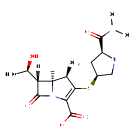
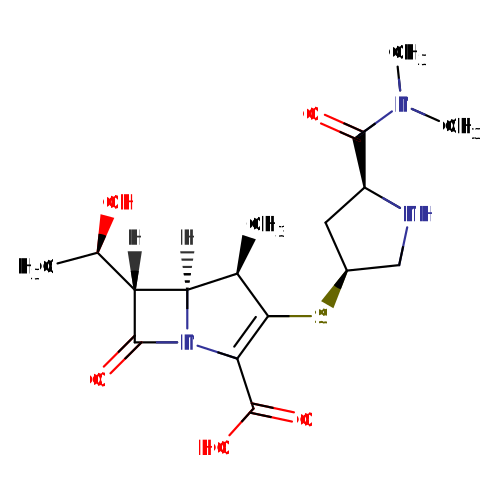
Structure for Meropenem (DB00760)
- Weight
- Average: 383.463
Monoisotopic: 383.151491615 - Chemical Formula
- C17H25N3O5S
- Synonyms
- (4R,5S,6S)-3-{[(3S,5S)-5-(dimethylcarbamoyl)pyrrolidin-3-yl]thio}-6-[(1R)-1-hydroxyethyl]-4-methyl-7-oxo-1-azabicyclo[3.2.0]hept-2-ene-2-carboxylic acid
- Meropenem
- Meropenem anhydrous
- Meropenemum
- External IDs
- Antibiotic SM 7338
- ICI 194660
- SM 7338

Pharmacology
- Indication
For use as single agent therapy for the treatment of the following infections when caused by susceptible isolates of the designated microorganisms: complicated skin and skin structure infections due to Staphylococcus aureus (b-lactamase and non-b-lactamase producing, methicillin-susceptible isolates only), Streptococcus pyogenes, Streptococcus agalactiae, viridans group streptococci, Enterococcus faecalis (excluding vancomycin-resistant isolates), Pseudomonas aeruginosa, Escherichia coli, Proteus mirabilis, Bacteroides fragilis and Peptostreptococcus species; complicated appendicitis and peritonitis caused by viridans group streptococci, Escherichia coli, Klebsiella pneumoniae, Pseudomonas aeruginosa, Bacteroides fragilis, B. thetaiotaomicron, and Peptostreptococcus species. Also for use in the treatment of bacterial meningitis caused by Streptococcus pneumoniae, Haemophilus influenzae (b-lactamase and non-b-lactamase-producing isolates), and Neisseria meningitidis.
 Reduce drug development failure ratesBuild, train, & validate machine-learning modelswith evidence-based and structured datasets.Build, train, & validate predictive machine-learning models with structured datasets.
- Associated Conditions
Indication Type Indication Combined Product Details Approval Level Age Group Patient Characteristics Dose Form Treatment of Bacterial infections •••••••••••• Treatment of Bacterial meningitis •••••••••••• Treatment of Complicated intra-abdominal infections •••••••••••• •••••• ••••••••• Used in combination to treat Complicated urinary tract infection bacterial Combination Product in combination with: Vaborbactam (DB12107) •••••••••••• Treatment of Complicated skin infection bacterial •••••••••••• - Contraindications & Blackbox Warnings
 Prevent Adverse Drug Events TodayTap into our Clinical API for life-saving information on contraindications & blackbox warnings, population restrictions, harmful risks, & more.Avoid life-threatening adverse drug events with our Clinical API
- Pharmacodynamics
Meropenem is a broad-spectrum carbapenem antibiotic. It is active against Gram-positive and Gram-negative bacteria. Meropenem exerts its action by penetrating bacterial cells readily and interfering with the synthesis of vital cell wall components, which leads to cell death.
- Mechanism of action
The bactericidal activity of meropenem results from the inhibition of cell wall synthesis. Meropenem readily penetrates the cell wall of most Gram-positive and Gram-negative bacteria to reach penicillin-binding- protein (PBP) targets. Its strongest affinities are toward PBPs 2, 3 and 4 of Escherichia coli and Pseudomonas aeruginosa; and PBPs 1, 2 and 4 of Staphylococcus aureus.
Target Actions Organism AD-alanyl-D-alanine carboxypeptidase DacB inhibitorEscherichia coli (strain K12) - Absorption
Not Available
- Volume of distribution
Not Available
- Protein binding
Approximately 2%.
- Metabolism
Primarily excreted unchanged. There is one metabolite which is microbiologically inactive.
- Route of elimination
Approximately 70% of the intravenously administered dose is recovered as unchanged meropenem in the urine over 12 hours, after which little further urinary excretion is detectable.
- Half-life
Approximately 1 hour in adults and children 2 years of age and older with normal renal function. Approximately 1.5 hours in children 3 months to 2 years of age.
- Clearance
Not Available
- Adverse Effects
 Improve decision support & research outcomesWith structured adverse effects data, including: blackbox warnings, adverse reactions, warning & precautions, & incidence rates. View sample adverse effects data in our new Data Library!Improve decision support & research outcomes with our structured adverse effects data.
- Toxicity
In mice and rats, large intravenous doses of meropenem (2200-4000 mg/kg) have been associated with ataxia, dyspnea, convulsions, and mortalities.
- Pathways
- Not Available
- Pharmacogenomic Effects/ADRs
- Not Available
Interactions
- Drug Interactions
- This information should not be interpreted without the help of a healthcare provider. If you believe you are experiencing an interaction, contact a healthcare provider immediately. The absence of an interaction does not necessarily mean no interactions exist.
Drug Interaction Integrate drug-drug
interactions in your softwareAbacavir Meropenem may decrease the excretion rate of Abacavir which could result in a higher serum level. Aceclofenac Aceclofenac may decrease the excretion rate of Meropenem which could result in a higher serum level. Acemetacin Acemetacin may decrease the excretion rate of Meropenem which could result in a higher serum level. Acenocoumarol The risk or severity of bleeding can be increased when Meropenem is combined with Acenocoumarol. Acetaminophen Acetaminophen may decrease the excretion rate of Meropenem which could result in a higher serum level. - Food Interactions
- No interactions found.
Products
 Drug product information from 10+ global regionsOur datasets provide approved product information including:dosage, form, labeller, route of administration, and marketing period.Access drug product information from over 10 global regions.
- Product Ingredients
Ingredient UNII CAS InChI Key Meropenem sodium Not Available 211238-34-5 UBQRNADYCUXRBD-NACOAMSHSA-N Meropenem trihydrate FV9J3JU8B1 119478-56-7 CTUAQTBUVLKNDJ-OBZXMJSBSA-N - International/Other Brands
- Aronem (ACI) / Aropen (Aristopharma) / Carbanem (Sanofi-Aventis) / Erope (Lincoln) / Fulspec (Acme) / I-penam (Incepta) / Merenz (Admac) / Merofit (FHC) / Meronem (AstraZeneca) / Meronis (Neiss) / Meropen (Swiss Parenterals) / Merotec (Zuventus) / Merrem I.V. (AstraZeneca) / Monan (AstraZeneca) / Ropenem (Drug International) / Zeropenem (Sanofi-Aventis)
- Brand Name Prescription Products
Name Dosage Strength Route Labeller Marketing Start Marketing End Region Image Meropenem Injection, powder, for solution 2 g/1 Intravenous WG Critical Care, LLC 2023-09-08 Not applicable US 
Meropenem and Sodium Chloride Injection, solution 1 g/50mL Intravenous B. Braun Medical Inc. 2015-04-30 Not applicable US Meropenem and Sodium Chloride Injection, solution 500 mg/50mL Intravenous B. Braun Medical Inc. 2015-04-30 Not applicable US Meropenem for Injection Powder, for solution 1 g / vial Intravenous Eugia Pharma Inc. Not applicable Not applicable Canada 
Meropenem for Injection Powder, for solution 500 mg / vial Intravenous Sterimax Inc 2021-05-25 Not applicable Canada - Generic Prescription Products
Name Dosage Strength Route Labeller Marketing Start Marketing End Region Image Meropenem Injection 1 g/30mL Intravenous Xellia Pharmaceuticals USA LLC 2021-06-28 Not applicable US Meropenem Injection, powder, for solution 500 mg/20mL Intravenous Par Pharmaceutical, Inc. 2016-08-01 2018-09-30 US Meropenem Injection, powder, for solution 1 g/30mL Intravenous Amneal Pharmaceuticals LLC 2016-05-09 Not applicable US Meropenem Injection 1 g/30mL Intravenous Civica, Inc 2020-09-23 Not applicable US Meropenem Injection 500 mg/20mL Intravenous Savior Lifetec Corporation 2016-04-19 Not applicable US - Mixture Products
Name Ingredients Dosage Route Labeller Marketing Start Marketing End Region Image Vabomere Meropenem trihydrate (1 g/2g) + Vaborbactam (1 g/2g) Injection, powder, for solution Intravenous Melinta Therapeutics, LLC 2017-10-02 Not applicable US Vabomere Meropenem trihydrate (1 g/2g) + Vaborbactam (1 g/2g) Injection, powder, for solution Intravenous The Medicines Company 2017-10-02 2019-07-31 US Vaborem Meropenem trihydrate (1 g) + Vaborbactam (1 g) Injection, powder, for solution Intravenous Menarini International Operations Luxembourg S.A. 2020-12-16 Not applicable EU 
VABOREM Meropenem (1 G) + Vaborbactam (1 G) Injection, powder, for solution Intravenous Menarini International Operations Luxembourg S.A. 2019-06-08 Not applicable Italy 
Categories
- ATC Codes
- J01DH02 — Meropenem
- J01DH — Carbapenems
- J01D — OTHER BETA-LACTAM ANTIBACTERIALS
- J01 — ANTIBACTERIALS FOR SYSTEMIC USE
- J — ANTIINFECTIVES FOR SYSTEMIC USE
- Drug Categories
- Chemical TaxonomyProvided by Classyfire
- Description
- This compound belongs to the class of organic compounds known as thienamycins. These are beta-lactam antibiotics that differ from penicillins in having the thiazolidine sulfur atom replaced by carbon, the sulfur then becoming the first atom in the side chain.
- Kingdom
- Organic compounds
- Super Class
- Organoheterocyclic compounds
- Class
- Lactams
- Sub Class
- Beta lactams
- Direct Parent
- Thienamycins
- Alternative Parents
- Proline and derivatives / Alpha amino acid amides / Pyrroline carboxylic acids / Pyrrolidinecarboxamides / Azepines / Vinylogous thioesters / Tertiary carboxylic acid amides / Thioenol ethers / Secondary alcohols / Amino acids show 10 more
- Substituents
- Alcohol / Aliphatic heteropolycyclic compound / Alpha-amino acid amide / Alpha-amino acid or derivatives / Amine / Amino acid / Amino acid or derivatives / Azacycle / Azepine / Azetidine show 28 more
- Molecular Framework
- Aliphatic heteropolycyclic compounds
- External Descriptors
- pyrrolidinecarboxamide, alpha,beta-unsaturated monocarboxylic acid, carbapenemcarboxylic acid (CHEBI:43968)
- Affected organisms
- Enteric bacteria and other eubacteria
Chemical Identifiers
- UNII
- YOP6PX0BAO
- CAS number
- 96036-03-2
- InChI Key
- DMJNNHOOLUXYBV-PQTSNVLCSA-N
- InChI
- InChI=1S/C17H25N3O5S/c1-7-12-11(8(2)21)16(23)20(12)13(17(24)25)14(7)26-9-5-10(18-6-9)15(22)19(3)4/h7-12,18,21H,5-6H2,1-4H3,(H,24,25)/t7-,8-,9+,10+,11-,12-/m1/s1
- IUPAC Name
- (4R,5S,6S)-3-{[(3S,5S)-5-(dimethylcarbamoyl)pyrrolidin-3-yl]sulfanyl}-6-[(1R)-1-hydroxyethyl]-4-methyl-7-oxo-1-azabicyclo[3.2.0]hept-2-ene-2-carboxylic acid
- SMILES
- [H][C@]1([C@@H](C)O)C(=O)N2C(C(O)=O)=C(S[C@@H]3CN[C@@H](C3)C(=O)N(C)C)[C@H](C)[C@]12[H]
References
- Synthesis Reference
Yoon Seok Song, Sung Woo Park, Yeon Jung Yoon, Hee Kyoon Yoon, Seong Cheol Moon, Byung Goo Lee, Soo Jin Choi, Sun Ah Jun, "METHOD FOR PREPARING MEROPENEM USING ZINC POWDER." U.S. Patent US20120065392, issued March 15, 2012.
US20120065392- General References
- Not Available
- External Links
- Human Metabolome Database
- HMDB0014898
- KEGG Drug
- D02222
- PubChem Compound
- 441130
- PubChem Substance
- 46504928
- ChemSpider
- 389924
- BindingDB
- 50129062
- 1546029
- ChEBI
- 43968
- ChEMBL
- CHEMBL127
- ZINC
- ZINC000003808779
- Therapeutic Targets Database
- DAP000441
- PharmGKB
- PA164764445
- PDBe Ligand
- MEM
- RxList
- RxList Drug Page
- Drugs.com
- Drugs.com Drug Page
- Wikipedia
- Meropenem
- PDB Entries
- 4euz
- FDA label
- Download (276 KB)
Clinical Trials
- Clinical Trials
Phase Status Purpose Conditions Count 4 Completed Not Available Initial Phase of Severe Sepsis and Septic Shock 1 4 Completed Not Available Ventilator Associated Bacterial Pneumonia (VABP) 1 4 Completed Prevention Pancreatitis,Acute Necrotizing 1 4 Completed Treatment Anti-drug antibody development / Cholangitis, Secondary Biliary / Compliance, Treatment 1 4 Completed Treatment Antibiotic Resistant Infection / Critically Ill Patients 1
Pharmacoeconomics
- Manufacturers
- Hospira inc
- Astrazeneca uk ltd
- Packagers
- AstraZeneca Inc.
- Hospira Inc.
- Zambon Ltd.
- Zeneca Pharma Inc.
- Dosage Forms
Form Route Strength Solution Intravenous 500 mg Solution Parenteral 500.00 mg Injection, powder, for solution Intravenous 100000 g Solution Intravenous 570.50 mg Solution Intravenous 1.140 g Injection, powder, for solution Intravenous 1 g Solution Intravenous 1.14 g Solution Parenteral 500 mg Solution Intravenous 570.000 mg Solution Intravenous 676.00 mg Solution Intravenous 500.000 mg Injection, powder, lyophilized, for solution Intravenous 1000 mg Injection, powder, for solution 500 mg Injection, powder, for solution 1 g Injection, powder, for solution Intravenous 1000 mg Injection, powder, for solution Intravenous 500 mg Injection Intravenous 1 g/30mL Injection Intravenous 1 g/20mL Injection Intravenous 500 mg/20mL Injection, powder, for solution Intravenous Injection, powder, for solution Intravenous 1 g/1 Injection, powder, for solution Intravenous 1 g/20mL Injection, powder, for solution Intravenous 1 g/30mL Injection, powder, for solution Intravenous 2 g/1 Injection, powder, for solution Intravenous 500 mg/1 Injection, powder, for solution Intravenous 500 mg/10mL Injection, powder, for solution Intravenous 500 mg/20mL Injection, powder, for solution Intravenous 0.5 g Injection, powder, for solution Intramuscular; Intravenous 500 mg Injection, powder, for solution Intramuscular; Intravenous 50000000 mg Injection, powder, for solution Parenteral Injection, solution Intravenous 1 g/50mL Injection, solution Intravenous 500 mg/50mL Injection, solution Intravenous 1000 mg Injection, powder, for solution Parenteral 2000 mg Injection, solution Intravenous 500 mg Injection, powder, for solution Parenteral 2 g Injection, powder, for solution Parenteral 1000 MG Injection, powder, for solution Parenteral 500 MG Powder 1 g Powder 500 mg Injection, powder, for solution Intravenous 100000000 mg Injection, powder, for solution 1000 MG Injection, powder, for solution 0.5 mg/ml Injection, powder, for solution 0.5 g Injection, powder, for solution 1371 mg Injection, powder, for solution 2 G Injection, powder, for solution Intravenous 1 g/vial Injection, powder, for solution Parenteral 0.5 g Injection, powder, for solution Parenteral 1 g Injection Intravenous 250 mg Injection Intravenous 500 mg Injection, powder, for solution Intravenous; Parenteral 1000 MG/20ML Injection, powder, for solution Intravenous; Parenteral 1000 MG Injection, powder, for solution Intravenous; Parenteral 500 MG/10ML Injection, powder, for solution Intravenous; Parenteral 500 MG Powder, for solution Intravenous 1 g / vial Powder, for solution Intravenous 1000 MG/100ML Powder, for solution Intravenous 250 MG/100ML Powder, for solution Intravenous 500 mg / vial Powder, for solution Intravenous 500 MG/100ML Injection, solution Intravenous 1 g Solution Parenteral 1140.980 mg Solution Intravenous 500.0 mg Powder Solution Intravenous 1.000 g Injection, powder, for solution Injection Intravenous Injection, powder, lyophilized, for solution Intravenous 1 g Injection, powder, for solution Intravenous Solution Intravenous 500.00 mg Powder 500 mg/1vial Injection, powder, for solution 500 mg/1vial - Prices
Unit description Cost Unit Merrem 1 gm Solution Vial 81.32USD vial Merrem iv 1 gm vial 78.19USD vial Merrem 500 mg Solution Vial 48.79USD vial DrugBank does not sell nor buy drugs. Pricing information is supplied for informational purposes only.- Patents
Patent Number Pediatric Extension Approved Expires (estimated) Region US4943569 No 1990-07-24 2010-06-21 US CA1322371 No 1993-09-21 2010-09-21 Canada US9694025 No 2017-07-04 2031-08-08 US US8680136 No 2014-03-25 2031-08-17 US US10183034 No 2019-01-22 2031-08-08 US US10172874 No 2019-01-08 2031-08-08 US US10561675 No 2020-02-18 2031-08-08 US US11007206 No 2021-05-18 2031-08-08 US US11376237 No 2019-04-06 2039-04-06 US
Properties
- State
- Solid
- Experimental Properties
Property Value Source water solubility Sparingly Not Available logP -0.6 Not Available - Predicted Properties
Property Value Source Water Solubility 5.63 mg/mL ALOGPS logP -0.69 ALOGPS logP -4.4 Chemaxon logS -1.8 ALOGPS pKa (Strongest Acidic) 3.28 Chemaxon pKa (Strongest Basic) 9.39 Chemaxon Physiological Charge 0 Chemaxon Hydrogen Acceptor Count 6 Chemaxon Hydrogen Donor Count 3 Chemaxon Polar Surface Area 110.18 Å2 Chemaxon Rotatable Bond Count 5 Chemaxon Refractivity 97.89 m3·mol-1 Chemaxon Polarizability 39.32 Å3 Chemaxon Number of Rings 3 Chemaxon Bioavailability 1 Chemaxon Rule of Five Yes Chemaxon Ghose Filter No Chemaxon Veber's Rule No Chemaxon MDDR-like Rule No Chemaxon - Predicted ADMET Features
Property Value Probability Human Intestinal Absorption + 0.7086 Blood Brain Barrier - 0.9901 Caco-2 permeable - 0.6556 P-glycoprotein substrate Substrate 0.8057 P-glycoprotein inhibitor I Non-inhibitor 0.6779 P-glycoprotein inhibitor II Non-inhibitor 0.952 Renal organic cation transporter Non-inhibitor 0.9053 CYP450 2C9 substrate Non-substrate 0.8286 CYP450 2D6 substrate Non-substrate 0.8136 CYP450 3A4 substrate Substrate 0.6007 CYP450 1A2 substrate Non-inhibitor 0.9045 CYP450 2C9 inhibitor Non-inhibitor 0.907 CYP450 2D6 inhibitor Non-inhibitor 0.9231 CYP450 2C19 inhibitor Non-inhibitor 0.9025 CYP450 3A4 inhibitor Non-inhibitor 0.9559 CYP450 inhibitory promiscuity Low CYP Inhibitory Promiscuity 0.9798 Ames test Non AMES toxic 0.68 Carcinogenicity Non-carcinogens 0.8623 Biodegradation Not ready biodegradable 0.8801 Rat acute toxicity 1.9158 LD50, mol/kg Not applicable hERG inhibition (predictor I) Weak inhibitor 0.9969 hERG inhibition (predictor II) Non-inhibitor 0.8683
Spectra
- Mass Spec (NIST)
- Not Available
- Spectra
Spectrum Spectrum Type Splash Key Predicted GC-MS Spectrum - GC-MS Predicted GC-MS splash10-0g6r-9165000000-bfa50046e33decc913f0 Predicted MS/MS Spectrum - 10V, Positive (Annotated) Predicted LC-MS/MS splash10-001i-0009000000-5b3acfe947b0904768c3 Predicted MS/MS Spectrum - 10V, Negative (Annotated) Predicted LC-MS/MS splash10-001i-0009000000-ef6ff13546cfad78ecf7 Predicted MS/MS Spectrum - 20V, Negative (Annotated) Predicted LC-MS/MS splash10-0gc0-0669000000-16e5f08678af7cae51eb Predicted MS/MS Spectrum - 20V, Positive (Annotated) Predicted LC-MS/MS splash10-0159-0009000000-2766478cde2d250e97e3 Predicted MS/MS Spectrum - 40V, Positive (Annotated) Predicted LC-MS/MS splash10-0uxr-4964000000-2075ec069ea11e57d986 Predicted MS/MS Spectrum - 40V, Negative (Annotated) Predicted LC-MS/MS splash10-0udi-0479000000-70ffc82a1431baa1c17c Predicted 1H NMR Spectrum 1D NMR Not Applicable Predicted 13C NMR Spectrum 1D NMR Not Applicable - Chromatographic Properties
Collision Cross Sections (CCS)
Adduct CCS Value (Å2) Source type Source [M-H]- 201.6655316 predictedDarkChem Lite v0.1.0 [M-H]- 189.5132316 predictedDarkChem Lite v0.1.0 [M-H]- 188.22679 predictedDeepCCS 1.0 (2019) [M+H]+ 203.1435316 predictedDarkChem Lite v0.1.0 [M+H]+ 190.3624316 predictedDarkChem Lite v0.1.0 [M+H]+ 190.62234 predictedDeepCCS 1.0 (2019) [M+Na]+ 203.1414316 predictedDarkChem Lite v0.1.0 [M+Na]+ 196.53487 predictedDeepCCS 1.0 (2019)
Targets

- Kind
- Protein
- Organism
- Escherichia coli (strain K12)
- Pharmacological action
- Yes
- Actions
- Inhibitor
- General Function
- Serine-type d-ala-d-ala carboxypeptidase activity
- Specific Function
- Not involved in transpeptidation but exclusively catalyzes a DD-carboxypeptidase and DD-endopeptidase reaction.
- Gene Name
- dacB
- Uniprot ID
- P24228
- Uniprot Name
- D-alanyl-D-alanine carboxypeptidase DacB
- Molecular Weight
- 51797.85 Da
References
- Overington JP, Al-Lazikani B, Hopkins AL: How many drug targets are there? Nat Rev Drug Discov. 2006 Dec;5(12):993-6. [Article]
- Imming P, Sinning C, Meyer A: Drugs, their targets and the nature and number of drug targets. Nat Rev Drug Discov. 2006 Oct;5(10):821-34. [Article]
- Kanazawa K, Nouda H, Sunagawa M: Structure-activity relationships of carbapenem compounds to anti-Haemophilus influenzae activity and affinity for penicillin-binding proteins. Effect of 1 beta-methyl group and C-2 side chain. J Antibiot (Tokyo). 1997 Feb;50(2):162-8. [Article]
- Ubukata K, Shibasaki Y, Yamamoto K, Chiba N, Hasegawa K, Takeuchi Y, Sunakawa K, Inoue M, Konno M: Association of amino acid substitutions in penicillin-binding protein 3 with beta-lactam resistance in beta-lactamase-negative ampicillin-resistant Haemophilus influenzae. Antimicrob Agents Chemother. 2001 Jun;45(6):1693-9. [Article]
Enzymes
- Kind
- Protein
- Organism
- Pseudomonas aeruginosa
- Pharmacological action
- Unknown
- Actions
- Substrate
- General Function
- Penicillin binding
- Specific Function
- Hydrolyzes both carbenicillin and oxacillin.
- Gene Name
- bla
- Uniprot ID
- P14489
- Uniprot Name
- Beta-lactamase OXA-10
- Molecular Weight
- 29506.575 Da
References
- Kind
- Protein
- Organism
- Humans
- Pharmacological action
- No
- Actions
- Substrate
- General Function
- Zinc ion binding
- Specific Function
- Hydrolyzes a wide range of dipeptides. Implicated in the renal metabolism of glutathione and its conjugates. Converts leukotriene D4 to leukotriene E4; it may play an important role in the regulati...
- Gene Name
- DPEP1
- Uniprot ID
- P16444
- Uniprot Name
- Dipeptidase 1
- Molecular Weight
- 45673.48 Da
References
- Perry CM, Ibbotson T: Biapenem. Drugs. 2002;62(15):2221-34; discussion 2235. doi: 10.2165/00003495-200262150-00005. [Article]

Drug created at June 13, 2005 13:24 / Updated at April 18, 2024 09:15