Identification
- Summary
Propantheline is an antimuscarinic agent used to treat urinary incontinence, hyperhidrosis, as well as cramps and spasms of the stomach, intestines, and bladder.
- Generic Name
- Propantheline
- DrugBank Accession Number
- DB00782
- Background
A muscarinic antagonist used as an antispasmodic, in rhinitis, in urinary incontinence, and in the treatment of ulcers. At high doses it has nicotinic effects resulting in neuromuscular blocking.
- Type
- Small Molecule
- Groups
- Approved
- Structure
Structure for Propantheline (DB00782)
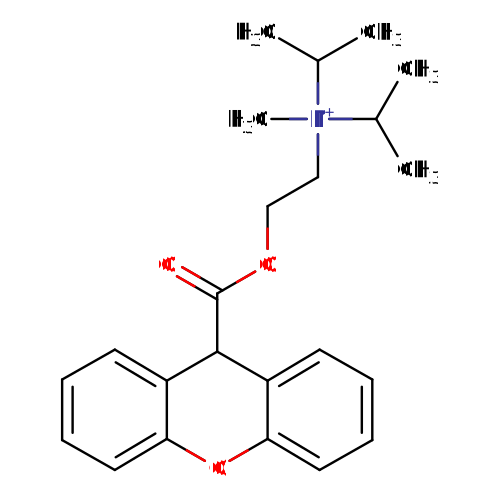
- Weight
- Average: 368.4892
Monoisotopic: 368.222568831 - Chemical Formula
- C23H30NO3
- Synonyms
- Propantheline
- External IDs
- SC 3171

Pharmacology
- Indication
For the treatment of enuresis. It has also been used for hyperhidrosis, and cramps or spasms of the stomach, intestines or bladder.
 Reduce drug development failure ratesBuild, train, & validate machine-learning modelswith evidence-based and structured datasets.Build, train, & validate predictive machine-learning models with structured datasets.
- Associated Conditions
Indication Type Indication Combined Product Details Approval Level Age Group Patient Characteristics Dose Form Adjunct therapy in treatment of Peptic ulcer •••••••••••• Used in combination to treat Gastrointestinal spasms Combination Product in combination with: Bromazepam (DB01558) •••••••••••• ••••••• - Contraindications & Blackbox Warnings
 Prevent Adverse Drug Events TodayTap into our Clinical API for life-saving information on contraindications & blackbox warnings, population restrictions, harmful risks, & more.Avoid life-threatening adverse drug events with our Clinical API
- Pharmacodynamics
Propantheline is an anticholinergic drug, a medication that reduces the effect of acetylcholine, a chemical released from nerves that stimulates muscles, by blocking the receptors for acetylcholine on smooth muscle (a type of muscle). It also has a direct relaxing effect on smooth muscle. Propantheline is used to treat or prevent spasm in the muscles of the gastrointestinal tract in the irritable bowel syndrome. In addition, Propantheline inhibits gastrointestinal propulsive motility and decreases gastric acid secretion and controls excessive pharyngeal, tracheal and bronchial secretions.
- Mechanism of action
Action is achieved via a dual mechanism: (1) a specific anticholinergic effect (antimuscarinic) at the acetylcholine-receptor sites and (2) a direct effect upon smooth muscle (musculotropic).
Target Actions Organism AMuscarinic acetylcholine receptor M1 antagonistHumans - Absorption
Not Available
- Volume of distribution
Not Available
- Protein binding
Not Available
- Metabolism
- Not Available
- Route of elimination
Approximately 70% of the dose is excreted in the urine, mostly as metabolites.
- Half-life
Not Available
- Clearance
Not Available
- Adverse Effects
 Improve decision support & research outcomesWith structured adverse effects data, including: blackbox warnings, adverse reactions, warning & precautions, & incidence rates. View sample adverse effects data in our new Data Library!Improve decision support & research outcomes with our structured adverse effects data.
- Toxicity
Not Available
- Pathways
- Not Available
- Pharmacogenomic Effects/ADRs
- Not Available
Interactions
- Drug Interactions
- This information should not be interpreted without the help of a healthcare provider. If you believe you are experiencing an interaction, contact a healthcare provider immediately. The absence of an interaction does not necessarily mean no interactions exist.
Drug Interaction Integrate drug-drug
interactions in your softwareAbacavir Propantheline may decrease the excretion rate of Abacavir which could result in a higher serum level. Aceclofenac Aceclofenac may decrease the excretion rate of Propantheline which could result in a higher serum level. Acemetacin Acemetacin may decrease the excretion rate of Propantheline which could result in a higher serum level. Acetaminophen Acetaminophen may decrease the excretion rate of Propantheline which could result in a higher serum level. Acetazolamide Acetazolamide may increase the excretion rate of Propantheline which could result in a lower serum level and potentially a reduction in efficacy. - Food Interactions
- Take before a meal. Take before a meal. Propantheline bromide should be taken 15 to 30 minutes before meals.
Products
 Drug product information from 10+ global regionsOur datasets provide approved product information including:dosage, form, labeller, route of administration, and marketing period.Access drug product information from over 10 global regions.
- Product Ingredients
Ingredient UNII CAS InChI Key Propantheline bromide UX9Z118X9F 50-34-0 XLBIBBZXLMYSFF-UHFFFAOYSA-M - International/Other Brands
- Ercoril (Medic) / Methaphyllin (Sannova) / Pro Banthine (Pfizer) / Prokind (Beacon) / Propanline (Chin Teng) / Propantheline (Shou Chan) / Spastheline (Sun)
- Brand Name Prescription Products
Name Dosage Strength Route Labeller Marketing Start Marketing End Region Image Pro-Banthine Tablet 15 mg/1 Oral Shire 1953-04-02 2012-01-10 US 
Pro-Banthine Tablet 7.5 mg/1 Oral Shire 1953-04-02 2012-01-10 US Pro-banthine Tablets 15mg Tablet 15 mg Oral Well Spring Pharmaceutical Corporation 1994-12-31 2009-02-23 Canada 
Pro-banthine Tablets 7.5 mg Tablet 7.5 mg Oral Well Spring Pharmaceutical Corporation 1994-12-31 2009-02-23 Canada Propanthel Tab 15mg Tablet 15 mg Oral Icn Pharmaceuticals 1974-12-31 2005-04-26 Canada - Generic Prescription Products
Name Dosage Strength Route Labeller Marketing Start Marketing End Region Image Propantheline Bromide Tablet, film coated 15 mg/1 Oral West-Ward Pharmaceuticals Corp. 1981-12-14 Not applicable US
Categories
- ATC Codes
- A03AB05 — Propantheline
- A03AB — Synthetic anticholinergics, quaternary ammonium compounds
- A03A — DRUGS FOR FUNCTIONAL GASTROINTESTINAL DISORDERS
- A03 — DRUGS FOR FUNCTIONAL GASTROINTESTINAL DISORDERS
- A — ALIMENTARY TRACT AND METABOLISM
- Drug Categories
- Agents producing tachycardia
- Alimentary Tract and Metabolism
- Amines
- Anti-Ulcer Agents
- Anticholinergic Agents
- Cholinergic Agents
- Drugs for Functional Gastrointestinal Disorders
- Drugs that are Mainly Renally Excreted
- Gastrointestinal Agents
- Heterocyclic Compounds, Fused-Ring
- Muscarinic Antagonists
- Neurotransmitter Agents
- Onium Compounds
- Quaternary Ammonium Compounds
- Synthetic Anticholinergics, Quaternary Ammonium Compounds
- Xanthenes
- Chemical TaxonomyProvided by Classyfire
- Description
- This compound belongs to the class of organic compounds known as xanthenes. These are polycyclic aromatic compounds containing a xanthene moiety, which consists of two benzene rings joined to each other by a pyran ring.
- Kingdom
- Organic compounds
- Super Class
- Organoheterocyclic compounds
- Class
- Benzopyrans
- Sub Class
- 1-benzopyrans
- Direct Parent
- Xanthenes
- Alternative Parents
- Diarylethers / Benzenoids / Tetraalkylammonium salts / Carboxylic acid esters / Oxacyclic compounds / Monocarboxylic acids and derivatives / Organopnictogen compounds / Organic salts / Organic oxides / Hydrocarbon derivatives show 3 more
- Substituents
- Amine / Aromatic heteropolycyclic compound / Benzenoid / Carbonyl group / Carboxylic acid derivative / Carboxylic acid ester / Diaryl ether / Ether / Hydrocarbon derivative / Monocarboxylic acid or derivatives show 12 more
- Molecular Framework
- Aromatic heteropolycyclic compounds
- External Descriptors
- xanthenes (CHEBI:8481)
- Affected organisms
- Humans and other mammals
Chemical Identifiers
- UNII
- 1306V2B0Q8
- CAS number
- 298-50-0
- InChI Key
- VVWYOYDLCMFIEM-UHFFFAOYSA-N
- InChI
- InChI=1S/C23H30NO3/c1-16(2)24(5,17(3)4)14-15-26-23(25)22-18-10-6-8-12-20(18)27-21-13-9-7-11-19(21)22/h6-13,16-17,22H,14-15H2,1-5H3/q+1
- IUPAC Name
- methylbis(propan-2-yl)[2-(9H-xanthene-9-carbonyloxy)ethyl]azanium
- SMILES
- CC(C)[N+](C)(CCOC(=O)C1C2=CC=CC=C2OC2=CC=CC=C12)C(C)C
References
- General References
- Not Available
- External Links
- Human Metabolome Database
- HMDB0014920
- KEGG Compound
- C07506
- PubChem Compound
- 4934
- PubChem Substance
- 46507187
- ChemSpider
- 4765
- BindingDB
- 50238663
- 8761
- ChEBI
- 8481
- ChEMBL
- CHEMBL1180725
- ZINC
- ZINC000001530761
- Therapeutic Targets Database
- DAP001123
- PharmGKB
- PA164746224
- Guide to Pharmacology
- GtP Drug Page
- Drugs.com
- Drugs.com Drug Page
- Wikipedia
- Propantheline_bromide
- MSDS
- Download (73.8 KB)
Clinical Trials
- Clinical Trials
Phase Status Purpose Conditions Count 4 Unknown Status Treatment Urinary tract lithiasis (excl renal) 1 1 Unknown Status Treatment Overactive Bladder Associated With HTLV-1 1
Pharmacoeconomics
- Manufacturers
- Gd searle llc
- Shire development inc
- Ascot hosp pharmaceuticals inc div travenol laboratories inc
- Heather drug co inc
- Impax laboratories inc
- Mylan pharmaceuticals inc
- Par pharmaceutical inc
- Private formulations inc
- Roxane laboratories inc
- Sandoz inc
- Tablicaps inc
- Watson laboratories inc
- Packagers
- Dispensing Solutions
- Gallipot
- Kaiser Foundation Hospital
- Major Pharmaceuticals
- Roxane Labs
- Shire Inc.
- Southwood Pharmaceuticals
- Dosage Forms
Form Route Strength Capsule Oral Tablet Oral 15 mg/1 Tablet Oral 7.5 mg/1 Tablet Oral 15 mg Tablet Oral 7.5 mg Tablet, film coated Oral 15 mg/1 - Prices
Unit description Cost Unit Propantheline bromide powder 7.77USD g Propantheline Bromide 15 mg tablet 0.76USD tablet Propantheline 15 mg tablet 0.6USD tablet DrugBank does not sell nor buy drugs. Pricing information is supplied for informational purposes only.- Patents
- Not Available
Properties
- State
- Solid
- Experimental Properties
- Not Available
- Predicted Properties
Property Value Source Water Solubility 7.22e-05 mg/mL ALOGPS logP 2.66 ALOGPS logP 0.36 Chemaxon logS -6.8 ALOGPS pKa (Strongest Acidic) 17.63 Chemaxon pKa (Strongest Basic) -3.7 Chemaxon Physiological Charge 1 Chemaxon Hydrogen Acceptor Count 1 Chemaxon Hydrogen Donor Count 0 Chemaxon Polar Surface Area 35.53 Å2 Chemaxon Rotatable Bond Count 7 Chemaxon Refractivity 119.25 m3·mol-1 Chemaxon Polarizability 40.87 Å3 Chemaxon Number of Rings 3 Chemaxon Bioavailability 1 Chemaxon Rule of Five Yes Chemaxon Ghose Filter Yes Chemaxon Veber's Rule Yes Chemaxon MDDR-like Rule Yes Chemaxon - Predicted ADMET Features
Property Value Probability Human Intestinal Absorption - 0.9327 Blood Brain Barrier + 0.9012 Caco-2 permeable + 0.6808 P-glycoprotein substrate Substrate 0.7706 P-glycoprotein inhibitor I Non-inhibitor 0.8742 P-glycoprotein inhibitor II Non-inhibitor 0.6149 Renal organic cation transporter Inhibitor 0.5354 CYP450 2C9 substrate Non-substrate 0.7749 CYP450 2D6 substrate Non-substrate 0.6028 CYP450 3A4 substrate Substrate 0.7332 CYP450 1A2 substrate Inhibitor 0.9107 CYP450 2C9 inhibitor Non-inhibitor 0.9071 CYP450 2D6 inhibitor Inhibitor 0.8931 CYP450 2C19 inhibitor Non-inhibitor 0.9025 CYP450 3A4 inhibitor Non-inhibitor 0.867 CYP450 inhibitory promiscuity Low CYP Inhibitory Promiscuity 0.7234 Ames test Non AMES toxic 0.9133 Carcinogenicity Non-carcinogens 0.8167 Biodegradation Not ready biodegradable 0.6006 Rat acute toxicity 2.7150 LD50, mol/kg Not applicable hERG inhibition (predictor I) Weak inhibitor 0.9055 hERG inhibition (predictor II) Non-inhibitor 0.5772
Spectra
- Mass Spec (NIST)
- Not Available
- Spectra
Spectrum Spectrum Type Splash Key Predicted GC-MS Spectrum - GC-MS Predicted GC-MS splash10-004u-6911000000-12b0c3360d2453760c3a Predicted 1H NMR Spectrum 1D NMR Not Applicable Predicted 13C NMR Spectrum 1D NMR Not Applicable - Chromatographic Properties
Collision Cross Sections (CCS)
Adduct CCS Value (Å2) Source type Source [M-H]- 183.0706 predictedDeepCCS 1.0 (2019) [M+H]+ 185.42859 predictedDeepCCS 1.0 (2019) [M+Na]+ 192.19746 predictedDeepCCS 1.0 (2019)
Targets

- Kind
- Protein
- Organism
- Humans
- Pharmacological action
- Yes
- Actions
- Antagonist
- General Function
- Phosphatidylinositol phospholipase c activity
- Specific Function
- The muscarinic acetylcholine receptor mediates various cellular responses, including inhibition of adenylate cyclase, breakdown of phosphoinositides and modulation of potassium channels through the...
- Gene Name
- CHRM1
- Uniprot ID
- P11229
- Uniprot Name
- Muscarinic acetylcholine receptor M1
- Molecular Weight
- 51420.375 Da
References
- Imming P, Sinning C, Meyer A: Drugs, their targets and the nature and number of drug targets. Nat Rev Drug Discov. 2006 Oct;5(10):821-34. [Article]
- Lukacs VA, Korting HC: [Antiperspirants and deodorants--ingredients and evaluation]. Derm Beruf Umwelt. 1989 Mar-Apr;37(2):53-7. [Article]
- Saitoh H, Hasegawa N, Kawai S, Miyazaki K, Arita T: Interaction of tertiary amines and quaternary ammonium compounds with gastrointestinal mucin. J Pharmacobiodyn. 1986 Dec;9(12):1008-14. [Article]
- Trkulja V, Crljen-Manestar V, Banfic H, Lackovic Z: Involvement of the peripheral cholinergic muscarinic system in the compensatory ovarian hypertrophy in the rat. Exp Biol Med (Maywood). 2004 Sep;229(8):793-805. [Article]
- Mokry J, Nosalova G, Jakubesova M: Propantheline and in vitro reactivity of urinary bladder smooth muscle in guinea pigs. Bratisl Lek Listy. 2005;106(4-5):151-4. [Article]
- Chen X, Ji ZL, Chen YZ: TTD: Therapeutic Target Database. Nucleic Acids Res. 2002 Jan 1;30(1):412-5. [Article]

Drug created at June 13, 2005 13:24 / Updated at April 09, 2024 18:23