Identification
- Summary
Cysteamine is a cystine depleting agent used to treat the effects of cystinosis.
- Brand Names
- Cystagon, Cystaran, Procysbi
- Generic Name
- Cysteamine
- DrugBank Accession Number
- DB00847
- Background
Cystinosis is a rare disease caused by mutations in the CTNS gene that encodes for cystinosin, a protein responsible for transporting cystine out of the cell lysosome. A defect in cystinosin function is followed by cystine accumulation throughout the body, especially the eyes and kidneys.2
Several preparations of cysteamine exist for the treatment of cystinosis manifestations, some in capsule form, and others in ophthalmic solution form.10,12 In particular, cystine deposits on the eye can cause significant discomfort throughout the day and require frequent treatment with eye drops, typically every waking hour.11
On August 25th 2020, the first ophthalmic solution for cystinosis requiring only 4 daily treatments was granted FDA approval.10 Cysteamine eye drops are a practical and effective option for those affected by ocular cystinosis. Marketed by Recordati Rare Diseases Inc., CYSTADROPS® reduce the burden of multiple frequent medications normally administered to those with cystinosis.9
- Type
- Small Molecule
- Groups
- Approved, Investigational
- Structure
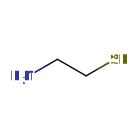
Structure for Cysteamine (DB00847)

- Weight
- Average: 77.149
Monoisotopic: 77.029919919 - Chemical Formula
- C2H7NS
- Synonyms
- 2-amino-1-ethanethiol
- 2-amino-ethanethiol
- 2-aminoethanethiol
- beta-aminoethanethiol
- beta-Mercaptoethylamine
- Cysteamine
- MEA
- Mercaptamina
- Mercaptamine
- Mercaptaminum
- Thioethanolamine
- β-aminoethylthiol
- β-MEA
- External IDs
- L 1573
- L-1573

Pharmacology
- Indication
The bitartrate salt of cysteamine is used for the oral treatment of nephropathic cystinosis and cystinuria in adults and children ≥6 years old.12 The hydrochloride salt, used in eye drop preparations, is indicated for the treatment of corneal cystine crystal accumulation in patients with cystinosis.9,10
 Reduce drug development failure ratesBuild, train, & validate machine-learning modelswith evidence-based and structured datasets.Build, train, & validate predictive machine-learning models with structured datasets.
- Associated Conditions
Indication Type Indication Combined Product Details Approval Level Age Group Patient Characteristics Dose Form Management of Nephropathic cystinosis •••••••••••• •••••• ••••••••• •••••••• ••••••• ••••••• Treatment of Corneal cystine crystal accumulation •••••••••••• •••••••••• - Contraindications & Blackbox Warnings
 Prevent Adverse Drug Events TodayTap into our Clinical API for life-saving information on contraindications & blackbox warnings, population restrictions, harmful risks, & more.Avoid life-threatening adverse drug events with our Clinical API
- Pharmacodynamics
Cystine accumulation is the cause of organ damage in cystinosis. Cysteamine prevents the accumulation of cystine crystals in the body and is specifically prescribed to prevent kidney and eye damage.4,9,12 Cysteamine converts cystine into a form that may easily exit cells, preventing harmful accumulation.10
- Mechanism of action
Individuals born without the ability to metabolize cystine suffer from cystinosis, a rare genetic disorder characterized by the widespread accumulation of cystine crystals throughout the body and eye tissues. The cystine crystals may cause considerable damage, particularly in the renal tissues and corneal tissues. In some cases, renal failure can occur during childhood if the condition is left untreated. Other organs that may be affected by cystinosis include the CNS, thyroid, pancreas, muscle tissues, and gonads.2
Cysteamine converts cystine to cysteine and cysteine-cysteamine mixed disulfides, reducing the buildup of corneal cystine crystals.11 This drug participates in a thiol-disulfide interchange reaction with lysosomes, leading to cysteine exit from the lysosome in patients diagnosed with cystinosis.12
Target Actions Organism UCystine cleavageHumans UNeuropeptide Y receptor type 2 other/unknownHumans - Absorption
Orally administered cysteamine is absorbed in the gastrointestinal tract and reaches its maximum plasma concentration in about 1.4 hours, with some variation according to the type of formulation (delayed versus immediate-release).6,5,12 One pharmacokinetic study of adults with Cystic Fibrosis revealed a Cmax of 2.86 mg/L.6The maximum plasma concentration after administration of cysteamine eye drops is unknown, however, it is likely to be considerably lower than oral administration.10
According to prescribing information, the AUC 0-12 h for the delayed-release oral tablets is 99.26 ± 44.2 μmol*h/L with a Cmax of 27.70 ± 14.99 μmol/L.12
The AUC 0-12 for the immediate-release tablets is 192.00 ± 75.62 μmol*h/L with a Cmax of 37.72 ± 12.10 μmol/L.12
- Volume of distribution
Cysteamine has a volume of distribution of about 129 L, according to one pharmacokinetic study.6 Prescribing information indicates a volume of distribution of 382 L for the delayed-release formulation and 198 L for the immediate-release preparation.12 It is known to cross the blood-brain barrier.8
- Protein binding
Cysteamine is 52% plasma protein bound, and is mostly bound to albumin.12
- Metabolism
There is limited information in the literature regarding the metabolism of cysteamine. This drug undergoes significant first-pass metabolism.8
- Route of elimination
Not Available
- Half-life
The half-life of cysteamine is about 3.7 hours.6
- Clearance
The plasma clearance of cysteamine is about 1.2 - 1.4 L/min.12 One reference mentions a clearance of 89.9 L/h in patients with Cystic Fibrosis.6
- Adverse Effects
 Improve decision support & research outcomesWith structured adverse effects data, including: blackbox warnings, adverse reactions, warning & precautions, & incidence rates. View sample adverse effects data in our new Data Library!Improve decision support & research outcomes with our structured adverse effects data.
- Toxicity
Two cases of human overdoses with cysteamine are recorded in the literature, according to prescribing information. In one case, vomiting was immediate after the administration of cysteamine, and the patient did not experience other symptoms. A 200 to 250 mg/kg dose was accidentally ingested by a healthy 13-month-old child. Vomiting and dehydration followed. A full recovery was made after hospitalization and the replenishment of fluids.13
There is no known antidote for an overdose with cysteamine. In the case of an overdose, provide supportive treatment, especially to the cardiovascular and respiratory systems. Hemodialysis may be useful in some cases due to the fact that cysteamine has poor plasma protein binding.13
- Pathways
Pathway Category Taurine and Hypotaurine Metabolism Metabolic Pantothenate and CoA Biosynthesis Metabolic - Pharmacogenomic Effects/ADRs
- Not Available
Interactions
- Drug Interactions
- This information should not be interpreted without the help of a healthcare provider. If you believe you are experiencing an interaction, contact a healthcare provider immediately. The absence of an interaction does not necessarily mean no interactions exist.
Drug Interaction Integrate drug-drug
interactions in your softwareAlmasilate The bioavailability of Cysteamine can be decreased when combined with Almasilate. Aluminium phosphate The bioavailability of Cysteamine can be decreased when combined with Aluminium phosphate. Aluminum hydroxide The bioavailability of Cysteamine can be decreased when combined with Aluminum hydroxide. Asenapine Asenapine can cause an increase in the absorption of Cysteamine resulting in an increased serum concentration and potentially a worsening of adverse effects. Bismuth subnitrate The bioavailability of Cysteamine can be decreased when combined with Bismuth subnitrate. - Food Interactions
- Take on an empty stomach. The delayed-release capsules should be taken at least 30 minutes before or 2 hours after a high-fat meal to ensure adequate exposure.
- Take with or without food. The immediate release preparation can be taken with or without food.
Products
 Drug product information from 10+ global regionsOur datasets provide approved product information including:dosage, form, labeller, route of administration, and marketing period.Access drug product information from over 10 global regions.
- Product Ingredients
Ingredient UNII CAS InChI Key Cysteamine bitartrate QO84GZ3TST 27761-19-9 NSKJTUFFDRENDM-ZVGUSBNCSA-N Cysteamine hydrochloride IF1B771SVB 156-57-0 OGMADIBCHLQMIP-UHFFFAOYSA-N - International/Other Brands
- Cystagon / Cystaran / Procysbi
- Brand Name Prescription Products
Name Dosage Strength Route Labeller Marketing Start Marketing End Region Image Cystadrops Solution 0.37 % w/w Ophthalmic Recordati Rare Diseases Canada Inc 2019-05-15 Not applicable Canada 
Cystadrops Solution 3.5 mg/1mL Ophthalmic RECORDATI RARE DISEASES, INC. 2020-08-19 Not applicable US 
Cystadrops Solution / drops 3.8 mg/ml Ophthalmic Recordati Rare Diseases 2020-12-23 Not applicable EU 
Cystadrops Solution / drops 3.8 mg/ml Ophthalmic Recordati Rare Diseases 2020-12-23 Not applicable EU Cystagon Capsule 150 mg Oral Recordati Rare Diseases 2016-09-08 Not applicable EU
Categories
- ATC Codes
- A16AA04 — Mercaptamine
- A16AA — Amino acids and derivatives
- A16A — OTHER ALIMENTARY TRACT AND METABOLISM PRODUCTS
- A16 — OTHER ALIMENTARY TRACT AND METABOLISM PRODUCTS
- A — ALIMENTARY TRACT AND METABOLISM
- Drug Categories
- Chemical TaxonomyProvided by Classyfire
- Description
- This compound belongs to the class of organic compounds known as alkylthiols. These are organic compounds containing the thiol functional group linked to an alkyl chain.
- Kingdom
- Organic compounds
- Super Class
- Organosulfur compounds
- Class
- Thiols
- Sub Class
- Alkylthiols
- Direct Parent
- Alkylthiols
- Alternative Parents
- Organopnictogen compounds / Monoalkylamines / Hydrocarbon derivatives
- Substituents
- Aliphatic acyclic compound / Alkylthiol / Amine / Hydrocarbon derivative / Organic nitrogen compound / Organonitrogen compound / Organopnictogen compound / Primary aliphatic amine / Primary amine
- Molecular Framework
- Aliphatic acyclic compounds
- External Descriptors
- thiol, amine (CHEBI:17141) / Biogenic amines (C01678) / a thiol (CPD-239)
- Affected organisms
- Humans and other mammals
Chemical Identifiers
- UNII
- 5UX2SD1KE2
- CAS number
- 60-23-1
- InChI Key
- UFULAYFCSOUIOV-UHFFFAOYSA-N
- InChI
- InChI=1S/C2H7NS/c3-1-2-4/h4H,1-3H2
- IUPAC Name
- 2-aminoethane-1-thiol
- SMILES
- NCCS
References
- Synthesis Reference
Tethuharu Okazaki, Takeo Komukai, Saburo Uchikuga, "Process for preparing cysteamine-S-substituted compounds and derivatives thereof." U.S. Patent US4371472, issued September, 1969.
US4371472- General References
- Dohil R, Fidler M, Gangoiti JA, Kaskel F, Schneider JA, Barshop BA: Twice-daily cysteamine bitartrate therapy for children with cystinosis. J Pediatr. 2010 Jan;156(1):71-75.e1-3. doi: 10.1016/j.jpeds.2009.07.016. Epub . [Article]
- Elmonem MA, Veys KR, Soliman NA, van Dyck M, van den Heuvel LP, Levtchenko E: Cystinosis: a review. Orphanet J Rare Dis. 2016 Apr 22;11:47. doi: 10.1186/s13023-016-0426-y. [Article]
- Besouw M, Masereeuw R, van den Heuvel L, Levtchenko E: Cysteamine: an old drug with new potential. Drug Discov Today. 2013 Aug;18(15-16):785-92. doi: 10.1016/j.drudis.2013.02.003. Epub 2013 Feb 14. [Article]
- Cherqui S: Cysteamine therapy: a treatment for cystinosis, not a cure. Kidney Int. 2012 Jan;81(2):127-9. doi: 10.1038/ki.2011.301. [Article]
- Gangoiti JA, Fidler M, Cabrera BL, Schneider JA, Barshop BA, Dohil R: Pharmacokinetics of enteric-coated cysteamine bitartrate in healthy adults: a pilot study. Br J Clin Pharmacol. 2010 Sep;70(3):376-82. doi: 10.1111/j.1365-2125.2010.03721.x. [Article]
- Devereux G, Steele S, Griffiths K, Devlin E, Fraser-Pitt D, Cotton S, Norrie J, Chrystyn H, O'Neil D: An Open-Label Investigation of the Pharmacokinetics and Tolerability of Oral Cysteamine in Adults with Cystic Fibrosis. Clin Drug Investig. 2016 Aug;36(8):605-12. doi: 10.1007/s40261-016-0405-z. [Article]
- Langman CB, Greenbaum LA, Sarwal M, Grimm P, Niaudet P, Deschenes G, Cornelissen E, Morin D, Cochat P, Matossian D, Gaillard S, Bagger MJ, Rioux P: A randomized controlled crossover trial with delayed-release cysteamine bitartrate in nephropathic cystinosis: effectiveness on white blood cell cystine levels and comparison of safety. Clin J Am Soc Nephrol. 2012 Jul;7(7):1112-20. doi: 10.2215/CJN.12321211. Epub 2012 May 3. [Article]
- Dohil R, Cabrera BL, Gangoiti JA, Barshop BA, Rioux P: Pharmacokinetics of cysteamine bitartrate following intraduodenal delivery. Fundam Clin Pharmacol. 2014 Apr;28(2):136-43. doi: 10.1111/fcp.12009. Epub 2012 Oct 31. [Article]
- PRN News Wire: U.S. FDA Approves CYSTADROPS® (Cysteamine Ophthalmic Solution) 0.37%, A New Practical Treatment Option for the Ocular Manifestations of Cystinosis [Link]
- FDA Approved Products: Cystadrops (cysteamine solution 0.37%) for ophthalmic use [Link]
- FDA approved products: CYSTARAN (cysteamine 0.44%) for ophthalmic use [Link]
- FDA approved products: PROCYSBI (cysteamine bitartrate) delayed-release oral capsules [Link]
- FDA Approved Products: CYSTAGON® (cysteamine bitartrate) oral capsules [Link]
- External Links
- Human Metabolome Database
- HMDB0002991
- KEGG Drug
- D03634
- KEGG Compound
- C01678
- PubChem Compound
- 6058
- PubChem Substance
- 46507730
- ChemSpider
- 5834
- BindingDB
- 7968
- 3022
- ChEBI
- 17141
- ChEMBL
- CHEMBL602
- ZINC
- ZINC000008034121
- Therapeutic Targets Database
- DAP001297
- PharmGKB
- PA449171
- PDBe Ligand
- DHL
- RxList
- RxList Drug Page
- Drugs.com
- Drugs.com Drug Page
- Wikipedia
- Cysteamine
- PDB Entries
- 2y8d / 3q1l / 3som / 4cg4 / 4pa5 / 5apr / 5ej0 / 6xic / 7s5g / 7s5h … show 6 more
- FDA label
- Download (115 KB)
- MSDS
- Download (73.7 KB)
Clinical Trials
- Clinical Trials
Phase Status Purpose Conditions Count 4 Completed Treatment Infantile Neuronal Ceroid Lipofuscinosis 1 3 Completed Treatment Cystinosis 5 3 Completed Treatment Melasma 1 3 Recruiting Treatment Community-acquired Pneumonia, Influenza, COVID-19 / Coronavirus Disease 2019 (COVID‑19) 1 2 Completed Treatment Cystic Fibrosis (CF) 1
Pharmacoeconomics
- Manufacturers
- Mylan pharmaceuticals inc
- Packagers
- Mylan
- Dosage Forms
Form Route Strength Solution Ophthalmic 0.37 % w/w Solution Ophthalmic 3.5 mg/1mL Solution / drops Ophthalmic 3.8 MG/ML Solution Ophthalmic 3.8 mg Capsule Oral 150 mg/1 Capsule Oral 150 MG Capsule Oral 50 MG Capsule Oral 50 mg/1 Capsule, coated Oral 150 mg Capsule, coated Oral 50 mg Solution Ophthalmic 6.5 mg/1mL Capsule, delayed release Oral 25 mg Capsule, delayed release Oral 75 mg Granule Oral 300 mg Granule Oral 75 mg Granule, delayed release Oral 300 mg/1 Granule, delayed release Oral 75 mg/1 Capsule, delayed release pellets Oral 25 mg/1 Capsule, delayed release pellets Oral 75 mg/1 - Prices
Unit description Cost Unit Cystagon 150 mg capsule 1.28USD capsule Cystagon 50 mg capsule 0.44USD capsule DrugBank does not sell nor buy drugs. Pricing information is supplied for informational purposes only.- Patents
Patent Number Pediatric Extension Approved Expires (estimated) Region US9192590 Yes 2015-11-24 2027-07-26 US US9198882 Yes 2015-12-01 2027-07-26 US US8026284 Yes 2011-09-27 2028-03-22 US US9233077 Yes 2016-01-12 2034-12-17 US US9173851 Yes 2015-11-03 2034-12-17 US US9925158 Yes 2018-03-27 2027-07-26 US US9925157 Yes 2018-03-27 2027-07-26 US US9925156 Yes 2018-03-27 2027-07-26 US US10143665 Yes 2018-12-04 2037-02-16 US US10328037 Yes 2019-06-25 2037-02-16 US US10548859 Yes 2020-02-04 2037-02-16 US US10905662 Yes 2021-02-02 2037-02-16 US
Properties
- State
- Solid
- Experimental Properties
Property Value Source melting point (°C) 67-71 https://www.chemicalbook.com/ChemicalProductProperty_US_CB9337215.aspx boiling point (°C) 133.6±23.0 http://www.chemspider.com/Chemical-Structure.5834.html water solubility Freely soluble in water. https://www.chemicalbook.com/ChemicalProductProperty_US_CB9337215.aspx logP 0.1 https://link.springer.com/article/10.1007/s40261-016-0405-z pKa 10.4 https://link.springer.com/article/10.1007/s40261-016-0405-z - Predicted Properties
Property Value Source Water Solubility 23.5 mg/mL ALOGPS logP 0.01 ALOGPS logP -0.42 Chemaxon logS -0.52 ALOGPS pKa (Strongest Acidic) 9.42 Chemaxon pKa (Strongest Basic) 10.4 Chemaxon Physiological Charge 1 Chemaxon Hydrogen Acceptor Count 1 Chemaxon Hydrogen Donor Count 2 Chemaxon Polar Surface Area 26.02 Å2 Chemaxon Rotatable Bond Count 1 Chemaxon Refractivity 22.39 m3·mol-1 Chemaxon Polarizability 8.65 Å3 Chemaxon Number of Rings 0 Chemaxon Bioavailability 1 Chemaxon Rule of Five Yes Chemaxon Ghose Filter No Chemaxon Veber's Rule Yes Chemaxon MDDR-like Rule No Chemaxon - Predicted ADMET Features
Property Value Probability Human Intestinal Absorption + 0.9378 Blood Brain Barrier + 0.7618 Caco-2 permeable + 0.7461 P-glycoprotein substrate Non-substrate 0.7 P-glycoprotein inhibitor I Non-inhibitor 0.9634 P-glycoprotein inhibitor II Non-inhibitor 0.9637 Renal organic cation transporter Non-inhibitor 0.751 CYP450 2C9 substrate Non-substrate 0.9035 CYP450 2D6 substrate Non-substrate 0.5713 CYP450 3A4 substrate Non-substrate 0.8282 CYP450 1A2 substrate Non-inhibitor 0.9046 CYP450 2C9 inhibitor Non-inhibitor 0.9071 CYP450 2D6 inhibitor Non-inhibitor 0.9231 CYP450 2C19 inhibitor Non-inhibitor 0.9025 CYP450 3A4 inhibitor Non-inhibitor 0.9396 CYP450 inhibitory promiscuity Low CYP Inhibitory Promiscuity 0.8091 Ames test Non AMES toxic 0.8488 Carcinogenicity Non-carcinogens 0.5197 Biodegradation Not ready biodegradable 0.7564 Rat acute toxicity 2.2165 LD50, mol/kg Not applicable hERG inhibition (predictor I) Weak inhibitor 0.8358 hERG inhibition (predictor II) Non-inhibitor 0.8686
Spectra
- Mass Spec (NIST)
- Download (7.29 KB)
- Spectra
- Chromatographic Properties
Collision Cross Sections (CCS)
Adduct CCS Value (Å2) Source type Source [M-H]- 100.768434 predictedDarkChem Lite v0.1.0 [M-H]- 100.730434 predictedDarkChem Lite v0.1.0 [M-H]- 117.33682 predictedDeepCCS 1.0 (2019) [M+H]+ 102.378734 predictedDarkChem Lite v0.1.0 [M+H]+ 102.355334 predictedDarkChem Lite v0.1.0 [M+H]+ 119.17246 predictedDeepCCS 1.0 (2019) [M+Na]+ 101.418534 predictedDarkChem Lite v0.1.0 [M+Na]+ 101.527934 predictedDarkChem Lite v0.1.0 [M+Na]+ 126.305214 predictedDeepCCS 1.0 (2019)
Targets

References
- Omran Z, Kay G, Di Salvo A, Knott RM, Cairns D: PEGylated derivatives of cystamine as enhanced treatments for nephropathic cystinosis. Bioorg Med Chem Lett. 2011 Jan 1;21(1):45-7. doi: 10.1016/j.bmcl.2010.11.085. Epub 2010 Nov 21. [Article]
- FDA approved products: PROCYSBI (cysteamine bitartrate) delayed-release oral capsules [Link]
- PRN News Wire: U.S. FDA Approves CYSTADROPS® (Cysteamine Ophthalmic Solution) 0.37%, A New Practical Treatment Option for the Ocular Manifestations of Cystinosis [Link]
- Kind
- Protein
- Organism
- Humans
- Pharmacological action
- Unknown
- Actions
- Other/unknown
- Curator comments
- Data for this target action are limited to animal studies and relevance to humans is unknown.
- General Function
- Receptor activity
- Specific Function
- Receptor for neuropeptide Y and peptide YY. The rank order of affinity of this receptor for pancreatic polypeptides is PYY > NPY > PYY (3-36) > NPY (2-36) > [Ile-31, Gln-34] PP > [Leu-31, Pro-34] N...
- Gene Name
- NPY2R
- Uniprot ID
- P49146
- Uniprot Name
- Neuropeptide Y receptor type 2
- Molecular Weight
- 42730.69 Da
References
- Li W, Hexum TD: Cysteamine selectively enhances neuropeptide Y2 receptor binding activity. Biochem Biophys Res Commun. 1992 Apr 15;184(1):380-6. [Article]
Enzymes
- Kind
- Protein
- Organism
- Humans
- Pharmacological action
- Unknown
- Actions
- Substrate
- General Function
- Peroxidase activity
- Specific Function
- Part of the host defense system of polymorphonuclear leukocytes. It is responsible for microbicidal activity against a wide range of organisms. In the stimulated PMN, MPO catalyzes the production o...
- Gene Name
- MPO
- Uniprot ID
- P05164
- Uniprot Name
- Myeloperoxidase
- Molecular Weight
- 83867.71 Da
References
- Svensson BE: Abilities of peroxidases to catalyse peroxidase-oxidase oxidation of thiols. Biochem J. 1988 Dec 15;256(3):757-62. [Article]
- Svensson BE, Graslund A, Strom G, Moldeus P: Thiols as peroxidase substrates. Free Radic Biol Med. 1993 Feb;14(2):167-75. [Article]
- Svensson BE, Lindvall S: Myeloperoxidase-oxidase oxidation of cysteamine. Biochem J. 1988 Jan 15;249(2):521-30. [Article]
Carriers
- Kind
- Protein
- Organism
- Humans
- Pharmacological action
- Unknown
- Actions
- Binder
- General Function
- Toxic substance binding
- Specific Function
- Serum albumin, the main protein of plasma, has a good binding capacity for water, Ca(2+), Na(+), K(+), fatty acids, hormones, bilirubin and drugs. Its main function is the regulation of the colloid...
- Gene Name
- ALB
- Uniprot ID
- P02768
- Uniprot Name
- Serum albumin
- Molecular Weight
- 69365.94 Da
References
- FDA approved products: PROCYSBI (cysteamine bitartrate) delayed-release oral capsules [Link]


Drug created at June 13, 2005 13:24 / Updated at April 23, 2024 11:38