Identification
- Summary
Risedronic acid is a bisphosphonate used to treat osteoporosis and Paget's disease.
- Brand Names
- Actonel, Atelvia
- Generic Name
- Risedronic acid
- DrugBank Accession Number
- DB00884
- Background
Risedronic acid is a third generation bisphosphonate that is used for the treatment of some forms of osteoperosis and Paget's diseaseLabel1,2. It functions by preventing resorption of boneLabel1.
- Type
- Small Molecule
- Groups
- Approved, Investigational
- Structure
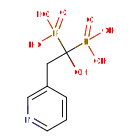
Structure for Risedronic acid (DB00884)
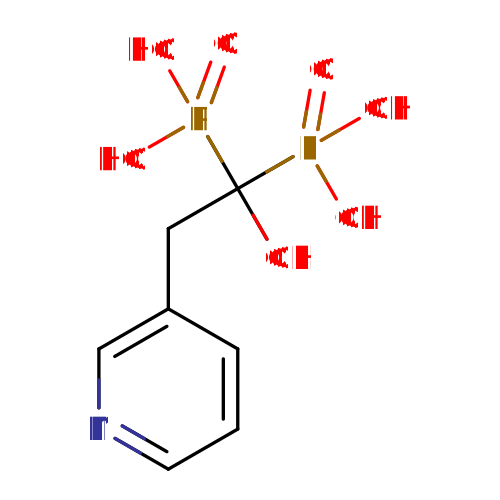
- Weight
- Average: 283.1123
Monoisotopic: 283.001074735 - Chemical Formula
- C7H11NO7P2
- Synonyms
- Acide risédroniqe
- Acido risedronico
- Acidum risedronicum
- Risedronate
- Risedronic acid
- Risedronsäure
- External IDs
- NE-58095

Pharmacology
- Indication
Risedronic acid is indicated for the treatment of osteoperosis in men, treatment of Paget's disease, treatment and prevention of osteoperosis in postmenopausal women, and treatment and prevention of glucocorticoid-induced osteoperosisLabel.
 Reduce drug development failure ratesBuild, train, & validate machine-learning modelswith evidence-based and structured datasets.Build, train, & validate predictive machine-learning models with structured datasets.
- Associated Conditions
Indication Type Indication Combined Product Details Approval Level Age Group Patient Characteristics Dose Form Management of Hypercalcemia of malignancy ••• ••••• Used in combination to prevent Osteoporosis Regimen in combination with: Calcium (DB01373), Cholecalciferol (DB00169) •••••••••••• •••••••••••••• Used in combination to manage Osteoporosis Regimen in combination with: Calcium (DB01373), Cholecalciferol (DB00169) •••••••••••• •••••••••••••• Treatment of Osteoporosis •••••••••••• ••••••••••••••• Treatment of Osteoporosis •••••••••••• - Contraindications & Blackbox Warnings
 Prevent Adverse Drug Events TodayTap into our Clinical API for life-saving information on contraindications & blackbox warnings, population restrictions, harmful risks, & more.Avoid life-threatening adverse drug events with our Clinical API
- Pharmacodynamics
Risedronate is a pyridine-based bisphosphonate that inhibits bone resorption caused by osteoclastsLabel.
- Mechanism of action
Risedronatic acid binds to bone hydroxyapatiteLabel. Bone resorption causes local acidification, releasing risedronic acid which is that taken into osteoclasts by fluid-phase endocytosis1. Endocytic vesicles are acidified, releasing risedronic acid to the cytosol of osteoclasts where they induce apoptosis through inhbition of farnesyl pyrophosphate synthase1. Inhibition of osteoclasts results in decreased bone resorption1.
Target Actions Organism AHydroxylapatite antagonistHumans AFarnesyl pyrophosphate synthase inhibitorHumans - Absorption
Oral bioavailability is 0.63% and maximum absorption is approximately 1 hour after dosingLabel. Administration half and hour before a meal reduces bioavailability by 55% compared to fasting and dosing 1 hour before a meal reduces bioavailability by 30%Label.
- Volume of distribution
13.8 L/kgLabel.
- Protein binding
~24%Label.
- Metabolism
Risedronic acid is not likely not metabolized before eliminationLabel. The P-C-P group of bisphosphonates is resistant to chemical and enzymatic hydrolysis preventing metabolism of the molecule1.
- Route of elimination
Risedronate is excreted by the kidneys and the unabsorbed dose is eliminated in the fecesLabel.
- Half-life
The initial half life of risedronic acid is approximately 1.5 hours3, with a terminal half life of 561 hoursLabel.
- Clearance
Mean renal clearance was 52mL/min and mean total clearance was 73mL/minLabel.
- Adverse Effects
 Improve decision support & research outcomesWith structured adverse effects data, including: blackbox warnings, adverse reactions, warning & precautions, & incidence rates. View sample adverse effects data in our new Data Library!Improve decision support & research outcomes with our structured adverse effects data.
- Toxicity
In clinical trials, over 10% of patients experienced back pain, arthralgia, abdominal pain, and dyspepsiaLabel. Less commonly, patients experience angioedema, generalized rash, bullous skin reactions, iritis, and uveitisLabel.
Patients experiencing an overdose may experience a decrease in serum calcium and phosphorusLabel. Patients can be given milk or antacids to bind the drug and reduce its absorptionLabel. In more severe cases, patients may require gastric lavage and intravenous calciumLabel. A lethal dose in rats is equivalent to 320 to 620 times the human dose based on surface areaLabel.
- Pathways
Pathway Category Risedronate Action Pathway Drug action - Pharmacogenomic Effects/ADRs
- Not Available
Interactions
- Drug Interactions
- This information should not be interpreted without the help of a healthcare provider. If you believe you are experiencing an interaction, contact a healthcare provider immediately. The absence of an interaction does not necessarily mean no interactions exist.
Drug Interaction Integrate drug-drug
interactions in your softwareAceclofenac The risk or severity of gastrointestinal bleeding can be increased when Aceclofenac is combined with Risedronic acid. Acemetacin The risk or severity of gastrointestinal bleeding can be increased when Acemetacin is combined with Risedronic acid. Acetylsalicylic acid The risk or severity of gastrointestinal bleeding can be increased when Acetylsalicylic acid is combined with Risedronic acid. Acipimox The risk or severity of myopathy, rhabdomyolysis, and myoglobinuria can be increased when Risedronic acid is combined with Acipimox. Acyclovir The risk or severity of nephrotoxicity and hypocalcemia can be increased when Acyclovir is combined with Risedronic acid. - Food Interactions
- Administer vitamin supplements. Patients may require supplemental vitamin D.
- Avoid multivalent ions. Calcium, antacids, and divalent ions may interfere with the absorption of this medication.
- Take on an empty stomach.
- Take with a full glass of water.
Products
 Drug product information from 10+ global regionsOur datasets provide approved product information including:dosage, form, labeller, route of administration, and marketing period.Access drug product information from over 10 global regions.
- Product Ingredients
Ingredient UNII CAS InChI Key Risedronate sodium OFG5EXG60L 115436-72-1 DRFDPXKCEWYIAW-UHFFFAOYSA-M Risedronate sodium hemi-pentahydrate HU2YAQ274O 329003-65-8 HYFDYHPNTXOPPO-UHFFFAOYSA-L Risedronate sodium monohydrate F67L43UT5C 353228-19-0 KLQNARDFMJRXSF-UHFFFAOYSA-M - Product Images
- International/Other Brands
- Benet (Takeda ) / Ridron
- Brand Name Prescription Products
Name Dosage Strength Route Labeller Marketing Start Marketing End Region Image Actonel Tablet, film coated 150 mg/1 Oral Warner Chilcott 2008-04-22 Not applicable US 
Actonel Tablet, film coated 5 mg/1 Oral Physicians Total Care, Inc. 2002-03-15 Not applicable US Actonel Tablet 35 mg Oral Abbvie 2002-12-10 Not applicable Canada 
Actonel Tablet 5 mg Oral Allergan Pharma Co. 2000-07-25 2019-01-04 Canada Actonel Tablet, film coated 35 mg/1 Oral Warner Chilcott 2002-05-17 Not applicable US - Generic Prescription Products
Name Dosage Strength Route Labeller Marketing Start Marketing End Region Image Aa-risedronate Dr Tablet, delayed release 35 mg Oral Aa Pharma Inc 2021-05-18 Not applicable Canada Apo-risedronate Tablet 150 mg Oral Apotex Corporation 2012-05-17 Not applicable Canada Apo-risedronate Tablet 35 mg Oral Apotex Corporation 2010-11-10 Not applicable Canada Auro-risedronate Tablet 5 mg Oral Auro Pharma Inc Not applicable Not applicable Canada Auro-risedronate Tablet 30 mg Oral Auro Pharma Inc Not applicable Not applicable Canada - Mixture Products
Name Ingredients Dosage Route Labeller Marketing Start Marketing End Region Image Actonel Risedronate sodium hemi-pentahydrate (64.5 mg/1) + Risedronate sodium monohydrate (10.5 mg/1) Tablet, film coated Oral Allergan, Inc. 2007-04-16 2010-03-31 US Actonel Risedronate sodium hemi-pentahydrate (25.8 mg/1) + Risedronate sodium monohydrate (4.2 mg/1) Tablet, film coated Oral Allergan, Inc. 1998-03-27 2020-02-28 US Actonel Risedronate sodium hemi-pentahydrate (4.3 mg/1) + Risedronate sodium monohydrate (0.7 mg/1) Tablet, film coated Oral Allergan, Inc. 2000-04-14 2020-07-28 US Actonel Risedronate sodium hemi-pentahydrate (129 mg/1) + Risedronate sodium monohydrate (21 mg/1) Tablet, film coated Oral Allergan, Inc. 2008-04-22 Not applicable US Actonel Risedronate sodium hemi-pentahydrate (30.1 mg/1) + Risedronate sodium monohydrate (4.9 mg/1) Tablet, film coated Oral Allergan, Inc. 2002-05-17 Not applicable US 


Categories
- ATC Codes
- M05BB07 — Risedronic acid and colecalciferol
- M05BB — Bisphosphonates, combinations
- M05B — DRUGS AFFECTING BONE STRUCTURE AND MINERALIZATION
- M05 — DRUGS FOR TREATMENT OF BONE DISEASES
- M — MUSCULO-SKELETAL SYSTEM
- M05BB — Bisphosphonates, combinations
- M05B — DRUGS AFFECTING BONE STRUCTURE AND MINERALIZATION
- M05 — DRUGS FOR TREATMENT OF BONE DISEASES
- M — MUSCULO-SKELETAL SYSTEM
- M05BB — Bisphosphonates, combinations
- M05B — DRUGS AFFECTING BONE STRUCTURE AND MINERALIZATION
- M05 — DRUGS FOR TREATMENT OF BONE DISEASES
- M — MUSCULO-SKELETAL SYSTEM
- Drug Categories
- Agents Causing Muscle Toxicity
- Bisphosphonates
- Bone Density Conservation Agents
- Calcium-Regulating Hormones and Agents
- Cardiovascular Agents
- Drugs Affecting Bone Structure and Mineralization
- Drugs for Treatment of Bone Diseases
- Membrane Transport Modulators
- Musculo-Skeletal System
- Organophosphonates
- Organophosphorus Compounds
- Pyridines
- Chemical TaxonomyProvided by Classyfire
- Description
- This compound belongs to the class of organic compounds known as bisphosphonates. These are organic compounds containing two phosphonate groups linked together through a carbon atoms.
- Kingdom
- Organic compounds
- Super Class
- Organic acids and derivatives
- Class
- Organic phosphonic acids and derivatives
- Sub Class
- Bisphosphonates
- Direct Parent
- Bisphosphonates
- Alternative Parents
- Pyridines and derivatives / Organic phosphonic acids / Heteroaromatic compounds / Azacyclic compounds / Organopnictogen compounds / Organophosphorus compounds / Organooxygen compounds / Organonitrogen compounds / Organic oxides / Hydrocarbon derivatives
- Substituents
- Aromatic heteromonocyclic compound / Azacycle / Bisphosphonate / Heteroaromatic compound / Hydrocarbon derivative / Organic nitrogen compound / Organic oxide / Organic oxygen compound / Organoheterocyclic compound / Organonitrogen compound
- Molecular Framework
- Aromatic heteromonocyclic compounds
- External Descriptors
- pyridines (CHEBI:8869)
- Affected organisms
- Humans and other mammals
Chemical Identifiers
- UNII
- KM2Z91756Z
- CAS number
- 105462-24-6
- InChI Key
- IIDJRNMFWXDHID-UHFFFAOYSA-N
- InChI
- InChI=1S/C7H11NO7P2/c9-7(16(10,11)12,17(13,14)15)4-6-2-1-3-8-5-6/h1-3,5,9H,4H2,(H2,10,11,12)(H2,13,14,15)
- IUPAC Name
- [1-hydroxy-1-phosphono-2-(pyridin-3-yl)ethyl]phosphonic acid
- SMILES
- OC(CC1=CN=CC=C1)(P(O)(O)=O)P(O)(O)=O
References
- Synthesis Reference
Srinivasa Rao V.N Divvela, Lenin Racha, Sivakumaran Meenakshisunderam, Ramesh Dandala, "Process for the preparation of risedronate sodium hemi-pentahydrate." U.S. Patent US20070173484, issued July 26, 2007.
US20070173484- General References
- Russell RG, Watts NB, Ebetino FH, Rogers MJ: Mechanisms of action of bisphosphonates: similarities and differences and their potential influence on clinical efficacy. Osteoporos Int. 2008 Jun;19(6):733-59. doi: 10.1007/s00198-007-0540-8. [Article]
- Cremers S, Drake MT, Ebetino FH, Bilezikian JP, Russell RGG: Pharmacology of bisphosphonates. Br J Clin Pharmacol. 2019 Jun;85(6):1052-1062. doi: 10.1111/bcp.13867. Epub 2019 Feb 28. [Article]
- Thompson Micromedex (2004). Usp Vol I Drug Info Health Vol: Volume I (USP DI: v.1 Drug Information for the Health Care Professional) (24th ed., pp. 2475). Thompson PDR. [ISBN:1563634635]
- Risedronate Sodium Tablet MSDS [Link]
- FDA Approved Drugs: Risedronic Acid Oral Tablets [Link]
- FDA Approved Drug Products: Risedronic Acid Extended Release Tablets [Link]
- External Links
- Human Metabolome Database
- HMDB0015022
- KEGG Drug
- D08484
- KEGG Compound
- C08233
- PubChem Compound
- 5245
- PubChem Substance
- 46507526
- ChemSpider
- 5055
- BindingDB
- 12576
- 55685
- ChEBI
- 8869
- ChEMBL
- CHEMBL923
- ZINC
- ZINC000001531009
- Therapeutic Targets Database
- DAP000658
- PharmGKB
- PA451255
- PDBe Ligand
- RIS
- RxList
- RxList Drug Page
- Drugs.com
- Drugs.com Drug Page
- PDRhealth
- PDRhealth Drug Page
- Wikipedia
- Risedronic_acid
- PDB Entries
- 1rqj / 1yhl / 1yq7 / 1yv5 / 2o1o / 2qis / 4kpd / 4kqs / 4n9u / 4ng6 … show 9 more
- FDA label
- Download (229 KB)
- MSDS
- Download (69.7 KB)
Clinical Trials
- Clinical Trials
Phase Status Purpose Conditions Count 4 Completed Not Available Crohn's Disease (CD) / Decreased bone mineral density 1 4 Completed Prevention Bone Fractures / Bone Loss / Epilepsy / Osteoporosis 1 4 Completed Prevention Bone Loss / Breast Cancer / Osteoporosis 1 4 Completed Prevention Cystic Fibrosis (CF) / Duchenne Muscular Dystrophy (DMD) / Osteoporosis 1 4 Completed Prevention Postmenopausal Osteoporosis 1
Pharmacoeconomics
- Manufacturers
- Warner chilcott co llc
- Teva pharmaceuticals usa
- Procter & Gamble
- Packagers
- Diversified Healthcare Services Inc.
- Lake Erie Medical and Surgical Supply
- Murfreesboro Pharmaceutical Nursing Supply
- Norwich Pharmaceuticals Inc.
- Physicians Total Care Inc.
- Procter & Gamble
- Resource Optimization and Innovation LLC
- Stat Rx Usa
- Warner Chilcott Co. Inc.
- WC Pharmaceuticals
- Dosage Forms
Form Route Strength Tablet, film coated Oral 35 mg Tablet, effervescent Tablet Oral 75 mg Tablet, film coated Oral 150 mg/1 Tablet, film coated Oral 30 mg/1 Tablet, film coated Oral 35 mg/1 Tablet, film coated Oral 5 mg/1 Tablet, film coated Oral 75 mg/1 Tablet, film coated Oral 30 MG Tablet, film coated Oral 75 MG Tablet, delayed release Oral 35 mg Tablet, coated Oral 150 mg Tablet, film coated Oral 150 mg Granule, effervescent; kit; tablet Oral Tablet, film coated Oral 5 mg Kit Oral Tablet Oral 35.000 mg Tablet Oral 150 mg Tablet, delayed release Oral Tablet, effervescent 150 mg Tablet, effervescent 75 mg Tablet, coated Oral Tablet Oral Tablet Oral 35.00 mg Tablet, film coated Oral Tablet, delayed release Oral 35 mg/1 Tablet, film coated Oral Powder Not applicable 1 kg/1kg Tablet Oral Tablet, effervescent Oral Tablet Oral 5.000 mg Tablet Oral 30 mg Tablet Oral 35 mg Tablet Oral 5 mg Kit; tablet Oral Tablet, coated Oral 35 mg - Prices
Unit description Cost Unit Actonel 150 mg tablet 125.1USD tablet Actonel 4 35 mg tablet Disp Pack 119.43USD disp Actonel 75 mg tablet 54.83USD tablet Actonel 30 mg tablet 29.32USD tablet Actonel 35 mg tablet 28.75USD tablet Actonel 5 mg tablet 4.13USD tablet Actonel with calcium tablet 3.92USD tablet DrugBank does not sell nor buy drugs. Pricing information is supplied for informational purposes only.- Patents
Patent Number Pediatric Extension Approved Expires (estimated) Region US6096342 No 2000-08-01 2011-11-22 US CA2294595 No 2001-08-21 2018-07-17 Canada CA2399976 No 2007-03-27 2021-02-01 Canada US7192938 Yes 2007-03-20 2023-11-06 US US7718634 Yes 2010-05-18 2023-11-06 US US6165513 Yes 2000-12-26 2018-12-10 US US5994329 Yes 1999-11-30 2019-01-17 US US6015801 Yes 2000-01-18 2019-01-17 US US6432932 Yes 2002-08-13 2019-01-17 US US6465443 Yes 2002-10-15 2019-02-14 US US7645459 No 2010-01-12 2028-01-09 US US7645460 No 2010-01-12 2028-01-09 US US8246989 No 2012-08-21 2026-01-16 US
Properties
- State
- Solid
- Experimental Properties
Property Value Source melting point (°C) 252-262 https://www.greenstonellc.com/sites/default/files/pdfs/MSDS/RISEDRONATE%20SODIUM%20TABLETS%20MSDS_0.pdf boiling point (°C) 692.3 https://www.greenstonellc.com/sites/default/files/pdfs/MSDS/RISEDRONATE%20SODIUM%20TABLETS%20MSDS_0.pdf - Predicted Properties
Property Value Source Water Solubility 10.4 mg/mL ALOGPS logP -0.75 ALOGPS logP -3.3 Chemaxon logS -1.4 ALOGPS pKa (Strongest Acidic) 0.68 Chemaxon pKa (Strongest Basic) 4.91 Chemaxon Physiological Charge -3 Chemaxon Hydrogen Acceptor Count 8 Chemaxon Hydrogen Donor Count 5 Chemaxon Polar Surface Area 148.18 Å2 Chemaxon Rotatable Bond Count 4 Chemaxon Refractivity 57.12 m3·mol-1 Chemaxon Polarizability 21.91 Å3 Chemaxon Number of Rings 1 Chemaxon Bioavailability 1 Chemaxon Rule of Five Yes Chemaxon Ghose Filter No Chemaxon Veber's Rule No Chemaxon MDDR-like Rule No Chemaxon - Predicted ADMET Features
Property Value Probability Human Intestinal Absorption - 0.9357 Blood Brain Barrier + 0.9172 Caco-2 permeable - 0.6795 P-glycoprotein substrate Non-substrate 0.6846 P-glycoprotein inhibitor I Non-inhibitor 0.9582 P-glycoprotein inhibitor II Non-inhibitor 1.0 Renal organic cation transporter Non-inhibitor 0.9542 CYP450 2C9 substrate Non-substrate 0.8452 CYP450 2D6 substrate Non-substrate 0.8162 CYP450 3A4 substrate Non-substrate 0.7208 CYP450 1A2 substrate Non-inhibitor 0.8778 CYP450 2C9 inhibitor Non-inhibitor 0.8792 CYP450 2D6 inhibitor Non-inhibitor 0.9062 CYP450 2C19 inhibitor Non-inhibitor 0.8777 CYP450 3A4 inhibitor Non-inhibitor 0.9068 CYP450 inhibitory promiscuity Low CYP Inhibitory Promiscuity 0.989 Ames test Non AMES toxic 0.7663 Carcinogenicity Non-carcinogens 0.8386 Biodegradation Not ready biodegradable 0.5058 Rat acute toxicity 2.1053 LD50, mol/kg Not applicable hERG inhibition (predictor I) Weak inhibitor 0.9095 hERG inhibition (predictor II) Non-inhibitor 0.9303
Spectra
- Mass Spec (NIST)
- Not Available
- Spectra
Spectrum Spectrum Type Splash Key Predicted GC-MS Spectrum - GC-MS Predicted GC-MS splash10-001l-9030000000-834cccb13596d4a6e4c2 Predicted MS/MS Spectrum - 10V, Positive (Annotated) Predicted LC-MS/MS splash10-0ue9-0490000000-57ddb91ff8ccb149a8a2 Predicted MS/MS Spectrum - 20V, Positive (Annotated) Predicted LC-MS/MS splash10-001i-0790000000-c2a233ca5a42b3cdd925 Predicted MS/MS Spectrum - 10V, Negative (Annotated) Predicted LC-MS/MS splash10-001i-0090000000-f4a556d28a85f9424b04 Predicted MS/MS Spectrum - 20V, Negative (Annotated) Predicted LC-MS/MS splash10-03fr-9030000000-dea17b00a079a831b2c2 Predicted MS/MS Spectrum - 40V, Positive (Annotated) Predicted LC-MS/MS splash10-00kf-9100000000-a8daf608efb1da969f9c Predicted MS/MS Spectrum - 40V, Negative (Annotated) Predicted LC-MS/MS splash10-03fr-9010000000-02449ab92bded9025cc5 Predicted 1H NMR Spectrum 1D NMR Not Applicable Predicted 13C NMR Spectrum 1D NMR Not Applicable - Chromatographic Properties
Collision Cross Sections (CCS)
Adduct CCS Value (Å2) Source type Source [M-H]- 161.6330857 predictedDarkChem Lite v0.1.0 [M-H]- 144.6663 predictedDeepCCS 1.0 (2019) [M+H]+ 160.9833857 predictedDarkChem Lite v0.1.0 [M+H]+ 147.06187 predictedDeepCCS 1.0 (2019) [M+Na]+ 160.4181857 predictedDarkChem Lite v0.1.0 [M+Na]+ 153.03542 predictedDeepCCS 1.0 (2019)
Targets

References
- Jahnke W, Henry C: An in vitro assay to measure targeted drug delivery to bone mineral. ChemMedChem. 2010 May 3;5(5):770-6. doi: 10.1002/cmdc.201000016. [Article]
- Nancollas GH, Tang R, Phipps RJ, Henneman Z, Gulde S, Wu W, Mangood A, Russell RG, Ebetino FH: Novel insights into actions of bisphosphonates on bone: differences in interactions with hydroxyapatite. Bone. 2006 May;38(5):617-27. Epub 2005 Jul 20. [Article]
- Kind
- Protein
- Organism
- Humans
- Pharmacological action
- Yes
- Actions
- Inhibitor
- General Function
- Poly(a) rna binding
- Specific Function
- Key enzyme in isoprenoid biosynthesis which catalyzes the formation of farnesyl diphosphate (FPP), a precursor for several classes of essential metabolites including sterols, dolichols, carotenoids...
- Gene Name
- FDPS
- Uniprot ID
- P14324
- Uniprot Name
- Farnesyl pyrophosphate synthase
- Molecular Weight
- 48275.03 Da
References
- Bergstrom JD, Bostedor RG, Masarachia PJ, Reszka AA, Rodan G: Alendronate is a specific, nanomolar inhibitor of farnesyl diphosphate synthase. Arch Biochem Biophys. 2000 Jan 1;373(1):231-41. [Article]
- Chen X, Ji ZL, Chen YZ: TTD: Therapeutic Target Database. Nucleic Acids Res. 2002 Jan 1;30(1):412-5. [Article]
- Coxon FP, Ebetino FH, Mules EH, Seabra MC, McKenna CE, Rogers MJ: Phosphonocarboxylate inhibitors of Rab geranylgeranyl transferase disrupt the prenylation and membrane localization of Rab proteins in osteoclasts in vitro and in vivo. Bone. 2005 Sep;37(3):349-58. [Article]
- Dunford JE, Thompson K, Coxon FP, Luckman SP, Hahn FM, Poulter CD, Ebetino FH, Rogers MJ: Structure-activity relationships for inhibition of farnesyl diphosphate synthase in vitro and inhibition of bone resorption in vivo by nitrogen-containing bisphosphonates. J Pharmacol Exp Ther. 2001 Feb;296(2):235-42. [Article]
- Ortiz-Gomez A, Jimenez C, Estevez AM, Carrero-Lerida J, Ruiz-Perez LM, Gonzalez-Pacanowska D: Farnesyl diphosphate synthase is a cytosolic enzyme in Leishmania major promastigotes and its overexpression confers resistance to risedronate. Eukaryot Cell. 2006 Jul;5(7):1057-64. [Article]
- Russell RG, Xia Z, Dunford JE, Oppermann U, Kwaasi A, Hulley PA, Kavanagh KL, Triffitt JT, Lundy MW, Phipps RJ, Barnett BL, Coxon FP, Rogers MJ, Watts NB, Ebetino FH: Bisphosphonates: an update on mechanisms of action and how these relate to clinical efficacy. Ann N Y Acad Sci. 2007 Nov;1117:209-57. [Article]
Enzymes
- Kind
- Protein
- Organism
- Humans
- Pharmacological action
- Unknown
- Actions
- Inducer
- General Function
- Prostaglandin-endoperoxide synthase activity
- Specific Function
- Converts arachidonate to prostaglandin H2 (PGH2), a committed step in prostanoid synthesis. Constitutively expressed in some tissues in physiological conditions, such as the endothelium, kidney and...
- Gene Name
- PTGS2
- Uniprot ID
- P35354
- Uniprot Name
- Prostaglandin G/H synthase 2
- Molecular Weight
- 68995.625 Da
References
- Valenti MT, Giannini S, Donatelli L, Zanatta M, Bertoldo F, Sella S, Vilei MT, Ossi E, Realdi G, Lo Cascio V, Dalle Carbonare L: The effect of risedronate on osteogenic lineage is mediated by cyclooxygenase-2 gene upregulation. Arthritis Res Ther. 2010;12(4):R163. doi: 10.1186/ar3122. Epub 2010 Aug 25. [Article]

Drug created at June 13, 2005 13:24 / Updated at April 18, 2024 09:15