Identification
- Summary
Pemirolast is a medication used to treat allergies such as hay fever and allergic conjunctivitis.
- Generic Name
- Pemirolast
- DrugBank Accession Number
- DB00885
- Background
Pemirolast potassium is a slightly yellow powder that is soluble in water. It is a mast cell stabilizer that acts as an antiallergic agent. As an ophthalmic aqueous sterile solution, pemirolast is used for the prevention of itching of the eyes caused by allergies such as hay fever, and allergic conjunctivitis. Pemirolast is potentially useful for prophylaxis of pulmonary hypersensitivity reactions to drugs such as paclitaxel.
- Type
- Small Molecule
- Groups
- Approved, Investigational
- Structure
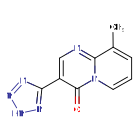
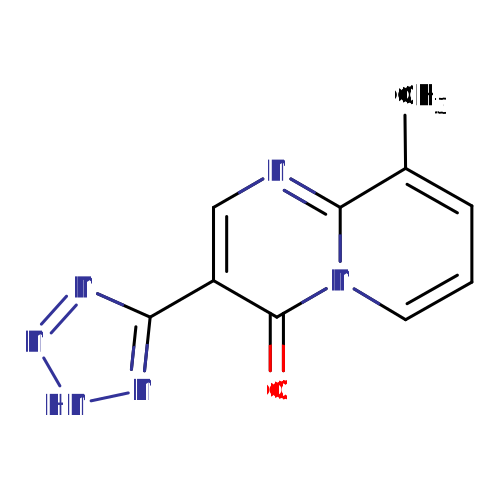
Structure for Pemirolast (DB00885)
- Weight
- Average: 228.2101
Monoisotopic: 228.075958908 - Chemical Formula
- C10H8N6O
- Synonyms
- Pemirolast
- Pemirolastum
- External IDs
- BMY 26517
- DE 068
- TBX

Pharmacology
- Indication
For the prevention of itching of the eyes caused by allergies such as hay fever, and allergic conjunctivitis
 Reduce drug development failure ratesBuild, train, & validate machine-learning modelswith evidence-based and structured datasets.Build, train, & validate predictive machine-learning models with structured datasets.
- Associated Conditions
Indication Type Indication Combined Product Details Approval Level Age Group Patient Characteristics Dose Form Treatment of Conjunctivitis allergic •••••••••••• •••••••• Treatment of Seasonal allergic conjunctivitis •••••••••••• •••••••• - Contraindications & Blackbox Warnings
 Prevent Adverse Drug Events TodayTap into our Clinical API for life-saving information on contraindications & blackbox warnings, population restrictions, harmful risks, & more.Avoid life-threatening adverse drug events with our Clinical API
- Pharmacodynamics
Pemirolast is used for the prophylactic treatment of itching of the eye associated with allergic conjunctivitis. Pemirolast potassium is a mast cell stabilizer that inhibits the in vivo Type I immediate hypersensitivity reaction. Pemirolast inhibits the antigen-induced release of inflammatory mediators (e.g., histamine, leukotriene C4, D4, E4) from human mast cells. Allergic reactions lead to cell-degranulation and the release of histamine (and other chemical mediators) from the mast cell or basophil. Once released, histamine can react with local or widespread tissues through histamine receptors. Histamine, acting on H1-receptors, produces pruritis and vasodilatation (allowing blood fluids to enter the area to cause swelling). Pemirolast is a histamine H1 antagonist. It competes with histamine for the normal H1-receptor sites on effector cells of blood vessels to provide effective, temporary relief of watery and itchy eyes.
- Mechanism of action
Pemirolast binds to the histamine H1 receptor. This blocks the action of endogenous histamine, which subsequently leads to temporary relief of the negative symptoms brought on by histamine. Pemirolast has also been observed to inhibit antigen-stimulated calcium ion influx into mast cells through the blockage of calcium channels. Pemirolast inhibits the chemotaxis of eosinophils into ocular tissue, and prevents inflammatory mediator release from human eosinophils.
- Absorption
Not Available
- Volume of distribution
Not Available
- Protein binding
Not Available
- Metabolism
Hepatic (Ophthalmic)
- Route of elimination
Following topical administration, about 10-15% of the dose was excreted unchanged in the urine.
- Half-life
4.5 hours (Ophthalmic)
- Clearance
Not Available
- Adverse Effects
 Improve decision support & research outcomesWith structured adverse effects data, including: blackbox warnings, adverse reactions, warning & precautions, & incidence rates. View sample adverse effects data in our new Data Library!Improve decision support & research outcomes with our structured adverse effects data.
- Toxicity
Not Available
- Pathways
- Not Available
- Pharmacogenomic Effects/ADRs
- Not Available
Interactions
- Drug Interactions
- This information should not be interpreted without the help of a healthcare provider. If you believe you are experiencing an interaction, contact a healthcare provider immediately. The absence of an interaction does not necessarily mean no interactions exist.No interactions found.
- Food Interactions
- No interactions found.
Products
 Drug product information from 10+ global regionsOur datasets provide approved product information including:dosage, form, labeller, route of administration, and marketing period.Access drug product information from over 10 global regions.
- Product Ingredients
Ingredient UNII CAS InChI Key Pemirolast potassium 497A17OUUE 100299-08-9 NMMVKSMGBDRONO-UHFFFAOYSA-N - International/Other Brands
- Alegysal (Santen Pharmaceutical Co.) / Pemirox
- Brand Name Prescription Products
Name Dosage Strength Route Labeller Marketing Start Marketing End Region Image Alamast Solution 1 mg/1mL Ophthalmic Vistakon Pharmaceuticals 2000-05-01 2014-11-14 US 
Categories
- Drug Categories
- Chemical TaxonomyProvided by Classyfire
- Description
- This compound belongs to the class of organic compounds known as pyridopyrimidines. These are compounds containing a pyridopyrimidine, which consists of a pyridine fused to a pyrimidine. Pyridine is 6-membered ring consisting of five carbon atoms and a nitrogen atom. Pyrimidine is a 6-membered ring consisting of four carbon atoms and two nitrogen centers at the 1- and 3- ring positions.
- Kingdom
- Organic compounds
- Super Class
- Organoheterocyclic compounds
- Class
- Pyridopyrimidines
- Sub Class
- Not Available
- Direct Parent
- Pyridopyrimidines
- Alternative Parents
- Pyrimidones / Methylpyridines / Tetrazoles / Heteroaromatic compounds / Lactams / Azacyclic compounds / Organopnictogen compounds / Organooxygen compounds / Organonitrogen compounds / Organic oxides show 1 more
- Substituents
- Aromatic heteropolycyclic compound / Azacycle / Azole / Heteroaromatic compound / Hydrocarbon derivative / Lactam / Methylpyridine / Organic nitrogen compound / Organic oxide / Organic oxygen compound show 8 more
- Molecular Framework
- Aromatic heteropolycyclic compounds
- External Descriptors
- Not Available
- Affected organisms
- Humans and other mammals
Chemical Identifiers
- UNII
- 2C09NV773M
- CAS number
- 69372-19-6
- InChI Key
- HIANJWSAHKJQTH-UHFFFAOYSA-N
- InChI
- InChI=1S/C10H8N6O/c1-6-3-2-4-16-9(6)11-5-7(10(16)17)8-12-14-15-13-8/h2-5H,1H3,(H,12,13,14,15)
- IUPAC Name
- 9-methyl-3-(2H-1,2,3,4-tetrazol-5-yl)-4H-pyrido[1,2-a]pyrimidin-4-one
- SMILES
- CC1=CC=CN2C(=O)C(=CN=C12)C1=NNN=N1
References
- Synthesis Reference
Graziano Castaldi, "Process for the preparation of high purity pemirolast." U.S. Patent US20030032805, issued February 13, 2003.
US20030032805- General References
- Tinkelman DG, Berkowitz RB: A pilot study of pemirolast in patients with seasonal allergic rhinitis. Ann Allergy. 1991 Feb;66(2):162-5. [Article]
- External Links
- Human Metabolome Database
- HMDB0015023
- KEGG Drug
- D01088
- PubChem Compound
- 57697
- PubChem Substance
- 46509034
- ChemSpider
- 51990
- BindingDB
- 50323686
- 19551
- ChEBI
- 134936
- ChEMBL
- CHEMBL1201198
- ZINC
- ZINC000005783214
- Therapeutic Targets Database
- DAP001064
- PharmGKB
- PA164781018
- RxList
- RxList Drug Page
- Drugs.com
- Drugs.com Drug Page
- Wikipedia
- Pemirolast
- FDA label
- Download (372 KB)
Clinical Trials
- Clinical Trials
Phase Status Purpose Conditions Count 2 Terminated Treatment Asthma, Allergic 1 1 Completed Not Available Healthy Volunteers (HV) 1
Pharmacoeconomics
- Manufacturers
- Santen inc
- Packagers
- Santen Inc.
- Vistakon Pharmaceuticals LLC
- Dosage Forms
Form Route Strength Solution Ophthalmic 1 mg/1mL Solution / drops Ophthalmic Solution / drops Ophthalmic 1 mg/1mL - Prices
Unit description Cost Unit Alamast 0.1% drops 11.39USD ml DrugBank does not sell nor buy drugs. Pricing information is supplied for informational purposes only.- Patents
Patent Number Pediatric Extension Approved Expires (estimated) Region US5034230 No 1991-07-23 2011-07-02 US
Properties
- State
- Solid
- Experimental Properties
Property Value Source logP 0 Not Available - Predicted Properties
Property Value Source Water Solubility 0.462 mg/mL ALOGPS logP 0.13 ALOGPS logP 1.46 Chemaxon logS -2.7 ALOGPS pKa (Strongest Acidic) 4.25 Chemaxon pKa (Strongest Basic) 2.21 Chemaxon Physiological Charge -1 Chemaxon Hydrogen Acceptor Count 5 Chemaxon Hydrogen Donor Count 1 Chemaxon Polar Surface Area 87.13 Å2 Chemaxon Rotatable Bond Count 1 Chemaxon Refractivity 63.35 m3·mol-1 Chemaxon Polarizability 21.96 Å3 Chemaxon Number of Rings 3 Chemaxon Bioavailability 1 Chemaxon Rule of Five Yes Chemaxon Ghose Filter Yes Chemaxon Veber's Rule No Chemaxon MDDR-like Rule No Chemaxon - Predicted ADMET Features
Property Value Probability Human Intestinal Absorption + 1.0 Blood Brain Barrier + 0.9766 Caco-2 permeable + 0.6032 P-glycoprotein substrate Non-substrate 0.6874 P-glycoprotein inhibitor I Non-inhibitor 0.7029 P-glycoprotein inhibitor II Non-inhibitor 0.9336 Renal organic cation transporter Non-inhibitor 0.8165 CYP450 2C9 substrate Non-substrate 0.7256 CYP450 2D6 substrate Non-substrate 0.8314 CYP450 3A4 substrate Substrate 0.5485 CYP450 1A2 substrate Inhibitor 0.874 CYP450 2C9 inhibitor Non-inhibitor 0.8783 CYP450 2D6 inhibitor Non-inhibitor 0.8729 CYP450 2C19 inhibitor Non-inhibitor 0.8134 CYP450 3A4 inhibitor Non-inhibitor 0.543 CYP450 inhibitory promiscuity Low CYP Inhibitory Promiscuity 0.5112 Ames test AMES toxic 0.5453 Carcinogenicity Non-carcinogens 0.8916 Biodegradation Not ready biodegradable 0.9965 Rat acute toxicity 2.3619 LD50, mol/kg Not applicable hERG inhibition (predictor I) Weak inhibitor 0.9391 hERG inhibition (predictor II) Non-inhibitor 0.8932
Spectra
- Mass Spec (NIST)
- Not Available
- Spectra
Spectrum Spectrum Type Splash Key Predicted GC-MS Spectrum - GC-MS Predicted GC-MS splash10-0kbf-3950000000-c347e87f936efcb3141d Predicted MS/MS Spectrum - 10V, Positive (Annotated) Predicted LC-MS/MS splash10-004i-0090000000-768f6fec08df17b84ffe Predicted MS/MS Spectrum - 10V, Negative (Annotated) Predicted LC-MS/MS splash10-004i-0090000000-705f00072cc1e2f5a5d1 Predicted MS/MS Spectrum - 20V, Positive (Annotated) Predicted LC-MS/MS splash10-004i-0290000000-c3c9b43fe9e501938be5 Predicted MS/MS Spectrum - 20V, Negative (Annotated) Predicted LC-MS/MS splash10-004i-0090000000-0bb47822b783a8294c58 Predicted MS/MS Spectrum - 40V, Positive (Annotated) Predicted LC-MS/MS splash10-0fk9-1960000000-ab3363731e369dafa26d Predicted MS/MS Spectrum - 40V, Negative (Annotated) Predicted LC-MS/MS splash10-03dj-3900000000-a2551c6d7fd57b5d765d Predicted 1H NMR Spectrum 1D NMR Not Applicable Predicted 13C NMR Spectrum 1D NMR Not Applicable - Chromatographic Properties
Collision Cross Sections (CCS)
Adduct CCS Value (Å2) Source type Source [M-H]- 155.3150555 predictedDarkChem Lite v0.1.0 [M-H]- 155.0148555 predictedDarkChem Lite v0.1.0 [M-H]- 148.1572 predictedDeepCCS 1.0 (2019) [M+H]+ 156.0863555 predictedDarkChem Lite v0.1.0 [M+H]+ 156.1823555 predictedDarkChem Lite v0.1.0 [M+H]+ 150.55276 predictedDeepCCS 1.0 (2019) [M+Na]+ 155.8338555 predictedDarkChem Lite v0.1.0 [M+Na]+ 155.5771555 predictedDarkChem Lite v0.1.0 [M+Na]+ 156.56596 predictedDeepCCS 1.0 (2019)

Drug created at June 13, 2005 13:24 / Updated at February 02, 2024 22:45