Identification
- Summary
Oxybuprocaine is a local anesthetic used in ophthalmology.
- Brand Names
- Altafluor, Fluress
- Generic Name
- Oxybuprocaine
- DrugBank Accession Number
- DB00892
- Background
Oxybuprocaine (also known as Benoxinate) is a local anesthetic, which is used especially in ophthalmology and otolaryngology. Oxybuprocaine binds to sodium channels and reversibly stabilizes the neuronal membrane which decreases its permeability to sodium ions.
- Type
- Small Molecule
- Groups
- Approved, Investigational
- Structure
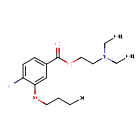
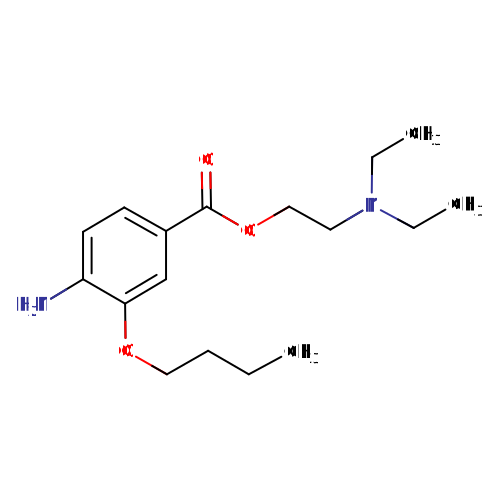
Structure for Oxybuprocaine (DB00892)
- Weight
- Average: 308.4158
Monoisotopic: 308.209992772 - Chemical Formula
- C17H28N2O3
- Synonyms
- 4-Amino-3-butoxy-2-(diethylamino)ethyl ester benzoic acid
- 4-Amino-3-butoxy-benzoic acid 2-diethylamino-ethyl ester
- 4-Amino-3-n-butoxy-benzoesäure-diäthylaminoäthylester
- Benoxinate
- BNX
- Butoxyaminobenzoyldiethylaminoethanol
- Oxibuprocaina
- Oxybucaine
- Oxybuprocaine
- Oxybuprocainum
- Oxyriprocaine

Pharmacology
- Indication
Used to temporarily numb the front surface of the eye so that the eye pressure can be measured or a foreign body removed.
 Reduce drug development failure ratesBuild, train, & validate machine-learning modelswith evidence-based and structured datasets.Build, train, & validate predictive machine-learning models with structured datasets.
- Associated Therapies
- Contraindications & Blackbox Warnings
 Prevent Adverse Drug Events TodayTap into our Clinical API for life-saving information on contraindications & blackbox warnings, population restrictions, harmful risks, & more.Avoid life-threatening adverse drug events with our Clinical API
- Pharmacodynamics
Oxybuprocaine is a local anaesthetic. It may be less irritating than tetracaine, and the onset and duration of action are similar to tetracaine.
- Mechanism of action
Oxybuprocaine binds to sodium channel and reversibly stabilizes the neuronal membrane which decreases its permeability to sodium ions. Depolarization of the neuronal membrane is inhibited thereby blocking the initiation and conduction of nerve impulses.
Target Actions Organism ASodium channel protein type 10 subunit alpha inhibitorHumans - Absorption
Not Available
- Volume of distribution
Not Available
- Protein binding
Not Available
- Metabolism
- Not Available
- Route of elimination
Not Available
- Half-life
Not Available
- Clearance
Not Available
- Adverse Effects
 Improve decision support & research outcomesWith structured adverse effects data, including: blackbox warnings, adverse reactions, warning & precautions, & incidence rates. View sample adverse effects data in our new Data Library!Improve decision support & research outcomes with our structured adverse effects data.
- Toxicity
Not Available
- Pathways
Pathway Category Oxybuprocaine Action Pathway Drug action - Pharmacogenomic Effects/ADRs
- Not Available
Interactions
- Drug Interactions
- This information should not be interpreted without the help of a healthcare provider. If you believe you are experiencing an interaction, contact a healthcare provider immediately. The absence of an interaction does not necessarily mean no interactions exist.
Drug Interaction Integrate drug-drug
interactions in your software1,2-Benzodiazepine The risk or severity of CNS depression can be increased when Oxybuprocaine is combined with 1,2-Benzodiazepine. Abemaciclib The risk or severity of methemoglobinemia can be increased when Abemaciclib is combined with Oxybuprocaine. Abiraterone The risk or severity of methemoglobinemia can be increased when Abiraterone is combined with Oxybuprocaine. Acetaminophen The risk or severity of methemoglobinemia can be increased when Acetaminophen is combined with Oxybuprocaine. Acetazolamide The risk or severity of methemoglobinemia can be increased when Acetazolamide is combined with Oxybuprocaine. - Food Interactions
- No interactions found.
Products
 Drug product information from 10+ global regionsOur datasets provide approved product information including:dosage, form, labeller, route of administration, and marketing period.Access drug product information from over 10 global regions.
- Product Ingredients
Ingredient UNII CAS InChI Key Oxybuprocaine hydrochloride 0VE4U49K15 5987-82-6 PRGUDWLMFLCODA-UHFFFAOYSA-N - International/Other Brands
- Benoxil (Santen) / Cebesine (Chauvin Bausch & Lomb) / Conjuncain / Dorsacaine / Lacrimin (Santen) / Novesin (Novartis) / Novesine (Novartis) / Prescaina (Llorens)
- Over the Counter Products
Name Dosage Strength Route Labeller Marketing Start Marketing End Region Image Minims Benoxinate Hydrochloride 0.4% Solution / drops .4 % Ophthalmic; Topical Chauvin Pharmaceuticals Limited 1995-12-31 2003-07-08 Canada 
- Mixture Products
Name Ingredients Dosage Route Labeller Marketing Start Marketing End Region Image Altafluor Oxybuprocaine hydrochloride (4 mg/1mL) + Fluorescein sodium (2.5 mg/1mL) Solution Ophthalmic Altaire Pharmaceuticals Inc. 2018-03-01 Not applicable US 
Altafluor Oxybuprocaine hydrochloride (4 mg/1mL) + Fluorescein sodium (2.5 mg/1mL) Solution Ophthalmic Altaire Pharmaceuticals Inc. 2017-01-01 2018-04-19 US AMIGDAL-B® Oxybuprocaine hydrochloride (0.2 mg) + Cetylpyridinium chloride (1 mg) Tablet Buccal; Oral COLOMPACK S.A 2009-06-12 Not applicable Colombia 
DIMETAPP GARGANTA® TABLETAS MASTICABLES Oxybuprocaine hydrochloride (0.2 mg) + Cetylpyridinium chloride (1 mg) Tablet, chewable Buccal COLOMPACK S.A. 2018-04-23 2019-08-16 Colombia Fluorescein Sodium & Benoxinate Hydrochloride Ophthalmic Solution, USP Oxybuprocaine hydrochloride (0.4 %) + Fluorescein sodium (0.25 %) Solution Ophthalmic Bausch & Lomb Inc 1998-10-27 Not applicable Canada - Unapproved/Other Products
Name Ingredients Dosage Route Labeller Marketing Start Marketing End Region Image Fluorescein Sodium and Benoxinate Hydrochloride Oxybuprocaine hydrochloride (4 mg/1mL) + Fluorescein sodium (2.5 mg/1mL) Solution / drops Ophthalmic Bausch & Lomb Incorporated 1995-01-01 2017-06-01 US Fluress Oxybuprocaine hydrochloride (4 mg/1mL) + Fluorescein sodium (2.5 mg/1mL) Solution / drops Ophthalmic Akorn, Inc. 1995-02-01 Not applicable US Flurox Oxybuprocaine hydrochloride (4 mg/1mL) + Fluorescein sodium (2.5 mg/1mL) Solution Ophthalmic OCuSOFT, INC. 2014-01-29 Not applicable US Flurox Oxybuprocaine hydrochloride (4 mg/1mL) + Fluorescein sodium (2.5 mg/1mL) Solution Ophthalmic O Cu Soft, Inc. 2006-08-30 2012-02-29 US
Categories
- ATC Codes
- S01HA02 — OxybuprocaineD04AB03 — Oxybuprocaine
- Drug Categories
- Acids, Carbocyclic
- Aminobenzoates
- Anesthetics
- Anesthetics for Topical Use
- Anesthetics, Local
- Antipruritics, Incl. Antihistamines, Anesthetics, Etc.
- Benzene Derivatives
- Benzoates
- Central Nervous System Agents
- Central Nervous System Depressants
- Cholinesterase substrates
- Dermatologicals
- Local Anesthetics (Ester)
- Ophthalmologicals
- para-Aminobenzoates
- Peripheral Nervous System Agents
- Sensory Organs
- Sensory System Agents
- Chemical TaxonomyProvided by Classyfire
- Description
- This compound belongs to the class of organic compounds known as benzoic acid esters. These are ester derivatives of benzoic acid.
- Kingdom
- Organic compounds
- Super Class
- Benzenoids
- Class
- Benzene and substituted derivatives
- Sub Class
- Benzoic acids and derivatives
- Direct Parent
- Benzoic acid esters
- Alternative Parents
- Aminobenzoic acids and derivatives / Aminophenyl ethers / Phenoxy compounds / Benzoyl derivatives / Aniline and substituted anilines / Alkyl aryl ethers / Trialkylamines / Carboxylic acid esters / Amino acids and derivatives / Monocarboxylic acids and derivatives show 4 more
- Substituents
- Alkyl aryl ether / Amine / Amino acid or derivatives / Aminobenzoic acid or derivatives / Aminophenyl ether / Aniline or substituted anilines / Aromatic homomonocyclic compound / Benzoate ester / Benzoyl / Carboxylic acid derivative show 15 more
- Molecular Framework
- Aromatic homomonocyclic compounds
- External Descriptors
- tertiary amino compound, substituted aniline, benzoate ester, amino acid ester (CHEBI:309594)
- Affected organisms
- Humans and other mammals
Chemical Identifiers
- UNII
- AXQ0JYM303
- CAS number
- 99-43-4
- InChI Key
- CMHHMUWAYWTMGS-UHFFFAOYSA-N
- InChI
- InChI=1S/C17H28N2O3/c1-4-7-11-21-16-13-14(8-9-15(16)18)17(20)22-12-10-19(5-2)6-3/h8-9,13H,4-7,10-12,18H2,1-3H3
- IUPAC Name
- 2-(diethylamino)ethyl 4-amino-3-butoxybenzoate
- SMILES
- CCCCOC1=CC(=CC=C1N)C(=O)OCCN(CC)CC
References
- Synthesis Reference
Katsuyuki Inoo, Mitsuhiro Kawada, Kenjiro Mori, "Oxybuprocaine-Containing Analgesic/Antipruritic External Preparation." U.S. Patent US20110124727, issued May 26, 2011.
US20110124727- General References
- Not Available
- External Links
- Human Metabolome Database
- HMDB0015029
- KEGG Drug
- D08319
- PubChem Compound
- 4633
- PubChem Substance
- 46505399
- ChemSpider
- 4472
- BindingDB
- 50225499
- 18889
- ChEBI
- 309594
- ChEMBL
- CHEMBL1200
- ZINC
- ZINC000002019492
- Therapeutic Targets Database
- DAP001231
- PharmGKB
- PA164764617
- RxList
- RxList Drug Page
- Wikipedia
- Oxybuprocaine
- MSDS
- Download (45.5 KB)
Clinical Trials
- Clinical Trials
Phase Status Purpose Conditions Count 4 Completed Treatment Myopia (Disorder) 1 3 Not Yet Recruiting Treatment Local Anaesthesia therapy 1 2 Completed Other Sedation, Conscious 1 2 Completed Treatment Acinar cell carcinoma of pancreas / Pancreatic Ductal Adenocarcinoma (PDAC) / Recurrent Pancreatic Carcinoma / Stage IV Pancreatic Cancer 1 2 Completed Treatment Recurrent Extragonadal Seminoma / Recurrent Malignant Extragonadal Germ Cell Tumor / Recurrent Malignant Extragonadal Non-Seminomatous Germ Cell Tumor / Recurrent Malignant Testicular Germ Cell Tumor / Recurrent Ovarian Germ Cell Tumor / Stage III Testicular Cancer / Stage IV Extragonadal Non-Seminomatous Germ Cell Tumor / Stage IV Extragonadal Seminoma / Stage IV Ovarian Germ Cell Tumor 1
Pharmacoeconomics
- Manufacturers
- Sola barnes hind
- Packagers
- Akorn Inc.
- Dosage Forms
Form Route Strength Tablet Buccal; Oral Tablet Oral Solution Topical 1 % Solution / drops Ophthalmic 0.4 % Tablet, chewable Buccal Solution / drops Ophthalmic Liquid Ophthalmic Solution Ophthalmic Solution / drops Ophthalmic; Topical .4 % Solution / drops Ophthalmic 4 mg/ml Solution / drops Ophthalmic Solution Conjunctival; Ophthalmic 4 mg Solution Ophthalmic 4 mg - Prices
Unit description Cost Unit Fluress eye drops 2.29USD ml DrugBank does not sell nor buy drugs. Pricing information is supplied for informational purposes only.- Patents
Patent Number Pediatric Extension Approved Expires (estimated) Region US10293047 No 2019-05-21 2037-11-15 US US10632197 No 2020-04-28 2037-11-15 US US10842872 No 2020-11-24 2037-11-15 US
Properties
- State
- Solid
- Experimental Properties
Property Value Source melting point (°C) 216.5 °C at 2.00E+00 mm Hg Not Available water solubility Very soluble (hydrochloride salt) Not Available logP 3.1 Not Available - Predicted Properties
Property Value Source Water Solubility 0.544 mg/mL ALOGPS logP 3.3 ALOGPS logP 3.05 Chemaxon logS -2.8 ALOGPS pKa (Strongest Acidic) 19.76 Chemaxon pKa (Strongest Basic) 8.96 Chemaxon Physiological Charge 1 Chemaxon Hydrogen Acceptor Count 4 Chemaxon Hydrogen Donor Count 1 Chemaxon Polar Surface Area 64.79 Å2 Chemaxon Rotatable Bond Count 11 Chemaxon Refractivity 90.64 m3·mol-1 Chemaxon Polarizability 35.83 Å3 Chemaxon Number of Rings 1 Chemaxon Bioavailability 1 Chemaxon Rule of Five Yes Chemaxon Ghose Filter Yes Chemaxon Veber's Rule No Chemaxon MDDR-like Rule No Chemaxon - Predicted ADMET Features
Property Value Probability Human Intestinal Absorption + 0.9769 Blood Brain Barrier + 0.8876 Caco-2 permeable + 0.6501 P-glycoprotein substrate Substrate 0.7085 P-glycoprotein inhibitor I Non-inhibitor 0.7586 P-glycoprotein inhibitor II Non-inhibitor 0.9645 Renal organic cation transporter Non-inhibitor 0.7172 CYP450 2C9 substrate Non-substrate 0.8202 CYP450 2D6 substrate Non-substrate 0.5953 CYP450 3A4 substrate Substrate 0.5624 CYP450 1A2 substrate Inhibitor 0.9107 CYP450 2C9 inhibitor Non-inhibitor 0.9093 CYP450 2D6 inhibitor Inhibitor 0.8932 CYP450 2C19 inhibitor Non-inhibitor 0.9025 CYP450 3A4 inhibitor Non-inhibitor 0.831 CYP450 inhibitory promiscuity Low CYP Inhibitory Promiscuity 0.5247 Ames test Non AMES toxic 0.7542 Carcinogenicity Non-carcinogens 0.7336 Biodegradation Not ready biodegradable 0.9764 Rat acute toxicity 2.5543 LD50, mol/kg Not applicable hERG inhibition (predictor I) Weak inhibitor 0.8356 hERG inhibition (predictor II) Non-inhibitor 0.5406
Spectra
- Mass Spec (NIST)
- Download (8.76 KB)
- Spectra
- Chromatographic Properties
Collision Cross Sections (CCS)
Adduct CCS Value (Å2) Source type Source [M-H]- 184.9057535 predictedDarkChem Lite v0.1.0 [M-H]- 175.35005 predictedDeepCCS 1.0 (2019) [M+H]+ 185.0268535 predictedDarkChem Lite v0.1.0 [M+H]+ 177.70805 predictedDeepCCS 1.0 (2019) [M+Na]+ 184.8708535 predictedDarkChem Lite v0.1.0 [M+Na]+ 183.80121 predictedDeepCCS 1.0 (2019)
Targets

- Kind
- Protein
- Organism
- Humans
- Pharmacological action
- Yes
- Actions
- Inhibitor
- General Function
- Voltage-gated sodium channel activity
- Specific Function
- Tetrodotoxin-resistant channel that mediates the voltage-dependent sodium ion permeability of excitable membranes. Assuming opened or closed conformations in response to the voltage difference acro...
- Gene Name
- SCN10A
- Uniprot ID
- Q9Y5Y9
- Uniprot Name
- Sodium channel protein type 10 subunit alpha
- Molecular Weight
- 220623.605 Da
References
- Overington JP, Al-Lazikani B, Hopkins AL: How many drug targets are there? Nat Rev Drug Discov. 2006 Dec;5(12):993-6. [Article]
- Imming P, Sinning C, Meyer A: Drugs, their targets and the nature and number of drug targets. Nat Rev Drug Discov. 2006 Oct;5(10):821-34. [Article]
- Hung CH, Wang JJ, Chen YC, Chu CC, Chen YW: Intrathecal oxybuprocaine and proxymetacaine produced potent and long-lasting spinal anesthesia in rats. Neurosci Lett. 2009 May 1;454(3):249-53. doi: 10.1016/j.neulet.2009.03.018. Epub 2009 Mar 11. [Article]
Enzymes
- Kind
- Protein
- Organism
- Humans
- Pharmacological action
- Unknown
- Actions
- Substrate
- General Function
- Identical protein binding
- Specific Function
- Esterase with broad substrate specificity. Contributes to the inactivation of the neurotransmitter acetylcholine. Can degrade neurotoxic organophosphate esters.
- Gene Name
- BCHE
- Uniprot ID
- P06276
- Uniprot Name
- Cholinesterase
- Molecular Weight
- 68417.575 Da
References
- Draeger J, Schloot W, Wirt H: Interindividual differences of corneal sensitivity. Genetic aspects. Ophthalmic Paediatr Genet. 1985 Aug;6(1-2):291-5. [Article]
- Dubbels R, Schloot W: Studies on the metabolism of benoxinate by human pseudocholinesterase. Metab Pediatr Syst Ophthalmol. 1983;7(1):37-43. [Article]


Drug created at June 13, 2005 13:24 / Updated at April 18, 2024 09:15