Identification
- Summary
Paricalcitol is a vitamin D analog used to treat hyperparathyroidism associated with stage 3 or greater chronic kidney disease.
- Brand Names
- Zemplar
- Generic Name
- Paricalcitol
- DrugBank Accession Number
- DB00910
- Background
Paricalcitol is a synthetic vitamin D analog. Paricalcitol has been used to reduce parathyroid hormone levels. Paricalcitol is indicated for the prevention and treatment of secondary hyperparathyroidism associated with chronic renal failure.
- Type
- Small Molecule
- Groups
- Approved, Investigational
- Structure
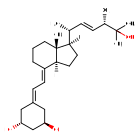
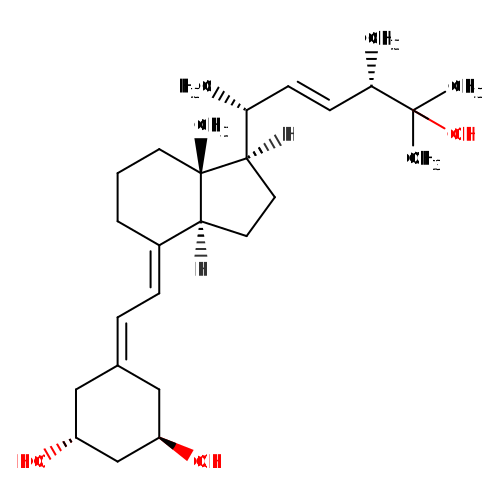
Structure for Paricalcitol (DB00910)
- Weight
- Average: 416.6365
Monoisotopic: 416.329045274 - Chemical Formula
- C27H44O3
- Synonyms
- 19-Nor-1alpha,25-dihydroxyvitamin D2
- Paricalcitol
- External IDs
- COMPOUND 49510
- COMPOUND-49510

Pharmacology
- Indication
For treatment of secondary hyperparathyroidism associated with chronic kidney disease (CKD) Stage 3 and 4
 Reduce drug development failure ratesBuild, train, & validate machine-learning modelswith evidence-based and structured datasets.Build, train, & validate predictive machine-learning models with structured datasets.
- Associated Conditions
Indication Type Indication Combined Product Details Approval Level Age Group Patient Characteristics Dose Form Prophylaxis of Secondary hyperparathyroidism •••••••••••• Treatment of Secondary hyperparathyroidism •••••••••••• Prophylaxis of Secondary hyperparathyroidism •••••••••••• Prophylaxis of Secondary hyperparathyroidism •••••••••••• Treatment of Secondary hyperparathyroidism •••••••••••• - Contraindications & Blackbox Warnings
 Prevent Adverse Drug Events TodayTap into our Clinical API for life-saving information on contraindications & blackbox warnings, population restrictions, harmful risks, & more.Avoid life-threatening adverse drug events with our Clinical API
- Pharmacodynamics
Secondary hyperparathyroidism is characterized by an elevation in parathyroid hormone (PTH) associated with inadequate levels of active vitamin D hormone. The source of vitamin D in the body is from synthesis in the skin and from dietary intake. Vitamin D requires two sequential hydroxylations in the liver and the kidney to bind to and to activate the vitamin D receptor (VDR). The endogenous VDR activator, calcitriol [1,25(OH)2 D3], is a hormone that binds to VDRs that are present in the parathyroid gland, intestine, kidney, and bone to maintain parathyroid function and calcium and phosphorus homeostasis, and to VDRs found in many other tissues, including prostate, endothelium and immune cells. VDR activation is essential for the proper formation and maintenance of normal bone. In the diseased kidney, the activation of vitamin D is diminished, resulting in a rise of PTH, subsequently leading to secondary hyperparathyroidism and disturbances in the calcium and phosphorus homeostasis.1 Decreased levels of 1,25(OH)2 D3 have been observed in early stages of chronic kidney disease. The decreased levels of 1,25(OH)2 D3 and resultant elevated PTH levels, both of which often precede abnormalities in serum calcium and phosphorus, affect bone turnover rate and may result in renal osteodystrophy. An in vitro study indicates that paricalcitol is not an inhibitor of CYP1A2, CYP2A6, CYP2B6, CYP2C8, CYP2C9, CYP2C19, CYP2D6, CYP2E1 or CYP3A at concentrations up to 50 nM (21 ng/mL).
- Mechanism of action
Paricalcitol is a synthetic, biologically active vitamin D analog of calcitriol with modifications to the side chain (D2) and the A (19-nor) ring. Preclinical andin vitro studies have demonstrated that paricalcitol's biological actions are mediated through binding of the VDR, which results in the selective activation of vitamin D responsive pathways. Vitamin D and paricalcitol have been shown to reduce parathyroid hormone levels by inhibiting PTH synthesis and secretion.
Target Actions Organism AVitamin D3 receptor agonistHumans - Absorption
Well absorbed
- Volume of distribution
- 30.8 ± 7.5 L [CKD Stage 5-HD]
- 34.9 ± 9.5 L [CKD Stage 5-PD]
- 23.8 L [healthy subjects]
- Protein binding
99.8% (bound to plasma proteins)
- Metabolism
Metabolized by multiple hepatic and non-hepatic enzymes, including mitochondrial CYP24, as well as CYP3A4 and UGT1A4
- Route of elimination
Paricalcitol is excreted primarily by hepatobiliary excretion.
- Half-life
4 to 6 hours
- Clearance
- 1.49 +/- 0.60 L/h [chronic kidney disease Stage 5 with hemodialysis]
- 1.54 +/- 0.95 L/h [chronic kidney disease Stage 5with peritoneal dialysis]
- Adverse Effects
 Improve decision support & research outcomesWith structured adverse effects data, including: blackbox warnings, adverse reactions, warning & precautions, & incidence rates. View sample adverse effects data in our new Data Library!Improve decision support & research outcomes with our structured adverse effects data.
- Toxicity
Not Available
- Pathways
- Not Available
- Pharmacogenomic Effects/ADRs
- Not Available
Interactions
- Drug Interactions
- This information should not be interpreted without the help of a healthcare provider. If you believe you are experiencing an interaction, contact a healthcare provider immediately. The absence of an interaction does not necessarily mean no interactions exist.
Drug Interaction Integrate drug-drug
interactions in your softwareAbametapir The serum concentration of Paricalcitol can be increased when it is combined with Abametapir. Acetyldigitoxin The risk or severity of ventricular arrhythmias and Cardiac Arrhythmia can be increased when Paricalcitol is combined with Acetyldigitoxin. Alfacalcidol The risk or severity of adverse effects can be increased when Paricalcitol is combined with Alfacalcidol. Aluminum hydroxide The serum concentration of Aluminum hydroxide can be increased when it is combined with Paricalcitol. Amiodarone The metabolism of Paricalcitol can be decreased when combined with Amiodarone. - Food Interactions
- Avoid antacids. Avoid taking aluminum-containing antacids chronically with paricalcitol as there is an increased risk of aluminum toxicity.
- Exercise caution with grapefruit products. Grapefruit inhibits CYP3A4, and paricalcitol metabolism is mediated partially through CYP3A4; therefore, grapefruit may increase paricalcitol serum levels.
- Take with or without food.
Products
 Drug product information from 10+ global regionsOur datasets provide approved product information including:dosage, form, labeller, route of administration, and marketing period.Access drug product information from over 10 global regions.
- Product Images
- Brand Name Prescription Products
Name Dosage Strength Route Labeller Marketing Start Marketing End Region Image Paricalcitol Injection, solution 5 ug/1mL Intravenous Accord Healthcare, Inc. 2016-03-24 Not applicable US 
Paricalcitol Injection 5 ug/1mL Intravenous West-Ward Pharmaceuticals Corp 2014-11-18 Not applicable US Paricalcitol Injection, solution 5 ug/1mL Intravenous Hospira, Inc. 2014-11-01 Not applicable US Paricalcitol Injection, solution 2 ug/1mL Intravenous Accord Healthcare, Inc. 2016-03-24 Not applicable US Paricalcitol Injection 2 ug/1mL Intravenous West-Ward Pharmaceuticals Corp 2014-11-18 Not applicable US - Generic Prescription Products
Name Dosage Strength Route Labeller Marketing Start Marketing End Region Image Paricalcitol Capsule, liquid filled 1 ug/1 Oral MARKSANS PHARMA LIMITED 2016-12-31 Not applicable US Paricalcitol Capsule, liquid filled 1 ug/1 Oral Zydus Pharmaceuticals USA Inc 2010-06-14 2020-08-03 US 
Paricalcitol Capsule 4 mg/1 Oral Banner Life Sciences Llc. 2015-10-01 Not applicable US Paricalcitol Capsule 1 ug/1 Oral Golden State Medical Supply, Inc. 2014-03-27 Not applicable US Paricalcitol Injection 5 ug/1mL Intravenous Amneal Pharmaceuticals LLC 2017-03-09 Not applicable US - Unapproved/Other Products
Name Ingredients Dosage Route Labeller Marketing Start Marketing End Region Image PARISITOL 10 MCG/2 ML IV ENJEKSIYONLUK COZELTI ICEREN AMPUL 2 ML AMPUL, 5 ADET Paricalcitol (10 mcg/2ml) Injection, solution Intravenous PHARMADA İLAÇ SAN. VE TİC. A.Ş. 2019-04-30 2024-01-23 Turkey 
PARISITOL 5 MCG/ML IV ENJEKSIYONLUK COZELTI ICEREN AMPUL 1 ML AMPUL, 5 ADET Paricalcitol (5 mcg/ml) Injection, solution Intravenous PHARMADA İLAÇ SAN. VE TİC. A.Ş. 2018-12-25 2024-01-23 Turkey


Categories
- ATC Codes
- H05BX02 — Paricalcitol
- Drug Categories
- Anti-Parathyroid Agents
- Bone Density Conservation Agents
- Calcium Homeostasis
- Cholestanes
- Cholestenes
- Cytochrome P-450 CYP3A Substrates
- Cytochrome P-450 CYP3A4 Substrates
- Cytochrome P-450 Substrates
- Fused-Ring Compounds
- Lipids
- Membrane Lipids
- Secosteroids
- Steroids
- Sterols
- Systemic Hormonal Preparations, Excl. Sex Hormones and Insulins
- UGT1A4 substrates
- Vitamin D and Analogues
- Vitamins
- Vitamins (Fat Soluble)
- Chemical TaxonomyProvided by Classyfire
- Description
- This compound belongs to the class of organic compounds known as vitamin d and derivatives. These are compounds containing a secosteroid backbone, usually secoergostane or secocholestane.
- Kingdom
- Organic compounds
- Super Class
- Lipids and lipid-like molecules
- Class
- Steroids and steroid derivatives
- Sub Class
- Vitamin D and derivatives
- Direct Parent
- Vitamin D and derivatives
- Alternative Parents
- Triterpenoids / Tertiary alcohols / Secondary alcohols / Cyclic alcohols and derivatives / Hydrocarbon derivatives
- Substituents
- Alcohol / Aliphatic homopolycyclic compound / Cyclic alcohol / Hydrocarbon derivative / Organic oxygen compound / Organooxygen compound / Secondary alcohol / Tertiary alcohol / Triterpenoid
- Molecular Framework
- Aliphatic homopolycyclic compounds
- External Descriptors
- seco-cholestane, hydroxy seco-steroid (CHEBI:7931) / Vitamin D2 and derivatives (C08127) / C27 bile acids, alcohols, and derivatives (LMST04030163)
- Affected organisms
- Humans and other mammals
Chemical Identifiers
- UNII
- 6702D36OG5
- CAS number
- 131918-61-1
- InChI Key
- BPKAHTKRCLCHEA-UBFJEZKGSA-N
- InChI
- InChI=1S/C27H44O3/c1-18(8-9-19(2)26(3,4)30)24-12-13-25-21(7-6-14-27(24,25)5)11-10-20-15-22(28)17-23(29)16-20/h8-11,18-19,22-25,28-30H,6-7,12-17H2,1-5H3/b9-8+,21-11+/t18-,19+,22-,23-,24-,25+,27-/m1/s1
- IUPAC Name
- (1R,3R)-5-{2-[(1R,3aS,4E,7aR)-1-[(2R,3E,5S)-6-hydroxy-5,6-dimethylhept-3-en-2-yl]-7a-methyl-octahydro-1H-inden-4-ylidene]ethylidene}cyclohexane-1,3-diol
- SMILES
- [H][C@@]1(CC[C@@]2([H])\C(CCC[C@]12C)=C\C=C1C[C@@H](O)C[C@H](O)C1)[C@H](C)\C=C\[C@H](C)C(C)(C)O
References
- Synthesis Reference
Anchel Schwartz, Alexei Ploutno, Koby Wolfman, "Preparation of paricalcitol." U.S. Patent US20070149489, issued June 28, 2007.
US20070149489- General References
- Not Available
- External Links
- Human Metabolome Database
- HMDB0015046
- KEGG Drug
- D00930
- KEGG Compound
- C08127
- PubChem Compound
- 5281104
- PubChem Substance
- 46505780
- ChemSpider
- 4444552
- BindingDB
- 233195
- 73710
- ChEBI
- 7931
- ChEMBL
- CHEMBL1200622
- ZINC
- ZINC000013911941
- Therapeutic Targets Database
- DAP000211
- PharmGKB
- PA450798
- RxList
- RxList Drug Page
- Drugs.com
- Drugs.com Drug Page
- Wikipedia
- Paricalcitol
- FDA label
- Download (447 KB)
Clinical Trials
- Clinical Trials
Phase Status Purpose Conditions Count 4 Completed Prevention Chronic Kidney Disease (CKD) 1 4 Completed Prevention Chronic Kidney Disease (CKD) / Coronary Calcification / Deficiency, Vitamin D / Disorders of Calcium and Bone Metabolism 1 4 Completed Prevention Kidney Failure 1 4 Completed Treatment Anemia / Chronic Kidney Disease (CKD) 1 4 Completed Treatment Cardiorenal Syndrome (CRS) / Chronic Allograft Nephropathy (CAN) 1
Pharmacoeconomics
- Manufacturers
- Abbott laboratories pharmaceutical products div
- Abbott laboratories
- Packagers
- Abbott Laboratories Ltd.
- Cardinal Health
- Catalent Pharma Solutions
- Hospira Inc.
- Murfreesboro Pharmaceutical Nursing Supply
- Remedy Repack
- Dosage Forms
Form Route Strength Injection, solution Intravenous 10 mcg/2ml Solution Intravenous 0.005 mg Injection, solution Parenteral 2 MCG/ML Injection, solution 5 MICROGRAMMI/ML Injection, solution Parenteral 2 MICROGRAMMI/ML Injection, solution Parenteral 5 MICROGRAMMI/ML Injection, solution Capsule Oral 2 MICROGRAMMI Injection, solution Intravenous 2 mcg/ml Capsule Oral 1 mg/1 Capsule Oral 1 ug/1 Capsule Oral 2 ug/1 Capsule Oral 2 mg/1 Capsule Oral 4 ug/1 Capsule Oral 4 mg/1 Capsule, gelatin coated Oral 1 ug/1 Capsule, gelatin coated Oral 2 ug/1 Capsule, gelatin coated Oral 4 ug/1 Capsule, liquid filled Oral 1 ug/1 Capsule, liquid filled Oral 2 ug/1 Capsule, liquid filled Oral 4 ug/1 Injection Intravenous 10 ug/2mL Injection Intravenous 2 ug/1mL Injection Intravenous 5 ug/1mL Injection, solution Intravenous 2 ug/1mL Injection, solution Intravenous 5 ug/1mL Injection, solution Parenteral Injection, solution Intravenous 5 mcg/1ml Injection, solution Intravenous 10 mcg/ml Injection, solution Intravenous 5 mcg/ml Injection, solution Intravenous Capsule Oral 4 MCG Injection Intravenous Injection, solution Parenteral 5 MCG/ML Solution Intravenous 5 mcg / mL Solution Intravenous 2 cg Capsule Oral 1 mcg Capsule Oral 2 mcg Capsule Oral Injection Intravenous 5 mcg/ml Solution Intravenous 5 mcg Capsule, liquid filled Oral 1 cg Capsule, liquid filled Oral 2 mcg Injection, solution 5 mcg/mL Solution Intravenous 5.000 mcg - Prices
Unit description Cost Unit Zemplar 4 mcg capsule 37.58USD capsule Zemplar 5 mcg/ml vial 28.03USD ml Zemplar 2 mcg capsule 18.79USD capsule Zemplar 2 mcg/ml vial 11.22USD ml Zemplar 1 mcg capsule 9.39USD capsule DrugBank does not sell nor buy drugs. Pricing information is supplied for informational purposes only.- Patents
Patent Number Pediatric Extension Approved Expires (estimated) Region US5246925 No 1993-09-21 2012-04-17 US US5597815 Yes 1997-01-28 2016-01-13 US US6361758 Yes 2002-03-26 2018-10-08 US US6136799 Yes 2000-10-24 2018-10-08 US
Properties
- State
- Solid
- Experimental Properties
Property Value Source logP 4.5 Not Available - Predicted Properties
Property Value Source Water Solubility 0.0068 mg/mL ALOGPS logP 5.27 ALOGPS logP 4.26 Chemaxon logS -4.8 ALOGPS pKa (Strongest Acidic) 14.81 Chemaxon pKa (Strongest Basic) -1 Chemaxon Physiological Charge 0 Chemaxon Hydrogen Acceptor Count 3 Chemaxon Hydrogen Donor Count 3 Chemaxon Polar Surface Area 60.69 Å2 Chemaxon Rotatable Bond Count 5 Chemaxon Refractivity 127.95 m3·mol-1 Chemaxon Polarizability 51.06 Å3 Chemaxon Number of Rings 3 Chemaxon Bioavailability 1 Chemaxon Rule of Five Yes Chemaxon Ghose Filter No Chemaxon Veber's Rule No Chemaxon MDDR-like Rule No Chemaxon - Predicted ADMET Features
Property Value Probability Human Intestinal Absorption + 0.9971 Blood Brain Barrier + 0.795 Caco-2 permeable + 0.776 P-glycoprotein substrate Substrate 0.7667 P-glycoprotein inhibitor I Non-inhibitor 0.7431 P-glycoprotein inhibitor II Non-inhibitor 0.8491 Renal organic cation transporter Non-inhibitor 0.8292 CYP450 2C9 substrate Non-substrate 0.7968 CYP450 2D6 substrate Non-substrate 0.8903 CYP450 3A4 substrate Substrate 0.7662 CYP450 1A2 substrate Non-inhibitor 0.8127 CYP450 2C9 inhibitor Non-inhibitor 0.8277 CYP450 2D6 inhibitor Non-inhibitor 0.948 CYP450 2C19 inhibitor Non-inhibitor 0.8491 CYP450 3A4 inhibitor Non-inhibitor 0.8409 CYP450 inhibitory promiscuity Low CYP Inhibitory Promiscuity 0.6631 Ames test Non AMES toxic 0.9116 Carcinogenicity Non-carcinogens 0.9111 Biodegradation Not ready biodegradable 0.988 Rat acute toxicity 4.4277 LD50, mol/kg Not applicable hERG inhibition (predictor I) Weak inhibitor 0.9069 hERG inhibition (predictor II) Non-inhibitor 0.8015
Spectra
- Mass Spec (NIST)
- Not Available
- Spectra
Spectrum Spectrum Type Splash Key Predicted GC-MS Spectrum - GC-MS Predicted GC-MS splash10-0a4i-4029200000-0e69ac54ae775b70b07f Predicted MS/MS Spectrum - 10V, Negative (Annotated) Predicted LC-MS/MS splash10-014i-0002900000-ed839cd803e7e35776fd Predicted MS/MS Spectrum - 10V, Positive (Annotated) Predicted LC-MS/MS splash10-0002-0159100000-3006fb4fcb351b310c55 Predicted MS/MS Spectrum - 20V, Negative (Annotated) Predicted LC-MS/MS splash10-014i-0009700000-c6a3a09d423477bb16f0 Predicted MS/MS Spectrum - 20V, Positive (Annotated) Predicted LC-MS/MS splash10-00kf-4059200000-d41f6b4b0841dd302543 Predicted MS/MS Spectrum - 40V, Negative (Annotated) Predicted LC-MS/MS splash10-016r-2229400000-8c3a97c89f7bba51f093 Predicted MS/MS Spectrum - 40V, Positive (Annotated) Predicted LC-MS/MS splash10-0a4r-4397000000-899dedec2239aa471ec0 Predicted 1H NMR Spectrum 1D NMR Not Applicable Predicted 13C NMR Spectrum 1D NMR Not Applicable - Chromatographic Properties
Collision Cross Sections (CCS)
Adduct CCS Value (Å2) Source type Source [M-H]- 224.2377527 predictedDarkChem Lite v0.1.0 [M-H]- 210.0181527 predictedDarkChem Lite v0.1.0 [M-H]- 217.25342 predictedDeepCCS 1.0 (2019) [M+H]+ 227.0913527 predictedDarkChem Lite v0.1.0 [M+H]+ 208.9158527 predictedDarkChem Lite v0.1.0 [M+H]+ 219.14882 predictedDeepCCS 1.0 (2019) [M+Na]+ 222.9676527 predictedDarkChem Lite v0.1.0 [M+Na]+ 209.8199527 predictedDarkChem Lite v0.1.0 [M+Na]+ 225.20703 predictedDeepCCS 1.0 (2019)
Targets

- Kind
- Protein
- Organism
- Humans
- Pharmacological action
- Yes
- Actions
- Agonist
- General Function
- Zinc ion binding
- Specific Function
- Nuclear hormone receptor. Transcription factor that mediates the action of vitamin D3 by controlling the expression of hormone sensitive genes. Recruited to promoters via its interaction with BAZ1B...
- Gene Name
- VDR
- Uniprot ID
- P11473
- Uniprot Name
- Vitamin D3 receptor
- Molecular Weight
- 48288.64 Da
References
- Overington JP, Al-Lazikani B, Hopkins AL: How many drug targets are there? Nat Rev Drug Discov. 2006 Dec;5(12):993-6. [Article]
- Imming P, Sinning C, Meyer A: Drugs, their targets and the nature and number of drug targets. Nat Rev Drug Discov. 2006 Oct;5(10):821-34. [Article]
- Andress DL: Vitamin D treatment in chronic kidney disease. Semin Dial. 2005 Jul-Aug;18(4):315-21. [Article]
- Brancaccio D, Cozzolino M, Pasho S, Fallabrino G, Olivi L, Gallieni M: New acquisitions in therapy of secondary hyperparathyroidism in chronic kidney disease and peritoneal dialysis patients: role of vitamin D receptor activators. Contrib Nephrol. 2009;163:219-26. doi: 10.1159/000223802. Epub 2009 Jun 3. [Article]
- Wu-Wong JR, Nakane M, Gagne GD, Brooks KA, Noonan WT: Comparison of the pharmacological effects of paricalcitol and doxercalciferol on the factors involved in mineral homeostasis. Int J Endocrinol. 2010;2010:621687. doi: 10.1155/2010/621687. Epub 2010 Mar 2. [Article]
- Chen X, Ji ZL, Chen YZ: TTD: Therapeutic Target Database. Nucleic Acids Res. 2002 Jan 1;30(1):412-5. [Article]
Enzymes
- Kind
- Protein
- Organism
- Humans
- Pharmacological action
- Unknown
- Actions
- Substrate
- General Function
- Oxidoreductase activity
- Specific Function
- Has a role in maintaining calcium homeostasis. Catalyzes the NADPH-dependent 24-hydroxylation of calcidiol (25-hydroxyvitamin D(3)) and calcitriol (1-alpha,25-dihydroxyvitamin D(3)). The enzyme can...
- Gene Name
- CYP24A1
- Uniprot ID
- Q07973
- Uniprot Name
- 1,25-dihydroxyvitamin D(3) 24-hydroxylase, mitochondrial
- Molecular Weight
- 58874.695 Da
References
- Robinson DM, Scott LJ: Paricalcitol: a review of its use in the management of secondary hyperparathyroidism. Drugs. 2005;65(4):559-76. [Article]
- Kind
- Protein
- Organism
- Humans
- Pharmacological action
- Unknown
- Actions
- Substrate
- General Function
- Vitamin d3 25-hydroxylase activity
- Specific Function
- Cytochromes P450 are a group of heme-thiolate monooxygenases. In liver microsomes, this enzyme is involved in an NADPH-dependent electron transport pathway. It performs a variety of oxidation react...
- Gene Name
- CYP3A4
- Uniprot ID
- P08684
- Uniprot Name
- Cytochrome P450 3A4
- Molecular Weight
- 57342.67 Da
- Kind
- Protein
- Organism
- Humans
- Pharmacological action
- Unknown
- Actions
- Substrate
- General Function
- Protein homodimerization activity
- Specific Function
- UDPGT is of major importance in the conjugation and subsequent elimination of potentially toxic xenobiotics and endogenous compounds. This isoform glucuronidates bilirubin IX-alpha to form both the...
- Gene Name
- UGT1A4
- Uniprot ID
- P22310
- Uniprot Name
- UDP-glucuronosyltransferase 1-4
- Molecular Weight
- 60024.535 Da

Drug created at June 13, 2005 13:24 / Updated at February 02, 2024 22:46