Identification
- Generic Name
- Mezlocillin
- DrugBank Accession Number
- DB00948
- Background
Semisynthetic ampicillin-derived acylureido penicillin. It has been proposed for infections with certain anaerobes and may be useful in inner ear, bile, and CNS infections.
- Type
- Small Molecule
- Groups
- Approved, Investigational
- Structure
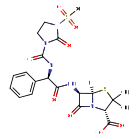
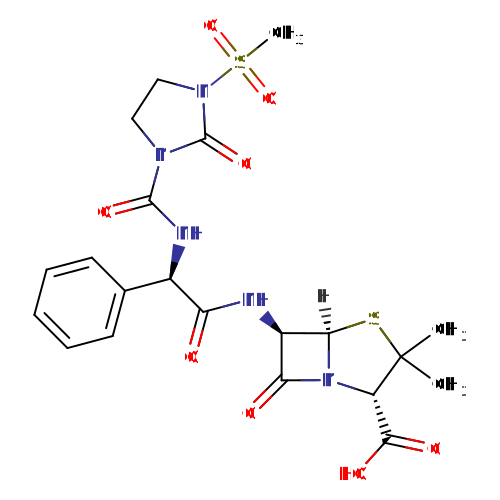
Structure for Mezlocillin (DB00948)
- Weight
- Average: 539.582
Monoisotopic: 539.114454181 - Chemical Formula
- C21H25N5O8S2
- Synonyms
- (2S,5R,6R)-3,3-dimethyl-6-{[(2R)-2-({[3-(methylsulfonyl)-2-oxoimidazolidin-1-yl]carbonyl}amino)-2-phenylacetyl]amino}-7-oxo-4-thia-1-azabicyclo[3.2.0]heptane-2-carboxylic acid
- 6β-{(2R)-2-[3-(methanesulfonyl)-2-oxoimidazolidine-1-carboxamido]-2-phenylacetamido}penicillanic acid
- Mezlocilina
- Mezlocillin
- Mezlocilline
- Mezlocillinum
- External IDs
- BAY-F-1353

Pharmacology
- Indication
Used to treat serious gram–negative infections of the lungs, urinary tract, and skin.
 Reduce drug development failure ratesBuild, train, & validate machine-learning modelswith evidence-based and structured datasets.Build, train, & validate predictive machine-learning models with structured datasets.
- Contraindications & Blackbox Warnings
 Prevent Adverse Drug Events TodayTap into our Clinical API for life-saving information on contraindications & blackbox warnings, population restrictions, harmful risks, & more.Avoid life-threatening adverse drug events with our Clinical API
- Pharmacodynamics
Mezlocillin is a penicillin beta-lactam antibiotic used in the treatment of bacterial infections caused by susceptible, usually gram-positive, organisms. The name "penicillin" can either refer to several variants of penicillin available, or to the group of antibiotics derived from the penicillins. Mezlocillin has in vitro activity against gram-positive and gram-negative aerobic and anaerobic bacteria. The bactericidal activity of mezlocillin results from the inhibition of cell wall synthesis and is mediated through mezlocillin binding to penicillin binding proteins (PBPs). Mezlocillin is stable against hydrolysis by a variety of beta-lactamases, including penicillinases, and cephalosporinases and extended spectrum beta-lactamases. Mezlocillin can be used to treat susceptible strains of H. influenzae, Klebsiella species, Pseudomonas species, Proteus mirabilis, E. coli, Enterobacter species, Streptococcus faecelis, Peptococcus species, Peptostreptococcus species, Bacteriodes species (including B. fragilis), Morganella morganii, Serratia species, N. gonorrhoeae, P. vulgaris, and Providencia rettgeri. This drug is discontinued in the U.S.
- Mechanism of action
By binding to specific penicillin-binding proteins (PBPs) located inside the bacterial cell wall, mezlocillin inhibits the third and last stage of bacterial cell wall synthesis. Cell lysis is then mediated by bacterial cell wall autolytic enzymes such as autolysins; it is possible that mezlocillin interferes with an autolysin inhibitor.
Target Actions Organism APenicillin-binding protein 1A inhibitorClostridium perfringens (strain 13 / Type A) APenicillin-binding protein 3 inhibitorStreptococcus pneumoniae UPenicillin-binding protein 2 inhibitorEscherichia coli (strain K12) - Absorption
Not Available
- Volume of distribution
Not Available
- Protein binding
16-59%
- Metabolism
Unlike many other penicillins, mezlocillin is either extensively metabolized or is subject to biliary excretion, as only about 50% of the dose was accounted for in normal urine.
- Route of elimination
Not Available
- Half-life
1.3 to 4.4 hours
- Clearance
Not Available
- Adverse Effects
 Improve decision support & research outcomesWith structured adverse effects data, including: blackbox warnings, adverse reactions, warning & precautions, & incidence rates. View sample adverse effects data in our new Data Library!Improve decision support & research outcomes with our structured adverse effects data.
- Toxicity
Symptoms of overdose include rash, fever, chills, and peeling skin.
- Pathways
- Not Available
- Pharmacogenomic Effects/ADRs
- Not Available
Interactions
- Drug Interactions
- This information should not be interpreted without the help of a healthcare provider. If you believe you are experiencing an interaction, contact a healthcare provider immediately. The absence of an interaction does not necessarily mean no interactions exist.
Drug Interaction Integrate drug-drug
interactions in your softwareAcemetacin Acemetacin may decrease the excretion rate of Mezlocillin which could result in a higher serum level. Acenocoumarol Mezlocillin may increase the anticoagulant activities of Acenocoumarol. Ambroxol The risk or severity of methemoglobinemia can be increased when Mezlocillin is combined with Ambroxol. Amikacin The serum concentration of Amikacin can be decreased when it is combined with Mezlocillin. Articaine The risk or severity of methemoglobinemia can be increased when Mezlocillin is combined with Articaine. - Food Interactions
- Not Available
Products
 Drug product information from 10+ global regionsOur datasets provide approved product information including:dosage, form, labeller, route of administration, and marketing period.Access drug product information from over 10 global regions.
- Product Ingredients
Ingredient UNII CAS InChI Key Mezlocillin sodium RX227TP94U 42057-22-7 GTGQRSIMEUWHPA-ZBJAFUORSA-M Mezlocillin sodium monohydrate 3CWW8B5904 80495-46-1 CZXDIDROKIDGNE-SYNJJEHYSA-M - International/Other Brands
- Mezlin
Categories
- ATC Codes
- J01CR50 — Combinations of penicillins
- J01CR — Combinations of penicillins, incl. beta-lactamase inhibitors
- J01C — BETA-LACTAM ANTIBACTERIALS, PENICILLINS
- J01 — ANTIBACTERIALS FOR SYSTEMIC USE
- J — ANTIINFECTIVES FOR SYSTEMIC USE
- Drug Categories
- Chemical TaxonomyProvided by Classyfire
- Description
- This compound belongs to the class of organic compounds known as peptides. These are compounds containing an amide derived from two or more amino carboxylic acid molecules (the same or different) by formation of a covalent bond from the carbonyl carbon of one to the nitrogen atom of another.
- Kingdom
- Organic compounds
- Super Class
- Organic acids and derivatives
- Class
- Carboxylic acids and derivatives
- Sub Class
- Amino acids, peptides, and analogues
- Direct Parent
- Peptides
- Alternative Parents
- Penicillins / N-carbamoyl-alpha amino acids and derivatives / N-acyl-alpha amino acids and derivatives / Alpha amino acid amides / Phenylacetamides / Sulfonylureas / Imidazolidinones / Thiazolidines / Tertiary carboxylic acid amides / Sulfonyls show 13 more
- Substituents
- Alpha peptide / Alpha-amino acid amide / Alpha-amino acid or derivatives / Aromatic heteropolycyclic compound / Azacycle / Azetidine / Benzenoid / Beta-lactam / Carbonic acid derivative / Carbonyl group show 33 more
- Molecular Framework
- Aromatic heteropolycyclic compounds
- External Descriptors
- penicillin (CHEBI:6919)
- Affected organisms
- Enteric bacteria and other eubacteria
Chemical Identifiers
- UNII
- OH2O403D1G
- CAS number
- 51481-65-3
- InChI Key
- YPBATNHYBCGSSN-VWPFQQQWSA-N
- InChI
- InChI=1S/C21H25N5O8S2/c1-21(2)14(18(29)30)26-16(28)13(17(26)35-21)22-15(27)12(11-7-5-4-6-8-11)23-19(31)24-9-10-25(20(24)32)36(3,33)34/h4-8,12-14,17H,9-10H2,1-3H3,(H,22,27)(H,23,31)(H,29,30)/t12-,13-,14+,17-/m1/s1
- IUPAC Name
- (2S,5R,6R)-6-[(2R)-2-[(3-methanesulfonyl-2-oxoimidazolidine-1-carbonyl)amino]-2-phenylacetamido]-3,3-dimethyl-7-oxo-4-thia-1-azabicyclo[3.2.0]heptane-2-carboxylic acid
- SMILES
- [H][C@]12SC(C)(C)[C@@H](N1C(=O)[C@H]2NC(=O)[C@H](NC(=O)N1CCN(C1=O)S(C)(=O)=O)C1=CC=CC=C1)C(O)=O
References
- General References
- Kristof RA, Clusmann H, Koehler W, Fink KB, Schramm J: Treatment of accidental high dose intraventricular mezlocillin application by cerebrospinal fluid exchange. J Neurol Neurosurg Psychiatry. 1998 Mar;64(3):379-81. [Article]
- McCormick PA, Greenslade L, Kibbler CC, Chin JK, Burroughs AK, McIntyre N: A prospective randomized trial of ceftazidime versus netilmicin plus mezlocillin in the empirical therapy of presumed sepsis in cirrhotic patients. Hepatology. 1997 Apr;25(4):833-6. [Article]
- Rohde B, Werner U, Hickstein H, Ehmcke H, Drewelow B: Pharmacokinetics of mezlocillin and sulbactam under continuous veno-venous hemodialysis (CVVHD) in intensive care patients with acute renal failure. Eur J Clin Pharmacol. 1997;53(2):111-5. [Article]
- External Links
- Human Metabolome Database
- HMDB0015083
- KEGG Drug
- D05021
- KEGG Compound
- C07221
- PubChem Compound
- 656511
- PubChem Substance
- 46506692
- ChemSpider
- 570894
- 6927
- ChEBI
- 6919
- ChEMBL
- CHEMBL1731
- ZINC
- ZINC000003831120
- Therapeutic Targets Database
- DAP001180
- PharmGKB
- PA164750540
- Wikipedia
- Mezlocillin
Clinical Trials
- Clinical Trials
Phase Status Purpose Conditions Count 0 Terminated Treatment Osteomyelitis 1
Pharmacoeconomics
- Manufacturers
- Bayer pharmaceuticals corp
- Packagers
- Not Available
- Dosage Forms
Form Route Strength Injection, powder, for solution Injection, solution Intramuscular - Prices
- Not Available
- Patents
- Not Available
Properties
- State
- Solid
- Experimental Properties
Property Value Source logP 0 Not Available - Predicted Properties
Property Value Source Water Solubility 0.471 mg/mL ALOGPS logP 0.21 ALOGPS logP -0.84 Chemaxon logS -3.1 ALOGPS pKa (Strongest Acidic) 3.49 Chemaxon pKa (Strongest Basic) -5.9 Chemaxon Physiological Charge -1 Chemaxon Hydrogen Acceptor Count 8 Chemaxon Hydrogen Donor Count 3 Chemaxon Polar Surface Area 173.5 Å2 Chemaxon Rotatable Bond Count 5 Chemaxon Refractivity 124.88 m3·mol-1 Chemaxon Polarizability 51.5 Å3 Chemaxon Number of Rings 4 Chemaxon Bioavailability 1 Chemaxon Rule of Five No Chemaxon Ghose Filter No Chemaxon Veber's Rule No Chemaxon MDDR-like Rule No Chemaxon - Predicted ADMET Features
Property Value Probability Human Intestinal Absorption - 0.8903 Blood Brain Barrier - 0.9802 Caco-2 permeable - 0.6285 P-glycoprotein substrate Substrate 0.7696 P-glycoprotein inhibitor I Non-inhibitor 0.817 P-glycoprotein inhibitor II Non-inhibitor 0.9892 Renal organic cation transporter Non-inhibitor 0.8761 CYP450 2C9 substrate Non-substrate 0.5979 CYP450 2D6 substrate Non-substrate 0.7973 CYP450 3A4 substrate Non-substrate 0.5132 CYP450 1A2 substrate Non-inhibitor 0.8033 CYP450 2C9 inhibitor Non-inhibitor 0.7397 CYP450 2D6 inhibitor Non-inhibitor 0.8934 CYP450 2C19 inhibitor Non-inhibitor 0.7272 CYP450 3A4 inhibitor Non-inhibitor 0.7478 CYP450 inhibitory promiscuity Low CYP Inhibitory Promiscuity 0.9747 Ames test Non AMES toxic 0.6484 Carcinogenicity Non-carcinogens 0.8275 Biodegradation Ready biodegradable 0.8269 Rat acute toxicity 2.5003 LD50, mol/kg Not applicable hERG inhibition (predictor I) Weak inhibitor 0.9907 hERG inhibition (predictor II) Non-inhibitor 0.7489
Spectra
- Mass Spec (NIST)
- Not Available
- Spectra
- Chromatographic Properties
Collision Cross Sections (CCS)
Adduct CCS Value (Å2) Source type Source [M-H]- 237.123493 predictedDarkChem Lite v0.1.0 [M-H]- 236.553993 predictedDarkChem Lite v0.1.0 [M-H]- 207.91518 predictedDeepCCS 1.0 (2019) [M+H]+ 237.710993 predictedDarkChem Lite v0.1.0 [M+H]+ 235.792093 predictedDarkChem Lite v0.1.0 [M+H]+ 209.74005 predictedDeepCCS 1.0 (2019) [M+Na]+ 237.577993 predictedDarkChem Lite v0.1.0 [M+Na]+ 236.647693 predictedDarkChem Lite v0.1.0 [M+Na]+ 215.34589 predictedDeepCCS 1.0 (2019)
Targets

- Kind
- Protein
- Organism
- Clostridium perfringens (strain 13 / Type A)
- Pharmacological action
- Yes
- Actions
- Inhibitor
- General Function
- Transferase activity, transferring glycosyl groups
- Specific Function
- Cell wall formation. Synthesis of cross-linked peptidoglycan from the lipid intermediates. The enzyme has a penicillin-insensitive transglycosylase N-terminal domain (formation of linear glycan str...
- Gene Name
- pbpA
- Uniprot ID
- Q8XJ01
- Uniprot Name
- Penicillin-binding protein 1A
- Molecular Weight
- 75176.35 Da
References
- Overington JP, Al-Lazikani B, Hopkins AL: How many drug targets are there? Nat Rev Drug Discov. 2006 Dec;5(12):993-6. [Article]
- Imming P, Sinning C, Meyer A: Drugs, their targets and the nature and number of drug targets. Nat Rev Drug Discov. 2006 Oct;5(10):821-34. [Article]
- Lei Y, Li JT: [Affinity of penicillin-binding proteins of Escherichia coli K-12 for furbenicillin and other beta-lactam antibiotics]. Zhongguo Yao Li Xue Bao. 1989 Mar;10(2):177-80. [Article]
- Kind
- Protein
- Organism
- Streptococcus pneumoniae
- Pharmacological action
- Yes
- Actions
- Inhibitor
- General Function
- Serine-type d-ala-d-ala carboxypeptidase activity
- Specific Function
- Not Available
- Gene Name
- pbp3
- Uniprot ID
- Q75Y35
- Uniprot Name
- Penicillin-binding protein 3
- Molecular Weight
- 45209.84 Da
References
- Lei Y, Li JT: [Affinity of penicillin-binding proteins of Escherichia coli K-12 for furbenicillin and other beta-lactam antibiotics]. Zhongguo Yao Li Xue Bao. 1989 Mar;10(2):177-80. [Article]
- Drugeon HB, Caillon J, Moinard D, Juvin ME, Pirault JL: [Bactericidal effect of piperacillin alone and combined]. Presse Med. 1986 Dec 20;15(46):2297-302. [Article]
- McCloskey RV, LeFrock JL, Smith BR, Aronoff GR: Microbiology, pharmacology, and clinical use of mezlocillin sodium. Pharmacotherapy. 1982 Nov-Dec;2(6):300-12. [Article]
- Kind
- Protein
- Organism
- Escherichia coli (strain K12)
- Pharmacological action
- Unknown
- Actions
- Inhibitor
- General Function
- Serine-type d-ala-d-ala carboxypeptidase activity
- Specific Function
- Cell wall formation; PBP-2 is responsible for the determination of the rod shape of the cell. It synthesizes cross-linked peptidoglycan from lipid intermediates.
- Gene Name
- mrdA
- Uniprot ID
- P0AD65
- Uniprot Name
- Penicillin-binding protein 2
- Molecular Weight
- 70856.1 Da
References
- Lei Y, Li JT: [Affinity of penicillin-binding proteins of Escherichia coli K-12 for furbenicillin and other beta-lactam antibiotics]. Zhongguo Yao Li Xue Bao. 1989 Mar;10(2):177-80. [Article]

Drug created at June 13, 2005 13:24 / Updated at April 24, 2024 13:53