Identification
- Summary
Selenium Sulfide is an antifungal used to treat dandruff, seborrheic dermatitis of the scalp, and tinea capitis.
- Brand Names
- Selrx, Selsun Blue
- Generic Name
- Selenium Sulfide
- DrugBank Accession Number
- DB00971
- Background
Selenium Sulfide is an antifungal agent as well as a cytostatic agent, slowing the growth of hyperproliferative cells in seborrhea. Selenium Sulfide is the active ingredient often used in shampoos for the treatment of dandruff, seborrheic dermatitis and tinea capitis, a fungal infection that is primarily a disease of preadolescent children.
- Type
- Small Molecule
- Groups
- Approved
- Structure
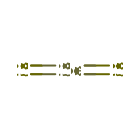
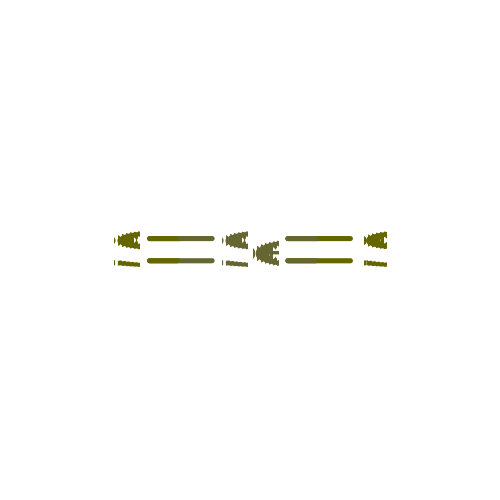
Structure for Selenium Sulfide (DB00971)
- Weight
- Average: 143.09
Monoisotopic: 143.860663208 - Chemical Formula
- S2Se
- Synonyms
- Selenii disulfidum
- Selenium disulfide
- Selenium disulphide
- Selenium Sulfide
- Selenium sulfide, micronized
- Selenium sulphide
- Selenium sulphide, micronized
- Selenium(IV) disulfide
- Selenium(IV) disulphide
- Selenium(IV) sulfide
- Selenium(IV) sulphide

Pharmacology
- Indication
For treatment of tinea versicolor, tinea capitis, dandruff and seborrheic dermatitis of the scalp.
 Reduce drug development failure ratesBuild, train, & validate machine-learning modelswith evidence-based and structured datasets.Build, train, & validate predictive machine-learning models with structured datasets.
- Associated Conditions
Indication Type Indication Combined Product Details Approval Level Age Group Patient Characteristics Dose Form Symptomatic treatment of Dandruff ••• ••• Symptomatic treatment of Seborrheic dermatitis •••••••••••• Treatment of Tinea versicolor •••••••••••• - Contraindications & Blackbox Warnings
 Prevent Adverse Drug Events TodayTap into our Clinical API for life-saving information on contraindications & blackbox warnings, population restrictions, harmful risks, & more.Avoid life-threatening adverse drug events with our Clinical API
- Pharmacodynamics
Selenium sulfide is an antifungal agent often used in shampoos for the treatment of dandruff and seborrheic dermatitis. Selenium sulfide is highly active in inhibiting the growth of P. ovale. It is also a proven cytostatic agent, slowing the growth of both hyperproliferative and normal cells in dandruff and seborrheic dermatitis. A 0.6% micronized form of selenium sulfide is also safe and effective for dandruff.
- Mechanism of action
Topical selenium sulfide may act by an antimitotic action, resulting in a reduction in the turnover of epidermal cells. It also has local irritant, antibacterial, and mild antifungal activity, which may contribute to its effectiveness. An antimitotic mechanism of action is suggested by data showing that selenium sulfide decreases the rate of incorporation of radioactively labeled thymidine into the DNA of dermal epithelial cells. The following organisms are generally considered susceptible to selenium sulfide in vitro: Malassezia furfur, Microsporum sp. including Microsporum audouinii and Microsporum canis, Pityrosporon sp., Trichophyton sp. including Trichophyton schoenleinii and Trichophyton tonsurans. Selenium sulfide has been shown to be sporicidal to T. tonsurans, the most common etiologic agent of tinea capitis. One in-vitro study demonstrated that 2.5% selenium sulfide was equivalent in sporicidal activity to both 1% and 2% zinc pyrithione.
- Absorption
There is no substantial absorption through intact skin. Absorption has been reported in patients with open lesions on the scalp or in patients using a 1% cream on the back - a patient with scalp lesions that used selenium shampoos had a level of selenium sulfide as high as 32 μg/ml in her urine.
- Volume of distribution
Not Available
- Protein binding
Not Available
- Metabolism
- Not Available
- Route of elimination
Not Available
- Half-life
Not Available
- Clearance
Not Available
- Adverse Effects
 Improve decision support & research outcomesWith structured adverse effects data, including: blackbox warnings, adverse reactions, warning & precautions, & incidence rates. View sample adverse effects data in our new Data Library!Improve decision support & research outcomes with our structured adverse effects data.
- Toxicity
No documented reports of serious toxicity in humans resulting from acute ingestion of selenium sulfide, however, acute toxicity studies in animals suggest that ingestion of large amounts could result in potential human toxicity.
- Pathways
- Not Available
- Pharmacogenomic Effects/ADRs
- Not Available
Interactions
- Drug Interactions
- This information should not be interpreted without the help of a healthcare provider. If you believe you are experiencing an interaction, contact a healthcare provider immediately. The absence of an interaction does not necessarily mean no interactions exist.No interactions found.
- Food Interactions
- No interactions found.
Products
 Drug product information from 10+ global regionsOur datasets provide approved product information including:dosage, form, labeller, route of administration, and marketing period.Access drug product information from over 10 global regions.
- Active Moieties
Name Kind UNII CAS InChI Key Selenium unknown H6241UJ22B 7782-49-2 BUGBHKTXTAQXES-UHFFFAOYSA-N - International/Other Brands
- Exsel Lotion Shampoo / Glo-Sel / Head & Shoulders Intensive Treatment / Versel Lotion
- Brand Name Prescription Products
Name Dosage Strength Route Labeller Marketing Start Marketing End Region Image Selenium Sulfide Shampoo 22.5 mg/1mL Topical Rochester Pharmaceuticals 2011-03-30 2019-07-08 US 
Selenium Sulfide Shampoo 23 mg/1mL Topical Bowyn Labs, Llc 2018-04-12 2024-05-31 US Selenium Sulfide Shampoo 23 mg/1mL Topical Method Pharmaceuticals, LLC 2018-04-05 2023-12-31 US Selenium Sulfide Shampoo 22.5 mg/1mL Topical River's Edge Pharmaceuticals, LLC 2008-12-08 2012-10-31 US Selenium Sulfide Shampoo 22.5 mg/1mL Topical Kmm Pharmaceuticals, Llc 2017-11-14 2023-01-31 US - Generic Prescription Products
Name Dosage Strength Route Labeller Marketing Start Marketing End Region Image Selenium Sulfide Lotion 2.5 mg/100mL Topical Rpk Pharmaceuticals, Inc. 2006-09-25 Not applicable US Selenium Sulfide Lotion 2.5 g/100mL Topical Physicians Total Care, Inc. 2006-09-25 Not applicable US Selenium Sulfide Lotion 2.5 mg/100mL Topical Nucare Pharmaceuticals,inc. 2006-09-25 Not applicable US Selenium Sulfide Lotion 25 mg/1mL Topical Morton Grove Pharmaceuticals, Inc. 1983-09-01 Not applicable US Selenium Sulfide Lotion 25 mg/1mL Topical Central Texas Community Health Centers 1983-09-01 Not applicable US - Over the Counter Products
Name Dosage Strength Route Labeller Marketing Start Marketing End Region Image Antidandruff Medicated Shampoo 1.0000 mL/100mL Topical Safeway 2010-08-05 Not applicable US Antidandruff Medicated Shampoo 1.0000 mL/100mL Topical CVS Health 2010-07-06 Not applicable US Care One Medicated Liquid 10 mg/1mL Topical American Sales Company 2013-08-15 Not applicable US Care One Moisturizing Liquid 10 mg/1mL Topical American Sales Company 2013-07-15 Not applicable US Careone Medicated Dandruff Shampoo 10 mg/1mL Topical Retail Business Services, LLC 2021-08-26 Not applicable US - Unapproved/Other Products
Name Ingredients Dosage Route Labeller Marketing Start Marketing End Region Image Clease and Treat Selenium Sulfide (0.5 g/5g) + Benzoyl peroxide (0.8 g/5g) Cloth Topical Quinnova Pharmaceuticals, Inc. 2009-01-01 Not applicable US Selenium Sulfide Selenium Sulfide (22.5 mg/1mL) Shampoo Topical Bi-Coastal Pharma International LLC 2011-06-01 Not applicable US Selenium Sulfide Selenium Sulfide (22.5 mg/1mL) Shampoo Topical Noble Pharmaceuticals, Llc 2017-05-09 Not applicable US Selenium Sulfide Selenium Sulfide (22.5 mg/1mL) Shampoo Topical River's Edge Pharmaceuticals, LLC 2008-12-08 2012-10-31 US Selenium Sulfide Selenium Sulfide (22.5 mg/1mL) Shampoo Topical Westminster Pharmaceuticals, LLC 2019-09-09 Not applicable US
Categories
- ATC Codes
- D01AE13 — Selenium sulfide
- Drug Categories
- Chemical TaxonomyProvided by Classyfire
- Description
- This compound belongs to the class of inorganic compounds known as other non-metal sulfides. These are inorganic compounds containing a sulfur atom of an oxidation state of -2, in which the heaviest atom bonded to the oxygen belongs to the class of other non-metals.
- Kingdom
- Inorganic compounds
- Super Class
- Homogeneous non-metal compounds
- Class
- Other non-metal organides
- Sub Class
- Other non-metal sulfides
- Direct Parent
- Other non-metal sulfides
- Alternative Parents
- Inorganic sulfides
- Substituents
- Inorganic sulfide / Other non-metal sulfide
- Molecular Framework
- Not Available
- External Descriptors
- Not Available
- Affected organisms
- Humans and other mammals
- Fungi
- Bacteria
Chemical Identifiers
- UNII
- Z69D9E381Q
- CAS number
- 7488-56-4
- InChI Key
- JNMWHTHYDQTDQZ-UHFFFAOYSA-N
- InChI
- InChI=1S/S2Se/c1-3-2
- IUPAC Name
- thione
- SMILES
- S=[Se]=S
References
- General References
- Johnson BA, Nunley JR: Treatment of seborrheic dermatitis. Am Fam Physician. 2000 May 1;61(9):2703-10, 2713-4. [Article]
- Chen C, Koch LH, Dice JE, Dempsey KK, Moskowitz AB, Barnes-Eley ML, Hubbard TW, Williams JV: A randomized, double-blind study comparing the efficacy of selenium sulfide shampoo 1% and ciclopirox shampoo 1% as adjunctive treatments for tinea capitis in children. Pediatr Dermatol. 2010 Sep-Oct;27(5):459-62. doi: 10.1111/j.1525-1470.2010.01093.x. Epub 2010 Aug 24. [Article]
- External Links
- PubChem Compound
- 24087
- PubChem Substance
- 46507535
- ChemSpider
- 22519
- 36345
- ChEBI
- 135934
- ChEMBL
- CHEMBL1200680
- PharmGKB
- PA164771240
- RxList
- RxList Drug Page
- Drugs.com
- Drugs.com Drug Page
- MSDS
- Download (73.8 KB)
Clinical Trials
- Clinical Trials
Phase Status Purpose Conditions Count Not Available Completed Treatment Tinea Capitis 1
Pharmacoeconomics
- Manufacturers
- Allergan herbert div allergan inc
- Actavis mid atlantic llc
- Ivax pharmaceuticals inc
- Perrigo new york inc
- Taro pharmaceuticals usa inc
- Wockhardt eu operations (swiss) ag
- Chattem inc
- Packagers
- Advanced Pharmaceutical Services Inc.
- Bioglan Pharmaceuticals Co.
- Chattem Chemicals Inc.
- DispenseXpress Inc.
- Dispensing Solutions
- Groupe Parima Inc.
- Ide Interstate
- Ivax Pharmaceuticals
- Major Pharmaceuticals
- Perrigo Co.
- Pharmaderm
- Pharmedix
- Physicians Total Care Inc.
- Professional Co.
- Qualitest
- Quinnova Pharmaceuticals
- River's Edge Pharmaceuticals
- Sonar Products Inc.
- Taro Pharmaceuticals USA
- Wockhardt Ltd.
- Dosage Forms
Form Route Strength Shampoo Topical 1.0000 mL/100mL Suspension Topical 2.5 g/100ml Cloth Topical Shampoo Topical 1 mL/100mL Liquid Topical 10 mg/1mL Liquid Topical 0.1 g/1mL Liquid Topical 1 mg/384mL Lotion / shampoo Topical 1 g/100mL Shampoo Topical 1 kg/100L Shampoo Topical 325 mL/100mL Shampoo Topical 0.6 g/100mL Lotion / shampoo Topical 1.77 g/177mL Liquid Topical 1 mL/100mL Lotion Topical 2.5 % w/v Lotion Topical 2.5 mg/100mL Lotion Topical 2.5 g/100mL Lotion Topical 25 mg/1mL Shampoo Topical 10 mg/1mL Shampoo Topical 22.5 mg/1mL Shampoo Topical 23 mg/1mL Shampoo, suspension Topical 0.0225 mg/1mL Lotion Topical Suspension Topical 2.5 % Shampoo Topical 1 g/100mL Shampoo Topical 1 % Shampoo Topical 1.0 % Shampoo Topical 25 mg/ml Shampoo Topical 0.025 g/1mL Shampoo Topical 2.5 % w/v Shampoo Topical Shampoo Topical 2.5 g/100g Suspension Topical 120 ml Aerosol, foam Topical 1.44 g/70g Solution Topical Cream Topical 1 g/56.7g Cream Topical 2.5 %w/w - Prices
Unit description Cost Unit Selenium Sulfide 2.5% Lotion 118ml Bottle 19.99USD bottle Selenium Sulfide 2.5% Lotion 120ml Bottle 19.99USD bottle Selenium sulfide 99% powder 5.64USD g Tersi 2.25% foam 2.05USD g Selenium sulfide 2.25% shampoo 0.33USD ml Selenium sulf 2.5% shampoo 0.17USD ml Selenium 2.5% lotion-shampoo 0.1USD ml Selenium sulfide 2.5% lotion 0.1USD ml Selsun blue shampoo x-medic 0.04USD ml Selsun blue 1% shampoo 0.03USD ml Selsun blue daily shampoo 0.03USD ml DrugBank does not sell nor buy drugs. Pricing information is supplied for informational purposes only.- Patents
- Not Available
Properties
- State
- Solid
- Experimental Properties
Property Value Source melting point (°C) 100 °C Not Available water solubility Practically insoluble Not Available - Predicted Properties
Property Value Source logP 0.91 Chemaxon Physiological Charge 0 Chemaxon Hydrogen Acceptor Count 1 Chemaxon Hydrogen Donor Count 0 Chemaxon Polar Surface Area 0 Å2 Chemaxon Rotatable Bond Count 0 Chemaxon Refractivity 31.98 m3·mol-1 Chemaxon Polarizability 9.59 Å3 Chemaxon Number of Rings 0 Chemaxon Bioavailability 1 Chemaxon Rule of Five Yes Chemaxon Ghose Filter No Chemaxon Veber's Rule Yes Chemaxon MDDR-like Rule No Chemaxon - Predicted ADMET Features
Property Value Probability Human Intestinal Absorption + 0.9946 Blood Brain Barrier + 0.9786 Caco-2 permeable + 0.6224 P-glycoprotein substrate Non-substrate 0.908 P-glycoprotein inhibitor I Non-inhibitor 0.9531 P-glycoprotein inhibitor II Non-inhibitor 0.9963 Renal organic cation transporter Non-inhibitor 0.9254 CYP450 2C9 substrate Non-substrate 0.8623 CYP450 2D6 substrate Non-substrate 0.8451 CYP450 3A4 substrate Non-substrate 0.8077 CYP450 1A2 substrate Non-inhibitor 0.7526 CYP450 2C9 inhibitor Non-inhibitor 0.7658 CYP450 2D6 inhibitor Non-inhibitor 0.9304 CYP450 2C19 inhibitor Non-inhibitor 0.8352 CYP450 3A4 inhibitor Non-inhibitor 0.891 CYP450 inhibitory promiscuity Low CYP Inhibitory Promiscuity 0.7268 Ames test Non AMES toxic 0.8363 Carcinogenicity Carcinogens 0.6874 Biodegradation Not ready biodegradable 0.9612 Rat acute toxicity 2.2807 LD50, mol/kg Not applicable hERG inhibition (predictor I) Weak inhibitor 0.933 hERG inhibition (predictor II) Non-inhibitor 0.9694
Spectra
- Mass Spec (NIST)
- Not Available
- Spectra
- Chromatographic Properties
Collision Cross Sections (CCS)
Adduct CCS Value (Å2) Source type Source [M-H]- 115.21242 predictedDeepCCS 1.0 (2019) [M+H]+ 117.041504 predictedDeepCCS 1.0 (2019) [M+Na]+ 124.19514 predictedDeepCCS 1.0 (2019)

Drug created at June 13, 2005 13:24 / Updated at February 02, 2024 22:46