Identification
- Summary
Methyl aminolevulinate is a porphyrin precursor used to treat non-hyperkeratotic, non-pigmented actinic keratosis of the face and scalp.
- Brand Names
- Metvix, Metvixia
- Generic Name
- Methyl aminolevulinate
- DrugBank Accession Number
- DB00992
- Background
Methyl aminolevulinate is a prodrug that is metabolised to Protoporphyrin IX (a photosensitizer) used in photodynamic therapy.
- Type
- Small Molecule
- Groups
- Approved, Investigational
- Structure
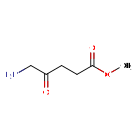
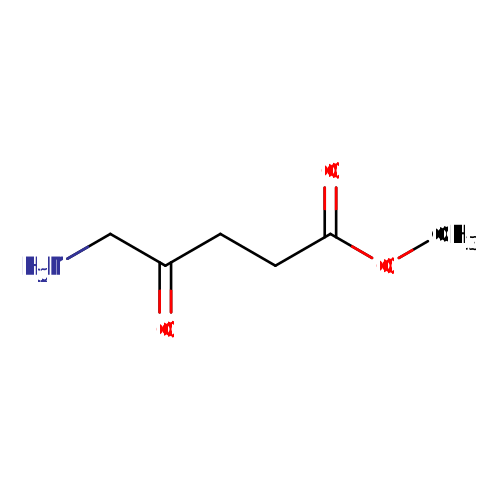
Structure for Methyl aminolevulinate (DB00992)
- Weight
- Average: 145.1564
Monoisotopic: 145.073893223 - Chemical Formula
- C6H11NO3
- Synonyms
- 5-aminolevulinic acid methyl ester
- Aminolevulinato de metilo
- Aminolevulinic acid methyl ester
- methyl 5-aminolevulinate
- Methyl aminolevulinate
- Methyl delta-aminolevulinate
- methyl δ-aminolevulinate

Pharmacology
- Indication
For topical use, in combination with 570 to 670 nm wavelength red light illumination, in the treatment of non-hyperkeratotic actinic keratoses of the face and scalp in immunocompetent patients when used in conjunction with lesion preparation (debridement using a sharp dermal curette).
 Reduce drug development failure ratesBuild, train, & validate machine-learning modelswith evidence-based and structured datasets.Build, train, & validate predictive machine-learning models with structured datasets.
- Associated Conditions
Indication Type Indication Combined Product Details Approval Level Age Group Patient Characteristics Dose Form Treatment of Actinic keratosis of face and scalp •••••••••••• ••••••••••••••••••••• ••••• - Contraindications & Blackbox Warnings
 Prevent Adverse Drug Events TodayTap into our Clinical API for life-saving information on contraindications & blackbox warnings, population restrictions, harmful risks, & more.Avoid life-threatening adverse drug events with our Clinical API
- Pharmacodynamics
After topical application of methyl aminolevulinate, porphyrins will accumulate intracellularly in the treated skin lesions. The intracellular porphyrins (including PpIX) are photoactive, fluorescing compounds and, upon light activation in the presence of oxygen, singlet oxygen is formed which causes damage to cellular compartments, in particular the mitochondria. Light activation of accumulated porphyrins leads to a photochemical reaction and thereby phototoxicity to the light-exposed target cells.
- Mechanism of action
Photosensitization following application of methyl aminolevulinate cream occurs through the metabolic conversion of methyl aminolevulinate (prodrug) to photoactive porphyrins (PAP), which accumulates in the skin lesions to which the cream has been applied. When exposed to light of appropriate wavelength and energy, the accumulated photoactive porphyrins produce a photodynamic reaction, resulting in a cytotoxic process dependent upon the simultaneous presence of oxygen. The absorption of light results in an excited state of porphyrin molecules, and subsequent spin transfer from photoactive porphyrins to molecular oxygen generates singlet oxygen, which can further react to form superoxide and hydroxyl radicals.
- Absorption
In vitro, after 24 hours the mean cumulative absorption through human skin was 0.26% of the administered dose.
- Volume of distribution
Not Available
- Protein binding
Not Available
- Metabolism
- Not Available
- Route of elimination
Not Available
- Half-life
Not Available
- Clearance
Not Available
- Adverse Effects
 Improve decision support & research outcomesWith structured adverse effects data, including: blackbox warnings, adverse reactions, warning & precautions, & incidence rates. View sample adverse effects data in our new Data Library!Improve decision support & research outcomes with our structured adverse effects data.
- Toxicity
The severity of local phototoxic reactions such as erythema, pain and burning sensation may increase in case of prolonged application time or very high light intensity.
- Pathways
- Not Available
- Pharmacogenomic Effects/ADRs
- Not Available
Interactions
- Drug Interactions
- This information should not be interpreted without the help of a healthcare provider. If you believe you are experiencing an interaction, contact a healthcare provider immediately. The absence of an interaction does not necessarily mean no interactions exist.
Drug Interaction Integrate drug-drug
interactions in your softwareEtrasimod The risk or severity of immunosuppression can be increased when Methyl aminolevulinate is combined with Etrasimod. Padeliporfin Methyl aminolevulinate may increase the photosensitizing activities of Padeliporfin. Tretinoin The risk or severity of adverse effects can be increased when Tretinoin is combined with Methyl aminolevulinate. - Food Interactions
- No interactions found.
Products
 Drug product information from 10+ global regionsOur datasets provide approved product information including:dosage, form, labeller, route of administration, and marketing period.Access drug product information from over 10 global regions.
- Product Ingredients
Ingredient UNII CAS InChI Key Methyl aminolevulinate hydrochloride 7S73606O1A 79416-27-6 UJYSYPVQHFNBML-UHFFFAOYSA-N - Brand Name Prescription Products
Name Dosage Strength Route Labeller Marketing Start Marketing End Region Image Metvix Cream 168 mg / g Topical Galderma 2009-06-16 Not applicable Canada 
Metvixia Cream 168 mg/1g Topical Galderma 2004-07-27 2012-11-29 US 
Metvixia Cream 168 mg/1g Topical Penn Pharmaceutical Services Ltd. 2007-10-02 Not applicable US
Categories
- ATC Codes
- L01XD03 — Methyl aminolevulinate
- Drug Categories
- Amino Acids
- Amino Acids, Peptides, and Proteins
- Antineoplastic Agents
- Antineoplastic and Immunomodulating Agents
- Dermatologicals
- Keto Acids
- Levulinic Acids
- Misc. Skin and Mucous Membrane Agents
- Photochemotherapy
- Photosensitizing Agents
- Photosensitizing Agents for Phototherapy
- Porphyrin Precursor
- Radiation-Sensitizing Agents
- Sensitizers Used in Photodynamic/radiation Therapy
- Chemical TaxonomyProvided by Classyfire
- Description
- This compound belongs to the class of organic compounds known as delta amino acids and derivatives. These are compounds containing a carboxylic acid group and an amino group at the C5 carbon atom.
- Kingdom
- Organic compounds
- Super Class
- Organic acids and derivatives
- Class
- Carboxylic acids and derivatives
- Sub Class
- Amino acids, peptides, and analogues
- Direct Parent
- Delta amino acids and derivatives
- Alternative Parents
- Gamma-keto acids and derivatives / Fatty acid methyl esters / Methyl esters / Alpha-amino ketones / Monocarboxylic acids and derivatives / Organopnictogen compounds / Organic oxides / Monoalkylamines / Hydrocarbon derivatives
- Substituents
- Aliphatic acyclic compound / Alpha-aminoketone / Amine / Carbonyl group / Carboxylic acid ester / Delta amino acid or derivatives / Fatty acid ester / Fatty acid methyl ester / Fatty acyl / Gamma-keto acid
- Molecular Framework
- Aliphatic acyclic compounds
- External Descriptors
- delta-amino acid ester (CHEBI:724125)
- Affected organisms
- Humans and other mammals
Chemical Identifiers
- UNII
- 585NM85KYM
- CAS number
- 33320-16-0
- InChI Key
- YUUAYBAIHCDHHD-UHFFFAOYSA-N
- InChI
- InChI=1S/C6H11NO3/c1-10-6(9)3-2-5(8)4-7/h2-4,7H2,1H3
- IUPAC Name
- methyl 5-amino-4-oxopentanoate
- SMILES
- COC(=O)CCC(=O)CN
References
- General References
- Smits T, Moor AC: New aspects in photodynamic therapy of actinic keratoses. J Photochem Photobiol B. 2009 Sep 4;96(3):159-69. doi: 10.1016/j.jphotobiol.2009.06.003. Epub 2009 Jun 13. [Article]
- External Links
- Human Metabolome Database
- HMDB0015127
- KEGG Drug
- D08204
- PubChem Compound
- 157922
- PubChem Substance
- 46507004
- ChemSpider
- 138950
- 337068
- ChEBI
- 724125
- ChEMBL
- CHEMBL1096562
- ZINC
- ZINC000001909090
- Therapeutic Targets Database
- DAP001024
- PharmGKB
- PA164784028
- Drugs.com
- Drugs.com Drug Page
- Wikipedia
- Methyl_aminolevulinate
- FDA label
- Download (597 KB)
Clinical Trials
- Clinical Trials
Phase Status Purpose Conditions Count 4 Completed Other Actinic Keratosis (AK) 1 4 Completed Treatment Actinic Keratosis (AK) / Natural Daylight Photodynamic Therapy 1 4 Completed Treatment Multiple Actinic Keratoses 1 4 Recruiting Treatment Cutaneous Squamous Cell Carcinoma in Situ (CSCCis) 1 4 Unknown Status Treatment Superficial Basal Cell Carcinoma 1
Pharmacoeconomics
- Manufacturers
- Galderma laboratories lp
- Packagers
- Galderma Laboratories
- Penn Pharmaceutical Services Ltd.
- Dosage Forms
Form Route Strength Cream Topical 160 mg/g Cream Cutaneous 160 MG/G Cream Topical 168 mg / g Cream Topical 16 % w/w Cream Topical 16 g Cream Topical 168 mg/1g Cream Cutaneous 160.000 mg - Prices
Unit description Cost Unit Metvixia 16.8% cream 82.2USD g DrugBank does not sell nor buy drugs. Pricing information is supplied for informational purposes only.- Patents
Patent Number Pediatric Extension Approved Expires (estimated) Region CA2215069 No 2006-09-12 2016-03-08 Canada US6034267 No 2000-03-07 2016-03-08 US
Properties
- State
- Solid
- Experimental Properties
Property Value Source water solubility Freely soluble Not Available logP -1.2 Not Available - Predicted Properties
Property Value Source Water Solubility 220.0 mg/mL ALOGPS logP -1.3 ALOGPS logP -0.85 Chemaxon logS 0.18 ALOGPS pKa (Strongest Acidic) 17.16 Chemaxon pKa (Strongest Basic) 7.83 Chemaxon Physiological Charge 1 Chemaxon Hydrogen Acceptor Count 3 Chemaxon Hydrogen Donor Count 1 Chemaxon Polar Surface Area 69.39 Å2 Chemaxon Rotatable Bond Count 5 Chemaxon Refractivity 35.22 m3·mol-1 Chemaxon Polarizability 14.55 Å3 Chemaxon Number of Rings 0 Chemaxon Bioavailability 1 Chemaxon Rule of Five Yes Chemaxon Ghose Filter No Chemaxon Veber's Rule No Chemaxon MDDR-like Rule No Chemaxon - Predicted ADMET Features
Property Value Probability Human Intestinal Absorption + 0.9652 Blood Brain Barrier + 0.9677 Caco-2 permeable - 0.5715 P-glycoprotein substrate Non-substrate 0.6238 P-glycoprotein inhibitor I Non-inhibitor 0.806 P-glycoprotein inhibitor II Non-inhibitor 0.7456 Renal organic cation transporter Non-inhibitor 0.7855 CYP450 2C9 substrate Non-substrate 0.8561 CYP450 2D6 substrate Non-substrate 0.7888 CYP450 3A4 substrate Non-substrate 0.6617 CYP450 1A2 substrate Non-inhibitor 0.5854 CYP450 2C9 inhibitor Non-inhibitor 0.9022 CYP450 2D6 inhibitor Non-inhibitor 0.9309 CYP450 2C19 inhibitor Non-inhibitor 0.8932 CYP450 3A4 inhibitor Non-inhibitor 0.8724 CYP450 inhibitory promiscuity Low CYP Inhibitory Promiscuity 0.8936 Ames test Non AMES toxic 0.8519 Carcinogenicity Non-carcinogens 0.8042 Biodegradation Ready biodegradable 0.899 Rat acute toxicity 1.7684 LD50, mol/kg Not applicable hERG inhibition (predictor I) Weak inhibitor 0.8837 hERG inhibition (predictor II) Non-inhibitor 0.8402
Spectra
- Mass Spec (NIST)
- Not Available
- Spectra
Spectrum Spectrum Type Splash Key Predicted GC-MS Spectrum - GC-MS Predicted GC-MS splash10-0a59-9000000000-3022d6725fb55c4c97ad Predicted MS/MS Spectrum - 10V, Positive (Annotated) Predicted LC-MS/MS splash10-01p9-9300000000-7ee52514cc0405d78e44 Predicted MS/MS Spectrum - 10V, Negative (Annotated) Predicted LC-MS/MS splash10-08fr-9800000000-7744908f16455598ae69 Predicted MS/MS Spectrum - 20V, Negative (Annotated) Predicted LC-MS/MS splash10-052f-9000000000-83f85c6438abb9de370b Predicted MS/MS Spectrum - 20V, Positive (Annotated) Predicted LC-MS/MS splash10-0671-9000000000-2fea78841fd747b97809 Predicted MS/MS Spectrum - 40V, Negative (Annotated) Predicted LC-MS/MS splash10-0006-9000000000-a0c27425f58a099bf418 Predicted MS/MS Spectrum - 40V, Positive (Annotated) Predicted LC-MS/MS splash10-0a4l-9000000000-9e5b5c3951c171f5b2cf Predicted 1H NMR Spectrum 1D NMR Not Applicable Predicted 13C NMR Spectrum 1D NMR Not Applicable - Chromatographic Properties
Collision Cross Sections (CCS)
Adduct CCS Value (Å2) Source type Source [M-H]- 133.815387 predictedDarkChem Lite v0.1.0 [M-H]- 133.933987 predictedDarkChem Lite v0.1.0 [M-H]- 126.27411 predictedDeepCCS 1.0 (2019) [M+H]+ 134.812087 predictedDarkChem Lite v0.1.0 [M+H]+ 134.884687 predictedDarkChem Lite v0.1.0 [M+H]+ 129.7836 predictedDeepCCS 1.0 (2019) [M+Na]+ 134.474187 predictedDarkChem Lite v0.1.0 [M+Na]+ 134.022787 predictedDarkChem Lite v0.1.0 [M+Na]+ 138.99568 predictedDeepCCS 1.0 (2019)

Drug created at June 13, 2005 13:24 / Updated at April 18, 2024 09:15