Identification
- Summary
Frovatriptan is a 5-HT1B/1D receptor agonist used to treat migraines.
- Brand Names
- Frova
- Generic Name
- Frovatriptan
- DrugBank Accession Number
- DB00998
- Background
Frovatriptan is a triptan drug developed by Vernalis for the treatment of migraine headaches, in particular those associated with menstruation. Frovatriptan causes vasoconstriction of arteries and veins that supply blood to the head.
- Type
- Small Molecule
- Groups
- Approved, Investigational
- Structure
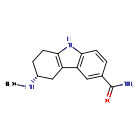
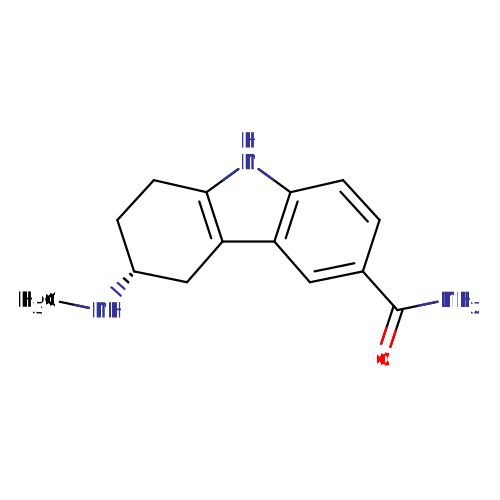
Structure for Frovatriptan (DB00998)
- Weight
- Average: 243.3043
Monoisotopic: 243.137162181 - Chemical Formula
- C14H17N3O
- Synonyms
- Frovatriptan
- External IDs
- SB 209509

Pharmacology
- Indication
For the acute treatment of migraine attacks with or without aura in adults.
 Reduce drug development failure ratesBuild, train, & validate machine-learning modelswith evidence-based and structured datasets.Build, train, & validate predictive machine-learning models with structured datasets.
- Associated Conditions
Indication Type Indication Combined Product Details Approval Level Age Group Patient Characteristics Dose Form Treatment of Menstrual migraine ••• ••••• Treatment of Migraine with aura •••••••••••• ••••• •••••• Treatment of Migraine without aura •••••••••••• ••••• •••••• - Contraindications & Blackbox Warnings
 Prevent Adverse Drug Events TodayTap into our Clinical API for life-saving information on contraindications & blackbox warnings, population restrictions, harmful risks, & more.Avoid life-threatening adverse drug events with our Clinical API
- Pharmacodynamics
Frovatriptan is a second generation triptan 5-HT receptor agonist that binds with high affinity for 5-HT1B and 5-HT1D receptors. It is structurally distinct from, but pharmacologically related to other selective 5-HT1B/1D receptor agonists. Frovatriptan has no significant effects on GABAA mediated channel activity and has no significant affinity for benzodiazepine binding sites. Frovatriptan is believed to act on extracerebral, intracranial arteries and to inhibit excessive dilation of these vessels in migraine. Research has shown that migraine can be caused by the swelling of blood vessels around the brain. Frovatriptan eases the pain associated with migraine by narrowing these blood vessels. Frovatriptan has one of the highest affinities for the 5-HT1B of the second-generation triptan agonists.
- Mechanism of action
Three distinct pharmacological actions have been implicated in the antimigraine effect of the triptans: (1) stimulation of presynaptic 5-HT1D receptors, which serves to inhibit both dural vasodilation and inflammation; (2) direct inhibition of trigeminal nuclei cell excitability via 5-HT1B/1D receptor agonism in the brainstem and (3) vasoconstriction of meningeal, dural, cerebral or pial vessels as a result of vascular 5-HT1B receptor agonism.
Target Actions Organism A5-hydroxytryptamine receptor 1D agonistHumans A5-hydroxytryptamine receptor 1B agonistHumans - Absorption
Frovatriptan is rapidly absorbed from the duodenum, but has low oral bioavailability.
- Volume of distribution
- 4.2 L/kg [males]
- 3 L/kg [females]
- Protein binding
Binding to serum proteins is low (approximately 15%). Reversible binding to blood cells at equilibrium is approximately 60%.
- Metabolism
In vitro, cytochrome P450 1A2 appears to be the principal enzyme involved in the metabolism of frovatriptan to several metabolites including hydroxylated frovatriptan, N-acetyl desmethyl frovatriptan, hydroxylated N-acetyl desmethyl frovatriptan and desmethyl frovatriptan, and several other minor metabolites. Desmethyl frovatriptan has lower affinity for 5-HT1B/1D receptors compared to the parent compound. The N-acetyl desmethyl metabolite has no significant affinity for 5-HT receptors. The activity of the other metabolites is unknown.
Hover over products below to view reaction partners
- Route of elimination
Radiolabeled compounds excreted in urine were unchanged frovatriptan, hydroxylated frovatriptan, N-acetyl desmethyl frovatriptan, hydroxylated N-acetyl desmethyl frovatriptan and desmethyl frovatriptan, together with several other minor metabolites. Less than 10% of frovatriptan was excreted in urine after an oral dose.
- Half-life
26 hours
- Clearance
- 220 mL/min [male receiving IV dose of 0.8 mg]
- 130 mL/min [Female receiving IV dose of 0.8 mg]
- Adverse Effects
 Improve decision support & research outcomesWith structured adverse effects data, including: blackbox warnings, adverse reactions, warning & precautions, & incidence rates. View sample adverse effects data in our new Data Library!Improve decision support & research outcomes with our structured adverse effects data.
- Toxicity
There is no direct experience of any patient taking an overdose of Frovatriptan. The maximum single dose of frovatriptan given to male and female patients with migraine was 40 mg (16 times the clinical dose) and the maximum single dose given to healthy male subjects was 100 mg (40 times the clinical dose) without significant adverse events.
- Pathways
- Not Available
- Pharmacogenomic Effects/ADRs
Interacting Gene/Enzyme Allele name Genotype(s) Defining Change(s) Type(s) Description Details Guanine nucleotide-binding protein G(I)/G(S)/G(T) subunit beta-3 --- (T;T) / (C;T) T Allele Effect Directly Studied Patients with this genotype have an increased likelihood of responding to frovatriptan when treating (condition: cluster headache). Details
Interactions
- Drug Interactions
- This information should not be interpreted without the help of a healthcare provider. If you believe you are experiencing an interaction, contact a healthcare provider immediately. The absence of an interaction does not necessarily mean no interactions exist.
Drug Interaction Integrate drug-drug
interactions in your software1,2-Benzodiazepine The risk or severity of CNS depression can be increased when Frovatriptan is combined with 1,2-Benzodiazepine. Abametapir The serum concentration of Frovatriptan can be increased when it is combined with Abametapir. Abatacept The metabolism of Frovatriptan can be increased when combined with Abatacept. Abiraterone The serum concentration of Frovatriptan can be increased when it is combined with Abiraterone. Acebutolol Frovatriptan may decrease the antihypertensive activities of Acebutolol. - Food Interactions
- Take with or without food. Food does not affect bioavailability, but delays maximum concentrations by one hour.
Products
 Drug product information from 10+ global regionsOur datasets provide approved product information including:dosage, form, labeller, route of administration, and marketing period.Access drug product information from over 10 global regions.
- Product Ingredients
Ingredient UNII CAS InChI Key Frovatriptan succinate D28J6W18HY 158930-17-7 CUETXFMONOSVJA-KLQYNRQASA-N Frovatriptan succinate anhydrous 36K05YF32G 158930-09-7 WHTHWNUUXINXHN-SBSPUUFOSA-N - Product Images


- International/Other Brands
- Frova / Miguard
- Brand Name Prescription Products
Name Dosage Strength Route Labeller Marketing Start Marketing End Region Image Frova Tablet, film coated 2.5 mg/1 Oral Stat Rx USA 2001-11-08 Not applicable US 

Frova Tablet, film coated 2.5 mg/1 Oral Endo Pharmaceuticals, Inc. 2001-11-08 Not applicable US 
Frova Tablet 2.5 mg Oral Endo Pharmaceuticals 2008-01-04 Not applicable Canada 
Frova Tablet, film coated 2.5 mg/1 Oral Lake Erie Medical Dba Quality Care Produts Llc 2010-08-18 2017-06-01 US Frova Tablet, film coated 2.5 mg/1 Oral Unit Dose Services 2001-11-08 2017-12-31 US 
- Generic Prescription Products
Name Dosage Strength Route Labeller Marketing Start Marketing End Region Image Apo-frovatriptan Tablet 2.5 mg Oral Apotex Corporation 2014-08-11 Not applicable Canada Frovatriptan Tablet, film coated 2.5 mg/1 Oral Ingenus Pharmaceuticals, LLC 2022-07-22 Not applicable US Frovatriptan Tablet, film coated 2.5 mg/1 Oral Mylan Pharmaceuticals Inc. 2016-04-29 2023-04-30 US Frovatriptan Tablet, film coated 2.5 mg/1 Oral Amneal Pharmaceuticals NY LLC 2018-11-13 Not applicable US Frovatriptan Succinate Tablet, film coated 2.5 mg/1 Oral Glenmark Pharmaceuticals Inc., USA 2016-03-11 Not applicable US


Categories
- ATC Codes
- N02CC07 — Frovatriptan
- Drug Categories
- Agents that produce hypertension
- Amines
- Analgesics
- Antidepressive Agents
- Antimigraine Preparations
- Biogenic Amines
- Biogenic Monoamines
- Central Nervous System Depressants
- Cytochrome P-450 CYP1A2 Substrates
- Cytochrome P-450 Substrates
- Heterocyclic Compounds, Fused-Ring
- Indoles
- Migraine Disorders
- Nervous System
- Neurotransmitter Agents
- Selective Serotonin 5-HT1 Receptor Agonists
- Selective Serotonin Agonists
- Serotonergic Drugs Shown to Increase Risk of Serotonin Syndrome
- Serotonin 1b Receptor Agonists
- Serotonin 1d Receptor Agonists
- Serotonin 5-HT1 Receptor Agonists
- Serotonin Agents
- Serotonin Modulators
- Serotonin Receptor Agonists
- Serotonin-1b and Serotonin-1d Receptor Agonist
- Triptans
- Chemical TaxonomyProvided by Classyfire
- Description
- This compound belongs to the class of organic compounds known as carbazoles. These are compounds containing a three ring system containing a pyrrole ring fused on either side to a benzene ring.
- Kingdom
- Organic compounds
- Super Class
- Organoheterocyclic compounds
- Class
- Indoles and derivatives
- Sub Class
- Carbazoles
- Direct Parent
- Carbazoles
- Alternative Parents
- Indolecarboxamides and derivatives / 3-alkylindoles / Aralkylamines / Benzenoids / Pyrroles / Heteroaromatic compounds / Primary carboxylic acid amides / Amino acids and derivatives / Dialkylamines / Azacyclic compounds show 4 more
- Substituents
- 3-alkylindole / Amine / Amino acid or derivatives / Aralkylamine / Aromatic heteropolycyclic compound / Azacycle / Benzenoid / Carbazole / Carboxamide group / Carboxylic acid derivative show 15 more
- Molecular Framework
- Aromatic heteropolycyclic compounds
- External Descriptors
- Not Available
- Affected organisms
- Humans and other mammals
Chemical Identifiers
- UNII
- H82Q2D5WA7
- CAS number
- 158747-02-5
- InChI Key
- XPSQPHWEGNHMSK-SECBINFHSA-N
- InChI
- InChI=1S/C14H17N3O/c1-16-9-3-5-13-11(7-9)10-6-8(14(15)18)2-4-12(10)17-13/h2,4,6,9,16-17H,3,5,7H2,1H3,(H2,15,18)/t9-/m1/s1
- IUPAC Name
- (3R)-3-(methylamino)-2,3,4,9-tetrahydro-1H-carbazole-6-carboxamide
- SMILES
- CN[C@@H]1CCC2=C(C1)C1=C(N2)C=CC(=C1)C(N)=O
References
- Synthesis Reference
Samir Naik, Anthony Crasto, Narendra Joshi, Sachin Srivastava, "Amorphous frovatriptan succinate and process for the preparation thereof." U.S. Patent US20070299123, issued December 27, 2007.
US20070299123- General References
- Markus F, Mikko K: Frovatriptan review. Expert Opin Pharmacother. 2007 Dec;8(17):3029-33. [Article]
- Easthope SE, Goa KL: Frovatriptan. CNS Drugs. 2001;15(12):969-76; discussion 977-8. [Article]
- Balbisi EA: Frovatriptan: a review of pharmacology, pharmacokinetics and clinical potential in the treatment of menstrual migraine. Ther Clin Risk Manag. 2006 Sep;2(3):303-8. [Article]
- Balbisi EA: Frovatriptan succinate, a 5-HT1B/1D receptor agonist for migraine. Int J Clin Pract. 2004 Jul;58(7):695-705. [Article]
- Elkind AH, Wade A, Ishkanian G: Pharmacokinetics of frovatriptan in adolescent migraineurs. J Clin Pharmacol. 2004 Oct;44(10):1158-65. [Article]
- Jhee SS, Shiovitz T, Crawford AW, Cutler NR: Pharmacokinetics and pharmacodynamics of the triptan antimigraine agents: a comparative review. Clin Pharmacokinet. 2001;40(3):189-205. [Article]
- External Links
- Human Metabolome Database
- HMDB0015133
- KEGG Drug
- D07997
- PubChem Compound
- 77992
- PubChem Substance
- 46506288
- ChemSpider
- 70378
- BindingDB
- 50073689
- 228783
- ChEBI
- 134991
- ChEMBL
- CHEMBL1279
- ZINC
- ZINC000000018635
- Therapeutic Targets Database
- DAP000063
- PharmGKB
- PA164754891
- RxList
- RxList Drug Page
- Drugs.com
- Drugs.com Drug Page
- PDRhealth
- PDRhealth Drug Page
- Wikipedia
- Frovatriptan
- FDA label
- Download (871 KB)
Clinical Trials
- Clinical Trials
Phase Status Purpose Conditions Count 4 Completed Prevention Migraine 1 4 Completed Treatment Menstrual Migraine (MM) Headaches 1 3 Completed Not Available Migraine 1 3 Completed Prevention Menstrually Associated Migraine 1 3 Completed Treatment Migraine 2
Pharmacoeconomics
- Manufacturers
- Endo pharmaceuticals inc
- Packagers
- DispenseXpress Inc.
- Elan Pharmaceuticals Inc.
- Endo Pharmaceuticals Inc.
- Pharmaceutical Development and Manufacturing Services Ltd.
- Stat Rx Usa
- Warner Chilcott Co. Inc.
- Dosage Forms
Form Route Strength Tablet Oral 2.5 mg Tablet, film coated Oral 2.5 mg/1 Tablet, film coated Oral Tablet Oral Tablet, film coated Oral 2.5 MG - Prices
Unit description Cost Unit Frova 9 2.5 mg tablet Box 262.31USD box Frova 2.5 mg tablet 33.73USD tablet DrugBank does not sell nor buy drugs. Pricing information is supplied for informational purposes only.- Patents
Patent Number Pediatric Extension Approved Expires (estimated) Region US5962501 No 1999-10-05 2013-12-16 US CA2113726 No 2008-02-19 2012-06-17 Canada CA2152630 No 2005-07-26 2013-12-16 Canada US5464864 No 1995-11-07 2015-11-07 US US5827871 No 1998-10-27 2015-10-27 US
Properties
- State
- Solid
- Experimental Properties
Property Value Source water solubility Soluble Not Available logP 0.9 Not Available - Predicted Properties
Property Value Source Water Solubility 0.123 mg/mL ALOGPS logP 1.2 ALOGPS logP 1.08 Chemaxon logS -3.3 ALOGPS pKa (Strongest Acidic) 14.54 Chemaxon pKa (Strongest Basic) 10.42 Chemaxon Physiological Charge 1 Chemaxon Hydrogen Acceptor Count 2 Chemaxon Hydrogen Donor Count 3 Chemaxon Polar Surface Area 70.91 Å2 Chemaxon Rotatable Bond Count 2 Chemaxon Refractivity 71.84 m3·mol-1 Chemaxon Polarizability 27.63 Å3 Chemaxon Number of Rings 3 Chemaxon Bioavailability 1 Chemaxon Rule of Five Yes Chemaxon Ghose Filter Yes Chemaxon Veber's Rule No Chemaxon MDDR-like Rule No Chemaxon - Predicted ADMET Features
Property Value Probability Human Intestinal Absorption + 0.9934 Blood Brain Barrier + 0.986 Caco-2 permeable - 0.5794 P-glycoprotein substrate Substrate 0.602 P-glycoprotein inhibitor I Non-inhibitor 0.8862 P-glycoprotein inhibitor II Non-inhibitor 0.7244 Renal organic cation transporter Non-inhibitor 0.6147 CYP450 2C9 substrate Non-substrate 0.7785 CYP450 2D6 substrate Non-substrate 0.9116 CYP450 3A4 substrate Non-substrate 0.5 CYP450 1A2 substrate Inhibitor 0.6997 CYP450 2C9 inhibitor Non-inhibitor 0.8842 CYP450 2D6 inhibitor Non-inhibitor 0.8614 CYP450 2C19 inhibitor Non-inhibitor 0.6656 CYP450 3A4 inhibitor Non-inhibitor 0.5316 CYP450 inhibitory promiscuity High CYP Inhibitory Promiscuity 0.5744 Ames test Non AMES toxic 0.7623 Carcinogenicity Non-carcinogens 0.9456 Biodegradation Not ready biodegradable 0.9406 Rat acute toxicity 1.9582 LD50, mol/kg Not applicable hERG inhibition (predictor I) Weak inhibitor 0.9878 hERG inhibition (predictor II) Inhibitor 0.6428
Spectra
- Mass Spec (NIST)
- Not Available
- Spectra
Spectrum Spectrum Type Splash Key Predicted GC-MS Spectrum - GC-MS Predicted GC-MS splash10-004i-3690000000-20d2133e95fbc6b1f414 Predicted MS/MS Spectrum - 10V, Negative (Annotated) Predicted LC-MS/MS splash10-006x-0090000000-22692ba065a6b315c9cd Predicted MS/MS Spectrum - 10V, Positive (Annotated) Predicted LC-MS/MS splash10-01ox-0090000000-210f69a36d2eac8a9969 Predicted MS/MS Spectrum - 20V, Negative (Annotated) Predicted LC-MS/MS splash10-0006-0290000000-bdc6cd115757ee576770 Predicted MS/MS Spectrum - 20V, Positive (Annotated) Predicted LC-MS/MS splash10-0006-0090000000-c86eb1a80ee9fe73c149 Predicted MS/MS Spectrum - 40V, Negative (Annotated) Predicted LC-MS/MS splash10-014i-1910000000-4c03aff9c8c6e4123a0a Predicted MS/MS Spectrum - 40V, Positive (Annotated) Predicted LC-MS/MS splash10-01vk-0940000000-a8cc7402b35923ab13cb Predicted 1H NMR Spectrum 1D NMR Not Applicable Predicted 13C NMR Spectrum 1D NMR Not Applicable - Chromatographic Properties
Collision Cross Sections (CCS)
Adduct CCS Value (Å2) Source type Source [M-H]- 168.4135289 predictedDarkChem Lite v0.1.0 [M-H]- 168.2481289 predictedDarkChem Lite v0.1.0 [M-H]- 155.1603 predictedDeepCCS 1.0 (2019) [M+H]+ 169.4572289 predictedDarkChem Lite v0.1.0 [M+H]+ 169.2161289 predictedDarkChem Lite v0.1.0 [M+H]+ 157.5183 predictedDeepCCS 1.0 (2019) [M+Na]+ 168.4824289 predictedDarkChem Lite v0.1.0 [M+Na]+ 168.3196289 predictedDarkChem Lite v0.1.0 [M+Na]+ 163.9811 predictedDeepCCS 1.0 (2019)
Targets

- Kind
- Protein
- Organism
- Humans
- Pharmacological action
- Yes
- Actions
- Agonist
- General Function
- Serotonin receptor activity
- Specific Function
- G-protein coupled receptor for 5-hydroxytryptamine (serotonin). Also functions as a receptor for ergot alkaloid derivatives, various anxiolytic and antidepressant drugs and other psychoactive subst...
- Gene Name
- HTR1D
- Uniprot ID
- P28221
- Uniprot Name
- 5-hydroxytryptamine receptor 1D
- Molecular Weight
- 41906.38 Da
References
- Chen X, Ji ZL, Chen YZ: TTD: Therapeutic Target Database. Nucleic Acids Res. 2002 Jan 1;30(1):412-5. [Article]
- Easthope SE, Goa KL: Frovatriptan. CNS Drugs. 2001;15(12):969-76; discussion 977-8. [Article]
- Comer MB: Pharmacology of the selective 5-HT(1B/1D) agonist frovatriptan. Headache. 2002 Apr;42 Suppl 2:S47-53. [Article]
- Tfelt-Hansen P, De Vries P, Saxena PR: Triptans in migraine: a comparative review of pharmacology, pharmacokinetics and efficacy. Drugs. 2000 Dec;60(6):1259-87. [Article]
- Deleu D, Hanssens Y: Current and emerging second-generation triptans in acute migraine therapy: a comparative review. J Clin Pharmacol. 2000 Jul;40(7):687-700. [Article]
- Jahnichen S, Radtke OA, Pertz HH: Involvement of 5-HT1B receptors in triptan-induced contractile responses in guinea-pig isolated iliac artery. Naunyn Schmiedebergs Arch Pharmacol. 2004 Jul;370(1):54-63. Epub 2004 Jun 8. [Article]
- Balbisi EA: Frovatriptan succinate, a 5-HT1B/1D receptor agonist for migraine. Int J Clin Pract. 2004 Jul;58(7):695-705. [Article]
- Parsons AA, Raval P, Smith S, Tilford N, King FD, Kaumann AJ, Hunter J: Effects of the novel high-affinity 5-HT(1B/1D)-receptor ligand frovatriptan in human isolated basilar and coronary arteries. J Cardiovasc Pharmacol. 1998 Aug;32(2):220-4. [Article]
- Balbisi EA: Frovatriptan: a review of pharmacology, pharmacokinetics and clinical potential in the treatment of menstrual migraine. Ther Clin Risk Manag. 2006 Sep;2(3):303-8. [Article]
- Elkind AH, Wade A, Ishkanian G: Pharmacokinetics of frovatriptan in adolescent migraineurs. J Clin Pharmacol. 2004 Oct;44(10):1158-65. [Article]
- Buchan P, Wade A, Ward C, Oliver SD, Stewart AJ, Freestone S: Frovatriptan: a review of drug-drug interactions. Headache. 2002 Apr;42 Suppl 2:S63-73. [Article]
- Kind
- Protein
- Organism
- Humans
- Pharmacological action
- Yes
- Actions
- Agonist
- General Function
- Serotonin receptor activity
- Specific Function
- G-protein coupled receptor for 5-hydroxytryptamine (serotonin). Also functions as a receptor for ergot alkaloid derivatives, various anxiolytic and antidepressant drugs and other psychoactive subst...
- Gene Name
- HTR1B
- Uniprot ID
- P28222
- Uniprot Name
- 5-hydroxytryptamine receptor 1B
- Molecular Weight
- 43567.535 Da
References
- Chen X, Ji ZL, Chen YZ: TTD: Therapeutic Target Database. Nucleic Acids Res. 2002 Jan 1;30(1):412-5. [Article]
- Balbisi EA: Frovatriptan succinate, a 5-HT1B/1D receptor agonist for migraine. Int J Clin Pract. 2004 Jul;58(7):695-705. [Article]
- Comer MB: Pharmacology of the selective 5-HT(1B/1D) agonist frovatriptan. Headache. 2002 Apr;42 Suppl 2:S47-53. [Article]
- Parsons AA, Raval P, Smith S, Tilford N, King FD, Kaumann AJ, Hunter J: Effects of the novel high-affinity 5-HT(1B/1D)-receptor ligand frovatriptan in human isolated basilar and coronary arteries. J Cardiovasc Pharmacol. 1998 Aug;32(2):220-4. [Article]
- Easthope SE, Goa KL: Frovatriptan. CNS Drugs. 2001;15(12):969-76; discussion 977-8. [Article]
- Dodick DW, Sandrini G, Williams P: Use of the sustained pain-free plus no adverse events endpoint in clinical trials of triptans in acute migraine. CNS Drugs. 2007;21(1):73-82. [Article]
- Tfelt-Hansen P, De Vries P, Saxena PR: Triptans in migraine: a comparative review of pharmacology, pharmacokinetics and efficacy. Drugs. 2000 Dec;60(6):1259-87. [Article]
- Deleu D, Hanssens Y: Current and emerging second-generation triptans in acute migraine therapy: a comparative review. J Clin Pharmacol. 2000 Jul;40(7):687-700. [Article]
- Markus F, Mikko K: Frovatriptan review. Expert Opin Pharmacother. 2007 Dec;8(17):3029-33. [Article]
- Balbisi EA: Frovatriptan: a review of pharmacology, pharmacokinetics and clinical potential in the treatment of menstrual migraine. Ther Clin Risk Manag. 2006 Sep;2(3):303-8. [Article]
- Elkind AH, Wade A, Ishkanian G: Pharmacokinetics of frovatriptan in adolescent migraineurs. J Clin Pharmacol. 2004 Oct;44(10):1158-65. [Article]
- Buchan P, Wade A, Ward C, Oliver SD, Stewart AJ, Freestone S: Frovatriptan: a review of drug-drug interactions. Headache. 2002 Apr;42 Suppl 2:S63-73. [Article]
Enzymes
- Kind
- Protein
- Organism
- Humans
- Pharmacological action
- Unknown
- Actions
- Substrate
- General Function
- Oxidoreductase activity, acting on paired donors, with incorporation or reduction of molecular oxygen, reduced flavin or flavoprotein as one donor, and incorporation of one atom of oxygen
- Specific Function
- Cytochromes P450 are a group of heme-thiolate monooxygenases. In liver microsomes, this enzyme is involved in an NADPH-dependent electron transport pathway. It oxidizes a variety of structurally un...
- Gene Name
- CYP1A2
- Uniprot ID
- P05177
- Uniprot Name
- Cytochrome P450 1A2
- Molecular Weight
- 58293.76 Da
References
- Easthope SE, Goa KL: Frovatriptan. CNS Drugs. 2001;15(12):969-76; discussion 977-8. [Article]
- Buchan P, Keywood C, Wade A, Ward C: Clinical pharmacokinetics of frovatriptan. Headache. 2002 Apr;42 Suppl 2:S54-62. [Article]
- Buchan P, Wade A, Ward C, Oliver SD, Stewart AJ, Freestone S: Frovatriptan: a review of drug-drug interactions. Headache. 2002 Apr;42 Suppl 2:S63-73. [Article]
- Fovatriptan FDA label [File]

Drug created at June 13, 2005 13:24 / Updated at April 19, 2024 20:55