Banner
targets (1)
for drugs
Identification
Name Hydroxystilbamidine Isethionate
Accession Number DB01040 (APRD01024)
Type small molecule
Groups approved
Description

Hydroxystilbamidine Isethionate is used in the therapy of some patients with nonprogressive blastomycosis of the skin, and pulmonary or systemic blastomycosis in children, with fewer side effects than amphotericin B. Hydroxystilbamidine Isethionate is also used in pathology for diagnostic purposes.

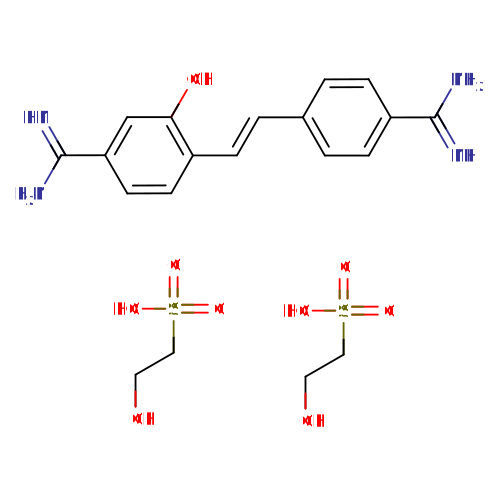
Structure Thumb
Download: MOL | SDF | SMILES | InChI
Display: 2D Structure | 3D Structure
Synonyms
  • HSB
Synonyms
HSB
Salts Not Available
Brand names Not Available
Brand mixtures Not Available
Categories
  • Antifungal Agents
  • Antimycotic Agents
  • Anti-trypanosomal Agents
  • Antimalarial Agents
CAS number 533-22-2
Weight Average: 532.588
Monoisotopic: 532.129769894
Chemical Formula C20H28N4O9S2
InChI Key InChIKey=VIDDZUWWPMDEHU-LTTFOTGMSA-N
InChI
InChI=1S/C16H16N4O.2C2H6O4S/c17-15(18)12-5-2-10(3-6-12)1-4-11-7-8-13(16(19)20)9-14(11)21;2*3-1-2-7(4,5)6/h1-9H,17-18H2,(H3,19,20);2*3H,1-2H2,(H,4,5,6)/b11-4-;;
Plain Text
IUPAC Name
(4Z)-4-{2-[4-(diaminomethylidene)cyclohexa-2,5-dien-1-ylidene]ethylidene}-3-oxocyclohexa-1,5-diene-1-carboximidamide; bis(2-hydroxyethane-1-sulfonic acid)
SMILES
OCCS(O)(=O)=O.OCCS(O)(=O)=O.NC(N)=C1C=CC(=C\C=C2\C=CC(=CC2=O)C(N)=N)C=C1
Plain Text
Mass Spec Not Available
Taxonomy
Kingdom Organic
Classes
  • Sulfonic Acids and Derivatives
Substructures
  • Hydroxy Compounds
  • Alkanes and Alkenes
  • Carboxylic Acids and Derivatives
  • Sulfonyls
  • Sulfonic Acids and Derivatives
  • Alcohols and Polyols
  • Isoprenes
  • Carboxamidines
  • Ketenes and Derivatives
  • Imines
  • Ketones
Pharmacology
Indication Used in the treatment of nonprogressive blastomycosis of the skin and other mycoses.
Pharmacodynamics Hydroxystilbamidine isethionate is a member of the diamidines, a large family of biochemially and pharmacologically interesting compounds. It has a rather unusual combination of properties, exhibiting antitrypanosomal, antimaliarial, antifungal and carcinostatic activities. It also appears to act as an immunosuppressant. This drug may be used in the treatment of blastomycosis, a disease cased by the dimorphic fungus or mold called Blastomyces dermatitids. Blastomycosis is a pulmonary infection that can lead to fever, cough and (rarely) symptoms similar to tuberculosis. Hydroxystilbamidine has largely been replaced with amphotericin B.
Mechanism of action Hydroxystilbamidine isethionate (HSB) acts on extracellular DNA and lysosomes. In Trypanosomes there is extensive and selective binding of HSB to the kinetoplastic DNA. This inhibits cell division and reproduction. In yeast there is evidence of binding to extranuclear DNA causing numerous mutations. HSB is also taken up in the lysosomes and leads to a significant increase in the number of lysosome-like bodies and secretion granules in trypanosomal organisms. HSB may also stabilize lysosomal membranes. HSB has also been found to bind RNA and is a powerful inhibitor of cellular ribonucleases.
Absorption Not Available
Volume of distribution Not Available
Protein binding Not Available
Metabolism Not Available
Route of elimination Not Available
Half life Not Available
Clearance Not Available
Toxicity Not Available
Affected organisms
  • Yeast, Molds, Trypanosomes
Pathways Not Available
Pharmacoeconomics
Manufacturers
  • Sanofi aventis us llc
Packagers Not Available
Dosage forms Not Available
Prices Not Available
Patents Not Available
Properties
State solid
Melting point Not Available
Experimental Properties
Property Value Source
logP 1.679 PhysProp
Predicted Properties
Property Value Source
water solubility ALOGPS
logP 0 ALOGPS
logP -0.071 ChemAxon Molconvert
logS 0 ALOGPS
pKa 0 ChemAxon Molconvert
hydrogen acceptor count 5 ChemAxon Molconvert
hydrogen donor count 4 ChemAxon Molconvert
polar surface area 118.98 ChemAxon Molconvert
rotatable bond count 6 ChemAxon Molconvert
refractivity 110.66 ChemAxon Molconvert
polarizability 30.93 ChemAxon Molconvert
References
Synthesis Reference Not Available
General Reference
  1. Link
  2. Murgatroyd LB: 2-hydroxystilbamidine isethionate: a new fluorochrome for use in general pathology. II. The selective demonstration of fungi. Diagn Histopathol. 1982 Jul-Sep;5(3):219-22. Pubmed
  3. Folds JD, Orlando G, Spitznagel JK: Immunosuppression by hydroxystilbamidine isethionate, a lysosome-stabilizing, anti-proteolytic, antifungal drug. Infect Immun. 1975 Mar;11(3):441-4. Pubmed
External Links
Resource Link
PubChem Compound 16051924 Link_out
PubChem Substance 46508302 Link_out
ChemSpider 13180289 Link_out
Therapeutic Targets Database DAP000850 Link_out
ATC Codes Not Available
AHFS Codes Not Available
PDB Entries Not Available
FDA label Not Available
MSDS Not Available
Interactions
Drug Interactions Not Available
Food Interactions Not Available
Targets

1. DNA

Pharmacological action: yes
Actions: other/unknown

DNA is the molecule of heredity, as it is responsible for the genetic propagation of most inherited traits. It is a polynucleic acid that carries genetic information on cell growth, division, and function. DNA consists of two long strands of nucleotides twisted into a double helix and held together by hydrogen bonds. The sequence of nucleotides determines hereditary characteristics. Each strand serves as the template for subsequent DNA replication and as a template for mRNA production, leading to protein synthesis via ribosomes.

Gene Sequence: FASTA

References:
  1. Overington JP, Al-Lazikani B, Hopkins AL: How many drug targets are there? Nat Rev Drug Discov. 2006 Dec;5(12):993-6. Pubmed
  2. Imming P, Sinning C, Meyer A: Drugs, their targets and the nature and number of drug targets. Nat Rev Drug Discov. 2006 Oct;5(10):821-34. Pubmed
  3. Folds JD, Orlando G, Spitznagel JK: Immunosuppression by hydroxystilbamidine isethionate, a lysosome-stabilizing, anti-proteolytic, antifungal drug. Infect Immun. 1975 Mar;11(3):441-4. Pubmed

Comments
Drug created on June 13, 2005 07:24 / Updated on February 14, 2012 11:45