Identification
- Summary
Etidronic acid is a bisphosphonate drug that prevents osteoclastic bone resorption; used for the prevention and treatment of osteoporosis.
- Generic Name
- Etidronic acid
- DrugBank Accession Number
- DB01077
- Background
Etidronic acid is a first generation bisphosphonate similar to clodronic acid and tiludronic acid.1 These drugs were developed to mimic the action of pyrophosphate, a regulator of calcification and decalcification.4 Etidronate’s use has decreased over the years in favor of the third generation, nitrogen containing bisphosphonate zoledronic acid, ibandronic acid, minodronic acid, and risedronic acid.1
Etidronic acid was granted FDA approval on 1 September 1977.7
- Type
- Small Molecule
- Groups
- Approved
- Structure
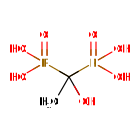
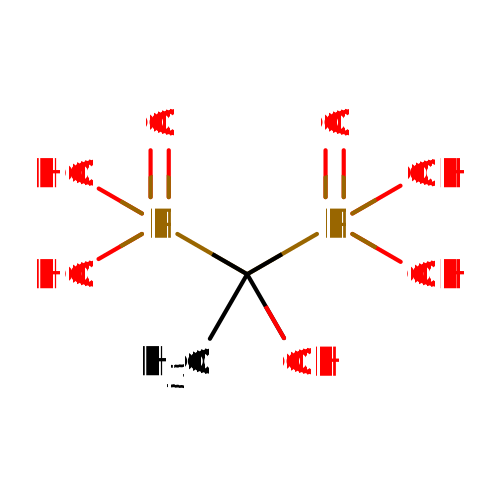
Structure for Etidronic acid (DB01077)
- Weight
- Average: 206.0282
Monoisotopic: 205.974525634 - Chemical Formula
- C2H8O7P2
- Synonyms
- (1-hydroxy-ethylidene)diphosphonic acid
- (1-Hydroxyethylene)diphosphonic acid
- (1-Hydroxyethylidene)bis(phosphonic acid)
- (1-Hydroxyethylidene)bisphosphonic acid
- (1-Hydroxyethylidene)diphosphonic acid
- (Hydroxyethylidene)diphosphonic acid
- 1-Hydroxy-1,1-diphosphonoethane
- 1-hydroxyethane 1,1-diphosphonic acid
- 1-Hydroxyethane-1,1-bisphosphonic acid
- 1-Hydroxyethane-1,1-diphosphonate
- 1-Hydroxyethane-1,1-diphosphonic acid
- 1-Hydroxyethanediphosphonic acid
- 1-Hydroxyethylidene-1,1-bisphosphonate
- 1-Hydroxyethylidene-1,1-diphosphonic acid
- 1,1,1-Ethanetriol diphosphonate
- Acetodiphosphonic acid
- acide étidronique
- ácido etidrónico
- acidum etidronicum
- EHDP
- Ethane-1-hydroxy-1,1-bisphosphonic acid
- Ethane-1-hydroxy-1,1-diphosphonate
- Ethane-1-hydroxy-1,1-diphosphonic acid
- Etidronate
- Etidronic acid
- Etidronsäure
- HEDP
- Hydroxyethanediphosphonic acid
- Oxyethylidenediphosphonic acid
- External IDs
- M05BA01
- NSC-227995

Pharmacology
- Indication
Etidronate is indicated to treat Paget's disease of bone, as well as the treatment and prevention of heterotropic ossification after total hip replacement of spinal cord injury.7
 Reduce drug development failure ratesBuild, train, & validate machine-learning modelswith evidence-based and structured datasets.Build, train, & validate predictive machine-learning models with structured datasets.
- Associated Conditions
Indication Type Indication Combined Product Details Approval Level Age Group Patient Characteristics Dose Form Symptomatic treatment of Paget's disease of bone •••••••••••• Prevention of Heterotopic ossification •••••••••••• Prevention of Heterotopic ossification •••••••••••• Treatment of Heterotopic ossification •••••••••••• Treatment of Heterotopic ossification •••••••••••• - Contraindications & Blackbox Warnings
 Prevent Adverse Drug Events TodayTap into our Clinical API for life-saving information on contraindications & blackbox warnings, population restrictions, harmful risks, & more.Avoid life-threatening adverse drug events with our Clinical API
- Pharmacodynamics
Etidronic acid is a first generation bisphosphonate that inhibits the action of osteoclasts, preventing bone resporption.7 It has a wide therapeutic index as overdoses are not associated with severe toxicity and a long duration of action as it slowly releases from the bone.7 Patients should be counselled regarding the risk of upper gastrointestinal adverse reactions.7
- Mechanism of action
Bisphosphonates are taken into the bone where they bind to hydroxyapatite. Bone resorption by osteoclasts causes local acidification, releasing the bisphosphonate, which is taken into the osteoclast by fluid-phase endocytosis.2 Endocytic vesicles become acidified, releasing bisphosphonates into the cytosol of osteoclasts where they act.2
Osteoclasts mediate resorption of bone.3 When osteoclasts bind to bone they form podosomes, ring structures of F-actin.3 Disruption of the podosomes causes osteoclasts to detach from bones, preventing bone resorption.3
First generation bisphosphonates closely mimic the structure of pyrophosphate, which can be incorporated into ATP anologues that cannot be hydrolyzed, disrupting all ATP mediated actions of osteoclasts.6
Target Actions Organism AHydroxylapatite antagonistHumans UReceptor-type tyrosine-protein phosphatase S inhibitorHumans UV-type proton ATPase catalytic subunit A inhibitorHumans UADP/ATP translocase 1 inhibitorHumans UADP/ATP translocase 2 inhibitorHumans UADP/ATP translocase 3 inhibitorHumans - Absorption
Etidronic acid has an oral bioavailability of 1-10%.5 Further data regarding pharmacokinetics of etidronic acid are not readily available.5,7
- Volume of distribution
Etidronic acid has a volume of distribution of 0.3-1.3L/kg.5
- Protein binding
Not Available
- Metabolism
Etidronic acid is not metabolized in vivo
- Route of elimination
Absorbed etidronic acid is eliminated in the urine, while the unabsorbed drug is eliminated in the feces.7
- Half-life
- Clearance
Etidronic acid has a renal clearance of 0.09L/kg/h.5
- Adverse Effects
 Improve decision support & research outcomesWith structured adverse effects data, including: blackbox warnings, adverse reactions, warning & precautions, & incidence rates. View sample adverse effects data in our new Data Library!Improve decision support & research outcomes with our structured adverse effects data.
- Toxicity
Patients experiencing an overdose may present with hypocalcemia, vomiting, parasthesia, and diarrhea.7 Overdose can be treated with symptomatic and supportive treatment that may include management of electrolyte imbalances and intravenous calcium gluconate.7
- Pathways
- Not Available
- Pharmacogenomic Effects/ADRs
- Not Available
Interactions
- Drug Interactions
- This information should not be interpreted without the help of a healthcare provider. If you believe you are experiencing an interaction, contact a healthcare provider immediately. The absence of an interaction does not necessarily mean no interactions exist.
Drug Interaction Integrate drug-drug
interactions in your softwareAceclofenac The risk or severity of gastrointestinal bleeding can be increased when Aceclofenac is combined with Etidronic acid. Acemetacin The risk or severity of gastrointestinal bleeding can be increased when Acemetacin is combined with Etidronic acid. Acetylsalicylic acid The risk or severity of gastrointestinal bleeding can be increased when Acetylsalicylic acid is combined with Etidronic acid. Acyclovir The risk or severity of nephrotoxicity and hypocalcemia can be increased when Acyclovir is combined with Etidronic acid. Adefovir dipivoxil The risk or severity of nephrotoxicity and hypocalcemia can be increased when Adefovir dipivoxil is combined with Etidronic acid. - Food Interactions
- Avoid multivalent ions. Separate administration from multivalent ions by at least two hours.
- Take on an empty stomach.
- Take with a full glass of water.
Products
 Drug product information from 10+ global regionsOur datasets provide approved product information including:dosage, form, labeller, route of administration, and marketing period.Access drug product information from over 10 global regions.
- Product Ingredients
Ingredient UNII CAS InChI Key Etidronate disodium M16PXG993G 7414-83-7 GWBBVOVXJZATQQ-UHFFFAOYSA-L - International/Other Brands
- Etidron (Gentili)
- Brand Name Prescription Products
Name Dosage Strength Route Labeller Marketing Start Marketing End Region Image Act Etidronate Tablet 400 mg Oral TEVA Canada Limited Not applicable Not applicable Canada 
Act Etidronate Tablet 200 mg Oral TEVA Canada Limited 2004-11-10 2022-05-30 Canada Didronel Tablet 400 mg/1 Oral Physicians Total Care, Inc. 1983-08-12 2010-06-30 US 
Didronel Tablet 400 mg/1 Oral Warner Chilcott 1983-08-12 2013-03-01 US Didronel Tablet 400 mg/1 Oral Warner Chilcott 2009-11-01 2013-03-01 US - Generic Prescription Products
Name Dosage Strength Route Labeller Marketing Start Marketing End Region Image Apo-etidronate Tablet 400 mg Oral Apotex Corporation Not applicable Not applicable Canada Apo-etidronate Tablet 200 mg Oral Apotex Corporation Not applicable Not applicable Canada Etidronate Disodium Tablet 200 mg/1 Oral Carilion Materials Management 2008-01-02 2019-12-31 US Etidronate Disodium Tablet 400 mg/1 Oral Genpharm Ulc 2015-11-01 2015-11-24 US Etidronate Disodium Tablet 400 mg/1 Oral Mylan Pharmaceuticals Inc. 2008-01-02 2019-12-31 US - Mixture Products
Name Ingredients Dosage Route Labeller Marketing Start Marketing End Region Image Act Etidrocal Etidronate disodium (400 mg) + Calcium carbonate (500 mg) Tablet Oral TEVA Canada Limited 2008-04-10 2021-03-05 Canada Didrocal Etidronate disodium (400 mg) + Calcium carbonate (500 mg) Kit; Tablet Oral Warner Chilcott 1995-12-31 2015-11-19 Canada Etidrocal Etidronate disodium (400 mg) + Calcium carbonate (500 mg) Tablet Oral Sanis Health Inc 2010-07-26 2017-07-31 Canada Etidrocal Etidronate disodium (400 mg) + Calcium carbonate (500 mg) Tablet Oral Cobalt Laboratories Not applicable Not applicable Canada Mylan-eti-cal Carepac Etidronate disodium (400 mg) + Calcium carbonate (500 mg) Kit; Tablet Oral Mylan Pharmaceuticals 2008-04-10 2017-01-09 Canada
Categories
- ATC Codes
- M05BB01 — Etidronic acid and calcium, sequential
- M05BB — Bisphosphonates, combinations
- M05B — DRUGS AFFECTING BONE STRUCTURE AND MINERALIZATION
- M05 — DRUGS FOR TREATMENT OF BONE DISEASES
- M — MUSCULO-SKELETAL SYSTEM
- Drug Categories
- Chemical TaxonomyProvided by Classyfire
- Description
- This compound belongs to the class of organic compounds known as bisphosphonates. These are organic compounds containing two phosphonate groups linked together through a carbon atoms.
- Kingdom
- Organic compounds
- Super Class
- Organic acids and derivatives
- Class
- Organic phosphonic acids and derivatives
- Sub Class
- Bisphosphonates
- Direct Parent
- Bisphosphonates
- Alternative Parents
- Organic phosphonic acids / Organopnictogen compounds / Organophosphorus compounds / Organooxygen compounds / Organic oxides / Hydrocarbon derivatives
- Substituents
- Aliphatic acyclic compound / Bisphosphonate / Hydrocarbon derivative / Organic oxide / Organic oxygen compound / Organooxygen compound / Organophosphonic acid / Organophosphorus compound / Organopnictogen compound
- Molecular Framework
- Aliphatic acyclic compounds
- External Descriptors
- 1,1-bis(phosphonic acid) (CHEBI:4907)
- Affected organisms
- Humans and other mammals
Chemical Identifiers
- UNII
- M2F465ROXU
- CAS number
- 2809-21-4
- InChI Key
- DBVJJBKOTRCVKF-UHFFFAOYSA-N
- InChI
- InChI=1S/C2H8O7P2/c1-2(3,10(4,5)6)11(7,8)9/h3H,1H3,(H2,4,5,6)(H2,7,8,9)
- IUPAC Name
- (1-hydroxy-1-phosphonoethyl)phosphonic acid
- SMILES
- CC(O)(P(O)(O)=O)P(O)(O)=O
References
- Synthesis Reference
Rogovin, L.,Brawn, D.P. and Kalberg, AN.; US. Patent 3,400,147; September 3,1968; assigned to The Procter & Gamble Co.
- General References
- Cremers S, Drake MT, Ebetino FH, Bilezikian JP, Russell RGG: Pharmacology of bisphosphonates. Br J Clin Pharmacol. 2019 Jun;85(6):1052-1062. doi: 10.1111/bcp.13867. Epub 2019 Feb 28. [Article]
- Russell RG, Watts NB, Ebetino FH, Rogers MJ: Mechanisms of action of bisphosphonates: similarities and differences and their potential influence on clinical efficacy. Osteoporos Int. 2008 Jun;19(6):733-59. doi: 10.1007/s00198-007-0540-8. [Article]
- Murakami H, Takahashi N, Tanaka S, Nakamura I, Udagawa N, Nakajo S, Nakaya K, Abe M, Yuda Y, Konno F, Barbier A, Suda T: Tiludronate inhibits protein tyrosine phosphatase activity in osteoclasts. Bone. 1997 May;20(5):399-404. [Article]
- Sansom LN, Necciari J, Thiercelin JF: Human pharmacokinetics of tiludronate. Bone. 1995 Nov;17(5 Suppl):479S-483S. [Article]
- Dunn CJ, Fitton A, Sorkin EM: Etidronic acid. A review of its pharmacological properties and therapeutic efficacy in resorptive bone disease. Drugs Aging. 1994 Dec;5(6):446-74. doi: 10.2165/00002512-199405060-00006. [Article]
- Russell RG: Bisphosphonates: the first 40 years. Bone. 2011 Jul;49(1):2-19. doi: 10.1016/j.bone.2011.04.022. Epub 2011 May 1. [Article]
- FDA Approved Drug Products: Didronel Etidronate Oral Tablet (Discontinued) [Link]
- External Links
- Human Metabolome Database
- HMDB0015210
- KEGG Drug
- D02373
- KEGG Compound
- C07736
- PubChem Compound
- 3305
- PubChem Substance
- 46507694
- ChemSpider
- 3189
- BindingDB
- 50115102
- 1356715
- ChEBI
- 4907
- ChEMBL
- CHEMBL871
- ZINC
- ZINC000003830813
- Therapeutic Targets Database
- DNC000629
- PharmGKB
- PA449548
- PDBe Ligand
- 911
- RxList
- RxList Drug Page
- Wikipedia
- Etidronic_acid
- PDB Entries
- 3sdv
- FDA label
- Download (42 KB)
- MSDS
- Download (44.4 KB)
Clinical Trials
- Clinical Trials
Phase Status Purpose Conditions Count 4 Completed Treatment Osteoporosis 1 3 Active Not Recruiting Treatment Prostate Cancer Metastatic to Bone 1 3 Recruiting Treatment Pseudoxanthoma Elasticum 1 2 Completed Treatment Arterial Calcification / CD73 Deficiency 1 2 Recruiting Treatment Fahr Disease / Fahr Syndrome / Primary Familial Brain Calcification 1
Pharmacoeconomics
- Manufacturers
- Not Available
- Packagers
- Genpharm LP
- MGI Pharma
- Murfreesboro Pharmaceutical Nursing Supply
- Mylan
- Norwich Pharmaceuticals Inc.
- Pharmaceutical Utilization Management Program VA Inc.
- Physicians Total Care Inc.
- Procter & Gamble
- Warner Chilcott Co. Inc.
- WC Pharmaceuticals
- Dosage Forms
Form Route Strength Tablet Oral Tablet Oral 200 mg Tablet Oral 400 mg Tablet Oral Tablet Oral 200 mg/1 Tablet Oral 400 mg/1 Solution Intravenous 50 mg / mL Capsule Kit; tablet Oral - Prices
Unit description Cost Unit Didronel 400 mg tablet 8.31USD tablet Didronel 200 mg tablet 4.16USD tablet Co Etidronate 200 mg Tablet 0.86USD tablet Mylan-Etidronate 200 mg Tablet 0.86USD tablet DrugBank does not sell nor buy drugs. Pricing information is supplied for informational purposes only.- Patents
- Not Available
Properties
- State
- Solid
- Experimental Properties
Property Value Source melting point (°C) 198-199 ChemSpider boiling point (°C) 578.8 ChemSpider - Predicted Properties
Property Value Source Water Solubility 11.5 mg/mL ALOGPS logP -0.77 ALOGPS logP -2.3 Chemaxon logS -1.2 ALOGPS pKa (Strongest Acidic) 0.7 Chemaxon pKa (Strongest Basic) -5.1 Chemaxon Physiological Charge -3 Chemaxon Hydrogen Acceptor Count 7 Chemaxon Hydrogen Donor Count 5 Chemaxon Polar Surface Area 135.29 Å2 Chemaxon Rotatable Bond Count 2 Chemaxon Refractivity 34.51 m3·mol-1 Chemaxon Polarizability 13.97 Å3 Chemaxon Number of Rings 0 Chemaxon Bioavailability 1 Chemaxon Rule of Five Yes Chemaxon Ghose Filter No Chemaxon Veber's Rule No Chemaxon MDDR-like Rule No Chemaxon - Predicted ADMET Features
Property Value Probability Human Intestinal Absorption - 0.8918 Blood Brain Barrier + 0.8901 Caco-2 permeable - 0.8581 P-glycoprotein substrate Non-substrate 0.7483 P-glycoprotein inhibitor I Non-inhibitor 0.9639 P-glycoprotein inhibitor II Non-inhibitor 0.9951 Renal organic cation transporter Non-inhibitor 0.9726 CYP450 2C9 substrate Non-substrate 0.7545 CYP450 2D6 substrate Non-substrate 0.8473 CYP450 3A4 substrate Non-substrate 0.6987 CYP450 1A2 substrate Non-inhibitor 0.9061 CYP450 2C9 inhibitor Non-inhibitor 0.9047 CYP450 2D6 inhibitor Non-inhibitor 0.9222 CYP450 2C19 inhibitor Non-inhibitor 0.9186 CYP450 3A4 inhibitor Non-inhibitor 0.9595 CYP450 inhibitory promiscuity Low CYP Inhibitory Promiscuity 0.9873 Ames test Non AMES toxic 0.8875 Carcinogenicity Carcinogens 0.5282 Biodegradation Not ready biodegradable 0.7701 Rat acute toxicity 1.9653 LD50, mol/kg Not applicable hERG inhibition (predictor I) Weak inhibitor 0.9519 hERG inhibition (predictor II) Non-inhibitor 0.9495
Spectra
- Mass Spec (NIST)
- Not Available
- Spectra
- Chromatographic Properties
Collision Cross Sections (CCS)
Adduct CCS Value (Å2) Source type Source [M-H]- 135.4512708 predictedDarkChem Lite v0.1.0 [M-H]- 119.56288 predictedDeepCCS 1.0 (2019) [M+H]+ 136.8601708 predictedDarkChem Lite v0.1.0 [M+H]+ 123.42992 predictedDeepCCS 1.0 (2019) [M+Na]+ 136.1749708 predictedDarkChem Lite v0.1.0 [M+Na]+ 132.46683 predictedDeepCCS 1.0 (2019)
Targets

References
- Grases F, Sanchis P, Perello J, Isern B, Prieto RM, Fernandez-Palomeque C, Torres JJ: Effect of crystallization inhibitors on vascular calcifications induced by vitamin D: a pilot study in Sprague-Dawley rats. Circ J. 2007 Jul;71(7):1152-6. [Article]
- Nancollas GH, Tang R, Phipps RJ, Henneman Z, Gulde S, Wu W, Mangood A, Russell RG, Ebetino FH: Novel insights into actions of bisphosphonates on bone: differences in interactions with hydroxyapatite. Bone. 2006 May;38(5):617-27. Epub 2005 Jul 20. [Article]
- Ono K, Wada S: [Regulation of calcification by bisphosphonates]. Clin Calcium. 2004 Jun;14(6):60-3. [Article]
- Takaishi Y: [Treatment of periodontal disease, prevention and bisphosphonate]. Clin Calcium. 2003 Feb;13(2):173-6. [Article]
- Kind
- Protein
- Organism
- Humans
- Pharmacological action
- Unknown
- Actions
- Inhibitor
- General Function
- Transmembrane receptor protein tyrosine phosphatase activity
- Specific Function
- Interacts with LAR-interacting protein LIP.1.
- Gene Name
- PTPRS
- Uniprot ID
- Q13332
- Uniprot Name
- Receptor-type tyrosine-protein phosphatase S
- Molecular Weight
- 217039.825 Da
References
- Schmidt A, Rutledge SJ, Endo N, Opas EE, Tanaka H, Wesolowski G, Leu CT, Huang Z, Ramachandaran C, Rodan SB, Rodan GA: Protein-tyrosine phosphatase activity regulates osteoclast formation and function: inhibition by alendronate. Proc Natl Acad Sci U S A. 1996 Apr 2;93(7):3068-73. [Article]
- Chen X, Ji ZL, Chen YZ: TTD: Therapeutic Target Database. Nucleic Acids Res. 2002 Jan 1;30(1):412-5. [Article]
- Russell RG: Bisphosphonates: the first 40 years. Bone. 2011 Jul;49(1):2-19. doi: 10.1016/j.bone.2011.04.022. Epub 2011 May 1. [Article]
- Kind
- Protein
- Organism
- Humans
- Pharmacological action
- Unknown
- Actions
- Inhibitor
- General Function
- Proton-transporting atpase activity, rotational mechanism
- Specific Function
- Catalytic subunit of the peripheral V1 complex of vacuolar ATPase. V-ATPase vacuolar ATPase is responsible for acidifying a variety of intracellular compartments in eukaryotic cells.
- Gene Name
- ATP6V1A
- Uniprot ID
- P38606
- Uniprot Name
- V-type proton ATPase catalytic subunit A
- Molecular Weight
- 68303.5 Da
References
- David P, Nguyen H, Barbier A, Baron R: The bisphosphonate tiludronate is a potent inhibitor of the osteoclast vacuolar H(+)-ATPase. J Bone Miner Res. 1996 Oct;11(10):1498-507. [Article]
- Russell RG: Bisphosphonates: the first 40 years. Bone. 2011 Jul;49(1):2-19. doi: 10.1016/j.bone.2011.04.022. Epub 2011 May 1. [Article]
- Kind
- Protein
- Organism
- Humans
- Pharmacological action
- Unknown
- Actions
- Inhibitor
- General Function
- Adenine transmembrane transporter activity
- Specific Function
- Catalyzes the exchange of cytoplasmic ADP with mitochondrial ATP across the mitochondrial inner membrane.
- Gene Name
- SLC25A4
- Uniprot ID
- P12235
- Uniprot Name
- ADP/ATP translocase 1
- Molecular Weight
- 33064.265 Da
References
- Lehenkari PP, Kellinsalmi M, Napankangas JP, Ylitalo KV, Monkkonen J, Rogers MJ, Azhayev A, Vaananen HK, Hassinen IE: Further insight into mechanism of action of clodronate: inhibition of mitochondrial ADP/ATP translocase by a nonhydrolyzable, adenine-containing metabolite. Mol Pharmacol. 2002 May;61(5):1255-62. [Article]
- Rogers MJ, Crockett JC, Coxon FP, Monkkonen J: Biochemical and molecular mechanisms of action of bisphosphonates. Bone. 2011 Jul;49(1):34-41. doi: 10.1016/j.bone.2010.11.008. Epub 2010 Nov 26. [Article]
- Russell RG: Bisphosphonates: the first 40 years. Bone. 2011 Jul;49(1):2-19. doi: 10.1016/j.bone.2011.04.022. Epub 2011 May 1. [Article]
- Kind
- Protein
- Organism
- Humans
- Pharmacological action
- Unknown
- Actions
- Inhibitor
- General Function
- Ubiquitin protein ligase binding
- Specific Function
- Catalyzes the exchange of cytoplasmic ADP with mitochondrial ATP across the mitochondrial inner membrane. As part of the mitotic spindle-associated MMXD complex it may play a role in chromosome seg...
- Gene Name
- SLC25A5
- Uniprot ID
- P05141
- Uniprot Name
- ADP/ATP translocase 2
- Molecular Weight
- 32851.965 Da
References
- Lehenkari PP, Kellinsalmi M, Napankangas JP, Ylitalo KV, Monkkonen J, Rogers MJ, Azhayev A, Vaananen HK, Hassinen IE: Further insight into mechanism of action of clodronate: inhibition of mitochondrial ADP/ATP translocase by a nonhydrolyzable, adenine-containing metabolite. Mol Pharmacol. 2002 May;61(5):1255-62. [Article]
- Rogers MJ, Crockett JC, Coxon FP, Monkkonen J: Biochemical and molecular mechanisms of action of bisphosphonates. Bone. 2011 Jul;49(1):34-41. doi: 10.1016/j.bone.2010.11.008. Epub 2010 Nov 26. [Article]
- Russell RG: Bisphosphonates: the first 40 years. Bone. 2011 Jul;49(1):2-19. doi: 10.1016/j.bone.2011.04.022. Epub 2011 May 1. [Article]
- Kind
- Protein
- Organism
- Humans
- Pharmacological action
- Unknown
- Actions
- Inhibitor
- General Function
- Atp:adp antiporter activity
- Specific Function
- Catalyzes the exchange of cytoplasmic ADP with mitochondrial ATP across the mitochondrial inner membrane. May participate in the formation of the permeability transition pore complex (PTPC) respons...
- Gene Name
- SLC25A6
- Uniprot ID
- P12236
- Uniprot Name
- ADP/ATP translocase 3
- Molecular Weight
- 32866.025 Da
References
- Lehenkari PP, Kellinsalmi M, Napankangas JP, Ylitalo KV, Monkkonen J, Rogers MJ, Azhayev A, Vaananen HK, Hassinen IE: Further insight into mechanism of action of clodronate: inhibition of mitochondrial ADP/ATP translocase by a nonhydrolyzable, adenine-containing metabolite. Mol Pharmacol. 2002 May;61(5):1255-62. [Article]
- Rogers MJ, Crockett JC, Coxon FP, Monkkonen J: Biochemical and molecular mechanisms of action of bisphosphonates. Bone. 2011 Jul;49(1):34-41. doi: 10.1016/j.bone.2010.11.008. Epub 2010 Nov 26. [Article]
- Russell RG: Bisphosphonates: the first 40 years. Bone. 2011 Jul;49(1):2-19. doi: 10.1016/j.bone.2011.04.022. Epub 2011 May 1. [Article]

Drug created at June 13, 2005 13:24 / Updated at April 18, 2024 09:15