Identification
- Generic Name
- Oxamniquine
- DrugBank Accession Number
- DB01096
- Background
An anthelmintic with schistosomicidal activity against Schistosoma mansoni, but not against other Schistosoma spp. Oxamniquine causes worms to shift from the mesenteric veins to the liver where the male worms are retained; the female worms return to the mesentery, but can no longer release eggs. (From Martidale, The Extra Pharmacopoeia, 31st ed, p121)
- Type
- Small Molecule
- Groups
- Approved
- Structure
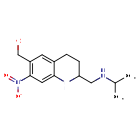
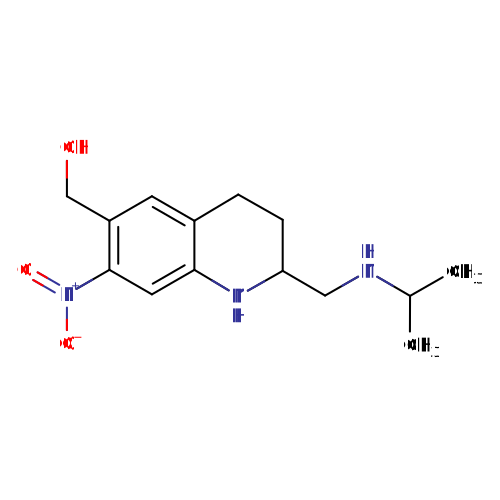
Structure for Oxamniquine (DB01096)
- Weight
- Average: 279.3348
Monoisotopic: 279.158291553 - Chemical Formula
- C14H21N3O3
- Synonyms
- Not Available
- External IDs
- UK-4261
- UK-4271

Pharmacology
- Indication
For treatment of Schistosomiasis caused by Schistosoma mansoni
 Reduce drug development failure ratesBuild, train, & validate machine-learning modelswith evidence-based and structured datasets.Build, train, & validate predictive machine-learning models with structured datasets.
- Contraindications & Blackbox Warnings
 Prevent Adverse Drug Events TodayTap into our Clinical API for life-saving information on contraindications & blackbox warnings, population restrictions, harmful risks, & more.Avoid life-threatening adverse drug events with our Clinical API
- Pharmacodynamics
Oxamniquine is an anthelmintic with schistosomicidal activity against Schistosoma mansoni, but not against other Schistosoma spp. Oxamniquine causes worms to shift from the mesenteric veins to the liver where the male worms are retained; the female worms return to the mesentery, but can no longer release egg.
- Mechanism of action
Oxamniquine may associate with an irreversible inhibition of the nucleic acid metabolism of the parasites. A hypothesis has been put forth that the drug is activated by a single step, in which a schistosome sulfotransferase enzyme converts oxamniquine into an ester (probably acetate, phosphate, or sulfate). Subsequently, the ester spontaneously dissociates, the resulting electrophilic reactant is capable of alkylation of schistosome DNA.
Target Actions Organism ADNA other/unknownHumans - Absorption
Well absorbed orally
- Volume of distribution
Not Available
- Protein binding
Not Available
- Metabolism
Probably hepatic
- Route of elimination
Not Available
- Half-life
1-2.5 hours
- Clearance
Not Available
- Adverse Effects
 Improve decision support & research outcomesWith structured adverse effects data, including: blackbox warnings, adverse reactions, warning & precautions, & incidence rates. View sample adverse effects data in our new Data Library!Improve decision support & research outcomes with our structured adverse effects data.
- Toxicity
Not Available
- Pathways
- Not Available
- Pharmacogenomic Effects/ADRs
- Not Available
Interactions
- Drug Interactions
- This information should not be interpreted without the help of a healthcare provider. If you believe you are experiencing an interaction, contact a healthcare provider immediately. The absence of an interaction does not necessarily mean no interactions exist.
Drug Interaction Integrate drug-drug
interactions in your softwareAcebutolol The metabolism of Acebutolol can be decreased when combined with Oxamniquine. Acetaminophen The metabolism of Acetaminophen can be decreased when combined with Oxamniquine. Almotriptan The metabolism of Almotriptan can be decreased when combined with Oxamniquine. Alogliptin The metabolism of Alogliptin can be decreased when combined with Oxamniquine. Aminophenazone The metabolism of Aminophenazone can be decreased when combined with Oxamniquine. - Food Interactions
- Not Available
Products
 Drug product information from 10+ global regionsOur datasets provide approved product information including:dosage, form, labeller, route of administration, and marketing period.Access drug product information from over 10 global regions.
- International/Other Brands
- Mansil / Vansil
Categories
- ATC Codes
- P02BA02 — Oxamniquine
- Drug Categories
- Anthelmintics
- Anti-Infective Agents
- Antihelminthic
- Antiparasitic Agents
- Antiparasitic Products, Insecticides and Repellents
- Antiplatyhelmintic Agents
- Antitrematodals
- Cytochrome P-450 CYP2D6 Inhibitors
- Cytochrome P-450 CYP2D6 Inhibitors (strength unknown)
- Cytochrome P-450 CYP2D6 Substrates
- Cytochrome P-450 Enzyme Inhibitors
- Cytochrome P-450 Substrates
- Heterocyclic Compounds, Fused-Ring
- Hydroxyquinolines
- Nitroquinolines
- Quinoline Derivatives and Related Substances
- Quinolines
- Schistosomicides
- Chemical TaxonomyProvided by Classyfire
- Description
- This compound belongs to the class of organic compounds known as nitroquinolines and derivatives. These are compounds containing a nitro group attached to a quinoline moiety.
- Kingdom
- Organic compounds
- Super Class
- Organoheterocyclic compounds
- Class
- Quinolines and derivatives
- Sub Class
- Nitroquinolines and derivatives
- Direct Parent
- Nitroquinolines and derivatives
- Alternative Parents
- Hydroquinolines / Nitroaromatic compounds / Secondary alkylarylamines / Aralkylamines / Benzenoids / Propargyl-type 1,3-dipolar organic compounds / Organic oxoazanium compounds / Dialkylamines / Azacyclic compounds / Primary alcohols show 5 more
- Substituents
- Alcohol / Allyl-type 1,3-dipolar organic compound / Amine / Aralkylamine / Aromatic alcohol / Aromatic heteropolycyclic compound / Azacycle / Benzenoid / C-nitro compound / Hydrocarbon derivative show 18 more
- Molecular Framework
- Aromatic heteropolycyclic compounds
- External Descriptors
- C-nitro compound, quinolines, secondary amino compound, aromatic primary alcohol (CHEBI:78416)
- Affected organisms
- Schistosoma mansoni
Chemical Identifiers
- UNII
- 0O977R722D
- CAS number
- 21738-42-1
- InChI Key
- XCGYUJZMCCFSRP-UHFFFAOYSA-N
- InChI
- InChI=1S/C14H21N3O3/c1-9(2)15-7-12-4-3-10-5-11(8-18)14(17(19)20)6-13(10)16-12/h5-6,9,12,15-16,18H,3-4,7-8H2,1-2H3
- IUPAC Name
- (7-nitro-2-{[(propan-2-yl)amino]methyl}-1,2,3,4-tetrahydroquinolin-6-yl)methanol
- SMILES
- CC(C)NCC1CCC2=CC(CO)=C(C=C2N1)[N+]([O-])=O
References
- Synthesis Reference
- US3821228
- General References
- Filho RP, de Souza Menezes CM, Pinto PL, Paula GA, Brandt CA, da Silveira MA: Design, synthesis, and in vivo evaluation of oxamniquine methacrylate and acrylamide prodrugs. Bioorg Med Chem. 2007 Feb 1;15(3):1229-36. Epub 2006 Nov 16. [Article]
- External Links
- Human Metabolome Database
- HMDB0015228
- KEGG Drug
- D00460
- KEGG Compound
- C07341
- PubChem Compound
- 4612
- PubChem Substance
- 46508789
- ChemSpider
- 4451
- 7778
- ChEBI
- 78416
- ChEMBL
- CHEMBL847
- Therapeutic Targets Database
- DAP000992
- PharmGKB
- PA164748782
- Drugs.com
- Drugs.com Drug Page
- Wikipedia
- Oxamniquine
- MSDS
- Download (50 KB)
Clinical Trials
Pharmacoeconomics
- Manufacturers
- Not Available
- Packagers
- Not Available
- Dosage Forms
- Not Available
- Prices
- Not Available
- Patents
- Not Available
Properties
- State
- Solid
- Experimental Properties
Property Value Source melting point (°C) 147-149 °C PhysProp water solubility 820 mg/L Not Available logP 2.24 SANGSTER (1993) - Predicted Properties
Property Value Source Water Solubility 0.124 mg/mL ALOGPS logP 1.54 ALOGPS logP 1.57 Chemaxon logS -3.4 ALOGPS pKa (Strongest Acidic) 14.47 Chemaxon pKa (Strongest Basic) 9.89 Chemaxon Physiological Charge 1 Chemaxon Hydrogen Acceptor Count 5 Chemaxon Hydrogen Donor Count 3 Chemaxon Polar Surface Area 87.43 Å2 Chemaxon Rotatable Bond Count 5 Chemaxon Refractivity 78.86 m3·mol-1 Chemaxon Polarizability 30.27 Å3 Chemaxon Number of Rings 2 Chemaxon Bioavailability 1 Chemaxon Rule of Five Yes Chemaxon Ghose Filter Yes Chemaxon Veber's Rule No Chemaxon MDDR-like Rule No Chemaxon - Predicted ADMET Features
Property Value Probability Human Intestinal Absorption + 0.9156 Blood Brain Barrier - 0.6502 Caco-2 permeable - 0.5759 P-glycoprotein substrate Substrate 0.872 P-glycoprotein inhibitor I Non-inhibitor 0.6528 P-glycoprotein inhibitor II Non-inhibitor 0.8828 Renal organic cation transporter Non-inhibitor 0.7578 CYP450 2C9 substrate Non-substrate 0.797 CYP450 2D6 substrate Non-substrate 0.8735 CYP450 3A4 substrate Non-substrate 0.583 CYP450 1A2 substrate Inhibitor 0.9107 CYP450 2C9 inhibitor Non-inhibitor 0.907 CYP450 2D6 inhibitor Inhibitor 0.8932 CYP450 2C19 inhibitor Non-inhibitor 0.6334 CYP450 3A4 inhibitor Non-inhibitor 0.8603 CYP450 inhibitory promiscuity Low CYP Inhibitory Promiscuity 0.8783 Ames test AMES toxic 0.9107 Carcinogenicity Non-carcinogens 0.7461 Biodegradation Not ready biodegradable 0.9958 Rat acute toxicity 3.5281 LD50, mol/kg Not applicable hERG inhibition (predictor I) Weak inhibitor 0.5899 hERG inhibition (predictor II) Inhibitor 0.6207
Spectra
- Mass Spec (NIST)
- Not Available
- Spectra
- Chromatographic Properties
Collision Cross Sections (CCS)
Adduct CCS Value (Å2) Source type Source [M-H]- 183.4441903 predictedDarkChem Lite v0.1.0 [M-H]- 160.57448 predictedDeepCCS 1.0 (2019) [M+H]+ 184.1053903 predictedDarkChem Lite v0.1.0 [M+H]+ 164.02684 predictedDeepCCS 1.0 (2019) [M+Na]+ 183.5662903 predictedDarkChem Lite v0.1.0 [M+Na]+ 172.08073 predictedDeepCCS 1.0 (2019)
Targets

References
- Overington JP, Al-Lazikani B, Hopkins AL: How many drug targets are there? Nat Rev Drug Discov. 2006 Dec;5(12):993-6. [Article]
- Imming P, Sinning C, Meyer A: Drugs, their targets and the nature and number of drug targets. Nat Rev Drug Discov. 2006 Oct;5(10):821-34. [Article]
- Pica-Mattoccia L, Carlini D, Guidi A, Cimica V, Vigorosi F, Cioli D: The schistosome enzyme that activates oxamniquine has the characteristics of a sulfotransferase. Mem Inst Oswaldo Cruz. 2006 Sep;101 Suppl 1:307-12. [Article]
Enzymes
- Kind
- Protein
- Organism
- Humans
- Pharmacological action
- Unknown
- Actions
- SubstrateInhibitor
- General Function
- Steroid hydroxylase activity
- Specific Function
- Responsible for the metabolism of many drugs and environmental chemicals that it oxidizes. It is involved in the metabolism of drugs such as antiarrhythmics, adrenoceptor antagonists, and tricyclic...
- Gene Name
- CYP2D6
- Uniprot ID
- P10635
- Uniprot Name
- Cytochrome P450 2D6
- Molecular Weight
- 55768.94 Da
References
- Masimirembwa CM, Hasler JA, Johansson I: Inhibitory effects of antiparasitic drugs on cytochrome P450 2D6. Eur J Clin Pharmacol. 1995;48(1):35-8. [Article]

Drug created at June 13, 2005 13:24 / Updated at May 07, 2021 21:22