Identification
- Generic Name
- Phenacemide
- DrugBank Accession Number
- DB01121
- Background
Phenacemide is used to control certain seizures in the treatment of epilepsy. This medicine acts on the central nervous system (CNS) to reduce the number and severity of seizures.
- Type
- Small Molecule
- Groups
- Approved
- Structure
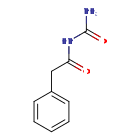
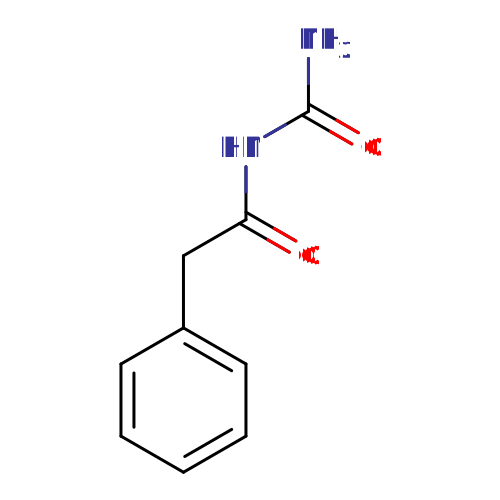
Structure for Phenacemide (DB01121)
- Weight
- Average: 178.1879
Monoisotopic: 178.074227574 - Chemical Formula
- C9H10N2O2
- Synonyms
- Phenacemide

Pharmacology
- Indication
Used to control certain seizures in the treatment of epilepsy.
 Reduce drug development failure ratesBuild, train, & validate machine-learning modelswith evidence-based and structured datasets.Build, train, & validate predictive machine-learning models with structured datasets.
- Contraindications & Blackbox Warnings
 Prevent Adverse Drug Events TodayTap into our Clinical API for life-saving information on contraindications & blackbox warnings, population restrictions, harmful risks, & more.Avoid life-threatening adverse drug events with our Clinical API
- Pharmacodynamics
Phenacemide is a ureal anticonvulsant indicated for control of severe epilepsy, particularly mixed forms of complex partial (psychomotor or temporal lobe) seizures, refractory to other anticonvulsants. Phenacemide elevates the threshold for minimal electroshock convulsions and abolishes the tonic phase of maximal electroshock seizures. It also prevents or modifies seizures induced by pentylenetetrazol or other convulsants.
- Mechanism of action
Phenacemide binds to and blocks neuronal sodium channels or voltage sensitive calcium channels. This blocks or suppresses neuronal depolarization and hypersynchronization. Hypersynchronization is what often causes seizures.
Target Actions Organism ASodium channel protein type 1 subunit alpha inhibitorHumans - Absorption
Almost completely absorbed.
- Volume of distribution
Not Available
- Protein binding
Not Available
- Metabolism
Metabolized in the liver by hepatic microsomal enzymes, where it is inactivated by p-hydroxylation.
- Route of elimination
Not Available
- Half-life
22-25 hours.
- Clearance
Not Available
- Adverse Effects
 Improve decision support & research outcomesWith structured adverse effects data, including: blackbox warnings, adverse reactions, warning & precautions, & incidence rates. View sample adverse effects data in our new Data Library!Improve decision support & research outcomes with our structured adverse effects data.
- Toxicity
Oral, mouse: LD50 = 987 mg/kg; Oral, rabbit: LD50 = 2500 mg/kg; Oral, rat: LD50 = 1600 mg/kg
- Pathways
- Not Available
- Pharmacogenomic Effects/ADRs
- Not Available
Interactions
- Drug Interactions
- This information should not be interpreted without the help of a healthcare provider. If you believe you are experiencing an interaction, contact a healthcare provider immediately. The absence of an interaction does not necessarily mean no interactions exist.
Drug Interaction Integrate drug-drug
interactions in your software1,2-Benzodiazepine The risk or severity of CNS depression can be increased when Phenacemide is combined with 1,2-Benzodiazepine. Acetazolamide The risk or severity of CNS depression can be increased when Acetazolamide is combined with Phenacemide. Acetophenazine The risk or severity of CNS depression can be increased when Acetophenazine is combined with Phenacemide. Agomelatine The risk or severity of CNS depression can be increased when Phenacemide is combined with Agomelatine. Alfentanil The risk or severity of CNS depression can be increased when Alfentanil is combined with Phenacemide. - Food Interactions
- Take with or without food. Co-administration with food may reduce gastrointestinal upset.
Products
 Drug product information from 10+ global regionsOur datasets provide approved product information including:dosage, form, labeller, route of administration, and marketing period.Access drug product information from over 10 global regions.
- International/Other Brands
- Phenurone
Categories
- ATC Codes
- N03AX07 — Phenacemide
- Drug Categories
- Chemical TaxonomyProvided by Classyfire
- Description
- This compound belongs to the class of organic compounds known as phenylacetamides. These are amide derivatives of phenylacetic acids.
- Kingdom
- Organic compounds
- Super Class
- Benzenoids
- Class
- Benzene and substituted derivatives
- Sub Class
- Phenylacetamides
- Direct Parent
- Phenylacetamides
- Alternative Parents
- N-acyl ureas / Dicarboximides / Organopnictogen compounds / Organonitrogen compounds / Organic oxides / Hydrocarbon derivatives / Carbonyl compounds
- Substituents
- Aromatic homomonocyclic compound / Carbonic acid derivative / Carbonyl group / Carboxylic acid derivative / Dicarboximide / Hydrocarbon derivative / N-acyl urea / Organic nitrogen compound / Organic oxide / Organic oxygen compound
- Molecular Framework
- Aromatic homomonocyclic compounds
- External Descriptors
- acetamides (CHEBI:8049)
- Affected organisms
- Humans and other mammals
Chemical Identifiers
- UNII
- PAI7J52V09
- CAS number
- 63-98-9
- InChI Key
- XPFRXWCVYUEORT-UHFFFAOYSA-N
- InChI
- InChI=1S/C9H10N2O2/c10-9(13)11-8(12)6-7-4-2-1-3-5-7/h1-5H,6H2,(H3,10,11,12,13)
- IUPAC Name
- (2-phenylacetyl)urea
- SMILES
- NC(=O)NC(=O)CC1=CC=CC=C1
References
- General References
- Coker SB: The use of phenacemide for intractable partial complex epilepsy in children. Pediatr Neurol. 1986 Jul-Aug;2(4):230-2. [Article]
- Coker SB, Holmes EW, Egel RT: Phenacemide therapy of complex partial epilepsy in children: determination of plasma drug concentrations. Neurology. 1987 Dec;37(12):1861-6. [Article]
- External Links
- Human Metabolome Database
- HMDB0015253
- KEGG Drug
- D00504
- KEGG Compound
- C07428
- PubChem Compound
- 4753
- PubChem Substance
- 46508400
- ChemSpider
- 4589
- BindingDB
- 50240044
- 33253
- ChEBI
- 8049
- ChEMBL
- CHEMBL918
- ZINC
- ZINC000000001916
- Therapeutic Targets Database
- DAP000501
- PharmGKB
- PA164745309
- Wikipedia
- Phenacemide
- MSDS
- Download (72.7 KB)
Clinical Trials
Pharmacoeconomics
- Manufacturers
- Not Available
- Packagers
- Not Available
- Dosage Forms
- Not Available
- Prices
- Not Available
- Patents
- Not Available
Properties
- State
- Solid
- Experimental Properties
Property Value Source melting point (°C) 215 °C PhysProp water solubility 10.2 g/L Not Available logP 0.87 HANSCH,C ET AL. (1995) - Predicted Properties
Property Value Source Water Solubility 1.06 mg/mL ALOGPS logP 0.81 ALOGPS logP 0.46 Chemaxon logS -2.2 ALOGPS pKa (Strongest Acidic) 11.75 Chemaxon pKa (Strongest Basic) -7.8 Chemaxon Physiological Charge 0 Chemaxon Hydrogen Acceptor Count 2 Chemaxon Hydrogen Donor Count 2 Chemaxon Polar Surface Area 72.19 Å2 Chemaxon Rotatable Bond Count 2 Chemaxon Refractivity 47.43 m3·mol-1 Chemaxon Polarizability 17.49 Å3 Chemaxon Number of Rings 1 Chemaxon Bioavailability 1 Chemaxon Rule of Five Yes Chemaxon Ghose Filter Yes Chemaxon Veber's Rule No Chemaxon MDDR-like Rule No Chemaxon - Predicted ADMET Features
Property Value Probability Human Intestinal Absorption + 0.9401 Blood Brain Barrier + 0.9935 Caco-2 permeable - 0.6496 P-glycoprotein substrate Non-substrate 0.7351 P-glycoprotein inhibitor I Non-inhibitor 0.9376 P-glycoprotein inhibitor II Non-inhibitor 0.9913 Renal organic cation transporter Non-inhibitor 0.8761 CYP450 2C9 substrate Non-substrate 0.7678 CYP450 2D6 substrate Non-substrate 0.7784 CYP450 3A4 substrate Non-substrate 0.8055 CYP450 1A2 substrate Non-inhibitor 0.7929 CYP450 2C9 inhibitor Non-inhibitor 0.8962 CYP450 2D6 inhibitor Non-inhibitor 0.942 CYP450 2C19 inhibitor Non-inhibitor 0.9183 CYP450 3A4 inhibitor Non-inhibitor 0.9088 CYP450 inhibitory promiscuity Low CYP Inhibitory Promiscuity 0.9183 Ames test Non AMES toxic 0.8748 Carcinogenicity Non-carcinogens 0.799 Biodegradation Ready biodegradable 0.8039 Rat acute toxicity 2.0779 LD50, mol/kg Not applicable hERG inhibition (predictor I) Weak inhibitor 0.9546 hERG inhibition (predictor II) Non-inhibitor 0.9759
Spectra
- Mass Spec (NIST)
- Not Available
- Spectra
- Chromatographic Properties
Collision Cross Sections (CCS)
Adduct CCS Value (Å2) Source type Source [M-H]- 144.5425728 predictedDarkChem Lite v0.1.0 [M-H]- 144.4195728 predictedDarkChem Lite v0.1.0 [M-H]- 133.44266 predictedDeepCCS 1.0 (2019) [M+H]+ 144.8927728 predictedDarkChem Lite v0.1.0 [M+H]+ 144.7722728 predictedDarkChem Lite v0.1.0 [M+H]+ 136.02664 predictedDeepCCS 1.0 (2019) [M+Na]+ 144.8523728 predictedDarkChem Lite v0.1.0 [M+Na]+ 144.7616728 predictedDarkChem Lite v0.1.0 [M+Na]+ 144.04793 predictedDeepCCS 1.0 (2019)
Targets

- Kind
- Protein
- Organism
- Humans
- Pharmacological action
- Yes
- Actions
- Inhibitor
- General Function
- Voltage-gated sodium channel activity
- Specific Function
- Mediates the voltage-dependent sodium ion permeability of excitable membranes. Assuming opened or closed conformations in response to the voltage difference across the membrane, the protein forms a...
- Gene Name
- SCN1A
- Uniprot ID
- P35498
- Uniprot Name
- Sodium channel protein type 1 subunit alpha
- Molecular Weight
- 228969.49 Da
References
- Overington JP, Al-Lazikani B, Hopkins AL: How many drug targets are there? Nat Rev Drug Discov. 2006 Dec;5(12):993-6. [Article]
- Imming P, Sinning C, Meyer A: Drugs, their targets and the nature and number of drug targets. Nat Rev Drug Discov. 2006 Oct;5(10):821-34. [Article]
- Wong MG, Defina JA, Andrews PR: Conformational analysis of clinically active anticonvulsant drugs. J Med Chem. 1986 Apr;29(4):562-72. [Article]
- Chen X, Ji ZL, Chen YZ: TTD: Therapeutic Target Database. Nucleic Acids Res. 2002 Jan 1;30(1):412-5. [Article]

Drug created at June 13, 2005 13:24 / Updated at May 07, 2021 21:23