Identification
- Summary
Econazole is a topical antifungal used to treat tinea pedis, tinea cruris, tinea corporis, cutaneous candidiasis and tinea versicolor.
- Brand Names
- Ecoza
- Generic Name
- Econazole
- DrugBank Accession Number
- DB01127
- Background
A broad spectrum antimycotic with some action against Gram positive bacteria. It is used topically in dermatomycoses also orally and parenterally.
- Type
- Small Molecule
- Groups
- Approved
- Structure

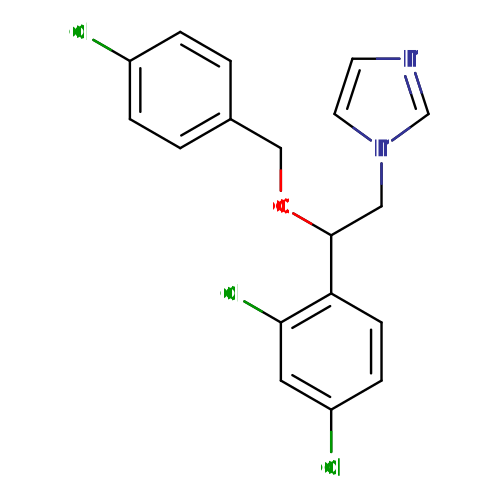
Structure for Econazole (DB01127)
- Weight
- Average: 381.684
Monoisotopic: 380.024996233 - Chemical Formula
- C18H15Cl3N2O
- Synonyms
- (+-)-Econazole
- Econazol
- Econazole

Pharmacology
- Indication
For topical application in the treatment of tinea pedis, tinea cruris, and tinea corporis caused by Trichophyton rubrum, Trichophyton mentagrophytes, Trichophyton tonsurans, Microsporum canis, Microsporum audouini, Microsporum gypseum, and Epidermophyton floccosum, in the treatment of cutaneous candidiasis, and in the treatment of tinea versicolor.
 Reduce drug development failure ratesBuild, train, & validate machine-learning modelswith evidence-based and structured datasets.Build, train, & validate predictive machine-learning models with structured datasets.
- Associated Conditions
Indication Type Indication Combined Product Details Approval Level Age Group Patient Characteristics Dose Form Used in combination to treat Allergy skin Combination Product in combination with: Triamcinolone (DB00620) •••••••••••• ••••• Treatment of Balanitis candida •••••••••••• Used in combination to treat Fungal infectious disorders of the beard Combination Product in combination with: Triamcinolone (DB00620) •••••••••••• •••••••• Used in combination to treat Fungal skin infection Combination Product in combination with: Triamcinolone (DB00620) •••••••••••• •••••••••••• •••••••• ••••• Used in combination to treat Fungal skin infection Combination Product in combination with: Triamcinolone (DB00620) •••••••••••• •••••• ••••• •••••••••••• ••••••••• •••••••• - Contraindications & Blackbox Warnings
 Prevent Adverse Drug Events TodayTap into our Clinical API for life-saving information on contraindications & blackbox warnings, population restrictions, harmful risks, & more.Avoid life-threatening adverse drug events with our Clinical API
- Pharmacodynamics
Econazole is an antifungal medication related to fluconazole (Diflucan), ketoconazole (Nizoral), itraconazole (Sporanox), and clotrimazole (Lotrimin, Mycelex). Econazole prevents fungal organisms from producing vital substances required for growth and function. This medication is effective only for infections caused by fungal organisms. It will not work for bacterial or viral infections.
- Mechanism of action
Econazole interacts with 14-α demethylase, a cytochrome P-450 enzyme necessary to convert lanosterol to ergosterol. As ergosterol is an essential component of the fungal cell membrane, inhibition of its synthesis results in increased cellular permeability causing leakage of cellular contents. Econazole may also inhibit endogenous respiration, interact with membrane phospholipids, inhibit the transformation of yeasts to mycelial forms, inhibit purine uptake, and impair triglyceride and/or phospholipid biosynthesis.
Target Actions Organism ACytochrome P450 51 antagonistYeast UNuclear receptor subfamily 1 group I member 2 partial agonistHumans - Absorption
After topical application to the skin of normal subjects, systemic absorption of econazole nitrate is extremely low. Although most of the applied drug remains on the skin surface, drug concentrations were found in the stratum corneum which, by far, exceeded the minimum inhibitory concentration for dermatophytes.
- Volume of distribution
Not Available
- Protein binding
Not Available
- Metabolism
Hepatic.
- Route of elimination
Not Available
- Half-life
Not Available
- Clearance
Not Available
- Adverse Effects
 Improve decision support & research outcomesWith structured adverse effects data, including: blackbox warnings, adverse reactions, warning & precautions, & incidence rates. View sample adverse effects data in our new Data Library!Improve decision support & research outcomes with our structured adverse effects data.
- Toxicity
Overdosage of econazole in humans has not been reported to date. In mice, rats guinea pigs and dogs, the oral LD 50 values were found to be 462, 668, 272, and > 160 mg/kg, respectively.
- Pathways
- Not Available
- Pharmacogenomic Effects/ADRs
- Not Available
Interactions
- Drug Interactions
- This information should not be interpreted without the help of a healthcare provider. If you believe you are experiencing an interaction, contact a healthcare provider immediately. The absence of an interaction does not necessarily mean no interactions exist.
Drug Interaction Integrate drug-drug
interactions in your softwareAdagrasib The serum concentration of Adagrasib can be increased when it is combined with Econazole. Alfuzosin The metabolism of Alfuzosin can be decreased when combined with Econazole. Asciminib The serum concentration of Asciminib can be increased when it is combined with Econazole. Atogepant The serum concentration of Atogepant can be increased when it is combined with Econazole. Avanafil The metabolism of Avanafil can be decreased when combined with Econazole. - Food Interactions
- No interactions found.
Products
 Drug product information from 10+ global regionsOur datasets provide approved product information including:dosage, form, labeller, route of administration, and marketing period.Access drug product information from over 10 global regions.
- Product Ingredients
Ingredient UNII CAS InChI Key Econazole nitrate H438WYN10E 24169-02-6 DDXORDQKGIZAME-UHFFFAOYSA-N - International/Other Brands
- Ecostatin (Bristol-Myers Squibb) / Gyno-Pevaryl (Janssen) / Ifenec (Italfarmaco) / Palavale (Otsuka Pharmaceutical) / Pevaryl (Janssen)
- Brand Name Prescription Products
Name Dosage Strength Route Labeller Marketing Start Marketing End Region Image Econasil Kit 10 mg/1g Topical PureTek Corporation 2020-03-25 2021-04-30 US 
Econazole Nitrate Cream Cream 10 mg/1g Topical Lake Erie Medical DBA Quality Care Products LLC 2018-06-15 2019-10-11 US Econazole Nitrate Cream Cream 10 mg/1g Topical Alvogen Inc. 2017-09-07 2019-09-01 US Econazole Nitrate Topical Foam, 1% Aerosol, foam 10 mg/1g Topical Xiromed Llc 2016-12-09 2017-05-02 US Ecostatin Cream 1% Cream 1 % Topical Bristol Myers Squibb 1982-12-31 2006-09-05 Canada 
- Generic Prescription Products
Name Dosage Strength Route Labeller Marketing Start Marketing End Region Image Econazole Nitrate Cream 10 mg/1 Topical REMEDYREPACK INC. 2013-02-20 2015-06-12 US Econazole Nitrate Cream 10 mg/1g Topical bryant ranch prepack 2006-08-08 Not applicable US Econazole Nitrate Cream 10 mg/1g Topical Rebel Distributors Corp 2004-06-23 Not applicable US Econazole Nitrate Cream 10 mg/1g Topical Preferred Pharmaceuticals Inc. 2019-03-12 2020-01-31 US Econazole Nitrate Cream 10 mg/1g Topical Taro Pharmaceuticals U.S.A., Inc. 2002-11-26 Not applicable US - Over the Counter Products
Name Dosage Strength Route Labeller Marketing Start Marketing End Region Image GYNO-PEVARYL DEPOT VAGINAL SUPPOSITORY 150 mg Suppository 150 mg Vaginal JOHNSON & JOHNSON PTE. LTD. 1989-06-05 Not applicable Singapore 
อีคอน Cream 1 %w/w Topical บริษัท เยนเนอร์ราลดรั๊กส์เฮ้าส์ จำกัด 1986-05-28 Not applicable Thailand 
- Mixture Products
Name Ingredients Dosage Route Labeller Marketing Start Marketing End Region Image AECORAS OINTMENT Econazole nitrate (1 %) + Triamcinolone acetonide (0.1 %) Ointment Topical DUOPHARMA (M) SDN. BHD. 2020-09-08 2022-02-08 Malaysia 
ECOCORT CREAM Econazole nitrate (1 %w/w) + Triamcinolone acetonide (0.1 %w/w) Cream Topical ZUELLIG PHARMA PTE. LTD. 1998-09-10 Not applicable Singapore ECOCORT CREAM Econazole nitrate (1 g/100g) + Triamcinolone acetonide (100 mg/100g) Cream บริษัท ซิลลิค ฟาร์มา จำกัด 2018-07-03 Not applicable Thailand Econavix Econazole nitrate (10 mg/1g) + Econazole nitrate (10 mg/1g) + Econazole nitrate (10 mg/1g) Kit Topical Primary Pharmaceuticals, Inc. 2020-12-20 Not applicable US Econavix Econazole nitrate (10 mg/1g) + Econazole nitrate (10 mg/1g) + Econazole nitrate (10 mg/1g) Kit Topical Primary Pharmaceuticals, Inc. 2020-12-20 Not applicable US - Unapproved/Other Products
Name Ingredients Dosage Route Labeller Marketing Start Marketing End Region Image 071023 Econazole Nitrate 1% / Niacinamide 4% Econazole nitrate (1 g/100g) + Nicotinamide (4 g/100g) Cream Topical Sincerus Florida, LLC 2020-07-02 Not applicable US Econasil Econazole nitrate (10 mg/1g) Kit Topical PureTek Corporation 2020-03-25 2021-04-30 US Econazole Nitrate 1% / Niacinamide 4% Econazole nitrate (1 g/100g) + Nicotinamide (4 g/100g) Cream Topical Sincerus Florida, LLC 2019-05-20 Not applicable US PM External Econazole nitrate (10 mg/1mL) + Levomenthol (20 mg/1mL) + Lidocaine (20 mg/1mL) + Salicylic acid (100 mg/1mL) Solution Topical OASIS TRADING 2018-11-15 Not applicable US Triamazole Econazole nitrate (10 mg/1g) + Triamcinolone acetonide (1 mg/1g) Kit Topical PureTek Corporation 2020-12-15 Not applicable US
Categories
- ATC Codes
- G01AF05 — Econazole
- G01AF — Imidazole derivatives
- G01A — ANTIINFECTIVES AND ANTISEPTICS, EXCL. COMBINATIONS WITH CORTICOSTEROIDS
- G01 — GYNECOLOGICAL ANTIINFECTIVES AND ANTISEPTICS
- G — GENITO URINARY SYSTEM AND SEX HORMONES
- D01AC — Imidazole and triazole derivatives
- D01A — ANTIFUNGALS FOR TOPICAL USE
- D01 — ANTIFUNGALS FOR DERMATOLOGICAL USE
- D — DERMATOLOGICALS
- G01AF — Imidazole derivatives
- G01A — ANTIINFECTIVES AND ANTISEPTICS, EXCL. COMBINATIONS WITH CORTICOSTEROIDS
- G01 — GYNECOLOGICAL ANTIINFECTIVES AND ANTISEPTICS
- G — GENITO URINARY SYSTEM AND SEX HORMONES
- Drug Categories
- 14-alpha Demethylase Inhibitors
- Anti-Infective Agents
- Antifungal Agents
- Antifungal Agents (Vaginal)
- Antifungals for Dermatological Use
- Antifungals for Topical Use
- Azole Antifungals
- Cytochrome P-450 CYP2E1 Inhibitors
- Cytochrome P-450 CYP2E1 Inhibitors (strength unknown)
- Cytochrome P-450 CYP3A Inhibitors
- Cytochrome P-450 CYP3A4 Inhibitors
- Cytochrome P-450 CYP3A4 Inhibitors (strong)
- Cytochrome P-450 Enzyme Inhibitors
- Dermatologicals
- Enzyme Inhibitors
- Genito Urinary System and Sex Hormones
- Gynecological Antiinfectives and Antiseptics
- Hormone Antagonists
- Hormones, Hormone Substitutes, and Hormone Antagonists
- Imidazole and Triazole Derivatives
- Imidazole Derivatives
- Imidazoles
- P-glycoprotein inhibitors
- Steroid Synthesis Inhibitors
- Chemical TaxonomyProvided by Classyfire
- Description
- This compound belongs to the class of organic compounds known as benzylethers. These are aromatic ethers with the general formula ROCR' (R = alkyl, aryl; R'=benzene).
- Kingdom
- Organic compounds
- Super Class
- Benzenoids
- Class
- Benzene and substituted derivatives
- Sub Class
- Benzylethers
- Direct Parent
- Benzylethers
- Alternative Parents
- Dichlorobenzenes / N-substituted imidazoles / Aryl chlorides / Heteroaromatic compounds / Dialkyl ethers / Azacyclic compounds / Organopnictogen compounds / Organonitrogen compounds / Organochlorides / Hydrocarbon derivatives
- Substituents
- 1,3-dichlorobenzene / Aromatic heteromonocyclic compound / Aryl chloride / Aryl halide / Azacycle / Azole / Benzylether / Chlorobenzene / Dialkyl ether / Ether
- Molecular Framework
- Aromatic heteromonocyclic compounds
- External Descriptors
- imidazoles, ether, dichlorobenzene, monochlorobenzenes (CHEBI:82873)
- Affected organisms
- Yeast and other fungi
Chemical Identifiers
- UNII
- 6Z1Y2V4A7M
- CAS number
- 27220-47-9
- InChI Key
- LEZWWPYKPKIXLL-UHFFFAOYSA-N
- InChI
- InChI=1S/C18H15Cl3N2O/c19-14-3-1-13(2-4-14)11-24-18(10-23-8-7-22-12-23)16-6-5-15(20)9-17(16)21/h1-9,12,18H,10-11H2
- IUPAC Name
- 1-{2-[(4-chlorophenyl)methoxy]-2-(2,4-dichlorophenyl)ethyl}-1H-imidazole
- SMILES
- ClC1=CC=C(COC(CN2C=CN=C2)C2=C(Cl)C=C(Cl)C=C2)C=C1
References
- Synthesis Reference
Godefroi, E.F. and Heeres, J.; U.S. Patent 3,717,655; February 20,1973; assigned to Jansen Pharmaceutica NV, Belgium.
US3717655- General References
- AIFA Product Information: Pevaryl (econazole) for vaginal use [Link]
- External Links
- Human Metabolome Database
- HMDB0015259
- KEGG Drug
- D03936
- KEGG Compound
- C08068
- PubChem Compound
- 3198
- PubChem Substance
- 46508881
- ChemSpider
- 3086
- BindingDB
- 31773
- 3743
- ChEBI
- 82873
- ChEMBL
- CHEMBL808
- Therapeutic Targets Database
- DAP001269
- PharmGKB
- PA164746010
- Guide to Pharmacology
- GtP Drug Page
- RxList
- RxList Drug Page
- Drugs.com
- Drugs.com Drug Page
- PDRhealth
- PDRhealth Drug Page
- Wikipedia
- Econazole
- FDA label
- Download (203 KB)
- MSDS
- Download (72.9 KB)
Clinical Trials
- Clinical Trials
Phase Status Purpose Conditions Count 3 Completed Treatment Tinea Pedis 3 2 Completed Treatment Interdigital Tinea Pedis 1 2 Completed Treatment Onychomycosis 1 2 Completed Treatment Tinea Pedis 1 1 Completed Other Healthy Volunteers (HV) 1
Pharmacoeconomics
- Manufacturers
- Not Available
- Packagers
- Dispensing Solutions
- Diversified Healthcare Services Inc.
- DPT Laboratories Ltd.
- E. Fougera and Co.
- Medisca Inc.
- Ortho Mcneil Janssen Pharmaceutical Inc.
- Perrigo Co.
- Pharmedix
- Physicians Total Care Inc.
- Prasco Labs
- Preferred Pharmaceuticals Inc.
- Prescript Pharmaceuticals
- Rebel Distributors Corp.
- Taro Pharmaceuticals USA
- Dosage Forms
Form Route Strength Solution Vaginal Cream Topical 1 % w/w Powder Topical Emulsion Topical 1 % Powder Topical 1 % Solution Vaginal 100 MG Kit Topical Cream Cream Topical 10 mg/1 Cream Topical 10 mg/1g Cream Topical Aerosol, foam Topical 10 mg/1g Cream Topical 1 % Spray Topical 1 % Emulsion Topical Solution Topical 10 mg Cream Topical 10 mg/g Cream Vaginal 10 mg/g Solution Vaginal 1 MG/ML Cream Vaginal Insert Vaginal 150 MG Suppository Vaginal 150 mg Cream Vaginal 1 % Gel Topical 1 % Insert Vaginal 50 MG Solution Topical 1 % Cream Topical Insert Vaginal Aerosol, foam Topical 1 % Douche Vaginal 0.3 g/100ml Cream Topical 10 mg/g Cream Topical 1 g Cream Cutaneous Emulsion Topical Solution Topical Aerosol, foam Topical Solution Topical Spray Cutaneous 1 % Ointment Topical Kit Topical 10 mg/1g Cream Topical 1 %w/w - Prices
Unit description Cost Unit Econazole Nitrate 1% Cream 85 gm Tube 73.63USD tube Econazole Nitrate 1% Cream 30 gm Tube 32.16USD tube Econazole Nitrate 1% Cream 15 gm Tube 19.32USD tube Econazole nitrate powder 2.5USD g Spectazole 1% cream 1.33USD g Econazole nitrate 1% cream 0.93USD g DrugBank does not sell nor buy drugs. Pricing information is supplied for informational purposes only.- Patents
Patent Number Pediatric Extension Approved Expires (estimated) Region US5993830 No 1999-11-30 2018-01-16 US US10071054 No 2018-09-11 2031-08-08 US
Properties
- State
- Solid
- Experimental Properties
Property Value Source melting point (°C) 162 Godefroi, E.F. and Heeres, J.; U.S. Patent 3,717,655; February 20,1973; assigned to Jansen Pharmaceutica NV, Belgium. logP 5.5 Not Available - Predicted Properties
Property Value Source Water Solubility 0.00148 mg/mL ALOGPS logP 4.67 ALOGPS logP 5.35 Chemaxon logS -5.4 ALOGPS pKa (Strongest Basic) 6.48 Chemaxon Physiological Charge 0 Chemaxon Hydrogen Acceptor Count 2 Chemaxon Hydrogen Donor Count 0 Chemaxon Polar Surface Area 27.05 Å2 Chemaxon Rotatable Bond Count 6 Chemaxon Refractivity 98.26 m3·mol-1 Chemaxon Polarizability 37.37 Å3 Chemaxon Number of Rings 3 Chemaxon Bioavailability 1 Chemaxon Rule of Five No Chemaxon Ghose Filter Yes Chemaxon Veber's Rule Yes Chemaxon MDDR-like Rule Yes Chemaxon - Predicted ADMET Features
Property Value Probability Human Intestinal Absorption + 0.9735 Blood Brain Barrier + 0.9823 Caco-2 permeable + 0.6096 P-glycoprotein substrate Non-substrate 0.545 P-glycoprotein inhibitor I Non-inhibitor 0.7958 P-glycoprotein inhibitor II Inhibitor 0.8387 Renal organic cation transporter Inhibitor 0.6806 CYP450 2C9 substrate Non-substrate 0.8407 CYP450 2D6 substrate Non-substrate 0.9116 CYP450 3A4 substrate Non-substrate 0.7017 CYP450 1A2 substrate Inhibitor 0.9472 CYP450 2C9 inhibitor Inhibitor 0.939 CYP450 2D6 inhibitor Inhibitor 0.9413 CYP450 2C19 inhibitor Inhibitor 0.9591 CYP450 3A4 inhibitor Inhibitor 0.8861 CYP450 inhibitory promiscuity High CYP Inhibitory Promiscuity 0.9961 Ames test Non AMES toxic 0.9133 Carcinogenicity Non-carcinogens 0.853 Biodegradation Not ready biodegradable 0.9933 Rat acute toxicity 2.8478 LD50, mol/kg Not applicable hERG inhibition (predictor I) Weak inhibitor 0.5 hERG inhibition (predictor II) Inhibitor 0.8505
Spectra
- Mass Spec (NIST)
- Not Available
- Spectra
- Chromatographic Properties
Collision Cross Sections (CCS)
Adduct CCS Value (Å2) Source type Source [M-H]- 170.2619752 predictedDarkChem Lite v0.1.0 [M-H]- 182.86502 predictedDeepCCS 1.0 (2019) [M+H]+ 171.6491752 predictedDarkChem Lite v0.1.0 [M+H]+ 185.3168 predictedDeepCCS 1.0 (2019) [M+Na]+ 170.7207752 predictedDarkChem Lite v0.1.0 [M+Na]+ 193.30585 predictedDeepCCS 1.0 (2019)
Targets

- Kind
- Protein
- Organism
- Yeast
- Pharmacological action
- Yes
- Actions
- Antagonist
- General Function
- Sterol 14-demethylase activity
- Specific Function
- Catalyzes C14-demethylation of lanosterol which is critical for ergosterol biosynthesis. It transforms lanosterol into 4,4'-dimethyl cholesta-8,14,24-triene-3-beta-ol.
- Gene Name
- ERG11
- Uniprot ID
- P10613
- Uniprot Name
- Lanosterol 14-alpha demethylase
- Molecular Weight
- 60674.965 Da
References
- Imming P, Sinning C, Meyer A: Drugs, their targets and the nature and number of drug targets. Nat Rev Drug Discov. 2006 Oct;5(10):821-34. [Article]
- Warrilow AG, Martel CM, Parker JE, Melo N, Lamb DC, Nes WD, Kelly DE, Kelly SL: Azole binding properties of Candida albicans sterol 14-alpha demethylase (CaCYP51). Antimicrob Agents Chemother. 2010 Oct;54(10):4235-45. doi: 10.1128/AAC.00587-10. Epub 2010 Jul 12. [Article]
- Strushkevich N, Usanov SA, Park HW: Structural basis of human CYP51 inhibition by antifungal azoles. J Mol Biol. 2010 Apr 9;397(4):1067-78. doi: 10.1016/j.jmb.2010.01.075. Epub 2010 Feb 10. [Article]
- Jackson CJ, Lamb DC, Kelly DE, Kelly SL: Bactericidal and inhibitory effects of azole antifungal compounds on Mycobacterium smegmatis. FEMS Microbiol Lett. 2000 Nov 15;192(2):159-62. [Article]
- Pietila MP, Vohra PK, Sanyal B, Wengenack NL, Raghavakaimal S, Thomas CF Jr: Cloning and characterization of CYP51 from Mycobacterium avium. Am J Respir Cell Mol Biol. 2006 Aug;35(2):236-42. Epub 2006 Mar 16. [Article]
- Berman HM, Westbrook J, Feng Z, Gilliland G, Bhat TN, Weissig H, Shindyalov IN, Bourne PE: The Protein Data Bank. Nucleic Acids Res. 2000 Jan 1;28(1):235-42. [Article]
- Kind
- Protein
- Organism
- Humans
- Pharmacological action
- Unknown
- Actions
- Partial agonist
- General Function
- Zinc ion binding
- Specific Function
- Nuclear receptor that binds and is activated by variety of endogenous and xenobiotic compounds. Transcription factor that activates the transcription of multiple genes involved in the metabolism an...
- Gene Name
- NR1I2
- Uniprot ID
- O75469
- Uniprot Name
- Nuclear receptor subfamily 1 group I member 2
- Molecular Weight
- 49761.245 Da
References
- Svecova L, Vrzal R, Burysek L, Anzenbacherova E, Cerveny L, Grim J, Trejtnar F, Kunes J, Pour M, Staud F, Anzenbacher P, Dvorak Z, Pavek P: Azole antimycotics differentially affect rifampicin-induced pregnane X receptor-mediated CYP3A4 gene expression. Drug Metab Dispos. 2008 Feb;36(2):339-48. Epub 2007 Nov 12. [Article]
Enzymes
- Kind
- Protein
- Organism
- Humans
- Pharmacological action
- No
- Actions
- Inhibitor
- General Function
- Oxygen binding
- Specific Function
- Catalyzes the formation of aromatic C18 estrogens from C19 androgens.
- Gene Name
- CYP19A1
- Uniprot ID
- P11511
- Uniprot Name
- Aromatase
- Molecular Weight
- 57882.48 Da
References
- Ayub M, Levell MJ: The inhibition of human prostatic aromatase activity by imidazole drugs including ketoconazole and 4-hydroxyandrostenedione. Biochem Pharmacol. 1990 Oct 1;40(7):1569-75. doi: 10.1016/0006-2952(90)90456-u. [Article]
- Kind
- Protein
- Organism
- Humans
- Pharmacological action
- No
- Actions
- Inhibitor
- General Function
- Steroid hydroxylase activity
- Specific Function
- Metabolizes several precarcinogens, drugs, and solvents to reactive metabolites. Inactivates a number of drugs and xenobiotics and also bioactivates many xenobiotic substrates to their hepatotoxic ...
- Gene Name
- CYP2E1
- Uniprot ID
- P05181
- Uniprot Name
- Cytochrome P450 2E1
- Molecular Weight
- 56848.42 Da
References
- Rendic S: Summary of information on human CYP enzymes: human P450 metabolism data. Drug Metab Rev. 2002 Feb-May;34(1-2):83-448. [Article]
- Tassaneeyakul W, Birkett DJ, Miners JO: Inhibition of human hepatic cytochrome P4502E1 by azole antifungals, CNS-active drugs and non-steroidal anti-inflammatory agents. Xenobiotica. 1998 Mar;28(3):293-301. doi: 10.1080/004982598239579 . [Article]
- Kind
- Protein
- Organism
- Humans
- Pharmacological action
- No
- Actions
- Inhibitor
- General Function
- Vitamin d3 25-hydroxylase activity
- Specific Function
- Cytochromes P450 are a group of heme-thiolate monooxygenases. In liver microsomes, this enzyme is involved in an NADPH-dependent electron transport pathway. It performs a variety of oxidation react...
- Gene Name
- CYP3A4
- Uniprot ID
- P08684
- Uniprot Name
- Cytochrome P450 3A4
- Molecular Weight
- 57342.67 Da
References
- Monostory K, Hazai E, Vereczkey L: Inhibition of cytochrome P450 enzymes participating in p-nitrophenol hydroxylation by drugs known as CYP2E1 inhibitors. Chem Biol Interact. 2004 Apr 15;147(3):331-40. doi: 10.1016/j.cbi.2004.03.003. [Article]
- Godamudunage MP, Grech AM, Scott EE: Comparison of Antifungal Azole Interactions with Adult Cytochrome P450 3A4 versus Neonatal Cytochrome P450 3A7. Drug Metab Dispos. 2018 Sep;46(9):1329-1337. doi: 10.1124/dmd.118.082032. Epub 2018 Jul 10. [Article]

Drug created at June 13, 2005 13:24 / Updated at May 07, 2021 21:23