Identification
- Generic Name
- Desoxycorticosterone pivalate
- DrugBank Accession Number
- DB01134
- Background
Desoxycorticosterone pivalate is a mineralocorticoid hormone and an analog of desoxycorticosterone. It is white, odorless, and stable in air. It is practically insoluble in water, sparingly soluble in acetone, slightly soluble in methanol, ether and vegetable oils. Federal (U.S.A.) law restricts this drug to use by or on the order of a licensed veterinarian.
- Type
- Small Molecule
- Groups
- Experimental, Vet approved
- Structure

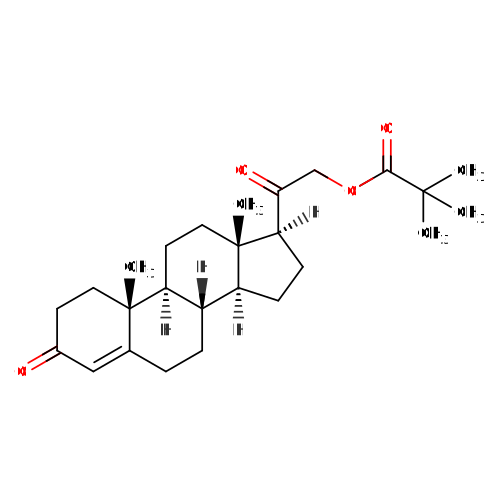
Structure for Desoxycorticosterone pivalate (DB01134)
- Weight
- Average: 414.586
Monoisotopic: 414.277009704 - Chemical Formula
- C26H38O4
- Synonyms
- 11-deoxycorticosterone pivalate
- Deoxycorticosterone pivalate
- Deoxycorticosterone trimethylacetate
- Deoxycortone pivalate
- Deoxycortone trimethylacetate
- Desoxycorticosterone pivalate
- Desoxycorticosterone trimethylacetate
- Desoxycortone pivalate
- DOCP
- DTMA

Pharmacology
- Indication
Examined for treatment of adrenocortical insufficiency especially in multiple sclerosis, congenital cerebral palsy, polyarteritis nodosa, and rheumatoid arthritis. Currently only approved in treating cats and dogs for the treatment of Addison's disease.
 Reduce drug development failure ratesBuild, train, & validate machine-learning modelswith evidence-based and structured datasets.Build, train, & validate predictive machine-learning models with structured datasets.
- Contraindications & Blackbox Warnings
 Prevent Adverse Drug Events TodayTap into our Clinical API for life-saving information on contraindications & blackbox warnings, population restrictions, harmful risks, & more.Avoid life-threatening adverse drug events with our Clinical API
- Pharmacodynamics
Used to treat adrenocortical insufficiency, desoxycorticosterone pivalate is a mineralocorticoid hormone and an analogue of desoxycorticosterone. It primarily acts on the metabolism of sodium, potassium and water. When the drug is given, there is decreased excretion of sodium accompanied by increased excretion of potassium; the concentration of sodium in the blood is thereby increased whereas that of potassium is decreased. There is a concomitant increase in the volume of blood and extracellular fluids, with a fall in hematocrit. It increases the rate of renal tubular absorption of sodium.
- Mechanism of action
Desoxycorticosterone Pivalate binds to the mineralocorticoid receptor. Mineralocorticoids are a family of steroids, secreted by the adrenal cortex, necessary for the regulation of a number of metabolic processes including electrolyte regulation. Desoxycorticosterone pivalate exerts its effect through its interaction with the mineralocorticoid receptor (MR), whereby it reacts with the receptor proteins to form a steroid-receptor complex. This complex moves into the nucleus, where it binds to chromatin which results in genetic transcription of cellular DNA to messenger RNA. The steroid hormones appear to induce transcription and synthesis of specific proteins, which produce the physiological effects seen after administration.
Target Actions Organism AMineralocorticoid receptor agonistHumans - Absorption
Not Available
- Volume of distribution
Not Available
- Protein binding
90%
- Metabolism
- Not Available
- Route of elimination
Not Available
- Half-life
Not Available
- Clearance
Not Available
- Adverse Effects
 Improve decision support & research outcomesWith structured adverse effects data, including: blackbox warnings, adverse reactions, warning & precautions, & incidence rates. View sample adverse effects data in our new Data Library!Improve decision support & research outcomes with our structured adverse effects data.
- Toxicity
Symptoms of overdose include polyuria, polydipsia, increased blood volume, edema, and cardiac enlargement.
- Pathways
- Not Available
- Pharmacogenomic Effects/ADRs
- Not Available
Interactions
- Drug Interactions
- This information should not be interpreted without the help of a healthcare provider. If you believe you are experiencing an interaction, contact a healthcare provider immediately. The absence of an interaction does not necessarily mean no interactions exist.
Drug Interaction Integrate drug-drug
interactions in your softwareAbametapir The serum concentration of Desoxycorticosterone pivalate can be increased when it is combined with Abametapir. Amiodarone The metabolism of Desoxycorticosterone pivalate can be decreased when combined with Amiodarone. Amprenavir The metabolism of Desoxycorticosterone pivalate can be decreased when combined with Amprenavir. Apalutamide The serum concentration of Desoxycorticosterone pivalate can be decreased when it is combined with Apalutamide. Aprepitant The metabolism of Desoxycorticosterone pivalate can be decreased when combined with Aprepitant. - Food Interactions
- Not Available
Products
 Drug product information from 10+ global regionsOur datasets provide approved product information including:dosage, form, labeller, route of administration, and marketing period.Access drug product information from over 10 global regions.
- International/Other Brands
- Cortexone M / Neodin-Depositum / Percorten / Percorten M / Percorten Pivalate / Zycortal
Categories
- Drug Categories
- Chemical TaxonomyProvided by Classyfire
- Description
- This compound belongs to the class of organic compounds known as gluco/mineralocorticoids, progestogins and derivatives. These are steroids with a structure based on a hydroxylated prostane moiety.
- Kingdom
- Organic compounds
- Super Class
- Lipids and lipid-like molecules
- Class
- Steroids and steroid derivatives
- Sub Class
- Pregnane steroids
- Direct Parent
- Gluco/mineralocorticoids, progestogins and derivatives
- Alternative Parents
- 20-oxosteroids / 3-oxo delta-4-steroids / Delta-4-steroids / Cyclohexenones / Alpha-acyloxy ketones / Carboxylic acid esters / Monocarboxylic acids and derivatives / Organic oxides / Hydrocarbon derivatives
- Substituents
- 20-oxosteroid / 3-oxo-delta-4-steroid / 3-oxosteroid / Aliphatic homopolycyclic compound / Alpha-acyloxy ketone / Carbonyl group / Carboxylic acid derivative / Carboxylic acid ester / Cyclic ketone / Cyclohexenone
- Molecular Framework
- Aliphatic homopolycyclic compounds
- External Descriptors
- pivalate ester, mineralocorticoid (CHEBI:50782)
- Affected organisms
- Humans and other mammals
Chemical Identifiers
- UNII
- 16665T4A2X
- CAS number
- 808-48-0
- InChI Key
- VVOIQBFMTVCINR-WWMZEODYSA-N
- InChI
- InChI=1S/C26H38O4/c1-24(2,3)23(29)30-15-22(28)21-9-8-19-18-7-6-16-14-17(27)10-12-25(16,4)20(18)11-13-26(19,21)5/h14,18-21H,6-13,15H2,1-5H3/t18-,19-,20-,21+,25-,26-/m0/s1
- IUPAC Name
- 2-[(1S,2R,10S,11S,14S,15S)-2,15-dimethyl-5-oxotetracyclo[8.7.0.0²,⁷.0¹¹,¹⁵]heptadec-6-en-14-yl]-2-oxoethyl 2,2-dimethylpropanoate
- SMILES
- [H][C@@]1(CC[C@@]2([H])[C@]3([H])CCC4=CC(=O)CC[C@]4(C)[C@@]3([H])CC[C@]12C)C(=O)COC(=O)C(C)(C)C
References
- General References
- Not Available
- External Links
- PubChem Compound
- 11876263
- PubChem Substance
- 46506381
- ChemSpider
- 10050591
- 22537
- ChEBI
- 50782
- ChEMBL
- CHEMBL1200592
- ZINC
- ZINC000004082455
- Therapeutic Targets Database
- DAP001106
- PharmGKB
- PA449245
- Wikipedia
- Desoxycorticosterone_pivalate
- MSDS
- Download (65.5 KB)
Clinical Trials
Pharmacoeconomics
- Manufacturers
- Not Available
- Packagers
- Baxter International Inc.
- Dosage Forms
- Not Available
- Prices
- Not Available
- Patents
- Not Available
Properties
- State
- Solid
- Experimental Properties
Property Value Source water solubility Insoluble Not Available logP 4 Not Available - Predicted Properties
Property Value Source Water Solubility 0.00141 mg/mL ALOGPS logP 3.9 ALOGPS logP 5.57 Chemaxon logS -5.5 ALOGPS pKa (Strongest Acidic) 17.19 Chemaxon pKa (Strongest Basic) -4.8 Chemaxon Physiological Charge 0 Chemaxon Hydrogen Acceptor Count 3 Chemaxon Hydrogen Donor Count 0 Chemaxon Polar Surface Area 60.44 Å2 Chemaxon Rotatable Bond Count 5 Chemaxon Refractivity 117.26 m3·mol-1 Chemaxon Polarizability 48.3 Å3 Chemaxon Number of Rings 4 Chemaxon Bioavailability 1 Chemaxon Rule of Five No Chemaxon Ghose Filter Yes Chemaxon Veber's Rule No Chemaxon MDDR-like Rule No Chemaxon - Predicted ADMET Features
Property Value Probability Human Intestinal Absorption + 0.9954 Blood Brain Barrier + 0.9553 Caco-2 permeable + 0.6211 P-glycoprotein substrate Substrate 0.6541 P-glycoprotein inhibitor I Inhibitor 0.9048 P-glycoprotein inhibitor II Inhibitor 0.8603 Renal organic cation transporter Non-inhibitor 0.6993 CYP450 2C9 substrate Non-substrate 0.8702 CYP450 2D6 substrate Non-substrate 0.9101 CYP450 3A4 substrate Substrate 0.8098 CYP450 1A2 substrate Non-inhibitor 0.9498 CYP450 2C9 inhibitor Non-inhibitor 0.8229 CYP450 2D6 inhibitor Non-inhibitor 0.9356 CYP450 2C19 inhibitor Non-inhibitor 0.8875 CYP450 3A4 inhibitor Non-inhibitor 0.8554 CYP450 inhibitory promiscuity Low CYP Inhibitory Promiscuity 0.7501 Ames test Non AMES toxic 0.9473 Carcinogenicity Non-carcinogens 0.9159 Biodegradation Not ready biodegradable 0.9231 Rat acute toxicity 1.7883 LD50, mol/kg Not applicable hERG inhibition (predictor I) Weak inhibitor 0.9494 hERG inhibition (predictor II) Non-inhibitor 0.7297
Spectra
- Mass Spec (NIST)
- Not Available
- Spectra
Spectrum Spectrum Type Splash Key Predicted MS/MS Spectrum - 10V, Positive (Annotated) Predicted LC-MS/MS splash10-015a-2159800000-d85ccc6b8eb374e3d0b1 Predicted MS/MS Spectrum - 10V, Negative (Annotated) Predicted LC-MS/MS splash10-0ik9-0500900000-1bb9734add1d4767a698 Predicted MS/MS Spectrum - 20V, Negative (Annotated) Predicted LC-MS/MS splash10-0udi-4900000000-1b8cc0f2d5042d483c0d Predicted MS/MS Spectrum - 20V, Positive (Annotated) Predicted LC-MS/MS splash10-0bta-7398200000-7f1ecc286ca19c023aa1 Predicted MS/MS Spectrum - 40V, Negative (Annotated) Predicted LC-MS/MS splash10-000i-9020000000-330e9f617d0ed4db4d08 Predicted MS/MS Spectrum - 40V, Positive (Annotated) Predicted LC-MS/MS splash10-0a4i-9581100000-ee12c8cb348ce6f1d966 Predicted 1H NMR Spectrum 1D NMR Not Applicable Predicted 13C NMR Spectrum 1D NMR Not Applicable - Chromatographic Properties
Collision Cross Sections (CCS)
Adduct CCS Value (Å2) Source type Source [M-H]- 215.6393653 predictedDarkChem Lite v0.1.0 [M-H]- 202.62843 predictedDeepCCS 1.0 (2019) [M+H]+ 215.4517653 predictedDarkChem Lite v0.1.0 [M+H]+ 204.52385 predictedDeepCCS 1.0 (2019) [M+Na]+ 210.22635 predictedDeepCCS 1.0 (2019)
Targets

- Kind
- Protein
- Organism
- Humans
- Pharmacological action
- Yes
- Actions
- Agonist
- General Function
- Zinc ion binding
- Specific Function
- Receptor for both mineralocorticoids (MC) such as aldosterone and glucocorticoids (GC) such as corticosterone or cortisol. Binds to mineralocorticoid response elements (MRE) and transactivates targ...
- Gene Name
- NR3C2
- Uniprot ID
- P08235
- Uniprot Name
- Mineralocorticoid receptor
- Molecular Weight
- 107066.575 Da
References
- Overington JP, Al-Lazikani B, Hopkins AL: How many drug targets are there? Nat Rev Drug Discov. 2006 Dec;5(12):993-6. [Article]
- Imming P, Sinning C, Meyer A: Drugs, their targets and the nature and number of drug targets. Nat Rev Drug Discov. 2006 Oct;5(10):821-34. [Article]
- Beaumont K, Fanestil DD: Characterization of rat brain aldosterone receptors reveals high affinity for corticosterone. Endocrinology. 1983 Dec;113(6):2043-51. [Article]
- Chen X, Ji ZL, Chen YZ: TTD: Therapeutic Target Database. Nucleic Acids Res. 2002 Jan 1;30(1):412-5. [Article]
- Sekihara H, Island DP, Liddle GW: New mineralocorticoids: 5alpha-dihydroaldosterone and 5alpha-dihydro-11-deoxycorticosterone. Endocrinology. 1978 Oct;103(4):1450-2. [Article]
Enzymes
- Kind
- Protein
- Organism
- Humans
- Pharmacological action
- No
- Actions
- Substrate
- General Function
- Vitamin d3 25-hydroxylase activity
- Specific Function
- Cytochromes P450 are a group of heme-thiolate monooxygenases. In liver microsomes, this enzyme is involved in an NADPH-dependent electron transport pathway. It performs a variety of oxidation react...
- Gene Name
- CYP3A4
- Uniprot ID
- P08684
- Uniprot Name
- Cytochrome P450 3A4
- Molecular Weight
- 57342.67 Da
References
- Pelletier G. (2010). Progress in Brain Research. Elsevier.

Drug created at June 13, 2005 13:24 / Updated at May 07, 2021 21:24