Identification
- Summary
Diphenylpyraline is an antihistamine used for the treatment of allergic rhinitis, hay fever, and allergic skin disorders.
- Generic Name
- Diphenylpyraline
- DrugBank Accession Number
- DB01146
- Background
Diphenylpyraline is an antihistamine. Antihistamines used in the treatment of allergy act by competing with histamine for H 1-receptor sites on effector cells. Antihistamines prevent, but do not reverse, responses mediated by histamine alone. Antihistamines antagonize, in varying degrees, most of the pharmacological effects of histamine, including urticaria and pruritus.
- Type
- Small Molecule
- Groups
- Approved, Investigational
- Structure
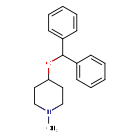
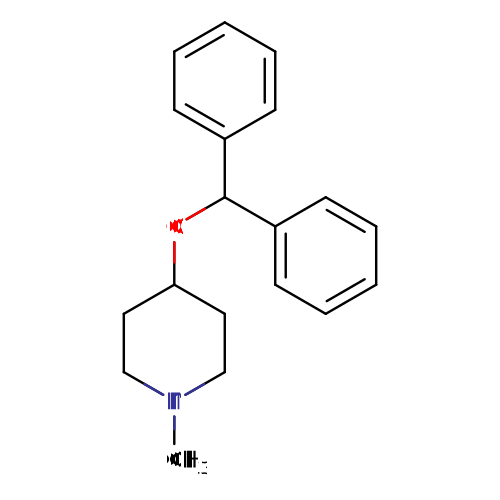
Structure for Diphenylpyraline (DB01146)
- Weight
- Average: 281.392
Monoisotopic: 281.177964363 - Chemical Formula
- C19H23NO
- Synonyms
- 1-methyl-4-hydroxypiperidine benzhydryl ether
- 1-methyl-4-piperidyl benzhydryl ether
- 4-(benzhydryloxy)-1-methylpiperidine
- 4-(benzhydryloxy)-N-methylpiperidine
- Difenilpiralina
- Diphenylpyralamine
- Diphenylpyraline
- Diphenylpyralinum

Pharmacology
- Indication
For use in the treatment of allergic rhinitis, hay fever, and allergic skin disorders.
 Reduce drug development failure ratesBuild, train, & validate machine-learning modelswith evidence-based and structured datasets.Build, train, & validate predictive machine-learning models with structured datasets.
- Associated Conditions
Indication Type Indication Combined Product Details Approval Level Age Group Patient Characteristics Dose Form Used in combination to manage Allergic rhinitis ••• ••• Used in combination to treat Carbuncle Combination Product in combination with: Dequalinium (DB04209), Bacitracin (DB00626) •••••••••••• •••••••• Used in combination to treat Folliculitis Combination Product in combination with: Dequalinium (DB04209), Bacitracin (DB00626) •••••••••••• •••••••• Used in combination to treat Furuncle Combination Product in combination with: Dequalinium (DB04209), Bacitracin (DB00626) •••••••••••• •••••••• Used in combination to treat Impetigo contagious Combination Product in combination with: Bacitracin (DB00626), Dequalinium (DB04209) •••••••••••• •••••••• - Contraindications & Blackbox Warnings
 Prevent Adverse Drug Events TodayTap into our Clinical API for life-saving information on contraindications & blackbox warnings, population restrictions, harmful risks, & more.Avoid life-threatening adverse drug events with our Clinical API
- Pharmacodynamics
Diphenylpyraline is an antihistamine that prevents, but does not reverse, responses mediated by histamine alone. Diphenylpyraline antagonizes most of the pharmacological effects of histamine, including urticaria and pruritus. Also, diphenylpyraline may exhibit anticholinergic actions (as do most of the antihistamines) and may thus provide a drying effect on the nasal mucosa.
- Mechanism of action
Antihistamines such as diphenylpyraline used in the treatment of allergy act by competing with histamine for H1-receptor sites on effector cells. This reduces the effects of histamine, leading to a temporary reduction of allergy symptoms.
Target Actions Organism AHistamine H1 receptor antagonistHumans USodium-dependent dopamine transporter inhibitorHumans - Absorption
Well absorbed after oral administration.
- Volume of distribution
Not Available
- Protein binding
> 99% in human serum albumin
- Metabolism
Hepatic
- Route of elimination
Not Available
- Half-life
Not Available
- Clearance
Not Available
- Adverse Effects
 Improve decision support & research outcomesWith structured adverse effects data, including: blackbox warnings, adverse reactions, warning & precautions, & incidence rates. View sample adverse effects data in our new Data Library!Improve decision support & research outcomes with our structured adverse effects data.
- Toxicity
Not Available
- Pathways
Pathway Category Diphenylpyraline H1-Antihistamine Action Drug action - Pharmacogenomic Effects/ADRs
- Not Available
Interactions
- Drug Interactions
- This information should not be interpreted without the help of a healthcare provider. If you believe you are experiencing an interaction, contact a healthcare provider immediately. The absence of an interaction does not necessarily mean no interactions exist.
Drug Interaction Integrate drug-drug
interactions in your softwareAmphetamine Amphetamine may decrease the sedative activities of Diphenylpyraline. Benzphetamine Benzphetamine may decrease the sedative activities of Diphenylpyraline. Benzylpenicilloyl polylysine Diphenylpyraline may decrease effectiveness of Benzylpenicilloyl polylysine as a diagnostic agent. Betahistine The therapeutic efficacy of Betahistine can be decreased when used in combination with Diphenylpyraline. Dextroamphetamine Dextroamphetamine may decrease the sedative activities of Diphenylpyraline. - Food Interactions
- No interactions found.
Products
 Drug product information from 10+ global regionsOur datasets provide approved product information including:dosage, form, labeller, route of administration, and marketing period.Access drug product information from over 10 global regions.
- Product Ingredients
Ingredient UNII CAS InChI Key Diphenylpyraline hydrochloride G9FU7F1E87 132-18-3 LPRLDRXGWKXRMQ-UHFFFAOYSA-N - International/Other Brands
- Allergen / Arbid / Belfene / Diafen (Riker) / Hispril (Nopco) / Histyn / Lergobine / Lyssipoll (Lyssia) / Mepiben / Neargal
- Mixture Products
Name Ingredients Dosage Route Labeller Marketing Start Marketing End Region Image Biohisdex DM Decongestant Diphenylpyraline hydrochloride (2 mg / 5 mL) + Dextromethorphan hydrobromide (10 mg / 5 mL) + Phenylephrine hydrochloride (20 mg / 5 mL) Liquid Oral Everest Pharmaceuticals Ltd. 1979-12-31 1999-07-14 Canada 
Biohisdine DM Decongestant Diphenylpyraline hydrochloride (1 mg / 5 mL) + Dextromethorphan hydrobromide (5 mg / 5 mL) + Phenylephrine hydrochloride (10 mg / 5 mL) Liquid Oral Everest Pharmaceuticals Ltd. 1979-12-31 1999-07-14 Canada Corytab Diphenylpyraline hydrochloride (2 mg) + Acetaminophen (300 mg) + Caffeine (16 mg) Tablet Oral Les Laboratoires Vachon Inc. 1988-12-31 2009-02-24 Canada Creo-rectal Adultes/adults Diphenylpyraline hydrochloride (1.5 mg) + Camphor (5 mg) + Guaiacol carbonate (600 mg) Suppository Rectal Laboratoires Confab Inc 1951-12-31 Not applicable Canada Creo-rectal Enfants/children Diphenylpyraline hydrochloride (0.5 mg) + Camphor (2 mg) + Guaiacol carbonate (200 mg) Suppository Rectal Laboratoires Confab Inc 1951-12-31 Not applicable Canada
Categories
- ATC Codes
- R06AA57 — Diphenylpyraline, combinations
- R06AA — Aminoalkyl ethers
- R06A — ANTIHISTAMINES FOR SYSTEMIC USE
- R06 — ANTIHISTAMINES FOR SYSTEMIC USE
- R — RESPIRATORY SYSTEM
- Drug Categories
- Chemical TaxonomyProvided by Classyfire
- Description
- This compound belongs to the class of organic compounds known as diphenylmethanes. These are compounds containing a diphenylmethane moiety, which consists of a methane wherein two hydrogen atoms are replaced by two phenyl groups.
- Kingdom
- Organic compounds
- Super Class
- Benzenoids
- Class
- Benzene and substituted derivatives
- Sub Class
- Diphenylmethanes
- Direct Parent
- Diphenylmethanes
- Alternative Parents
- Benzylethers / Piperidines / Trialkylamines / Dialkyl ethers / Azacyclic compounds / Organopnictogen compounds / Hydrocarbon derivatives
- Substituents
- Amine / Aromatic heteromonocyclic compound / Azacycle / Benzylether / Dialkyl ether / Diphenylmethane / Ether / Hydrocarbon derivative / Organic nitrogen compound / Organic oxygen compound
- Molecular Framework
- Aromatic heteromonocyclic compounds
- External Descriptors
- piperidines, tertiary amine (CHEBI:59788)
- Affected organisms
- Humans and other mammals
Chemical Identifiers
- UNII
- 33361OE3AV
- CAS number
- 147-20-6
- InChI Key
- OWQUZNMMYNAXSL-UHFFFAOYSA-N
- InChI
- InChI=1S/C19H23NO/c1-20-14-12-18(13-15-20)21-19(16-8-4-2-5-9-16)17-10-6-3-7-11-17/h2-11,18-19H,12-15H2,1H3
- IUPAC Name
- 4-(diphenylmethoxy)-1-methylpiperidine
- SMILES
- CN1CCC(CC1)OC(C1=CC=CC=C1)C1=CC=CC=C1
References
- Synthesis Reference
Knox, L.H. and Kapp, R.; U.S. Patent 2,479,843; August 23, 1949; assigned to Nopco Chemical Company.
US2479843- General References
- Lapa GB, Mathews TA, Harp J, Budygin EA, Jones SR: Diphenylpyraline, a histamine H1 receptor antagonist, has psychostimulant properties. Eur J Pharmacol. 2005 Jan 4;506(3):237-40. Epub 2004 Dec 8. [Article]
- Ohno T, Kobayashi S, Hayashi M, Sakurai M, Kanazawa I: Diphenylpyraline-responsive parkinsonism in cerebrotendinous xanthomatosis: long-term follow up of three patients. J Neurol Sci. 2001 Jan 1;182(2):95-7. [Article]
- Puhakka H, Rantanen T, Virolainen E: Diphenylpyraline (Lergobine) in the treatment of patients suffering from allergic and vasomotor rhinitis. J Int Med Res. 1977;5(1):37-41. [Article]
- External Links
- Human Metabolome Database
- HMDB0015277
- KEGG Drug
- D07862
- PubChem Compound
- 3103
- PubChem Substance
- 46504936
- ChemSpider
- 2992
- BindingDB
- 50241333
- 23386
- ChEBI
- 59788
- ChEMBL
- CHEMBL1492
- ZINC
- ZINC000000056643
- Therapeutic Targets Database
- DAP001071
- PharmGKB
- PA164746377
- Wikipedia
- Diphenylpyraline
Clinical Trials
Pharmacoeconomics
- Manufacturers
- Not Available
- Packagers
- Not Available
- Dosage Forms
Form Route Strength Liquid Oral Suppository Rectal Ointment Topical Solution Oral Syrup Oral Tablet Oral Tablet 3 mg - Prices
- Not Available
- Patents
- Not Available
Properties
- State
- Solid
- Experimental Properties
Property Value Source melting point (°C) 206 Not Available logP 3.7 Not Available - Predicted Properties
Property Value Source Water Solubility 0.0188 mg/mL ALOGPS logP 3.82 ALOGPS logP 3.66 Chemaxon logS -4.2 ALOGPS pKa (Strongest Basic) 8.87 Chemaxon Physiological Charge 1 Chemaxon Hydrogen Acceptor Count 2 Chemaxon Hydrogen Donor Count 0 Chemaxon Polar Surface Area 12.47 Å2 Chemaxon Rotatable Bond Count 4 Chemaxon Refractivity 87.36 m3·mol-1 Chemaxon Polarizability 32.97 Å3 Chemaxon Number of Rings 3 Chemaxon Bioavailability 1 Chemaxon Rule of Five Yes Chemaxon Ghose Filter Yes Chemaxon Veber's Rule Yes Chemaxon MDDR-like Rule No Chemaxon - Predicted ADMET Features
Property Value Probability Human Intestinal Absorption + 0.9896 Blood Brain Barrier + 0.9912 Caco-2 permeable + 0.8103 P-glycoprotein substrate Substrate 0.7232 P-glycoprotein inhibitor I Inhibitor 0.6457 P-glycoprotein inhibitor II Non-inhibitor 0.96 Renal organic cation transporter Inhibitor 0.8556 CYP450 2C9 substrate Non-substrate 0.7922 CYP450 2D6 substrate Substrate 0.5316 CYP450 3A4 substrate Substrate 0.5729 CYP450 1A2 substrate Non-inhibitor 0.9045 CYP450 2C9 inhibitor Non-inhibitor 0.9071 CYP450 2D6 inhibitor Inhibitor 0.8931 CYP450 2C19 inhibitor Non-inhibitor 0.9026 CYP450 3A4 inhibitor Non-inhibitor 0.9492 CYP450 inhibitory promiscuity Low CYP Inhibitory Promiscuity 0.9468 Ames test Non AMES toxic 0.7893 Carcinogenicity Non-carcinogens 0.9481 Biodegradation Not ready biodegradable 0.9066 Rat acute toxicity 2.3662 LD50, mol/kg Not applicable hERG inhibition (predictor I) Strong inhibitor 0.8094 hERG inhibition (predictor II) Inhibitor 0.5695
Spectra
- Mass Spec (NIST)
- Not Available
- Spectra
- Chromatographic Properties
Collision Cross Sections (CCS)
Adduct CCS Value (Å2) Source type Source [M-H]- 172.5665679 predictedDarkChem Lite v0.1.0 [M-H]- 173.1626679 predictedDarkChem Lite v0.1.0 [M-H]- 163.62979 predictedDeepCCS 1.0 (2019) [M+H]+ 172.5074679 predictedDarkChem Lite v0.1.0 [M+H]+ 172.3154679 predictedDarkChem Lite v0.1.0 [M+H]+ 165.9878 predictedDeepCCS 1.0 (2019) [M+Na]+ 172.6631679 predictedDarkChem Lite v0.1.0 [M+Na]+ 172.6635679 predictedDarkChem Lite v0.1.0 [M+Na]+ 172.08095 predictedDeepCCS 1.0 (2019)
Targets

- Kind
- Protein
- Organism
- Humans
- Pharmacological action
- Yes
- Actions
- Antagonist
- General Function
- Histamine receptor activity
- Specific Function
- In peripheral tissues, the H1 subclass of histamine receptors mediates the contraction of smooth muscles, increase in capillary permeability due to contraction of terminal venules, and catecholamin...
- Gene Name
- HRH1
- Uniprot ID
- P35367
- Uniprot Name
- Histamine H1 receptor
- Molecular Weight
- 55783.61 Da
References
- Overington JP, Al-Lazikani B, Hopkins AL: How many drug targets are there? Nat Rev Drug Discov. 2006 Dec;5(12):993-6. [Article]
- Imming P, Sinning C, Meyer A: Drugs, their targets and the nature and number of drug targets. Nat Rev Drug Discov. 2006 Oct;5(10):821-34. [Article]
- Nakai T, Kitamura N, Hashimoto T, Kajimoto Y, Nishino N, Mita T, Tanaka C: Decreased histamine H1 receptors in the frontal cortex of brains from patients with chronic schizophrenia. Biol Psychiatry. 1991 Aug 15;30(4):349-56. [Article]
- Taniguchi K, Masuda Y, Takanaka K: Inhibitory effects of histamine H1 receptor blocking drugs on metabolic activations of neutrophils. J Pharmacobiodyn. 1991 Feb;14(2):87-93. [Article]
- Weis R, Schweiger K, Faist J, Rajkovic E, Kungl AJ, Fabian WM, Schunack W, Seebacher W: Antimycobacterial and H1-antihistaminic activity of 2-substituted piperidine derivatives. Bioorg Med Chem. 2008 Dec 15;16(24):10326-31. doi: 10.1016/j.bmc.2008.10.042. Epub 2008 Oct 22. [Article]
- Lapa GB, Mathews TA, Harp J, Budygin EA, Jones SR: Diphenylpyraline, a histamine H1 receptor antagonist, has psychostimulant properties. Eur J Pharmacol. 2005 Jan 4;506(3):237-40. Epub 2004 Dec 8. [Article]
- Chen X, Ji ZL, Chen YZ: TTD: Therapeutic Target Database. Nucleic Acids Res. 2002 Jan 1;30(1):412-5. [Article]
- Kind
- Protein
- Organism
- Humans
- Pharmacological action
- Unknown
- Actions
- Inhibitor
- General Function
- Monoamine transmembrane transporter activity
- Specific Function
- Amine transporter. Terminates the action of dopamine by its high affinity sodium-dependent reuptake into presynaptic terminals.
- Gene Name
- SLC6A3
- Uniprot ID
- Q01959
- Uniprot Name
- Sodium-dependent dopamine transporter
- Molecular Weight
- 68494.255 Da
References
- Lapa GB, Mathews TA, Harp J, Budygin EA, Jones SR: Diphenylpyraline, a histamine H1 receptor antagonist, has psychostimulant properties. Eur J Pharmacol. 2005 Jan 4;506(3):237-40. Epub 2004 Dec 8. [Article]

Drug created at June 13, 2005 13:24 / Updated at March 03, 2024 02:34