Identification
- Generic Name
- Levacetylmethadol
- DrugBank Accession Number
- DB01227
- Background
Levacetylmethadol is a narcotic analgesic with a long onset and duration of action. It is used mainly in the treatment of narcotic dependence.
Levacetylmethadol was withdrawn from use in the European Union due to its high risk of QT interval prolongation. The production of levacetylmethadol in the US has ceased as well.2,1
- Type
- Small Molecule
- Groups
- Approved, Investigational, Withdrawn
- Structure

Structure for Levacetylmethadol (DB01227)
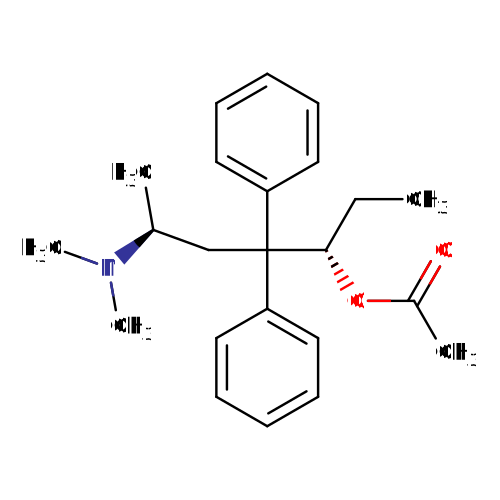
- Weight
- Average: 353.4977
Monoisotopic: 353.235479241 - Chemical Formula
- C23H31NO2
- Synonyms
- (-)-alpha-Acetylmethadol
- (1S,4S)-4-(dimethylamino)-1-ethyl-2,2-diphenylpentyl acetate
- 1-alpha-Acetylmethadol
- LAAM
- Levacetilmetadol
- Levacetylmethadol
- Levacetylmethadolum
- Levo-alpha-acetylmethadol
- Levo-methadyl acetate
- Levo-α-acetylmethadol
- Levomethadyl
- Levomethadyl acetate

Pharmacology
- Indication
For the treatment and management of opiate dependence. It is sometimes used to treat severe pain in terminal patients.
 Reduce drug development failure ratesBuild, train, & validate machine-learning modelswith evidence-based and structured datasets.Build, train, & validate predictive machine-learning models with structured datasets.
- Contraindications & Blackbox Warnings
 Prevent Adverse Drug Events TodayTap into our Clinical API for life-saving information on contraindications & blackbox warnings, population restrictions, harmful risks, & more.Avoid life-threatening adverse drug events with our Clinical API
- Pharmacodynamics
Levomethadyl acetate (also known as LAAM) is a synthetic synthetic opioid analgesic with multiple actions quantitatively similar to those as morphine, the most prominent of which involve the central nervous system and organs composed of smooth muscle. However, levomethadyl acetate is more active and more toxic than morphine. The principal actions of therapeutic value are analgesia and sedation and detoxification or temporary maintenance in narcotic addiction. In this respect, the drug is similar to Methadone and also has structural similarities to it. The levomethadyl acetate abstinence syndrome, although qualitatively similar to that of morphine, differs in that the onset is slower, the course is more prolonged, and the symptoms are less severe.
- Mechanism of action
Opiate receptors (Mu, Kappa, Delta) are coupled with G-protein receptors and function as both positive and negative regulators of synaptic transmission via G-proteins that activate effector proteins. Binding of the opiate stimulates the exchange of GTP for GDP on the G-protein complex. As the effector system is adenylate cyclase and cAMP located at the inner surface of the plasma membrane, opioids decrease intracellular cAMP by inhibiting adenylate cyclase. Subsequently, the release of nociceptive neurotransmitters such as substance P, GABA, dopamine, acetylcholine and noradrenaline is inhibited. Opioids also inhibit the release of vasopressin, somatostatin, insulin and glucagon. Levomethadyl acetate effectively opens calcium-dependent inwardly rectifying potassium channels (OP1 receptor agonist), resulting in hyperpolarization and reduced neuronal excitability.
Target Actions Organism AMu-type opioid receptor agonistHumans UNeuronal acetylcholine receptor subunit beta-4 other/unknownHumans UNeuronal acetylcholine receptor subunit alpha-3 antagonistHumans - Absorption
Levomethadyl acetate is rapidly absorbed from an oral solution.
- Volume of distribution
Not Available
- Protein binding
Approximately 80%
- Metabolism
Levomethadyl acetate is demethylated to nor-levomethadyl acetate which is again demethylated to dinor-levomethadyl acetate. This extensive first pass metabolism produces 2 metabolites that are more active than the parent drug.
Hover over products below to view reaction partners
- Route of elimination
Not Available
- Half-life
2.6 days
- Clearance
Not Available
- Adverse Effects
 Improve decision support & research outcomesWith structured adverse effects data, including: blackbox warnings, adverse reactions, warning & precautions, & incidence rates. View sample adverse effects data in our new Data Library!Improve decision support & research outcomes with our structured adverse effects data.
- Toxicity
Signs of overdose include apnea, circulatory collapse, pulmonary edema, cardiac arrest, and death.
- Pathways
Pathway Category Levomethadyl Acetate Action Action Pathway Drug action Levomethadyl Acetate Metabolism Pathway Drug metabolism - Pharmacogenomic Effects/ADRs
- Not Available
Interactions
- Drug Interactions
- This information should not be interpreted without the help of a healthcare provider. If you believe you are experiencing an interaction, contact a healthcare provider immediately. The absence of an interaction does not necessarily mean no interactions exist.
Drug Interaction Integrate drug-drug
interactions in your software1,2-Benzodiazepine The risk or severity of adverse effects can be increased when Levacetylmethadol is combined with 1,2-Benzodiazepine. Abametapir The serum concentration of Levacetylmethadol can be increased when it is combined with Abametapir. Abatacept The metabolism of Levacetylmethadol can be increased when combined with Abatacept. Acalabrutinib The metabolism of Levacetylmethadol can be decreased when combined with Acalabrutinib. Acetaminophen The metabolism of Levacetylmethadol can be increased when combined with Acetaminophen. - Food Interactions
- Not Available
Products
 Drug product information from 10+ global regionsOur datasets provide approved product information including:dosage, form, labeller, route of administration, and marketing period.Access drug product information from over 10 global regions.
- Product Ingredients
Ingredient UNII CAS InChI Key Levacetylmethadol hydrochloride B54CW5KG52 43033-72-3 UXBPQRGCVJOTNT-COBSGTNCSA-N - International/Other Brands
- Orlaam
Categories
- ATC Codes
- N07BC03 — Levacetylmethadol
- Drug Categories
- Analgesics
- Anticholinergic Agents
- Central Nervous System Agents
- Central Nervous System Depressants
- Cytochrome P-450 CYP3A Substrates
- Cytochrome P-450 CYP3A4 Substrates
- Cytochrome P-450 CYP3A4 Substrates with a Narrow Therapeutic Index
- Cytochrome P-450 CYP3A7 Substrates
- Cytochrome P-450 CYP3A7 Substrates with a Narrow Therapeutic Index
- Cytochrome P-450 Substrates
- Drugs Used in Addictive Disorders
- Drugs Used in Opioid Dependence
- Ketones
- Moderate Risk QTc-Prolonging Agents
- Narcotics
- Narrow Therapeutic Index Drugs
- Nervous System
- Nicotinic Antagonists
- Opioids
- Peripheral Nervous System Agents
- QTc Prolonging Agents
- Sensory System Agents
- Serotonergic Drugs Shown to Increase Risk of Serotonin Syndrome
- Chemical TaxonomyProvided by Classyfire
- Description
- This compound belongs to the class of organic compounds known as diphenylmethanes. These are compounds containing a diphenylmethane moiety, which consists of a methane wherein two hydrogen atoms are replaced by two phenyl groups.
- Kingdom
- Organic compounds
- Super Class
- Benzenoids
- Class
- Benzene and substituted derivatives
- Sub Class
- Diphenylmethanes
- Direct Parent
- Diphenylmethanes
- Alternative Parents
- Aralkylamines / Trialkylamines / Carboxylic acid esters / Amino acids and derivatives / Monocarboxylic acids and derivatives / Organopnictogen compounds / Organic oxides / Hydrocarbon derivatives / Carbonyl compounds
- Substituents
- Amine / Amino acid or derivatives / Aralkylamine / Aromatic homomonocyclic compound / Carbonyl group / Carboxylic acid derivative / Carboxylic acid ester / Diphenylmethane / Hydrocarbon derivative / Monocarboxylic acid or derivatives
- Molecular Framework
- Aromatic homomonocyclic compounds
- External Descriptors
- tertiary amino compound, acetate ester (CHEBI:6441)
- Affected organisms
- Humans and other mammals
Chemical Identifiers
- UNII
- R3B637Y991
- CAS number
- 1477-40-3
- InChI Key
- XBMIVRRWGCYBTQ-AVRDEDQJSA-N
- InChI
- InChI=1S/C23H31NO2/c1-6-22(26-19(3)25)23(17-18(2)24(4)5,20-13-9-7-10-14-20)21-15-11-8-12-16-21/h7-16,18,22H,6,17H2,1-5H3/t18-,22-/m0/s1
- IUPAC Name
- (3S,6S)-6-(dimethylamino)-4,4-diphenylheptan-3-yl acetate
- SMILES
- CC[C@H](OC(C)=O)C(C[C@H](C)N(C)C)(C1=CC=CC=C1)C1=CC=CC=C1
References
- General References
- Ghodse, AH; Galea, S. (2008). Chapter 8: Opioid analgesics and narcotic antagonists. In Side Effects of Drugs Annual: A Worldwide Yearly Survey of New Data and Trends in Adverse Drug Reactions (pp. 111). Elsevier. [ISBN:0080931510,9780080931517]
- EMA: Public statement on the recommendation to suspend the marketing authorisation for Orlaam (levacetylmethadol) in the European Union [Link]
- External Links
- Human Metabolome Database
- HMDB0015358
- KEGG Drug
- D04716
- KEGG Compound
- C08012
- PubChem Compound
- 15130
- PubChem Substance
- 46507749
- ChemSpider
- 14401
- 237005
- ChEBI
- 6441
- ChEMBL
- CHEMBL1514
- ZINC
- ZINC000001530967
- Therapeutic Targets Database
- DAP001139
- PharmGKB
- PA450215
- RxList
- RxList Drug Page
- Drugs.com
- Drugs.com Drug Page
- Wikipedia
- Levacetylmethadol
Clinical Trials
- Clinical Trials
Phase Status Purpose Conditions Count 2 Completed Treatment Heroin Dependence / Opioid Related Disorders 1
Pharmacoeconomics
- Manufacturers
- Not Available
- Packagers
- Not Available
- Dosage Forms
Form Route Strength Solution Oral - Prices
- Not Available
- Patents
- Not Available
Properties
- State
- Solid
- Experimental Properties
Property Value Source water solubility >15 mg/mL Not Available logP 5.4 Not Available - Predicted Properties
Property Value Source Water Solubility 0.00179 mg/mL ALOGPS logP 4.78 ALOGPS logP 4.88 Chemaxon logS -5.3 ALOGPS pKa (Strongest Basic) 9.87 Chemaxon Physiological Charge 1 Chemaxon Hydrogen Acceptor Count 2 Chemaxon Hydrogen Donor Count 0 Chemaxon Polar Surface Area 29.54 Å2 Chemaxon Rotatable Bond Count 9 Chemaxon Refractivity 117.86 m3·mol-1 Chemaxon Polarizability 40.53 Å3 Chemaxon Number of Rings 2 Chemaxon Bioavailability 1 Chemaxon Rule of Five Yes Chemaxon Ghose Filter Yes Chemaxon Veber's Rule Yes Chemaxon MDDR-like Rule No Chemaxon - Predicted ADMET Features
Property Value Probability Human Intestinal Absorption + 0.9965 Blood Brain Barrier + 0.9648 Caco-2 permeable + 0.7459 P-glycoprotein substrate Substrate 0.5822 P-glycoprotein inhibitor I Inhibitor 0.8472 P-glycoprotein inhibitor II Non-inhibitor 0.8897 Renal organic cation transporter Non-inhibitor 0.6473 CYP450 2C9 substrate Non-substrate 0.7976 CYP450 2D6 substrate Non-substrate 0.8641 CYP450 3A4 substrate Substrate 0.6658 CYP450 1A2 substrate Inhibitor 0.5619 CYP450 2C9 inhibitor Non-inhibitor 0.8153 CYP450 2D6 inhibitor Inhibitor 0.7123 CYP450 2C19 inhibitor Non-inhibitor 0.7312 CYP450 3A4 inhibitor Inhibitor 0.5242 CYP450 inhibitory promiscuity Low CYP Inhibitory Promiscuity 0.5811 Ames test Non AMES toxic 0.9016 Carcinogenicity Carcinogens 0.7025 Biodegradation Not ready biodegradable 0.9792 Rat acute toxicity 3.3406 LD50, mol/kg Not applicable hERG inhibition (predictor I) Weak inhibitor 0.9706 hERG inhibition (predictor II) Inhibitor 0.7157
Spectra
- Mass Spec (NIST)
- Not Available
- Spectra
Spectrum Spectrum Type Splash Key Predicted GC-MS Spectrum - GC-MS Predicted GC-MS splash10-0uk9-9081000000-c21fec0e8e70744482b4 Predicted MS/MS Spectrum - 10V, Positive (Annotated) Predicted LC-MS/MS splash10-0udi-1059000000-e4c3ebcd97ab4541f80f Predicted MS/MS Spectrum - 10V, Negative (Annotated) Predicted LC-MS/MS splash10-0a4i-9000000000-795e00f9f8072189b0b6 Predicted MS/MS Spectrum - 20V, Negative (Annotated) Predicted LC-MS/MS splash10-0a4i-9000000000-06464f476e9b46a53d83 Predicted MS/MS Spectrum - 20V, Positive (Annotated) Predicted LC-MS/MS splash10-0zfu-3092000000-90263d43fba5cf6c6e7f Predicted MS/MS Spectrum - 40V, Negative (Annotated) Predicted LC-MS/MS splash10-05dl-6930000000-7465df7e05f082a66875 Predicted MS/MS Spectrum - 40V, Positive (Annotated) Predicted LC-MS/MS splash10-00y0-7591000000-307ef02090719d8a3d71 Predicted 1H NMR Spectrum 1D NMR Not Applicable Predicted 13C NMR Spectrum 1D NMR Not Applicable - Chromatographic Properties
Collision Cross Sections (CCS)
Adduct CCS Value (Å2) Source type Source [M-H]- 194.8770228 predictedDarkChem Lite v0.1.0 [M-H]- 193.8580228 predictedDarkChem Lite v0.1.0 [M-H]- 186.87653 predictedDeepCCS 1.0 (2019) [M+H]+ 194.1496228 predictedDarkChem Lite v0.1.0 [M+H]+ 194.4231228 predictedDarkChem Lite v0.1.0 [M+H]+ 189.23451 predictedDeepCCS 1.0 (2019) [M+Na]+ 195.2479228 predictedDarkChem Lite v0.1.0 [M+Na]+ 194.0522228 predictedDarkChem Lite v0.1.0 [M+Na]+ 195.91646 predictedDeepCCS 1.0 (2019)
Targets

- Kind
- Protein
- Organism
- Humans
- Pharmacological action
- Yes
- Actions
- Agonist
- General Function
- Voltage-gated calcium channel activity
- Specific Function
- Receptor for endogenous opioids such as beta-endorphin and endomorphin. Receptor for natural and synthetic opioids including morphine, heroin, DAMGO, fentanyl, etorphine, buprenorphin and methadone...
- Gene Name
- OPRM1
- Uniprot ID
- P35372
- Uniprot Name
- Mu-type opioid receptor
- Molecular Weight
- 44778.855 Da
References
- Yu Y, Zhang L, Yin X, Sun H, Uhl GR, Wang JB: Mu opioid receptor phosphorylation, desensitization, and ligand efficacy. J Biol Chem. 1997 Nov 14;272(46):28869-74. [Article]
- Skoulis NP, James RC, Harbison RD, Roberts SM: Depression of hepatic glutathione by opioid analgesic drugs in mice. Toxicol Appl Pharmacol. 1989 Jun 1;99(1):139-47. [Article]
- Kreek MJ: Methadone-related opioid agonist pharmacotherapy for heroin addiction. History, recent molecular and neurochemical research and future in mainstream medicine. Ann N Y Acad Sci. 2000;909:186-216. [Article]
- Xiao Y, Smith RD, Caruso FS, Kellar KJ: Blockade of rat alpha3beta4 nicotinic receptor function by methadone, its metabolites, and structural analogs. J Pharmacol Exp Ther. 2001 Oct;299(1):366-71. [Article]
- Chen X, Ji ZL, Chen YZ: TTD: Therapeutic Target Database. Nucleic Acids Res. 2002 Jan 1;30(1):412-5. [Article]
- Kind
- Protein
- Organism
- Humans
- Pharmacological action
- Unknown
- Actions
- Other/unknown
- General Function
- Ligand-gated ion channel activity
- Specific Function
- After binding acetylcholine, the AChR responds by an extensive change in conformation that affects all subunits and leads to opening of an ion-conducting channel across the plasma membrane.
- Gene Name
- CHRNB4
- Uniprot ID
- P30926
- Uniprot Name
- Neuronal acetylcholine receptor subunit beta-4
- Molecular Weight
- 56378.985 Da
References
- Xiao Y, Smith RD, Caruso FS, Kellar KJ: Blockade of rat alpha3beta4 nicotinic receptor function by methadone, its metabolites, and structural analogs. J Pharmacol Exp Ther. 2001 Oct;299(1):366-71. [Article]
- Kind
- Protein
- Organism
- Humans
- Pharmacological action
- Unknown
- Actions
- Antagonist
- General Function
- Ligand-gated ion channel activity
- Specific Function
- After binding acetylcholine, the AChR responds by an extensive change in conformation that affects all subunits and leads to opening of an ion-conducting channel across the plasma membrane.
- Gene Name
- CHRNA3
- Uniprot ID
- P32297
- Uniprot Name
- Neuronal acetylcholine receptor subunit alpha-3
- Molecular Weight
- 57479.54 Da
References
- Xiao Y, Smith RD, Caruso FS, Kellar KJ: Blockade of rat alpha3beta4 nicotinic receptor function by methadone, its metabolites, and structural analogs. J Pharmacol Exp Ther. 2001 Oct;299(1):366-71. [Article]
Enzymes
- Kind
- Protein
- Organism
- Humans
- Pharmacological action
- Unknown
- Actions
- Substrate
- General Function
- Vitamin d3 25-hydroxylase activity
- Specific Function
- Cytochromes P450 are a group of heme-thiolate monooxygenases. In liver microsomes, this enzyme is involved in an NADPH-dependent electron transport pathway. It performs a variety of oxidation react...
- Gene Name
- CYP3A4
- Uniprot ID
- P08684
- Uniprot Name
- Cytochrome P450 3A4
- Molecular Weight
- 57342.67 Da
References
- Oda Y, Kharasch ED: Metabolism of methadone and levo-alpha-acetylmethadol (LAAM) by human intestinal cytochrome P450 3A4 (CYP3A4): potential contribution of intestinal metabolism to presystemic clearance and bioactivation. J Pharmacol Exp Ther. 2001 Sep;298(3):1021-32. [Article]
- Kharasch ED, Whittington D, Hoffer C, Krudys K, Craig K, Vicini P, Sheffels P, Lalovic B: Paradoxical role of cytochrome P450 3A in the bioactivation and clinical effects of levo-alpha-acetylmethadol: importance of clinical investigations to validate in vitro drug metabolism studies. Clin Pharmacokinet. 2005;44(7):731-51. doi: 10.2165/00003088-200544070-00005. [Article]
- Kind
- Protein
- Organism
- Humans
- Pharmacological action
- Unknown
- Actions
- Substrate
- General Function
- Oxygen binding
- Specific Function
- Cytochromes P450 are a group of heme-thiolate monooxygenases. In liver microsomes, this enzyme is involved in an NADPH-dependent electron transport pathway. It oxidizes a variety of structurally un...
- Gene Name
- CYP3A7
- Uniprot ID
- P24462
- Uniprot Name
- Cytochrome P450 3A7
- Molecular Weight
- 57525.03 Da

Drug created at June 13, 2005 13:24 / Updated at February 02, 2024 22:54