Identification
- Summary
Tetracosactide is a diagnostic agent used in the screening of patients presumed to have adrenocortical insufficiency.
- Brand Names
- Cortrosyn, Synacthen
- Generic Name
- Tetracosactide
- DrugBank Accession Number
- DB01284
- Background
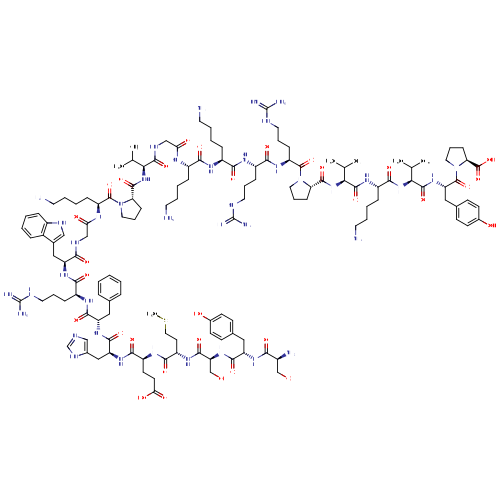
Tetracosactide (also known as Cosyntropin) is a synthetic peptide that is identical to the 24-amino acid segment (sequence: SYSMEHFRWGKPVGKKRRPVKVYP) at the N-terminal of adrenocorticotropic hormone. ACTH (1-24), a segment similar in all species, contains the biological activity that stimulates production of corticosteroids in the adrenal cortex. Tetracosactide exhibits the same activity as natural ACTH with regard to all its biological activities. The complex results in a product whose absorption in man is effected over a longer period of time as compared to corticotropin. Therefore, therapy may be maintained with less frequent administration.
- Type
- Small Molecule
- Groups
- Approved
- Structure
Structure for Tetracosactide (DB01284)
- Weight
- Average: 2933.49
Monoisotopic: 2931.580641316 - Chemical Formula
- C136H210N40O31S
- Synonyms
- adrenocorticotropic hormone 1-24
- Adrenocorticotropic hormone fragment 1-24 human, rat
- alpha(1-24)-corticotrophin
- ATCH (1-24)
- beta(1-24)-corticotrophin
- Corticotropin tetracosapeptide
- corticotropin-(1-24)
- corticotropin-(1-24) tetracosapeptide
- Cosyntropin
- Tetracosactida
- Tetracosactide
- Tetracosactrin
- α1-24-corticotrophin
- β1-24-corticotrophin

Pharmacology
- Indication
For use as a diagnostic agent in the screening of patients presumed to have adrenocortical insufficiency.
 Reduce drug development failure ratesBuild, train, & validate machine-learning modelswith evidence-based and structured datasets.Build, train, & validate predictive machine-learning models with structured datasets.
- Associated Conditions
Indication Type Indication Combined Product Details Approval Level Age Group Patient Characteristics Dose Form Adjunct therapy in treatment of Acute gout •••••••••••• Management of Acute rheumatic fever •••••••••••• Diagnostic agent Adrenal insufficiency •••••••••••• Management of Bell's palsy •••••••••••• Management of Choroiditis •••••••••••• - Contraindications & Blackbox Warnings
 Prevent Adverse Drug Events TodayTap into our Clinical API for life-saving information on contraindications & blackbox warnings, population restrictions, harmful risks, & more.Avoid life-threatening adverse drug events with our Clinical API
- Pharmacodynamics
Cosyntropin exhibits the full corticosteroidogenic activity of natural ACTH. Various studies have shown that the biologic activity of ACTH resides in the N- terminal portion of the molecule and that the 1-20 amino acid residue is the minimal sequence retaining full activity. Partial or complete loss of activity is noted with progressive shortening of the chain beyond 20 amino acid residue. For example, the decrement from 20 to 19 results in a 70% loss of potency. The pharmacologic profile of Cosyntropin is similar to that of purified natural ACTH. It has been established that 0.25 mg of Cosyntropin will stimulate the adrenal cortex maximally and to the same extent as 25 units of natural ACTH. Cosyntropin has less immunogenic activity than ACTH because the amino acid sequence having most of the antigenic activity of ACTH, i.e., amino acids 25-39, is not present in cosyntropin. The extra-adrenal effects which natural ACTH and Cosyntropin have in common include increased melanotropic activity, increased growth hormone secretion and an adipokinetic effect. These are considered to be without physiological or clinical significance.
- Mechanism of action
Cosyntropin combines with a specific receptor in the adrenal cell plasma membrane and, in patients with normal adrenocortical function, stimulates the initial reaction involved in the synthesis of adrenal steroids (including cortisol, cortisone, weak androgenic substances, and a limited quantity of aldosterone) from cholesterol by increasing the quantity of the substrate within the mitochondria. Cosyntropin does not significantly increase plasma cortisol concentration in patients with primary or secondary adrenocortical insufficiency.
Target Actions Organism AAdrenocorticotropic hormone receptor agonistHumans - Absorption
Rapidly absorbed following intramuscular administration.
- Volume of distribution
Not Available
- Protein binding
Not Available
- Metabolism
- Not Available
- Route of elimination
Not Available
- Half-life
About 15 minutes following intravenous administration.
- Clearance
Not Available
- Adverse Effects
 Improve decision support & research outcomesWith structured adverse effects data, including: blackbox warnings, adverse reactions, warning & precautions, & incidence rates. View sample adverse effects data in our new Data Library!Improve decision support & research outcomes with our structured adverse effects data.
- Toxicity
Not Available
- Pathways
- Not Available
- Pharmacogenomic Effects/ADRs
- Not Available
Interactions
- Drug Interactions
- This information should not be interpreted without the help of a healthcare provider. If you believe you are experiencing an interaction, contact a healthcare provider immediately. The absence of an interaction does not necessarily mean no interactions exist.
Drug Interaction Integrate drug-drug
interactions in your softwareAcetazolamide The risk or severity of liver damage can be increased when Tetracosactide is combined with Acetazolamide. Amobarbital The risk or severity of liver damage can be increased when Tetracosactide is combined with Amobarbital. Brexanolone The risk or severity of liver damage can be increased when Tetracosactide is combined with Brexanolone. Brivaracetam The risk or severity of liver damage can be increased when Tetracosactide is combined with Brivaracetam. Butalbital The risk or severity of liver damage can be increased when Tetracosactide is combined with Butalbital. - Food Interactions
- No interactions found.
Products
 Drug product information from 10+ global regionsOur datasets provide approved product information including:dosage, form, labeller, route of administration, and marketing period.Access drug product information from over 10 global regions.
- Product Ingredients
Ingredient UNII CAS InChI Key Tetracosactide acetate H86HJ92K8Y 22633-88-1 DFABUZLKSKOWCS-WMPFGLIOSA-N - Brand Name Prescription Products
Name Dosage Strength Route Labeller Marketing Start Marketing End Region Image Cortrosyn Injection, powder, lyophilized, for solution 0.25 mg/1mL Intramuscular; Intravenous A-S Medication Solutions 2003-08-01 Not applicable US 
Cortrosyn Injection, powder, lyophilized, for solution 0.25 mg/1mL Intramuscular; Intravenous Amphastar Pharmaceuticals, Inc. 2003-08-01 Not applicable US Cortrosyn Injection, powder, lyophilized, for solution 0.25 mg/1mL Intramuscular; Intravenous; Parenteral Henry Schein, Inc. 2022-01-09 Not applicable US Cortrosyn Injection, powder, lyophilized, for solution 0.25 mg/1mL Intramuscular; Intravenous; Parenteral General Injectables & Vaccines, Inc 2010-03-01 Not applicable US Cortrosyn Inj 0.25mg Powder, for solution 0.25 mg / vial Intramuscular; Intravenous Amphastar Pharmaceuticals, Inc. 1974-12-31 Not applicable Canada 
- Generic Prescription Products
Name Dosage Strength Route Labeller Marketing Start Marketing End Region Image Cosyntropin Injection, powder, for solution 0.25 mg/1mL Intramuscular; Intravenous Mylan Institutional LLC 2013-04-24 Not applicable US Cosyntropin Injection, powder, lyophilized, for solution 0.25 mg/1mL Intravenous HF Acquisition Co LLC, DBA HealthFirst 2021-07-10 Not applicable US Cosyntropin Injection, powder, for solution 0.25 mg/1mL Intramuscular; Intravenous Mylan Institutional LLC 2012-07-27 2012-07-27 US Cosyntropin Injection, powder, lyophilized, for solution 0.25 mg/1mL Intravenous Sandoz Inc 2012-06-29 Not applicable US Cosyntropin Injection, powder, lyophilized, for solution 0.25 mg/1mL Intravenous Medical Purchasing Solutions, Llc 2012-06-29 Not applicable US
Categories
- ATC Codes
- H01AA02 — Tetracosactide
- Drug Categories
- Adrenals
- Adrenocortical Insufficiency
- Adrenocorticotropic Hormone
- Amino Acids, Peptides, and Proteins
- Anterior Pituitary Lobe Hormones and Analogues
- Hormones
- Hormones, Hormone Substitutes, and Hormone Antagonists
- Melanocortins
- Nerve Tissue Proteins
- Neuropeptides
- Peptide Hormones
- Peptides
- Pituitary
- Pituitary and Hypothalamic Hormones and Analogues
- Pituitary Hormones
- Pituitary Hormones, Anterior
- Pro-Opiomelanocortin
- Proteins
- Systemic Hormonal Preparations, Excl. Sex Hormones and Insulins
- Chemical TaxonomyProvided by Classyfire
- Description
- This compound belongs to the class of organic compounds known as polypeptides. These are peptides containing ten or more amino acid residues.
- Kingdom
- Organic compounds
- Super Class
- Organic Polymers
- Class
- Polypeptides
- Sub Class
- Not Available
- Direct Parent
- Polypeptides
- Alternative Parents
- Peptides / Tyrosine and derivatives / Arginine and derivatives / Phenylalanine and derivatives / Histidine and derivatives / Glutamic acid and derivatives / Methionine and derivatives / Valine and derivatives / Proline and derivatives / N-acyl-L-alpha-amino acids show 30 more
- Substituents
- 1-hydroxy-2-unsubstituted benzenoid / 3-alkylindole / Alcohol / Alpha peptide / Alpha-amino acid amide / Alpha-amino acid or derivatives / Amine / Amino acid / Amino acid or derivatives / Amphetamine or derivatives show 61 more
- Molecular Framework
- Aromatic heteropolycyclic compounds
- External Descriptors
- polypeptide (CHEBI:3901)
- Affected organisms
- Humans and other mammals
Chemical Identifiers
- UNII
- 72YY86EA29
- CAS number
- 16960-16-0
- InChI Key
- ZOEFCCMDUURGSE-SQKVDDBVSA-N
- InChI
- InChI=1S/C136H210N40O31S/c1-75(2)109(127(200)154-71-106(181)156-88(31-13-17-52-137)114(187)158-89(32-14-18-53-138)115(188)159-91(35-21-56-149-134(142)143)116(189)164-96(37-23-58-151-136(146)147)131(204)175-60-25-39-104(175)126(199)173-111(77(5)6)128(201)163-90(33-15-19-54-139)120(193)171-110(76(3)4)129(202)169-101(65-80-43-47-84(180)48-44-80)132(205)176-61-26-40-105(176)133(206)207)172-125(198)103-38-24-59-174(103)130(203)95(34-16-20-55-140)157-107(182)70-153-113(186)99(66-81-68-152-87-30-12-11-29-85(81)87)167-117(190)92(36-22-57-150-135(144)145)160-121(194)98(63-78-27-9-8-10-28-78)166-123(196)100(67-82-69-148-74-155-82)168-118(191)93(49-50-108(183)184)161-119(192)94(51-62-208-7)162-124(197)102(73-178)170-122(195)97(165-112(185)86(141)72-177)64-79-41-45-83(179)46-42-79/h8-12,27-30,41-48,68-69,74-77,86,88-105,109-111,152,177-180H,13-26,31-40,49-67,70-73,137-141H2,1-7H3,(H,148,155)(H,153,186)(H,154,200)(H,156,181)(H,157,182)(H,158,187)(H,159,188)(H,160,194)(H,161,192)(H,162,197)(H,163,201)(H,164,189)(H,165,185)(H,166,196)(H,167,190)(H,168,191)(H,169,202)(H,170,195)(H,171,193)(H,172,198)(H,173,199)(H,183,184)(H,206,207)(H4,142,143,149)(H4,144,145,150)(H4,146,147,151)/t86-,88-,89-,90-,91-,92-,93-,94-,95-,96-,97-,98-,99-,100-,101-,102-,103-,104-,105-,109-,110-,111-/m0/s1
- IUPAC Name
- (2S)-1-[(2S)-2-[(2S)-2-[(2S)-6-amino-2-[(2S)-2-{[(2S)-1-[(2S)-2-[(2S)-2-[(2S)-6-amino-2-[(2S)-6-amino-2-{2-[(2S)-2-{[(2S)-1-[(2S)-6-amino-2-{2-[(2S)-2-[(2S)-2-[(2S)-2-[(2S)-2-[(2S)-2-[(2S)-2-[(2S)-2-[(2S)-2-[(2S)-2-amino-3-hydroxypropanamido]-3-(4-hydroxyphenyl)propanamido]-3-hydroxypropanamido]-4-(methylsulfanyl)butanamido]-4-carboxybutanamido]-3-(1H-imidazol-5-yl)propanamido]-3-phenylpropanamido]-5-carbamimidamidopentanamido]-3-(1H-indol-3-yl)propanamido]acetamido}hexanoyl]pyrrolidin-2-yl]formamido}-3-methylbutanamido]acetamido}hexanamido]hexanamido]-5-carbamimidamidopentanamido]-5-carbamimidamidopentanoyl]pyrrolidin-2-yl]formamido}-3-methylbutanamido]hexanamido]-3-methylbutanamido]-3-(4-hydroxyphenyl)propanoyl]pyrrolidine-2-carboxylic acid
- SMILES
- CSCC[C@H](NC(=O)[C@H](CO)NC(=O)[C@H](CC1=CC=C(O)C=C1)NC(=O)[C@@H](N)CO)C(=O)N[C@@H](CCC(O)=O)C(=O)N[C@@H](CC1=CN=CN1)C(=O)N[C@@H](CC1=CC=CC=C1)C(=O)N[C@@H](CCCNC(N)=N)C(=O)N[C@@H](CC1=CNC2=C1C=CC=C2)C(=O)NCC(=O)N[C@@H](CCCCN)C(=O)N1CCC[C@H]1C(=O)N[C@@H](C(C)C)C(=O)NCC(=O)N[C@@H](CCCCN)C(=O)N[C@@H](CCCCN)C(=O)N[C@@H](CCCNC(N)=N)C(=O)N[C@@H](CCCNC(N)=N)C(=O)N1CCC[C@H]1C(=O)N[C@@H](C(C)C)C(=O)N[C@@H](CCCCN)C(=O)N[C@@H](C(C)C)C(=O)N[C@@H](CC1=CC=C(O)C=C1)C(=O)N1CCC[C@H]1C(O)=O
References
- General References
- Not Available
- External Links
- KEGG Drug
- D00284
- KEGG Compound
- C06926
- PubChem Compound
- 16133751
- PubChem Substance
- 46506301
- ChemSpider
- 10481947
- BindingDB
- 50017180
- 2890
- ChEBI
- 3901
- ChEMBL
- CHEMBL2103784
- Therapeutic Targets Database
- DAP000284
- PharmGKB
- PA164749052
- RxList
- RxList Drug Page
- Drugs.com
- Drugs.com Drug Page
- Wikipedia
- Adrenocorticotropic_hormone_(medication)
Clinical Trials
- Clinical Trials
Phase Status Purpose Conditions Count 4 Completed Diagnostic Adrenal Insufficiency / Healthy Volunteers (HV) / Hypopituitarism 1 4 Completed Treatment Adrenal Failure 1 4 Completed Treatment Postdural Puncture Headache 1 4 Unknown Status Diagnostic Primary Aldosteronism 1 4 Withdrawn Diagnostic Adrenal Insufficiency 1
Pharmacoeconomics
- Manufacturers
- Not Available
- Packagers
- Amphastar Pharmaceuticals
- Generamedix Inc.
- Sandoz
- Dosage Forms
Form Route Strength Injection, powder, lyophilized, for solution Intramuscular; Intravenous; Parenteral 0.25 mg/1mL Powder, for solution Intramuscular; Intravenous 0.25 mg / vial Injection, powder, for solution Intramuscular; Intravenous 0.25 mg/1mL Injection, powder, lyophilized, for solution Intramuscular; Intravenous 0.25 mg/1mL Injection, powder, lyophilized, for solution Intravenous 0.25 mg/1mL Injection, solution Intravenous 0.25 mg/1mL Injection, solution Intravenous Injection, suspension Intramuscular 1 MG/ML Solution Intramuscular; Intravenous 0.25 mg/1ml Suspension Intramuscular 1 mg / mL Injection, suspension Intramuscular 1 mg - Prices
Unit description Cost Unit Cortrosyn 0.25 mg vial 127.9USD vial Cosyntropin 0.25 mg/ml 119.91USD ml Cosyntropin 0.25 mg vial 115.1USD vial Synacthen Depot 1 mg/vial 34.77USD vial DrugBank does not sell nor buy drugs. Pricing information is supplied for informational purposes only.- Patents
- Not Available
Properties
- State
- Solid
- Experimental Properties
- Not Available
- Predicted Properties
Property Value Source Water Solubility 0.0481 mg/mL ALOGPS logP -0.95 ALOGPS logP -14 Chemaxon logS -4.8 ALOGPS pKa (Strongest Acidic) 3.03 Chemaxon pKa (Strongest Basic) 12.38 Chemaxon Physiological Charge 6 Chemaxon Hydrogen Acceptor Count 46 Chemaxon Hydrogen Donor Count 42 Chemaxon Polar Surface Area 1158.72 Å2 Chemaxon Rotatable Bond Count 93 Chemaxon Refractivity 790.98 m3·mol-1 Chemaxon Polarizability 309.35 Å3 Chemaxon Number of Rings 9 Chemaxon Bioavailability 0 Chemaxon Rule of Five No Chemaxon Ghose Filter No Chemaxon Veber's Rule No Chemaxon MDDR-like Rule Yes Chemaxon - Predicted ADMET Features
- Not Available
Spectra
- Mass Spec (NIST)
- Not Available
- Spectra
- Not Available
- Chromatographic Properties
Collision Cross Sections (CCS)
Not Available
Targets

- Kind
- Protein
- Organism
- Humans
- Pharmacological action
- Yes
- Actions
- Agonist
- General Function
- Melanocortin receptor activity
- Specific Function
- Receptor for corticotropin (ACTH). This receptor is mediated by G proteins (G(s)) which activate adenylate cyclase (cAMP).
- Gene Name
- MC2R
- Uniprot ID
- Q01718
- Uniprot Name
- Adrenocorticotropic hormone receptor
- Molecular Weight
- 33926.28 Da
References
- Schwerin M, Kanitz E, Tuchscherer M, Brussow KP, Nurnberg G, Otten W: Stress-related gene expression in brain and adrenal gland of porcine fetuses and neonates. Theriogenology. 2005 Mar 1;63(4):1220-34. [Article]
- Mehrabani PA, Bassett JR: Adrenocorticotropin binding sites in rat cardiac tissue. Pharmacol Biochem Behav. 1990 Jan;35(1):99-103. [Article]
- Moraes RB, Czepielewski MA, Friedman G: Cortisol variation after low-dose Cortrosyn test. Crit Care Med. 2010 Jul;38(7):1612-3. doi: 10.1097/CCM.0b013e3181da4ef1. [Article]
- Chen X, Ji ZL, Chen YZ: TTD: Therapeutic Target Database. Nucleic Acids Res. 2002 Jan 1;30(1):412-5. [Article]

Drug created at May 24, 2007 03:46 / Updated at April 17, 2024 06:33