Identification
- Generic Name
- Forasartan
- DrugBank Accession Number
- DB01342
- Background
Forasartan, a specific angiotensin II antagonist, is used alone or with other antihypertensive agents to treat hypertension. Forasartan competes with angiotensin II for binding at the AT1 receptor subtype. As angiotensin II is a vasoconstrictor which also stimulates the synthesis and release of aldosterone, blockage of its effects results in a decreases in systemic vascular resistance.
- Type
- Small Molecule
- Groups
- Experimental
- Structure
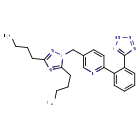
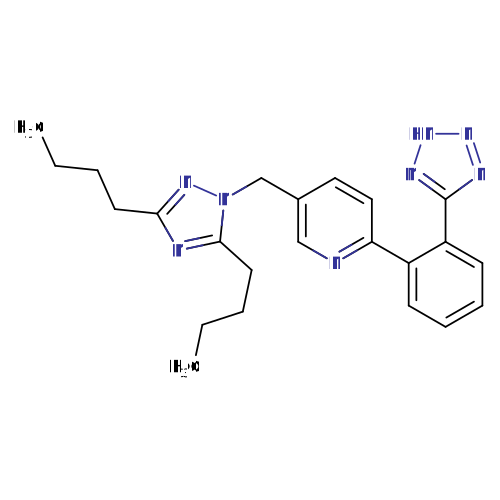
Structure for Forasartan (DB01342)
- Weight
- Average: 416.522
Monoisotopic: 416.243692936 - Chemical Formula
- C23H28N8
- Synonyms
- forasartán
- Forasartan
- External IDs
- SC-52458

Pharmacology
- Indication
For the treatment of hypertension.
 Reduce drug development failure ratesBuild, train, & validate machine-learning modelswith evidence-based and structured datasets.Build, train, & validate predictive machine-learning models with structured datasets.
- Contraindications & Blackbox Warnings
 Prevent Adverse Drug Events TodayTap into our Clinical API for life-saving information on contraindications & blackbox warnings, population restrictions, harmful risks, & more.Avoid life-threatening adverse drug events with our Clinical API
- Pharmacodynamics
Forasartan, a specific angiotensin II antagonist, is used alone or with other antihypertensive agents to treat hypertension. By inhibiting angiotensin II receptors, this drug leads to a decrease in sodium reabsorption (which decreases water content of blood) and a decrease in vasoconstriction. Combined, this has the effect of lowering blood pressure.
- Mechanism of action
Forasartan competes with angiotensin II for binding at the AT1 receptor subtype. As angiotensin II is a vasoconstrictor which also stimulates the synthesis and release of aldosterone, blockage of its effects results in a decreases in systemic vascular resistance. Also, since angiotensin causes vasoconstriction, the inhibition of this receptor decreases vasoconstriction, which consequently also decreases vascular resistnace.
Target Actions Organism AType-1 angiotensin II receptor antagonistHumans - Absorption
Not Available
- Volume of distribution
Not Available
- Protein binding
Not Available
- Metabolism
- Not Available
- Route of elimination
Not Available
- Half-life
Not Available
- Clearance
Not Available
- Adverse Effects
 Improve decision support & research outcomesWith structured adverse effects data, including: blackbox warnings, adverse reactions, warning & precautions, & incidence rates. View sample adverse effects data in our new Data Library!Improve decision support & research outcomes with our structured adverse effects data.
- Toxicity
Not Available
- Pathways
Pathway Category Forasartan Action Pathway Drug action - Pharmacogenomic Effects/ADRs
- Not Available
Interactions
- Drug Interactions
- This information should not be interpreted without the help of a healthcare provider. If you believe you are experiencing an interaction, contact a healthcare provider immediately. The absence of an interaction does not necessarily mean no interactions exist.
Drug Interaction Integrate drug-drug
interactions in your softwareAcebutolol The risk or severity of hyperkalemia can be increased when Acebutolol is combined with Forasartan. Aceclofenac The risk or severity of renal failure, hyperkalemia, and hypertension can be increased when Forasartan is combined with Aceclofenac. Acemetacin The risk or severity of renal failure, hyperkalemia, and hypertension can be increased when Forasartan is combined with Acemetacin. Acetylsalicylic acid The risk or severity of renal failure, hyperkalemia, and hypertension can be increased when Forasartan is combined with Acetylsalicylic acid. Alclofenac The risk or severity of renal failure, hyperkalemia, and hypertension can be increased when Forasartan is combined with Alclofenac. - Food Interactions
- Not Available
Categories
- Drug Categories
- Chemical TaxonomyProvided by Classyfire
- Description
- This compound belongs to the class of organic compounds known as phenylpyridines. These are polycyclic aromatic compounds containing a benzene ring linked to a pyridine ring through a CC or CN bond.
- Kingdom
- Organic compounds
- Super Class
- Organoheterocyclic compounds
- Class
- Pyridines and derivatives
- Sub Class
- Phenylpyridines
- Direct Parent
- Phenylpyridines
- Alternative Parents
- Phenyltetrazoles and derivatives / Benzene and substituted derivatives / Triazoles / Heteroaromatic compounds / Azacyclic compounds / Organopnictogen compounds / Organonitrogen compounds / Hydrocarbon derivatives
- Substituents
- 1,2,4-triazole / 2-phenylpyridine / Aromatic heteromonocyclic compound / Azacycle / Azole / Benzenoid / Heteroaromatic compound / Hydrocarbon derivative / Monocyclic benzene moiety / Organic nitrogen compound
- Molecular Framework
- Aromatic heteromonocyclic compounds
- External Descriptors
- Not Available
- Affected organisms
- Humans and other mammals
Chemical Identifiers
- UNII
- 065F7WPT0B
- CAS number
- 145216-43-9
- InChI Key
- YONOBYIBNBCDSJ-UHFFFAOYSA-N
- InChI
- InChI=1S/C23H28N8/c1-3-5-11-21-25-22(12-6-4-2)31(28-21)16-17-13-14-20(24-15-17)18-9-7-8-10-19(18)23-26-29-30-27-23/h7-10,13-15H,3-6,11-12,16H2,1-2H3,(H,26,27,29,30)
- IUPAC Name
- 5-[(3,5-dibutyl-1H-1,2,4-triazol-1-yl)methyl]-2-[2-(2H-1,2,3,4-tetrazol-5-yl)phenyl]pyridine
- SMILES
- CCCCC1=NN(CC2=CN=C(C=C2)C2=CC=CC=C2C2=NNN=N2)C(CCCC)=N1
References
- General References
- Not Available
- External Links
- Human Metabolome Database
- HMDB0015434
- KEGG Drug
- D04243
- PubChem Compound
- 132706
- PubChem Substance
- 46505698
- ChemSpider
- 117146
- BindingDB
- 50049209
- ChEBI
- 141552
- ChEMBL
- CHEMBL315021
- ZINC
- ZINC000005139136
- Therapeutic Targets Database
- DAP001256
- PharmGKB
- PA164776845
- Wikipedia
- Forasartan
Clinical Trials
Pharmacoeconomics
- Manufacturers
- Not Available
- Packagers
- Not Available
- Dosage Forms
- Not Available
- Prices
- Not Available
- Patents
- Not Available
Properties
- State
- Solid
- Experimental Properties
- Not Available
- Predicted Properties
Property Value Source Water Solubility 0.00667 mg/mL ALOGPS logP 4.51 ALOGPS logP 5.8 Chemaxon logS -4.8 ALOGPS pKa (Strongest Acidic) 5.8 Chemaxon pKa (Strongest Basic) 3.98 Chemaxon Physiological Charge -1 Chemaxon Hydrogen Acceptor Count 6 Chemaxon Hydrogen Donor Count 1 Chemaxon Polar Surface Area 98.06 Å2 Chemaxon Rotatable Bond Count 10 Chemaxon Refractivity 145.44 m3·mol-1 Chemaxon Polarizability 46.79 Å3 Chemaxon Number of Rings 4 Chemaxon Bioavailability 1 Chemaxon Rule of Five No Chemaxon Ghose Filter No Chemaxon Veber's Rule No Chemaxon MDDR-like Rule Yes Chemaxon - Predicted ADMET Features
Property Value Probability Human Intestinal Absorption + 1.0 Blood Brain Barrier + 0.9069 Caco-2 permeable + 0.5 P-glycoprotein substrate Substrate 0.615 P-glycoprotein inhibitor I Non-inhibitor 0.6612 P-glycoprotein inhibitor II Non-inhibitor 0.8805 Renal organic cation transporter Inhibitor 0.5228 CYP450 2C9 substrate Non-substrate 0.7854 CYP450 2D6 substrate Non-substrate 0.831 CYP450 3A4 substrate Non-substrate 0.5512 CYP450 1A2 substrate Non-inhibitor 0.64 CYP450 2C9 inhibitor Non-inhibitor 0.5115 CYP450 2D6 inhibitor Non-inhibitor 0.7168 CYP450 2C19 inhibitor Inhibitor 0.7661 CYP450 3A4 inhibitor Inhibitor 0.6576 CYP450 inhibitory promiscuity High CYP Inhibitory Promiscuity 0.7192 Ames test Non AMES toxic 0.5233 Carcinogenicity Non-carcinogens 0.8243 Biodegradation Not ready biodegradable 0.9969 Rat acute toxicity 2.7970 LD50, mol/kg Not applicable hERG inhibition (predictor I) Weak inhibitor 0.6462 hERG inhibition (predictor II) Non-inhibitor 0.546
Spectra
- Mass Spec (NIST)
- Not Available
- Spectra
Spectrum Spectrum Type Splash Key Predicted GC-MS Spectrum - GC-MS Predicted GC-MS splash10-00dr-2119100000-e04b6124d350613840ca Predicted MS/MS Spectrum - 10V, Positive (Annotated) Predicted LC-MS/MS splash10-014i-0000900000-17500480f357430ec3a0 Predicted MS/MS Spectrum - 10V, Negative (Annotated) Predicted LC-MS/MS splash10-014i-0001900000-2e545ec9daae55ac7005 Predicted MS/MS Spectrum - 20V, Positive (Annotated) Predicted LC-MS/MS splash10-00xr-0009200000-709ebc2860b36e2fb382 Predicted MS/MS Spectrum - 20V, Negative (Annotated) Predicted LC-MS/MS splash10-01b9-1009300000-4952b5ff7fe832d59f01 Predicted MS/MS Spectrum - 40V, Positive (Annotated) Predicted LC-MS/MS splash10-000i-0019000000-acb163d9ff99e775192c Predicted MS/MS Spectrum - 40V, Negative (Annotated) Predicted LC-MS/MS splash10-0ff0-0349000000-c6f53a38d425276c635b Predicted 1H NMR Spectrum 1D NMR Not Applicable Predicted 13C NMR Spectrum 1D NMR Not Applicable - Chromatographic Properties
Collision Cross Sections (CCS)
Adduct CCS Value (Å2) Source type Source [M-H]- 221.9292894 predictedDarkChem Lite v0.1.0 [M-H]- 224.6617894 predictedDarkChem Lite v0.1.0 [M-H]- 196.24512 predictedDeepCCS 1.0 (2019) [M+H]+ 222.5076894 predictedDarkChem Lite v0.1.0 [M+H]+ 224.6382894 predictedDarkChem Lite v0.1.0 [M+H]+ 198.60313 predictedDeepCCS 1.0 (2019) [M+Na]+ 222.4916894 predictedDarkChem Lite v0.1.0 [M+Na]+ 225.7403894 predictedDarkChem Lite v0.1.0 [M+Na]+ 205.65 predictedDeepCCS 1.0 (2019)
Targets

- Kind
- Protein
- Organism
- Humans
- Pharmacological action
- Yes
- Actions
- Antagonist
- General Function
- Protein heterodimerization activity
- Specific Function
- Receptor for angiotensin II. Mediates its action by association with G proteins that activate a phosphatidylinositol-calcium second messenger system.
- Gene Name
- AGTR1
- Uniprot ID
- P30556
- Uniprot Name
- Type-1 angiotensin II receptor
- Molecular Weight
- 41060.53 Da
References
- Tokunaga R, Kushiku K, Yamada K, Yamada H, Furukawa T: Possible involvement of calcium-calmodulin pathways in the positive chronotropic response to angiotensin II on the canine cardiac sympathetic ganglia. Jpn J Pharmacol. 2001 Aug;86(4):381-9. [Article]
- Usune S, Furukawa T: Effects of SC-52458, a new nonpeptide angiotensin II receptor antagonist, on increase in cytoplasmic Ca2+ concentrations and contraction induced by angiotensin II and K(+)-depolarization in guinea-pig taenia coli. Gen Pharmacol. 1996 Oct;27(7):1179-85. [Article]
- Hagmann M, Nussberger J, Naudin RB, Burns TS, Karim A, Waeber B, Brunner HR: SC-52458, an orally active angiotensin II-receptor antagonist: inhibition of blood pressure response to angiotensin II challenges and pharmacokinetics in normal volunteers. J Cardiovasc Pharmacol. 1997 Apr;29(4):444-50. [Article]
- Chen X, Ji ZL, Chen YZ: TTD: Therapeutic Target Database. Nucleic Acids Res. 2002 Jan 1;30(1):412-5. [Article]

Drug created at June 30, 2007 18:11 / Updated at February 21, 2021 18:51