Identification
- Generic Name
- Quinidine barbiturate
- DrugBank Accession Number
- DB01346
- Background
The administration of quinidine derivatives helps to observe various skin and mucosal reactions. A papulopurpuric eruption in a patient (without thrombopenia) can be developed who is taking quinidine phenylethyl barbiturate intermittently and at reintroduction.(PMID: 9739909)
- Type
- Small Molecule
- Groups
- Approved
- Structure
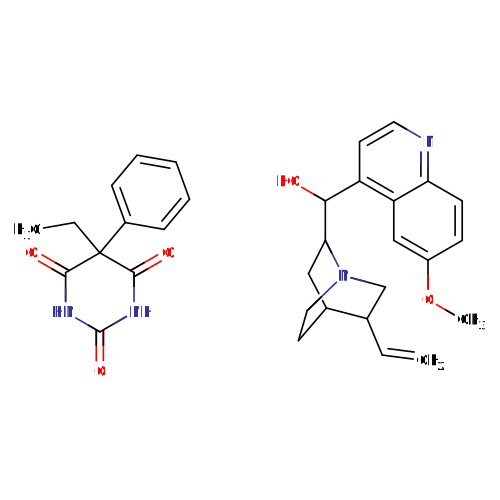
Structure for Quinidine barbiturate (DB01346)
- Weight
- Average: 556.652
Monoisotopic: 556.268570282 - Chemical Formula
- C32H36N4O5
- Synonyms
- Not Available

Pharmacology
- Indication
Not Available
 Reduce drug development failure ratesBuild, train, & validate machine-learning modelswith evidence-based and structured datasets.Build, train, & validate predictive machine-learning models with structured datasets.
- Contraindications & Blackbox Warnings
 Prevent Adverse Drug Events TodayTap into our Clinical API for life-saving information on contraindications & blackbox warnings, population restrictions, harmful risks, & more.Avoid life-threatening adverse drug events with our Clinical API
- Pharmacodynamics
Not Available
- Mechanism of action
Barbiturates work by binding to the GABAA receptor at either the alpha or the beta sub unit. These are binding sites that are distinct from GABA itself and also distinct from the benzodiazepine binding site. Like benzodiazepines, barbiturates potentiate the effect of GABA at this receptor. This GABAA receptor binding decreases input resistance, depresses burst and tonic firing, especially in ventrobasal and intralaminar neurons, while at the same time increasing burst duration and mean conductance at individual chloride channels; this increases both the amplitude and decay time of inhibitory postsynaptic currents. In addition to this GABA-ergic effect, barbiturates also block the AMPA receptor, a subtype of glutamate receptor. Glutamate is the principal excitatory neurotransmitter in the mammalian CNS.
Target Actions Organism AGamma-aminobutyric acid receptor subunit alpha-1 potentiatorHumans AGamma-aminobutyric acid receptor subunit alpha-2 potentiatorHumans ASodium channel protein type 5 subunit alpha inhibitorHumans UPotassium channel subfamily K member 1 inhibitorHumans UGlutamate receptor 2 antagonistHumans - Absorption
Not Available
- Volume of distribution
Not Available
- Protein binding
Not Available
- Metabolism
- Not Available
- Route of elimination
Not Available
- Half-life
Not Available
- Clearance
Not Available
- Adverse Effects
 Improve decision support & research outcomesWith structured adverse effects data, including: blackbox warnings, adverse reactions, warning & precautions, & incidence rates. View sample adverse effects data in our new Data Library!Improve decision support & research outcomes with our structured adverse effects data.
- Toxicity
Not Available
- Pathways
- Not Available
- Pharmacogenomic Effects/ADRs
- Not Available
Interactions
- Drug Interactions
- This information should not be interpreted without the help of a healthcare provider. If you believe you are experiencing an interaction, contact a healthcare provider immediately. The absence of an interaction does not necessarily mean no interactions exist.Not Available
- Food Interactions
- Not Available
Products
 Drug product information from 10+ global regionsOur datasets provide approved product information including:dosage, form, labeller, route of administration, and marketing period.Access drug product information from over 10 global regions.
Categories
- Drug Categories
- Not Available
- Chemical TaxonomyProvided by Classyfire
- Description
- This compound belongs to the class of organic compounds known as cinchona alkaloids. These are alkaloids structurally characterized by the presence of the cinchonan skeleton, which consists of a quinoline linked to an azabicyclo[2.2.2]octane moiety.
- Kingdom
- Organic compounds
- Super Class
- Alkaloids and derivatives
- Class
- Cinchona alkaloids
- Sub Class
- Not Available
- Direct Parent
- Cinchona alkaloids
- Alternative Parents
- 4-quinolinemethanols / Barbituric acid derivatives / Anisoles / Quinuclidines / Aralkylamines / Alkyl aryl ethers / N-acyl ureas / Diazinanes / Benzene and substituted derivatives / Pyridines and derivatives show 12 more
- Substituents
- 1,2-aminoalcohol / 1,3-diazinane / 4-quinolinemethanol / Alcohol / Alkyl aryl ether / Amine / Anisole / Aralkylamine / Aromatic alcohol / Aromatic heteropolycyclic compound show 31 more
- Molecular Framework
- Not Available
- External Descriptors
- Not Available
- Affected organisms
- Not Available
Chemical Identifiers
- UNII
- Not Available
- CAS number
- Not Available
- InChI Key
- YHRUERMOPBDCFD-UHFFFAOYSA-N
- InChI
- InChI=1S/C20H24N2O2.C12H12N2O3/c1-3-13-12-22-9-7-14(13)10-19(22)20(23)16-6-8-21-18-5-4-15(24-2)11-17(16)18;1-2-12(8-6-4-3-5-7-8)9(15)13-11(17)14-10(12)16/h3-6,8,11,13-14,19-20,23H,1,7,9-10,12H2,2H3;3-7H,2H2,1H3,(H2,13,14,15,16,17)
- IUPAC Name
- 5-ethyl-5-phenyl-1,3-diazinane-2,4,6-trione; {5-ethenyl-1-azabicyclo[2.2.2]octan-2-yl}(6-methoxyquinolin-4-yl)methanol
- SMILES
- CCC1(C(=O)NC(=O)NC1=O)C1=CC=CC=C1.COC1=CC2=C(C=CN=C2C=C1)C(O)C1CC2CCN1CC2C=C
References
- General References
- Not Available
- External Links
- Human Metabolome Database
- HMDB0015436
- PubChem Compound
- 53461739
- PubChem Substance
- 46504552
- ChemSpider
- 26329517
- Therapeutic Targets Database
- DAP000915
- PharmGKB
- PA164783957
Clinical Trials
Pharmacoeconomics
- Manufacturers
- Not Available
- Packagers
- Not Available
- Dosage Forms
Form Route Strength Tablet - Prices
- Not Available
- Patents
- Not Available
Properties
- State
- Solid
- Experimental Properties
- Not Available
- Predicted Properties
Property Value Source Water Solubility 0.334 mg/mL ALOGPS logP 2.82 ALOGPS logP 2.51 Chemaxon logS -3 ALOGPS pKa (Strongest Acidic) 13.89 Chemaxon pKa (Strongest Basic) 9.05 Chemaxon Physiological Charge 1 Chemaxon Hydrogen Acceptor Count 4 Chemaxon Hydrogen Donor Count 1 Chemaxon Polar Surface Area 45.59 Å2 Chemaxon Rotatable Bond Count 6 Chemaxon Refractivity 94.69 m3·mol-1 Chemaxon Polarizability 36.12 Å3 Chemaxon Number of Rings 6 Chemaxon Bioavailability 1 Chemaxon Rule of Five No Chemaxon Ghose Filter No Chemaxon Veber's Rule No Chemaxon MDDR-like Rule Yes Chemaxon - Predicted ADMET Features
Property Value Probability Human Intestinal Absorption + 0.9643 Blood Brain Barrier - 0.8743 Caco-2 permeable - 0.6288 P-glycoprotein substrate Substrate 0.8932 P-glycoprotein inhibitor I Inhibitor 0.6667 P-glycoprotein inhibitor II Inhibitor 0.5351 Renal organic cation transporter Non-inhibitor 0.749 CYP450 2C9 substrate Non-substrate 0.7463 CYP450 2D6 substrate Non-substrate 0.8209 CYP450 3A4 substrate Substrate 0.6175 CYP450 1A2 substrate Non-inhibitor 0.8637 CYP450 2C9 inhibitor Non-inhibitor 0.7258 CYP450 2D6 inhibitor Non-inhibitor 0.898 CYP450 2C19 inhibitor Non-inhibitor 0.7931 CYP450 3A4 inhibitor Non-inhibitor 0.5314 CYP450 inhibitory promiscuity Low CYP Inhibitory Promiscuity 0.6681 Ames test Non AMES toxic 0.6774 Carcinogenicity Non-carcinogens 0.8584 Biodegradation Not ready biodegradable 1.0 Rat acute toxicity 2.7298 LD50, mol/kg Not applicable hERG inhibition (predictor I) Weak inhibitor 0.8436 hERG inhibition (predictor II) Inhibitor 0.6121
Spectra
- Mass Spec (NIST)
- Not Available
- Spectra
- Not Available
- Chromatographic Properties
Collision Cross Sections (CCS)
Adduct CCS Value (Å2) Source type Source [M-H]- 218.20279 predictedDeepCCS 1.0 (2019) [M+H]+ 220.59834 predictedDeepCCS 1.0 (2019) [M+Na]+ 226.51088 predictedDeepCCS 1.0 (2019)
Targets

- Kind
- Protein
- Organism
- Humans
- Pharmacological action
- Yes
- Actions
- Potentiator
- General Function
- Inhibitory extracellular ligand-gated ion channel activity
- Specific Function
- Component of the heteropentameric receptor for GABA, the major inhibitory neurotransmitter in the vertebrate brain. Functions also as histamine receptor and mediates cellular responses to histamine...
- Gene Name
- GABRA1
- Uniprot ID
- P14867
- Uniprot Name
- Gamma-aminobutyric acid receptor subunit alpha-1
- Molecular Weight
- 51801.395 Da
References
- Whiting PJ: The GABAA receptor gene family: new opportunities for drug development. Curr Opin Drug Discov Devel. 2003 Sep;6(5):648-57. [Article]
- Mehta AK, Ticku MK: An update on GABAA receptors. Brain Res Brain Res Rev. 1999 Apr;29(2-3):196-217. [Article]
- Krasowski MD, Harrison NL: General anaesthetic actions on ligand-gated ion channels. Cell Mol Life Sci. 1999 Aug 15;55(10):1278-303. [Article]
- Yamakura T, Bertaccini E, Trudell JR, Harris RA: Anesthetics and ion channels: molecular models and sites of action. Annu Rev Pharmacol Toxicol. 2001;41:23-51. [Article]
- Chen X, Ji ZL, Chen YZ: TTD: Therapeutic Target Database. Nucleic Acids Res. 2002 Jan 1;30(1):412-5. [Article]
- Stobbs SH, Ohran AJ, Lassen MB, Allison DW, Brown JE, Steffensen SC: Ethanol suppression of ventral tegmental area GABA neuron electrical transmission involves N-methyl-D-aspartate receptors. J Pharmacol Exp Ther. 2004 Oct;311(1):282-9. Epub 2004 May 28. [Article]
- Kind
- Protein
- Organism
- Humans
- Pharmacological action
- Yes
- Actions
- Potentiator
- General Function
- Inhibitory extracellular ligand-gated ion channel activity
- Specific Function
- GABA, the major inhibitory neurotransmitter in the vertebrate brain, mediates neuronal inhibition by binding to the GABA/benzodiazepine receptor and opening an integral chloride channel.
- Gene Name
- GABRA2
- Uniprot ID
- P47869
- Uniprot Name
- Gamma-aminobutyric acid receptor subunit alpha-2
- Molecular Weight
- 51325.85 Da
References
- Yamakura T, Bertaccini E, Trudell JR, Harris RA: Anesthetics and ion channels: molecular models and sites of action. Annu Rev Pharmacol Toxicol. 2001;41:23-51. [Article]
- Mehta AK, Ticku MK: An update on GABAA receptors. Brain Res Brain Res Rev. 1999 Apr;29(2-3):196-217. [Article]
- Stobbs SH, Ohran AJ, Lassen MB, Allison DW, Brown JE, Steffensen SC: Ethanol suppression of ventral tegmental area GABA neuron electrical transmission involves N-methyl-D-aspartate receptors. J Pharmacol Exp Ther. 2004 Oct;311(1):282-9. Epub 2004 May 28. [Article]
- Kind
- Protein
- Organism
- Humans
- Pharmacological action
- Yes
- Actions
- Inhibitor
- General Function
- Voltage-gated sodium channel activity involved in sa node cell action potential
- Specific Function
- This protein mediates the voltage-dependent sodium ion permeability of excitable membranes. Assuming opened or closed conformations in response to the voltage difference across the membrane, the pr...
- Gene Name
- SCN5A
- Uniprot ID
- Q14524
- Uniprot Name
- Sodium channel protein type 5 subunit alpha
- Molecular Weight
- 226937.475 Da
References
- Stokoe KS, Thomas G, Goddard CA, Colledge WH, Grace AA, Huang CL: Effects of flecainide and quinidine on arrhythmogenic properties of Scn5a+/Delta murine hearts modelling long QT syndrome 3. J Physiol. 2007 Jan 1;578(Pt 1):69-84. Epub 2006 Oct 5. [Article]
- Itoh H, Shimizu M, Takata S, Mabuchi H, Imoto K: A novel missense mutation in the SCN5A gene associated with Brugada syndrome bidirectionally affecting blocking actions of antiarrhythmic drugs. J Cardiovasc Electrophysiol. 2005 May;16(5):486-93. [Article]
- Grant AO: Electrophysiological basis and genetics of Brugada syndrome. J Cardiovasc Electrophysiol. 2005 Sep;16 Suppl 1:S3-7. [Article]
- Napolitano C, Priori SG: Brugada syndrome. Orphanet J Rare Dis. 2006 Sep 14;1:35. [Article]
- Ohgo T, Okamura H, Noda T, Satomi K, Suyama K, Kurita T, Aihara N, Kamakura S, Ohe T, Shimizu W: Acute and chronic management in patients with Brugada syndrome associated with electrical storm of ventricular fibrillation. Heart Rhythm. 2007 Jun;4(6):695-700. Epub 2007 Feb 20. [Article]
- Chen X, Ji ZL, Chen YZ: TTD: Therapeutic Target Database. Nucleic Acids Res. 2002 Jan 1;30(1):412-5. [Article]
- Sheets MF, Fozzard HA, Lipkind GM, Hanck DA: Sodium channel molecular conformations and antiarrhythmic drug affinity. Trends Cardiovasc Med. 2010 Jan;20(1):16-21. doi: 10.1016/j.tcm.2010.03.002. [Article]
- Tella SR, Goldberg SR: Monoamine transporter and sodium channel mechanisms in the rapid pressor response to cocaine. Pharmacol Biochem Behav. 1998 Feb;59(2):305-12. [Article]
- Kind
- Protein
- Organism
- Humans
- Pharmacological action
- Unknown
- Actions
- Inhibitor
- General Function
- Sodium channel activity
- Specific Function
- Ion channel that contributes to passive transmembrane potassium transport and to the regulation of the resting membrane potential in brain astrocytes, but also in kidney and in other tissues (PubMe...
- Gene Name
- KCNK1
- Uniprot ID
- O00180
- Uniprot Name
- Potassium channel subfamily K member 1
- Molecular Weight
- 38142.775 Da
References
- Lesage F, Guillemare E, Fink M, Duprat F, Lazdunski M, Romey G, Barhanin J: TWIK-1, a ubiquitous human weakly inward rectifying K+ channel with a novel structure. EMBO J. 1996 Mar 1;15(5):1004-11. [Article]
- Fink M, Duprat F, Lesage F, Reyes R, Romey G, Heurteaux C, Lazdunski M: Cloning, functional expression and brain localization of a novel unconventional outward rectifier K+ channel. EMBO J. 1996 Dec 16;15(24):6854-62. [Article]
- Kind
- Protein
- Organism
- Humans
- Pharmacological action
- Unknown
- Actions
- Antagonist
- General Function
- Ionotropic glutamate receptor activity
- Specific Function
- Receptor for glutamate that functions as ligand-gated ion channel in the central nervous system and plays an important role in excitatory synaptic transmission. L-glutamate acts as an excitatory ne...
- Gene Name
- GRIA2
- Uniprot ID
- P42262
- Uniprot Name
- Glutamate receptor 2
- Molecular Weight
- 98820.32 Da
References
- Yamakura T, Bertaccini E, Trudell JR, Harris RA: Anesthetics and ion channels: molecular models and sites of action. Annu Rev Pharmacol Toxicol. 2001;41:23-51. [Article]
- Krasowski MD, Harrison NL: General anaesthetic actions on ligand-gated ion channels. Cell Mol Life Sci. 1999 Aug 15;55(10):1278-303. [Article]
- Stobbs SH, Ohran AJ, Lassen MB, Allison DW, Brown JE, Steffensen SC: Ethanol suppression of ventral tegmental area GABA neuron electrical transmission involves N-methyl-D-aspartate receptors. J Pharmacol Exp Ther. 2004 Oct;311(1):282-9. Epub 2004 May 28. [Article]

Drug created at June 30, 2007 18:14 / Updated at June 12, 2020 16:51