Identification
- Generic Name
- Glymidine
- DrugBank Accession Number
- DB01382
- Background
Glycodiazine is used with diet to lower blood glucose by increasing the secretion of insulin from pancreas and increasing the sensitivity of peripheral tissues to insulin. The mechanism of action of glycodiazine in lowering blood glucose appears to be dependent on stimulating the release of insulin from functioning pancreatic beta cells, and increasing sensitivity of peripheral tissues to insulin. Glycodiazine likely binds to ATP-sensitive potassium channel receptors on the pancreatic cell surface, reducing potassium conductance and causing depolarization of the membrane. Membrane depolarization stimulates calcium ion influx through voltage-sensitive calcium channels. This increase in intracellular calcium ion concentration induces the secretion of insulin. It is used for the concomitant use with insulin for the treatment of noninsulin-dependent (type 2) diabetes mellitus.
- Type
- Small Molecule
- Groups
- Approved, Investigational
- Structure
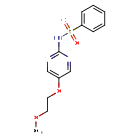
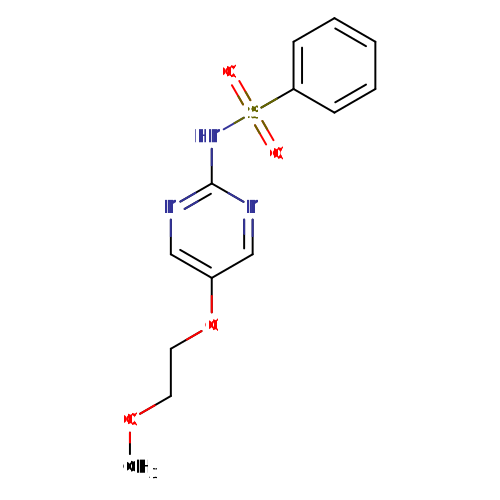
Structure for Glymidine (DB01382)
- Weight
- Average: 309.341
Monoisotopic: 309.078326673 - Chemical Formula
- C13H15N3O4S
- Synonyms
- Glidiazine
- Glycodiazine
- Glymidine
- Glymidinum

Pharmacology
- Indication
Glycodiazine is used concomitantly with insulin for the treatment of noninsulin-dependent (type 2) diabetes mellitus.
 Reduce drug development failure ratesBuild, train, & validate machine-learning modelswith evidence-based and structured datasets.Build, train, & validate predictive machine-learning models with structured datasets.
- Contraindications & Blackbox Warnings
 Prevent Adverse Drug Events TodayTap into our Clinical API for life-saving information on contraindications & blackbox warnings, population restrictions, harmful risks, & more.Avoid life-threatening adverse drug events with our Clinical API
- Pharmacodynamics
Glycodiazine is used with diet to lower blood glucose by increasing the secretion of insulin from pancreas and increasing the sensitivity of peripheral tissues to insulin.
- Mechanism of action
The mechanism of action of glycodiazine in lowering blood glucose appears to be dependent on stimulating the release of insulin from functioning pancreatic beta cells, and increasing sensitivity of peripheral tissues to insulin. Glycodiazine likely binds to ATP-sensitive potassium channel receptors on the pancreatic cell surface, reducing potassium conductance and causing depolarization of the membrane. Membrane depolarization stimulates calcium ion influx through voltage-sensitive calcium channels. The rise in intracellular calcium leads to increased fusion of insulin granulae with the cell membrane, and therefore increased secretion of (pro)insulin.
Target Actions Organism AATP-sensitive inward rectifier potassium channel 1 other/unknownHumans UATP-binding cassette sub-family C member 8 inducerHumans - Absorption
Rapidly and completely absorbed following oral administration.
- Volume of distribution
Not Available
- Protein binding
90% bound to plasma proteins.
- Metabolism
- Not Available
- Route of elimination
Not Available
- Half-life
4 hours.
- Clearance
Not Available
- Adverse Effects
 Improve decision support & research outcomesWith structured adverse effects data, including: blackbox warnings, adverse reactions, warning & precautions, & incidence rates. View sample adverse effects data in our new Data Library!Improve decision support & research outcomes with our structured adverse effects data.
- Toxicity
Severe hypoglycemic reactions with coma, seizure, or other neurological impairment.
- Pathways
- Not Available
- Pharmacogenomic Effects/ADRs
- Not Available
Interactions
- Drug Interactions
- This information should not be interpreted without the help of a healthcare provider. If you believe you are experiencing an interaction, contact a healthcare provider immediately. The absence of an interaction does not necessarily mean no interactions exist.
Drug Interaction Integrate drug-drug
interactions in your softwareAcarbose The risk or severity of hypoglycemia can be increased when Acarbose is combined with Glymidine. Acebutolol The therapeutic efficacy of Glymidine can be increased when used in combination with Acebutolol. Acetazolamide The therapeutic efficacy of Glymidine can be increased when used in combination with Acetazolamide. Acetohexamide The therapeutic efficacy of Acetohexamide can be increased when used in combination with Glymidine. Acetyl sulfisoxazole The therapeutic efficacy of Glymidine can be increased when used in combination with Acetyl sulfisoxazole. - Food Interactions
- Not Available
Products
 Drug product information from 10+ global regionsOur datasets provide approved product information including:dosage, form, labeller, route of administration, and marketing period.Access drug product information from over 10 global regions.
- International/Other Brands
- Glycanol (Bayer) / Glyconormal (Bayer) / Gondafon (Schering) / Lycanol (Bayer) / Redul (Bayer)
Categories
- ATC Codes
- A10BC01 — Glymidine
- A10BC — Sulfonamides (heterocyclic)
- A10B — BLOOD GLUCOSE LOWERING DRUGS, EXCL. INSULINS
- A10 — DRUGS USED IN DIABETES
- A — ALIMENTARY TRACT AND METABOLISM
- Drug Categories
- Chemical TaxonomyProvided by Classyfire
- Description
- This compound belongs to the class of organic compounds known as benzenesulfonamides. These are organic compounds containing a sulfonamide group that is S-linked to a benzene ring.
- Kingdom
- Organic compounds
- Super Class
- Benzenoids
- Class
- Benzene and substituted derivatives
- Sub Class
- Benzenesulfonamides
- Direct Parent
- Benzenesulfonamides
- Alternative Parents
- Benzenesulfonyl compounds / Alkyl aryl ethers / Pyrimidines and pyrimidine derivatives / Organosulfonamides / Heteroaromatic compounds / Aminosulfonyl compounds / Dialkyl ethers / Azacyclic compounds / Organopnictogen compounds / Organonitrogen compounds show 2 more
- Substituents
- Alkyl aryl ether / Aminosulfonyl compound / Aromatic heteromonocyclic compound / Azacycle / Benzenesulfonamide / Benzenesulfonyl group / Dialkyl ether / Ether / Heteroaromatic compound / Hydrocarbon derivative show 13 more
- Molecular Framework
- Aromatic heteromonocyclic compounds
- External Descriptors
- Not Available
- Affected organisms
- Humans and other mammals
Chemical Identifiers
- UNII
- 4C5I4BQZ8F
- CAS number
- 339-44-6
- InChI Key
- QFWPJPIVLCBXFJ-UHFFFAOYSA-N
- InChI
- InChI=1S/C13H15N3O4S/c1-19-7-8-20-11-9-14-13(15-10-11)16-21(17,18)12-5-3-2-4-6-12/h2-6,9-10H,7-8H2,1H3,(H,14,15,16)
- IUPAC Name
- N-[5-(2-methoxyethoxy)pyrimidin-2-yl]benzenesulfonamide
- SMILES
- COCCOC1=CN=C(NS(=O)(=O)C2=CC=CC=C2)N=C1
References
- Synthesis Reference
U.S. Patent 3,275,635.
- General References
- Not Available
- External Links
- Human Metabolome Database
- HMDB0015461
- PubChem Compound
- 9565
- PubChem Substance
- 46507076
- ChemSpider
- 9190
- 102848
- ChEBI
- 146188
- ChEMBL
- CHEMBL1697838
- ZINC
- ZINC000002040778
- Therapeutic Targets Database
- DAP000921
- PharmGKB
- PA164748839
- Wikipedia
- Glycodiazine
Clinical Trials
- Clinical Trials
Phase Status Purpose Conditions Count Not Available Completed Not Available Type 2 Diabetes Mellitus 3
Pharmacoeconomics
- Manufacturers
- Not Available
- Packagers
- Not Available
- Dosage Forms
- Not Available
- Prices
- Not Available
- Patents
- Not Available
Properties
- State
- Solid
- Experimental Properties
Property Value Source melting point (°C) 220-223 U.S. Patent 3,275,635. - Predicted Properties
Property Value Source Water Solubility 0.124 mg/mL ALOGPS logP 1.27 ALOGPS logP 1.01 Chemaxon logS -3.4 ALOGPS pKa (Strongest Acidic) 6.92 Chemaxon pKa (Strongest Basic) -2.4 Chemaxon Physiological Charge -1 Chemaxon Hydrogen Acceptor Count 6 Chemaxon Hydrogen Donor Count 1 Chemaxon Polar Surface Area 90.41 Å2 Chemaxon Rotatable Bond Count 6 Chemaxon Refractivity 77.01 m3·mol-1 Chemaxon Polarizability 31.34 Å3 Chemaxon Number of Rings 2 Chemaxon Bioavailability 1 Chemaxon Rule of Five Yes Chemaxon Ghose Filter Yes Chemaxon Veber's Rule No Chemaxon MDDR-like Rule No Chemaxon - Predicted ADMET Features
Property Value Probability Human Intestinal Absorption + 0.9892 Blood Brain Barrier + 0.7927 Caco-2 permeable - 0.6157 P-glycoprotein substrate Non-substrate 0.6453 P-glycoprotein inhibitor I Non-inhibitor 0.5185 P-glycoprotein inhibitor II Non-inhibitor 0.7509 Renal organic cation transporter Non-inhibitor 0.6957 CYP450 2C9 substrate Non-substrate 0.6516 CYP450 2D6 substrate Non-substrate 0.8178 CYP450 3A4 substrate Substrate 0.5243 CYP450 1A2 substrate Non-inhibitor 0.5153 CYP450 2C9 inhibitor Inhibitor 0.5078 CYP450 2D6 inhibitor Non-inhibitor 0.8897 CYP450 2C19 inhibitor Non-inhibitor 0.514 CYP450 3A4 inhibitor Non-inhibitor 0.6157 CYP450 inhibitory promiscuity High CYP Inhibitory Promiscuity 0.5638 Ames test Non AMES toxic 0.6181 Carcinogenicity Non-carcinogens 0.8573 Biodegradation Not ready biodegradable 1.0 Rat acute toxicity 2.0305 LD50, mol/kg Not applicable hERG inhibition (predictor I) Weak inhibitor 0.6503 hERG inhibition (predictor II) Non-inhibitor 0.5704
Spectra
- Mass Spec (NIST)
- Not Available
- Spectra
Spectrum Spectrum Type Splash Key Predicted GC-MS Spectrum - GC-MS Predicted GC-MS splash10-00kb-9770000000-ea6c0b6ca2cdf199cf0b Predicted MS/MS Spectrum - 10V, Positive (Annotated) Predicted LC-MS/MS splash10-03di-0009000000-a1ae149fd66efd9f0d54 Predicted MS/MS Spectrum - 10V, Negative (Annotated) Predicted LC-MS/MS splash10-0a4i-0098000000-ea3e8d615eb8f507f970 Predicted MS/MS Spectrum - 20V, Positive (Annotated) Predicted LC-MS/MS splash10-03di-1139000000-052bd88ec1a97cf40012 Predicted MS/MS Spectrum - 20V, Negative (Annotated) Predicted LC-MS/MS splash10-0a4l-0900000000-96403dab1d6a3aa9b3f2 Predicted MS/MS Spectrum - 40V, Positive (Annotated) Predicted LC-MS/MS splash10-0006-4910000000-f8839de773a05286418f Predicted MS/MS Spectrum - 40V, Negative (Annotated) Predicted LC-MS/MS splash10-0006-6900000000-25223c7334cad9e5ff60 Predicted 1H NMR Spectrum 1D NMR Not Applicable Predicted 13C NMR Spectrum 1D NMR Not Applicable - Chromatographic Properties
Collision Cross Sections (CCS)
Adduct CCS Value (Å2) Source type Source [M-H]- 181.9041715 predictedDarkChem Lite v0.1.0 [M-H]- 186.5949715 predictedDarkChem Lite v0.1.0 [M-H]- 168.73653 predictedDeepCCS 1.0 (2019) [M+H]+ 182.1528715 predictedDarkChem Lite v0.1.0 [M+H]+ 187.3294715 predictedDarkChem Lite v0.1.0 [M+H]+ 171.09453 predictedDeepCCS 1.0 (2019) [M+Na]+ 182.0263715 predictedDarkChem Lite v0.1.0 [M+Na]+ 187.0639715 predictedDarkChem Lite v0.1.0 [M+Na]+ 177.18767 predictedDeepCCS 1.0 (2019)
Targets

- Kind
- Protein
- Organism
- Humans
- Pharmacological action
- Yes
- Actions
- Other/unknown
- General Function
- Phosphatidylinositol-4,5-bisphosphate binding
- Specific Function
- In the kidney, probably plays a major role in potassium homeostasis. Inward rectifier potassium channels are characterized by a greater tendency to allow potassium to flow into the cell rather than...
- Gene Name
- KCNJ1
- Uniprot ID
- P48048
- Uniprot Name
- ATP-sensitive inward rectifier potassium channel 1
- Molecular Weight
- 44794.6 Da
References
- Overington JP, Al-Lazikani B, Hopkins AL: How many drug targets are there? Nat Rev Drug Discov. 2006 Dec;5(12):993-6. [Article]
- Imming P, Sinning C, Meyer A: Drugs, their targets and the nature and number of drug targets. Nat Rev Drug Discov. 2006 Oct;5(10):821-34. [Article]
- Guirgis FK, Ghanem MH, Abdel-Hay MM: Comparative study of the hypoglycaemic and antilipolytic effects of four antidiabetic agents administered i.v. Arzneimittelforschung. 1976;26(3):435-7. [Article]
- Greeley SA, Tucker SE, Naylor RN, Bell GI, Philipson LH: Neonatal diabetes mellitus: a model for personalized medicine. Trends Endocrinol Metab. 2010 Aug;21(8):464-72. doi: 10.1016/j.tem.2010.03.004. Epub 2010 Apr 29. [Article]
- Pondugula SR, Raveendran NN, Ergonul Z, Deng Y, Chen J, Sanneman JD, Palmer LG, Marcus DC: Glucocorticoid regulation of genes in the amiloride-sensitive sodium transport pathway by semicircular canal duct epithelium of neonatal rat. Physiol Genomics. 2006 Jan 12;24(2):114-23. Epub 2005 Nov 1. [Article]
- Lu M, Leng Q, Egan ME, Caplan MJ, Boulpaep EL, Giebisch GH, Hebert SC: CFTR is required for PKA-regulated ATP sensitivity of Kir1.1 potassium channels in mouse kidney. J Clin Invest. 2006 Mar;116(3):797-807. Epub 2006 Feb 9. [Article]
- Serrano-Martin X, Payares G, Mendoza-Leon A: Glibenclamide, a blocker of K+(ATP) channels, shows antileishmanial activity in experimental murine cutaneous leishmaniasis. Antimicrob Agents Chemother. 2006 Dec;50(12):4214-6. Epub 2006 Oct 2. [Article]
- Kind
- Protein
- Organism
- Humans
- Pharmacological action
- Unknown
- Actions
- Inducer
- General Function
- Sulfonylurea receptor activity
- Specific Function
- Subunit of the beta-cell ATP-sensitive potassium channel (KATP). Regulator of ATP-sensitive K(+) channels and insulin release.
- Gene Name
- ABCC8
- Uniprot ID
- Q09428
- Uniprot Name
- ATP-binding cassette sub-family C member 8
- Molecular Weight
- 176990.36 Da
References
- Dabrowski M, Ashcroft FM, Ashfield R, Lebrun P, Pirotte B, Egebjerg J, Bondo Hansen J, Wahl P: The novel diazoxide analog 3-isopropylamino-7-methoxy-4H-1,2,4-benzothiadiazine 1,1-dioxide is a selective Kir6.2/SUR1 channel opener. Diabetes. 2002 Jun;51(6):1896-906. [Article]
- Hambrock A, Preisig-Muller R, Russ U, Piehl A, Hanley PJ, Ray J, Daut J, Quast U, Derst C: Four novel splice variants of sulfonylurea receptor 1. Am J Physiol Cell Physiol. 2002 Aug;283(2):C587-98. [Article]
- Hambrock A, Loffler-Walz C, Quast U: Glibenclamide binding to sulphonylurea receptor subtypes: dependence on adenine nucleotides. Br J Pharmacol. 2002 Aug;136(7):995-1004. [Article]
- Nielsen FE, Bodvarsdottir TB, Worsaae A, MacKay P, Stidsen CE, Boonen HC, Pridal L, Arkhammar PO, Wahl P, Ynddal L, Junager F, Dragsted N, Tagmose TM, Mogensen JP, Koch A, Treppendahl SP, Hansen JB: 6-Chloro-3-alkylamino-4H-thieno[3,2-e]-1,2,4-thiadiazine 1,1-dioxide derivatives potently and selectively activate ATP sensitive potassium channels of pancreatic beta-cells. J Med Chem. 2002 Sep 12;45(19):4171-87. [Article]
- Babenko AP, Bryan J: SUR-dependent modulation of KATP channels by an N-terminal KIR6.2 peptide. Defining intersubunit gating interactions. J Biol Chem. 2002 Nov 15;277(46):43997-4004. Epub 2002 Sep 3. [Article]
- Ueda K, Komine J, Matsuo M, Seino S, Amachi T: Cooperative binding of ATP and MgADP in the sulfonylurea receptor is modulated by glibenclamide. Proc Natl Acad Sci U S A. 1999 Feb 16;96(4):1268-72. [Article]

Drug created at July 06, 2007 20:33 / Updated at June 12, 2020 16:51