Identification
- Summary
Ajmaline is an antiarrhythmic used to manage a variety of forms of tachycardias.
- Generic Name
- Ajmaline
- DrugBank Accession Number
- DB01426
- Background
An alkaloid found in the root of Rauwolfia serpentina, among other plant sources. It is a class Ia antiarrhythmic agent that apparently acts by changing the shape and threshold of cardiac action potentials. Ajmaline produces potent sodium channel blocking effects and a very short half-life which makes it a very useful drug for acute intravenous treatments. The drug has been very popular in some countries for the treatment of atrial fibrillation in patients with the Wolff–Parkinson–White syndrome and in well tolerated monomorphic ventricular tachycardias. It has also been used for many years as a drug to challenge the conduction system of the heart in cases of bundle branch block and syncope. In these cases, abnormal prolongation of the HV interval has been taken as a proof for infrahisian conduction defects tributary for permanent pacemaker implantation.
- Type
- Small Molecule
- Groups
- Approved, Experimental
- Structure
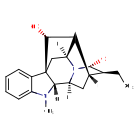
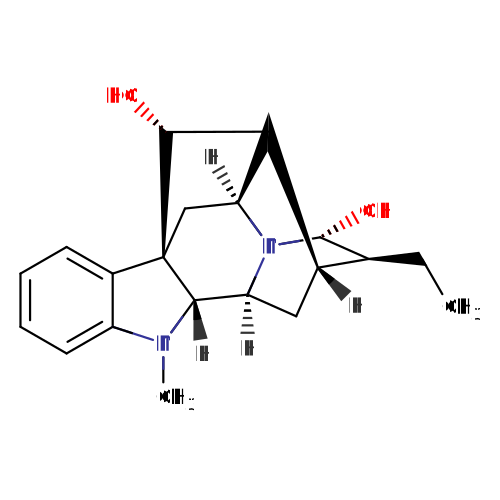
Structure for Ajmaline (DB01426)
- Weight
- Average: 326.4326
Monoisotopic: 326.199428086 - Chemical Formula
- C20H26N2O2
- Synonyms
- (+)-Ajmaline
- (5aR,6S,8S,10S,11S,11aS,12aR,13R)-5-methyl-5a,6,8,9,10,11,11a,12-octahydro-5H-6,10:11,12a-dimethanoindolo[3,2-b]quinolizine-8,13-diol
- Ajmalin
- Ajmaline

Pharmacology
- Indication
For use as an antiarrhythmic agent.
 Reduce drug development failure ratesBuild, train, & validate machine-learning modelswith evidence-based and structured datasets.Build, train, & validate predictive machine-learning models with structured datasets.
- Associated Conditions
Indication Type Indication Combined Product Details Approval Level Age Group Patient Characteristics Dose Form Treatment of Junctional ectopic tachycardia •••••••••••• •••••••••• •••••••• Treatment of Symptomatic supraventricular tachycardia •••••••••••• •••••••••• •••••••• Adjunct therapy in treatment of Ventricular tachycardia (vt) •••••••••••• ••••••••••••••• •••••• •••••••••• •••••••• - Associated Therapies
- Contraindications & Blackbox Warnings
 Prevent Adverse Drug Events TodayTap into our Clinical API for life-saving information on contraindications & blackbox warnings, population restrictions, harmful risks, & more.Avoid life-threatening adverse drug events with our Clinical API
- Pharmacodynamics
Ajmaline is a class 1A antiarrhythmic agent. By interfering with the sodium channels, this drug allows for improvement in abnormal rhythms of the heart
- Mechanism of action
The class I antiarrhythmic agents interfere with the sodium channel. A class IA agent lengthens the action potential (right shift) which brings about improvement in abnormal heart rhythms. This drug in particular has a high affinity for the Nav 1.5 sodium channel.
Target Actions Organism ASodium channel protein type 5 subunit alpha inhibitorHumans - Absorption
Not Available
- Volume of distribution
Not Available
- Protein binding
Not Available
- Metabolism
- Not Available
- Route of elimination
Not Available
- Half-life
Not Available
- Clearance
Not Available
- Adverse Effects
 Improve decision support & research outcomesWith structured adverse effects data, including: blackbox warnings, adverse reactions, warning & precautions, & incidence rates. View sample adverse effects data in our new Data Library!Improve decision support & research outcomes with our structured adverse effects data.
- Toxicity
Not Available
- Pathways
- Not Available
- Pharmacogenomic Effects/ADRs
- Not Available
Interactions
- Drug Interactions
- This information should not be interpreted without the help of a healthcare provider. If you believe you are experiencing an interaction, contact a healthcare provider immediately. The absence of an interaction does not necessarily mean no interactions exist.
Drug Interaction Integrate drug-drug
interactions in your softwareAcebutolol Acebutolol may increase the arrhythmogenic activities of Ajmaline. Acetyldigitoxin Acetyldigitoxin may increase the arrhythmogenic activities of Ajmaline. Acrivastine The risk or severity of QTc prolongation can be increased when Ajmaline is combined with Acrivastine. Adenosine Adenosine may increase the arrhythmogenic activities of Ajmaline. Albuterol The risk or severity of QTc prolongation can be increased when Salbutamol is combined with Ajmaline. - Food Interactions
- Not Available
Products
 Drug product information from 10+ global regionsOur datasets provide approved product information including:dosage, form, labeller, route of administration, and marketing period.Access drug product information from over 10 global regions.
- International/Other Brands
- Ajimalin
Categories
- ATC Codes
- C01BA05 — Ajmaline
- Drug Categories
- Ajmaline and derivatives
- Alkaloids
- Antiarrhythmic agents
- Antiarrhythmics, Class I
- Antiarrhythmics, Class Ia
- Antiarrhythmics, Class Ic
- Cardiac Therapy
- Cardiovascular Agents
- Heterocyclic Compounds, Fused-Ring
- Indole Alkaloids
- Indoles
- Indolizidines
- Indolizines
- Membrane Transport Modulators
- Potential QTc-Prolonging Agents
- QTc Prolonging Agents
- Secologanin Tryptamine Alkaloids
- Sodium Channel Blockers
- Voltage-Gated Sodium Channel Blockers
- Chemical TaxonomyProvided by Classyfire
- Description
- This compound belongs to the class of organic compounds known as ajmaline-sarpagine alkaloids. These are organic compounds containing either of the ajmalan, sarpagan skeleton, or derivative thereof. The Sarpagine (Akuammidine) group, based on the sarpagan nucleus, arises from bond formation between C-16 and C-5 of the corynantheine precursor. Ajmaline alkaloids are based on a 17,19-secoyohimban skeleton (oxayohimban) which is invariably present as an ether.
- Kingdom
- Organic compounds
- Super Class
- Alkaloids and derivatives
- Class
- Ajmaline-sarpagine alkaloids
- Sub Class
- Not Available
- Direct Parent
- Ajmaline-sarpagine alkaloids
- Alternative Parents
- Beta carbolines / Quinolizidines / Quinuclidines / Dialkylarylamines / Azepanes / Aralkylamines / Piperidines / Benzenoids / Secondary alcohols / Hemiaminals show 4 more
- Substituents
- Alcohol / Alkanolamine / Amine / Aralkylamine / Aromatic heteropolycyclic compound / Azacycle / Azepane / Benzenoid / Beta-carboline / Cyclic alcohol show 18 more
- Molecular Framework
- Aromatic heteropolycyclic compounds
- External Descriptors
- hemiaminal, monoterpenoid indole alkaloid (CHEBI:28462)
- Affected organisms
- Humans and other mammals
Chemical Identifiers
- UNII
- 1PON08459R
- CAS number
- 4360-12-7
- InChI Key
- CJDRUOGAGYHKKD-HEFSZTOGSA-N
- InChI
- InChI=1S/C20H26N2O2/c1-3-10-11-8-14-17-20(12-6-4-5-7-13(12)21(17)2)9-15(16(11)18(20)23)22(14)19(10)24/h4-7,10-11,14-19,23-24H,3,8-9H2,1-2H3/t10-,11-,14-,15-,16?,17-,18+,19+,20+/m0/s1
- IUPAC Name
- (1R,9R,10S,12R,13S,14R,16S,18R)-13-ethyl-8-methyl-8,15-diazahexacyclo[14.2.1.0^{1,9}.0^{2,7}.0^{10,15}.0^{12,17}]nonadeca-2,4,6-triene-14,18-diol
- SMILES
- [H][C@]12C[C@]34[C@H](O)C1[C@@]1([H])C[C@]([H])(N2[C@H](O)[C@H]1CC)[C@]3([H])N(C)C1=CC=CC=C41
References
- Synthesis Reference
Ivan F. Makarevich, Yaroslav I. Khadzhai, Valeria V. Pavlova, Anastasia V. Nikolaeva, "Cardenolide and bufadienolide derivatives of ajmaline and process for producing same." U.S. Patent US4175078, issued May, 1975.
US4175078- General References
- Brugada J, Brugada P, Brugada R: The ajmaline challenge in Brugada syndrome: a useful tool or misleading information? Eur Heart J. 2003 Jun;24(12):1085-6. [Article]
- External Links
- Human Metabolome Database
- HMDB0015495
- KEGG Drug
- D00199
- KEGG Compound
- C06542
- PubChem Compound
- 441080
- PubChem Substance
- 46506449
- ChemSpider
- 10145712
- 423
- ChEBI
- 28462
- ChEMBL
- CHEMBL2357792
- PharmGKB
- PA164776839
- Wikipedia
- Ajmaline
Clinical Trials
- Clinical Trials
Phase Status Purpose Conditions Count 4 Completed Treatment Atrial Fibrillation / Brugada Syndrome (BrS) / Ventricular Tachycardia (VT) 1 2 Unknown Status Diagnostic Brugada Syndrome (BrS) / Sudden Death 1 Not Available Completed Treatment Brugada Syndrome (BrS) 1 Not Available Recruiting Not Available Brugada Syndrome (BrS) / Cardiovascular Mortality / Channelopathies / Ventricular Fibrillation 1 Not Available Unknown Status Not Available Brugada Syndrome (BrS) 1
Pharmacoeconomics
- Manufacturers
- Not Available
- Packagers
- Not Available
- Dosage Forms
Form Route Strength Injection, solution, concentrate Intravenous 5 mg/ml - Prices
- Not Available
- Patents
- Not Available
Properties
- State
- Solid
- Experimental Properties
Property Value Source melting point (°C) 206 °C PhysProp water solubility 490 mg/L (at 30 °C) YALKOWSKY,SH & DANNENFELSER,RM (1992) logP 1.81 HANSCH,C ET AL. (1995) logS -2.82 ADME Research, USCD - Predicted Properties
Property Value Source Water Solubility 4.09 mg/mL ALOGPS logP 1.72 ALOGPS logP 1.85 Chemaxon logS -1.9 ALOGPS pKa (Strongest Acidic) 13.28 Chemaxon pKa (Strongest Basic) 7.2 Chemaxon Physiological Charge 1 Chemaxon Hydrogen Acceptor Count 4 Chemaxon Hydrogen Donor Count 2 Chemaxon Polar Surface Area 46.94 Å2 Chemaxon Rotatable Bond Count 1 Chemaxon Refractivity 92.57 m3·mol-1 Chemaxon Polarizability 36.73 Å3 Chemaxon Number of Rings 6 Chemaxon Bioavailability 1 Chemaxon Rule of Five Yes Chemaxon Ghose Filter Yes Chemaxon Veber's Rule No Chemaxon MDDR-like Rule No Chemaxon - Predicted ADMET Features
Property Value Probability Human Intestinal Absorption + 0.9264 Blood Brain Barrier + 0.9273 Caco-2 permeable + 0.8867 P-glycoprotein substrate Substrate 0.6942 P-glycoprotein inhibitor I Inhibitor 0.7071 P-glycoprotein inhibitor II Non-inhibitor 0.6439 Renal organic cation transporter Non-inhibitor 0.6752 CYP450 2C9 substrate Non-substrate 0.8249 CYP450 2D6 substrate Non-substrate 0.7415 CYP450 3A4 substrate Substrate 0.6739 CYP450 1A2 substrate Non-inhibitor 0.9045 CYP450 2C9 inhibitor Non-inhibitor 0.9071 CYP450 2D6 inhibitor Inhibitor 0.8932 CYP450 2C19 inhibitor Non-inhibitor 0.9025 CYP450 3A4 inhibitor Non-inhibitor 0.8309 CYP450 inhibitory promiscuity Low CYP Inhibitory Promiscuity 0.5565 Ames test Non AMES toxic 0.6621 Carcinogenicity Non-carcinogens 0.9182 Biodegradation Not ready biodegradable 1.0 Rat acute toxicity 2.9259 LD50, mol/kg Not applicable hERG inhibition (predictor I) Weak inhibitor 0.9809 hERG inhibition (predictor II) Inhibitor 0.7381
Spectra
- Mass Spec (NIST)
- Not Available
- Spectra
Spectrum Spectrum Type Splash Key Predicted GC-MS Spectrum - GC-MS Predicted GC-MS splash10-0bta-2498000000-49bdb2b520b940e4152b Predicted MS/MS Spectrum - 10V, Positive (Annotated) Predicted LC-MS/MS splash10-004i-0009000000-b766baa3888e4e4eacd6 Predicted MS/MS Spectrum - 10V, Negative (Annotated) Predicted LC-MS/MS splash10-004i-0009000000-7a137c4222984b239731 Predicted MS/MS Spectrum - 20V, Positive (Annotated) Predicted LC-MS/MS splash10-004i-0009000000-321ad9cc1b46d4c400f6 Predicted MS/MS Spectrum - 20V, Negative (Annotated) Predicted LC-MS/MS splash10-004i-0009000000-4046f915223b14aca354 Predicted MS/MS Spectrum - 40V, Negative (Annotated) Predicted LC-MS/MS splash10-002b-0095000000-8d85f5655be20a35fad5 Predicted MS/MS Spectrum - 40V, Positive (Annotated) Predicted LC-MS/MS splash10-004j-0069000000-b36dd88ff1be20f51f61 Predicted 1H NMR Spectrum 1D NMR Not Applicable Predicted 13C NMR Spectrum 1D NMR Not Applicable - Chromatographic Properties
Collision Cross Sections (CCS)
Adduct CCS Value (Å2) Source type Source [M-H]- 184.0718924 predictedDarkChem Lite v0.1.0 [M-H]- 183.7170924 predictedDarkChem Lite v0.1.0 [M-H]- 181.53204 predictedDeepCCS 1.0 (2019) [M+H]+ 184.3125924 predictedDarkChem Lite v0.1.0 [M+H]+ 184.5798924 predictedDarkChem Lite v0.1.0 [M+H]+ 183.74731 predictedDeepCCS 1.0 (2019) [M+Na]+ 183.8362924 predictedDarkChem Lite v0.1.0 [M+Na]+ 184.1178924 predictedDarkChem Lite v0.1.0 [M+Na]+ 189.65985 predictedDeepCCS 1.0 (2019)
Targets

- Kind
- Protein
- Organism
- Humans
- Pharmacological action
- Yes
- Actions
- Inhibitor
- General Function
- Voltage-gated sodium channel activity involved in sa node cell action potential
- Specific Function
- This protein mediates the voltage-dependent sodium ion permeability of excitable membranes. Assuming opened or closed conformations in response to the voltage difference across the membrane, the pr...
- Gene Name
- SCN5A
- Uniprot ID
- Q14524
- Uniprot Name
- Sodium channel protein type 5 subunit alpha
- Molecular Weight
- 226937.475 Da
References
- Barajas-Martinez HM, Hu D, Cordeiro JM, Wu Y, Kovacs RJ, Meltser H, Kui H, Elena B, Brugada R, Antzelevitch C, Dumaine R: Lidocaine-induced Brugada syndrome phenotype linked to a novel double mutation in the cardiac sodium channel. Circ Res. 2008 Aug 15;103(4):396-404. doi: 10.1161/CIRCRESAHA.108.172619. Epub 2008 Jul 3. [Article]
- Khodorov BI, Zaborovskaya LD: Blockade of sodium and potassium channels in the node of Ranvier by ajmaline and N-propyl ajmaline. Gen Physiol Biophys. 1983 Aug;2(4):233-68. [Article]
- Hermida JS, Dassonvalle E, Six I, Amant C, Coviaux F, Clerc J, Herent D, Hermida A, Rochette J, Jarry G: Prospective evaluation of the familial prevalence of the brugada syndrome. Am J Cardiol. 2010 Dec 15;106(12):1758-62. doi: 10.1016/j.amjcard.2010.07.049. [Article]
- Hoogendijk MG, Potse M, Vinet A, de Bakker JM, Coronel R: ST segment elevation by current-to-load mismatch: an experimental and computational study. Heart Rhythm. 2011 Jan;8(1):111-8. doi: 10.1016/j.hrthm.2010.09.066. Epub 2010 Oct 30. [Article]
- Leoni AL, Gavillet B, Rougier JS, Marionneau C, Probst V, Le Scouarnec S, Schott JJ, Demolombe S, Bruneval P, Huang CL, Colledge WH, Grace AA, Le Marec H, Wilde AA, Mohler PJ, Escande D, Abriel H, Charpentier F: Variable Na(v)1.5 protein expression from the wild-type allele correlates with the penetrance of cardiac conduction disease in the Scn5a(+/-) mouse model. PLoS One. 2010 Feb 19;5(2):e9298. doi: 10.1371/journal.pone.0009298. [Article]
- Hoogendijk MG, Potse M, Linnenbank AC, Verkerk AO, den Ruijter HM, van Amersfoorth SC, Klaver EC, Beekman L, Bezzina CR, Postema PG, Tan HL, Reimer AG, van der Wal AC, Ten Harkel AD, Dalinghaus M, Vinet A, Wilde AA, de Bakker JM, Coronel R: Mechanism of right precordial ST-segment elevation in structural heart disease: excitation failure by current-to-load mismatch. Heart Rhythm. 2010;7(2):238-48. doi: 10.1016/j.hrthm.2009.10.007. Epub 2009 Oct 12. [Article]
Carriers
- Kind
- Protein
- Organism
- Humans
- Pharmacological action
- Unknown
- General Function
- Not Available
- Specific Function
- Functions as transport protein in the blood stream. Binds various ligands in the interior of its beta-barrel domain. Also binds synthetic drugs and influences their distribution and availability in...
- Gene Name
- ORM1
- Uniprot ID
- P02763
- Uniprot Name
- Alpha-1-acid glycoprotein 1
- Molecular Weight
- 23511.38 Da
References
- Koppel C, Wagemann A, Martens F: Pharmacokinetics and antiarrhythmic efficacy of intravenous ajmaline in ventricular arrhythmia of acute onset. Eur J Drug Metab Pharmacokinet. 1989 Apr-Jun;14(2):161-7. [Article]

Drug created at July 24, 2007 12:27 / Updated at September 25, 2021 23:52