Identification
- Generic Name
- Bufotenine
- DrugBank Accession Number
- DB01445
- Background
A hallucinogenic serotonin analog found in frog or toad skins, mushrooms, higher plants, and mammals, especially in the brains, plasma, and urine of schizophrenics. Bufotenin has been used as a tool in CNS studies and misused as a psychedelic.
- Type
- Small Molecule
- Groups
- Experimental, Illicit
- Structure
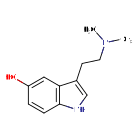
Structure for Bufotenine (DB01445)

- Weight
- Average: 204.2682
Monoisotopic: 204.126263144 - Chemical Formula
- C12H16N2O
- Synonyms
- 3-[2-(dimethylamino)ethyl]-5-indolol
- 3-[2-(dimethylamino)ethyl]indol-5-ol
- 3-[β-(dimethylamino)ethyl]-5-hydroxyindole
- 5-hydroxy-N,N-dimethyltryptamine
- Bufotenin
- DM5-HT
- N,N-dimethylserotonin

Pharmacology
- Indication
Not Available
 Reduce drug development failure ratesBuild, train, & validate machine-learning modelswith evidence-based and structured datasets.Build, train, & validate predictive machine-learning models with structured datasets.
- Contraindications & Blackbox Warnings
 Prevent Adverse Drug Events TodayTap into our Clinical API for life-saving information on contraindications & blackbox warnings, population restrictions, harmful risks, & more.Avoid life-threatening adverse drug events with our Clinical API
- Pharmacodynamics
Bufotenin is a tryptamine related to the neurotransmitter serotonin.
- Mechanism of action
- Not Available
- Absorption
Rapidly absorbed following intravenous administration.
- Volume of distribution
Not Available
- Protein binding
Not Available
- Metabolism
Upon oral administration, bufotenine is extensively metabolized by monoamine oxidase enzymes.
- Route of elimination
Not Available
- Half-life
Not Available
- Clearance
Not Available
- Adverse Effects
 Improve decision support & research outcomesWith structured adverse effects data, including: blackbox warnings, adverse reactions, warning & precautions, & incidence rates. View sample adverse effects data in our new Data Library!Improve decision support & research outcomes with our structured adverse effects data.
- Toxicity
Ingestion of Bufo toad venom and eggs by humans has resulted in several reported cases of poisoning, some of which resulted in death. The acute toxicity of bufotenin in rodents has been calculated to have an LD50 of between 200 and 300 mg/kg, which by comparison, is comparable to the LD50 for intravenous morphine (200-300 mg/kg) in mice. Respiratory arrest may occur, possibly leading to death.
- Pathways
- Not Available
- Pharmacogenomic Effects/ADRs
- Not Available
Interactions
- Drug Interactions
- This information should not be interpreted without the help of a healthcare provider. If you believe you are experiencing an interaction, contact a healthcare provider immediately. The absence of an interaction does not necessarily mean no interactions exist.
Drug Interaction Integrate drug-drug
interactions in your software1,2-Benzodiazepine The risk or severity of CNS depression can be increased when Bufotenine is combined with 1,2-Benzodiazepine. Acetazolamide The risk or severity of CNS depression can be increased when Acetazolamide is combined with Bufotenine. Acetophenazine The risk or severity of CNS depression can be increased when Acetophenazine is combined with Bufotenine. Agomelatine The risk or severity of CNS depression can be increased when Bufotenine is combined with Agomelatine. Alfentanil The risk or severity of CNS depression can be increased when Alfentanil is combined with Bufotenine. - Food Interactions
- Not Available
Categories
- Drug Categories
- Amphibian Venoms
- Antidepressive Agents
- Biological Factors
- Central Nervous System Agents
- Central Nervous System Depressants
- Complex Mixtures
- Hallucinogens
- Heterocyclic Compounds, Fused-Ring
- Indoles
- Monoamine Oxidase A Substrates
- N,N-Dimethyltryptamine
- Neurotransmitter Agents
- Psychotropic Drugs
- Serotonin Agents
- Serotonin Receptor Antagonists
- Toxins, Biological
- Tryptamines
- Venoms
- Chemical TaxonomyProvided by Classyfire
- Description
- This compound belongs to the class of organic compounds known as serotonins. These are compounds containing a serotonin moiety, which consists of an indole that bears an aminoethyl a position 2 and a hydroxyl group at position 5.
- Kingdom
- Organic compounds
- Super Class
- Organoheterocyclic compounds
- Class
- Indoles and derivatives
- Sub Class
- Tryptamines and derivatives
- Direct Parent
- Serotonins
- Alternative Parents
- Hydroxyindoles / 3-alkylindoles / Alkaloids and derivatives / Aralkylamines / 1-hydroxy-2-unsubstituted benzenoids / Substituted pyrroles / Heteroaromatic compounds / Trialkylamines / Azacyclic compounds / Organopnictogen compounds show 2 more
- Substituents
- 1-hydroxy-2-unsubstituted benzenoid / 3-alkylindole / Alkaloid or derivatives / Amine / Aralkylamine / Aromatic heteropolycyclic compound / Azacycle / Benzenoid / Heteroaromatic compound / Hydrocarbon derivative show 12 more
- Molecular Framework
- Aromatic heteropolycyclic compounds
- External Descriptors
- tertiary amine, tryptamine alkaloid (CHEBI:3210) / Indole alkaloids (C08299)
- Affected organisms
- Humans and other mammals
Chemical Identifiers
- UNII
- 0A31347TZK
- CAS number
- 487-93-4
- InChI Key
- VTTONGPRPXSUTJ-UHFFFAOYSA-N
- InChI
- InChI=1S/C12H16N2O/c1-14(2)6-5-9-8-13-12-4-3-10(15)7-11(9)12/h3-4,7-8,13,15H,5-6H2,1-2H3
- IUPAC Name
- 3-[2-(dimethylamino)ethyl]-1H-indol-5-ol
- SMILES
- CN(C)CCC1=CNC2=C1C=C(O)C=C2
References
- General References
- Pomilio AB, Vitale AA, Ciprian-Ollivier J, Cetkovich-Bakmas M, Gomez R, Vazquez G: Ayahoasca: an experimental psychosis that mirrors the transmethylation hypothesis of schizophrenia. J Ethnopharmacol. 1999 Apr;65(1):29-51. [Article]
- Ciprian-Ollivier J, Cetkovich-Bakmas MG: Altered consciousness states and endogenous psychoses: a common molecular pathway? Schizophr Res. 1997 Dec 19;28(2-3):257-65. [Article]
- Carpenter WT Jr, Fink EB, Narasimhachari N, Himwich HE: A test of the transmethylation hypothesis in acute schizophrenic patients. Am J Psychiatry. 1975 Oct;132(10):1067-71. [Article]
- Takeda N, Ikeda R, Ohba K, Kondo M: Bufotenine reconsidered as a diagnostic indicator of psychiatric disorders. Neuroreport. 1995 Nov 27;6(17):2378-80. [Article]
- Sponheim E, Myhre AM, Reichelt KL, Aalen OO: [Urine peptide patterns in children with milder types of autism]. Tidsskr Nor Laegeforen. 2006 May 25;126(11):1475-7. [Article]
- External Links
- Human Metabolome Database
- HMDB0041842
- KEGG Compound
- C08299
- PubChem Compound
- 10257
- PubChem Substance
- 46507174
- ChemSpider
- 9839
- BindingDB
- 50024206
- ChEBI
- 3210
- ChEMBL
- CHEMBL416526
- ZINC
- ZINC000000001070
- Guide to Pharmacology
- GtP Drug Page
- Wikipedia
- Bufotenin
Clinical Trials
Pharmacoeconomics
- Manufacturers
- Not Available
- Packagers
- Not Available
- Dosage Forms
- Not Available
- Prices
- Not Available
- Patents
- Not Available
Properties
- State
- Solid
- Experimental Properties
Property Value Source melting point (°C) 146.5 °C PhysProp - Predicted Properties
Property Value Source Water Solubility 3.2 mg/mL ALOGPS logP 2.04 ALOGPS logP 1.29 Chemaxon logS -1.8 ALOGPS pKa (Strongest Acidic) 9.23 Chemaxon pKa (Strongest Basic) 9.91 Chemaxon Physiological Charge 1 Chemaxon Hydrogen Acceptor Count 2 Chemaxon Hydrogen Donor Count 2 Chemaxon Polar Surface Area 39.26 Å2 Chemaxon Rotatable Bond Count 3 Chemaxon Refractivity 62.42 m3·mol-1 Chemaxon Polarizability 23.29 Å3 Chemaxon Number of Rings 2 Chemaxon Bioavailability 1 Chemaxon Rule of Five Yes Chemaxon Ghose Filter Yes Chemaxon Veber's Rule Yes Chemaxon MDDR-like Rule No Chemaxon - Predicted ADMET Features
Property Value Probability Human Intestinal Absorption + 0.9957 Blood Brain Barrier + 0.9604 Caco-2 permeable + 0.5521 P-glycoprotein substrate Substrate 0.7363 P-glycoprotein inhibitor I Non-inhibitor 0.9844 P-glycoprotein inhibitor II Non-inhibitor 0.6343 Renal organic cation transporter Inhibitor 0.6362 CYP450 2C9 substrate Non-substrate 0.7941 CYP450 2D6 substrate Substrate 0.5684 CYP450 3A4 substrate Substrate 0.6268 CYP450 1A2 substrate Inhibitor 0.6444 CYP450 2C9 inhibitor Non-inhibitor 0.9218 CYP450 2D6 inhibitor Non-inhibitor 0.5464 CYP450 2C19 inhibitor Non-inhibitor 0.919 CYP450 3A4 inhibitor Non-inhibitor 0.8388 CYP450 inhibitory promiscuity Low CYP Inhibitory Promiscuity 0.7531 Ames test Non AMES toxic 0.6702 Carcinogenicity Non-carcinogens 0.9596 Biodegradation Not ready biodegradable 0.9933 Rat acute toxicity 2.5986 LD50, mol/kg Not applicable hERG inhibition (predictor I) Weak inhibitor 0.7984 hERG inhibition (predictor II) Non-inhibitor 0.7167
Spectra
- Mass Spec (NIST)
- Not Available
- Spectra
- Chromatographic Properties
Collision Cross Sections (CCS)
Adduct CCS Value (Å2) Source type Source [M-H]- 154.7319889 predictedDarkChem Lite v0.1.0 [M-H]- 154.8940889 predictedDarkChem Lite v0.1.0 [M-H]- 153.8485889 predictedDarkChem Lite v0.1.0 [M-H]- 142.45326 predictedDeepCCS 1.0 (2019) [M-H]- 154.7319889 predictedDarkChem Lite v0.1.0 [M-H]- 154.8940889 predictedDarkChem Lite v0.1.0 [M-H]- 153.8485889 predictedDarkChem Lite v0.1.0 [M-H]- 142.45326 predictedDeepCCS 1.0 (2019) [M+H]+ 154.9507889 predictedDarkChem Lite v0.1.0 [M+H]+ 154.9369889 predictedDarkChem Lite v0.1.0 [M+H]+ 153.8248889 predictedDarkChem Lite v0.1.0 [M+H]+ 145.27708 predictedDeepCCS 1.0 (2019) [M+H]+ 154.9507889 predictedDarkChem Lite v0.1.0 [M+H]+ 154.9369889 predictedDarkChem Lite v0.1.0 [M+H]+ 153.8248889 predictedDarkChem Lite v0.1.0 [M+H]+ 145.27708 predictedDeepCCS 1.0 (2019) [M+Na]+ 154.7718889 predictedDarkChem Lite v0.1.0 [M+Na]+ 154.8926889 predictedDarkChem Lite v0.1.0 [M+Na]+ 154.0670889 predictedDarkChem Lite v0.1.0 [M+Na]+ 154.2351 predictedDeepCCS 1.0 (2019) [M+Na]+ 154.7718889 predictedDarkChem Lite v0.1.0 [M+Na]+ 154.8926889 predictedDarkChem Lite v0.1.0 [M+Na]+ 154.0670889 predictedDarkChem Lite v0.1.0 [M+Na]+ 154.2351 predictedDeepCCS 1.0 (2019)
Enzymes
- Kind
- Protein
- Organism
- Humans
- Pharmacological action
- Unknown
- Actions
- Substrate
- General Function
- Serotonin binding
- Specific Function
- Catalyzes the oxidative deamination of biogenic and xenobiotic amines and has important functions in the metabolism of neuroactive and vasoactive amines in the central nervous system and peripheral...
- Gene Name
- MAOA
- Uniprot ID
- P21397
- Uniprot Name
- Amine oxidase [flavin-containing] A
- Molecular Weight
- 59681.27 Da
References
- Jiang XL, Shen HW, Mager DE, Yu AM: Pharmacokinetic interactions between monoamine oxidase A inhibitor harmaline and 5-methoxy-N,N-dimethyltryptamine, and the impact of CYP2D6 status. Drug Metab Dispos. 2013 May;41(5):975-86. doi: 10.1124/dmd.112.050724. Epub 2013 Feb 7. [Article]
- Fuller RW, Snoddy HD, Perry KW: Tissue distribution, metabolism and effects of bufotenine administered to rats. Neuropharmacology. 1995 Jul;34(7):799-804. doi: 10.1016/0028-3908(95)00049-c. [Article]

Drug created at July 31, 2007 13:09 / Updated at January 07, 2021 03:10