Identification
- Generic Name
- 3-Methylfentanyl
- DrugBank Accession Number
- DB01571
- Background
3-Methylfentanyl is an opioid analgesic and is an analog of the potent opioid, fentanyl. 3-Methylfentanyl is one of the most powerful opioid drugs sold illegally and is estimated to be between 400-6000 times more potent than morphine in certain cases. 3-Methylfentanyl was initially discovered in 1974 and widespread illegal use of this drug has occurred since this time.
- Type
- Small Molecule
- Groups
- Illicit
- Structure

Structure for 3-Methylfentanyl (DB01571)
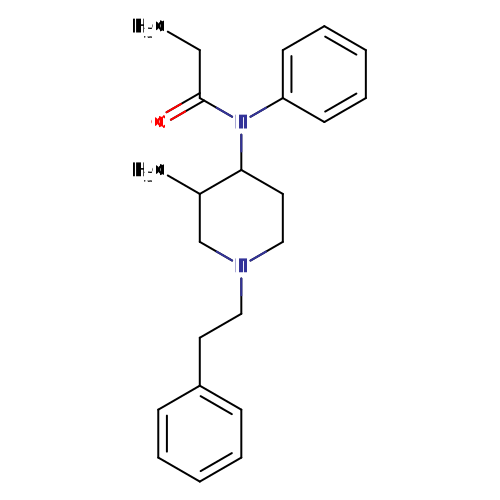
- Weight
- Average: 350.4971
Monoisotopic: 350.235813592 - Chemical Formula
- C23H30N2O
- Synonyms
- 3-MF
- mefentanyl
- External IDs
- DEA No. 9813

Pharmacology
- Indication
Not Available
 Reduce drug development failure ratesBuild, train, & validate machine-learning modelswith evidence-based and structured datasets.Build, train, & validate predictive machine-learning models with structured datasets.
- Contraindications & Blackbox Warnings
 Prevent Adverse Drug Events TodayTap into our Clinical API for life-saving information on contraindications & blackbox warnings, population restrictions, harmful risks, & more.Avoid life-threatening adverse drug events with our Clinical API
- Pharmacodynamics
3-Methylfentanyl exhibits similar pharmacodynamic effects to fentanyl but has been proven to be significantly stronger in these effects due to increased binding affinity to the opioid receptor. Fentanyl, administered alone, has a strong affinity for opioid receptors. 3-methylfentanyl has the potential to be extremely hazardous when used without the prescription and supervision of a medical professional. Ingestion of this drug has resulted in numerous deaths among individuals using the drug recreationally.
- Mechanism of action
Opiate receptors are coupled with G-protein receptors and function as both positive and negative regulators of synaptic transmission via G-proteins that activate effector proteins. Binding of the opiate stimulates the exchange of GTP for GDP on the G-protein complex. As the effector system is adenylate cyclase and cAMP located at the inner surface of the plasma membrane, opioids decrease intracellular cAMP by inhibiting adenylate cyclase. Subsequently, the release of nociceptive neurotransmitters such as substance P, GABA, dopamine, acetylcholine and noradrenaline is inhibited. Opioids also inhibit the release of vasopressin, somatostatin, insulin and glucagon. Fentanyl's analgesic activity is, most likely, due to its conversion to morphine. Opioids close N-type voltage-operated calcium channels (OP2-receptor agonist) and open calcium-dependent inwardly rectifying potassium channels (OP3 and OP1 receptor agonist). This results in hyperpolarization and reduced neuronal excitability.
Target Actions Organism AMu-type opioid receptor agonistHumans ADelta-type opioid receptor agonistHumans AKappa-type opioid receptor agonistHumans - Absorption
Not Available
- Volume of distribution
Not Available
- Protein binding
Not Available
- Metabolism
- Not Available
- Route of elimination
Not Available
- Half-life
Not Available
- Clearance
Not Available
- Adverse Effects
 Improve decision support & research outcomesWith structured adverse effects data, including: blackbox warnings, adverse reactions, warning & precautions, & incidence rates. View sample adverse effects data in our new Data Library!Improve decision support & research outcomes with our structured adverse effects data.
- Toxicity
3-Methylfentanyl has resulted in many deaths among opiate addicts using the drug.
- Pathways
- Not Available
- Pharmacogenomic Effects/ADRs
- Not Available
Interactions
- Drug Interactions
- This information should not be interpreted without the help of a healthcare provider. If you believe you are experiencing an interaction, contact a healthcare provider immediately. The absence of an interaction does not necessarily mean no interactions exist.Not Available
- Food Interactions
- Not Available
Categories
- Drug Categories
- Chemical TaxonomyProvided by Classyfire
- Description
- This compound belongs to the class of organic compounds known as fentanyls. These are compounds containing the fentanyl moiety or a derivative, which is based on a N-(1-(2-phenylethyl)-4-piperidinyl)-N-phenylpropanamide skeleton.
- Kingdom
- Organic compounds
- Super Class
- Organoheterocyclic compounds
- Class
- Piperidines
- Sub Class
- Fentanyls
- Direct Parent
- Fentanyls
- Alternative Parents
- Phenethylamines / Anilides / Aralkylamines / Tertiary carboxylic acid amides / Trialkylamines / Amino acids and derivatives / Azacyclic compounds / Organopnictogen compounds / Organic oxides / Hydrocarbon derivatives show 1 more
- Substituents
- Amine / Amino acid or derivatives / Anilide / Aralkylamine / Aromatic heteromonocyclic compound / Azacycle / Benzenoid / Carbonyl group / Carboxamide group / Carboxylic acid derivative show 13 more
- Molecular Framework
- Aromatic heteromonocyclic compounds
- External Descriptors
- piperidines, monocarboxylic acid amide (CHEBI:61092)
- Affected organisms
- Humans and other mammals
Chemical Identifiers
- UNII
- QVU94XE61A
- CAS number
- 42045-86-3
- InChI Key
- MLQRZXNZHAOCHQ-UHFFFAOYSA-N
- InChI
- InChI=1S/C23H30N2O/c1-3-23(26)25(21-12-8-5-9-13-21)22-15-17-24(18-19(22)2)16-14-20-10-6-4-7-11-20/h4-13,19,22H,3,14-18H2,1-2H3
- IUPAC Name
- N-[3-methyl-1-(2-phenylethyl)piperidin-4-yl]-N-phenylpropanamide
- SMILES
- CCC(=O)N(C1CCN(CCC2=CC=CC=C2)CC1C)C1=CC=CC=C1
References
- General References
- Not Available
- External Links
- PubChem Compound
- 61996
- PubChem Substance
- 46509149
- ChemSpider
- 55844
- ChEBI
- 61092
- Wikipedia
- 3-Methylfentanyl
Clinical Trials
Pharmacoeconomics
- Manufacturers
- Not Available
- Packagers
- Not Available
- Dosage Forms
- Not Available
- Prices
- Not Available
- Patents
- Not Available
Properties
- State
- Solid
- Experimental Properties
- Not Available
- Predicted Properties
Property Value Source Water Solubility 0.015 mg/mL ALOGPS logP 4.29 ALOGPS logP 4.29 Chemaxon logS -4.4 ALOGPS pKa (Strongest Basic) 9.08 Chemaxon Physiological Charge 1 Chemaxon Hydrogen Acceptor Count 2 Chemaxon Hydrogen Donor Count 0 Chemaxon Polar Surface Area 23.55 Å2 Chemaxon Rotatable Bond Count 6 Chemaxon Refractivity 107.9 m3·mol-1 Chemaxon Polarizability 41.59 Å3 Chemaxon Number of Rings 3 Chemaxon Bioavailability 1 Chemaxon Rule of Five Yes Chemaxon Ghose Filter Yes Chemaxon Veber's Rule Yes Chemaxon MDDR-like Rule Yes Chemaxon - Predicted ADMET Features
Property Value Probability Human Intestinal Absorption + 0.9808 Blood Brain Barrier + 0.9875 Caco-2 permeable + 0.695 P-glycoprotein substrate Substrate 0.6788 P-glycoprotein inhibitor I Inhibitor 0.8087 P-glycoprotein inhibitor II Non-inhibitor 0.735 Renal organic cation transporter Inhibitor 0.5413 CYP450 2C9 substrate Non-substrate 0.8205 CYP450 2D6 substrate Non-substrate 0.699 CYP450 3A4 substrate Substrate 0.6768 CYP450 1A2 substrate Non-inhibitor 0.6901 CYP450 2C9 inhibitor Non-inhibitor 0.8046 CYP450 2D6 inhibitor Non-inhibitor 0.5713 CYP450 2C19 inhibitor Non-inhibitor 0.7282 CYP450 3A4 inhibitor Non-inhibitor 0.6426 CYP450 inhibitory promiscuity Low CYP Inhibitory Promiscuity 0.6191 Ames test Non AMES toxic 0.8872 Carcinogenicity Non-carcinogens 0.8297 Biodegradation Not ready biodegradable 0.9033 Rat acute toxicity 2.9798 LD50, mol/kg Not applicable hERG inhibition (predictor I) Weak inhibitor 0.8516 hERG inhibition (predictor II) Inhibitor 0.6605
Spectra
- Mass Spec (NIST)
- Not Available
- Spectra
Spectrum Spectrum Type Splash Key Predicted MS/MS Spectrum - 10V, Positive (Annotated) Predicted LC-MS/MS splash10-0udj-0069000000-53ed761f0caef9e0cc54 Predicted MS/MS Spectrum - 10V, Negative (Annotated) Predicted LC-MS/MS splash10-0002-0009000000-74c89a77e6bca2f61f73 Predicted MS/MS Spectrum - 20V, Positive (Annotated) Predicted LC-MS/MS splash10-0udi-2393000000-b231f560fb1a64d8ac83 Predicted MS/MS Spectrum - 20V, Negative (Annotated) Predicted LC-MS/MS splash10-0a4l-9233000000-833bd7878812cf86ac7e Predicted MS/MS Spectrum - 40V, Positive (Annotated) Predicted LC-MS/MS splash10-0a4r-1910000000-e9907b4e3286b5a492c7 Predicted MS/MS Spectrum - 40V, Negative (Annotated) Predicted LC-MS/MS splash10-014l-7790000000-8d59483eeaa6ee10f2e8 Predicted 1H NMR Spectrum 1D NMR Not Applicable Predicted 13C NMR Spectrum 1D NMR Not Applicable - Chromatographic Properties
Collision Cross Sections (CCS)
Adduct CCS Value (Å2) Source type Source [M-H]- 180.04941 predictedDeepCCS 1.0 (2019) [M+H]+ 182.40741 predictedDeepCCS 1.0 (2019) [M+Na]+ 189.43024 predictedDeepCCS 1.0 (2019)
Targets

- Kind
- Protein
- Organism
- Humans
- Pharmacological action
- Yes
- Actions
- Agonist
- General Function
- Voltage-gated calcium channel activity
- Specific Function
- Receptor for endogenous opioids such as beta-endorphin and endomorphin. Receptor for natural and synthetic opioids including morphine, heroin, DAMGO, fentanyl, etorphine, buprenorphin and methadone...
- Gene Name
- OPRM1
- Uniprot ID
- P35372
- Uniprot Name
- Mu-type opioid receptor
- Molecular Weight
- 44778.855 Da
References
- Subramanian G, Paterlini MG, Portoghese PS, Ferguson DM: Molecular docking reveals a novel binding site model for fentanyl at the mu-opioid receptor. J Med Chem. 2000 Feb 10;43(3):381-91. [Article]
- Jin WQ, Xu H, Zhu YC, Fang SN, Xia XL, Huang ZM, Ge BL, Chi ZQ: Studies on synthesis and relationship between analgesic activity and receptor affinity for 3-methyl fentanyl derivatives. Sci Sin. 1981 May;24(5):710-20. [Article]
- Wang ZX, Zhu YC, Chen XJ, Ji RY: [Stereoisomers of 3-methylfentanyl: synthesis, absolute configuration and analgesic activity]. Yao Xue Xue Bao. 1993;28(12):905-10. [Article]
- Zhu J, Yin J, Law PY, Claude PA, Rice KC, Evans CJ, Chen C, Yu L, Liu-Chen LY: Irreversible binding of cis-(+)-3-methylfentanyl isothiocyanate to the delta opioid receptor and determination of its binding domain. J Biol Chem. 1996 Jan 19;271(3):1430-4. [Article]
- Kind
- Protein
- Organism
- Humans
- Pharmacological action
- Yes
- Actions
- Agonist
- General Function
- Opioid receptor activity
- Specific Function
- G-protein coupled receptor that functions as receptor for endogenous enkephalins and for a subset of other opioids. Ligand binding causes a conformation change that triggers signaling via guanine n...
- Gene Name
- OPRD1
- Uniprot ID
- P41143
- Uniprot Name
- Delta-type opioid receptor
- Molecular Weight
- 40368.235 Da
References
- Jin WQ, Xu H, Zhu YC, Fang SN, Xia XL, Huang ZM, Ge BL, Chi ZQ: Studies on synthesis and relationship between analgesic activity and receptor affinity for 3-methyl fentanyl derivatives. Sci Sin. 1981 May;24(5):710-20. [Article]
- Wang ZX, Zhu YC, Chen XJ, Ji RY: [Stereoisomers of 3-methylfentanyl: synthesis, absolute configuration and analgesic activity]. Yao Xue Xue Bao. 1993;28(12):905-10. [Article]
- Zhu J, Yin J, Law PY, Claude PA, Rice KC, Evans CJ, Chen C, Yu L, Liu-Chen LY: Irreversible binding of cis-(+)-3-methylfentanyl isothiocyanate to the delta opioid receptor and determination of its binding domain. J Biol Chem. 1996 Jan 19;271(3):1430-4. [Article]
- Kind
- Protein
- Organism
- Humans
- Pharmacological action
- Yes
- Actions
- Agonist
- General Function
- Opioid receptor activity
- Specific Function
- G-protein coupled opioid receptor that functions as receptor for endogenous alpha-neoendorphins and dynorphins, but has low affinity for beta-endorphins. Also functions as receptor for various synt...
- Gene Name
- OPRK1
- Uniprot ID
- P41145
- Uniprot Name
- Kappa-type opioid receptor
- Molecular Weight
- 42644.665 Da
References
- Jin WQ, Xu H, Zhu YC, Fang SN, Xia XL, Huang ZM, Ge BL, Chi ZQ: Studies on synthesis and relationship between analgesic activity and receptor affinity for 3-methyl fentanyl derivatives. Sci Sin. 1981 May;24(5):710-20. [Article]
- Wang ZX, Zhu YC, Chen XJ, Ji RY: [Stereoisomers of 3-methylfentanyl: synthesis, absolute configuration and analgesic activity]. Yao Xue Xue Bao. 1993;28(12):905-10. [Article]
- Zhu J, Yin J, Law PY, Claude PA, Rice KC, Evans CJ, Chen C, Yu L, Liu-Chen LY: Irreversible binding of cis-(+)-3-methylfentanyl isothiocyanate to the delta opioid receptor and determination of its binding domain. J Biol Chem. 1996 Jan 19;271(3):1430-4. [Article]

Drug created at July 31, 2007 13:10 / Updated at June 12, 2020 16:51