Identification
- Generic Name
- Erythrityl tetranitrate
- DrugBank Accession Number
- DB01613
- Background
A vasodilator with general properties similar to nitroglycerin. (From Martindale, The Extra Pharmacopoeia, 30th ed, p1020)
- Type
- Small Molecule
- Groups
- Approved, Experimental, Investigational
- Structure
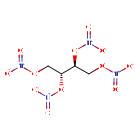
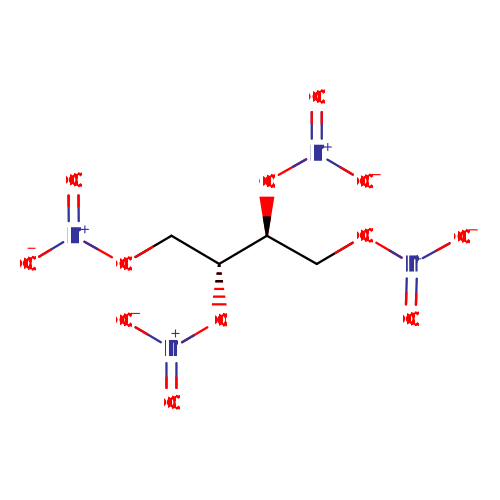
Structure for Erythrityl tetranitrate (DB01613)
- Weight
- Average: 302.11
Monoisotopic: 301.998221676 - Chemical Formula
- C4H6N4O12
- Synonyms
- (2R*,3S)-rel-1,2,3,4-butanetetroltetranitrate
- 1,2,3,4-Butanetetralyl tetranitrate
- Eritrityl tetranitrate
- Eritrityli tetranitras
- Erythritol tetranitrate
- Erythrityl tetranitrate
- Erythrol tetranitrate
- ETN
- Meso-erythritol tetranitrate
- Tetranitrate d'eritrityle
- Tetranitrato de eritritilo
- Tetranitrin
- Tetranitrol
- External IDs
- NSC-106566

Pharmacology
- Indication
For the prevention of angina.
 Reduce drug development failure ratesBuild, train, & validate machine-learning modelswith evidence-based and structured datasets.Build, train, & validate predictive machine-learning models with structured datasets.
- Contraindications & Blackbox Warnings
 Prevent Adverse Drug Events TodayTap into our Clinical API for life-saving information on contraindications & blackbox warnings, population restrictions, harmful risks, & more.Avoid life-threatening adverse drug events with our Clinical API
- Pharmacodynamics
Erythrityl Tetranitrate is a vasodilator with general properties similar to nitroglycerin.
- Mechanism of action
Similar to other nitrites and organic nitrates, erythrityl tetranitrate is converted to an active intermediate compound which activates the enzyme guanylate cyclase. This stimulates the synthesis of cyclic guanosine 3',5'-monophosphate (cGMP) which then activates a series of protein kinase-dependent phosphorylations in the smooth muscle cells, eventually resulting in the dephosphorylation of the myosin light chain of the smooth muscle fiber. The subsequent release of calcium ions results in the relaxation of the smooth muscle cells and vasodilation.
Target Actions Organism AAtrial natriuretic peptide receptor 1 agonistHumans AAtrial natriuretic peptide receptor 2 agonistHumans - Absorption
Not Available
- Volume of distribution
Not Available
- Protein binding
Not Available
- Metabolism
- Not Available
- Route of elimination
Not Available
- Half-life
Not Available
- Clearance
Not Available
- Adverse Effects
 Improve decision support & research outcomesWith structured adverse effects data, including: blackbox warnings, adverse reactions, warning & precautions, & incidence rates. View sample adverse effects data in our new Data Library!Improve decision support & research outcomes with our structured adverse effects data.
- Toxicity
Symptoms of overdose include increased intracranial pressure, with any or all of persistent throbbing headache, confusion, and moderate fever; Vertigo; Palpitations; Visual disturbances; Nausea and vomiting (possibly with colic and even bloody diarrhea); Syncope (especially in the upright posture); Air hunger and dyspnea, later followed by reduced ventilatory effort; Diaphoresis, with the skin either flushed or cold and clammy; Heart block and bradycardia; Paralysis; Coma; Seizures; Death.
- Pathways
- Not Available
- Pharmacogenomic Effects/ADRs
- Not Available
Interactions
- Drug Interactions
- This information should not be interpreted without the help of a healthcare provider. If you believe you are experiencing an interaction, contact a healthcare provider immediately. The absence of an interaction does not necessarily mean no interactions exist.
Drug Interaction Integrate drug-drug
interactions in your softwareAmiodarone Amiodarone may increase the vasodilatory activities of Erythrityl tetranitrate. Amlodipine Amlodipine may increase the vasodilatory activities of Erythrityl tetranitrate. Avanafil Avanafil may increase the hypotensive activities of Erythrityl tetranitrate. Bepridil Bepridil may increase the vasodilatory activities of Erythrityl tetranitrate. Carvedilol Carvedilol may increase the vasodilatory activities of Erythrityl tetranitrate. - Food Interactions
- Avoid alcohol.
- Take on an empty stomach. Take at least 1 hour before or 2 hours after meals.
Products
 Drug product information from 10+ global regionsOur datasets provide approved product information including:dosage, form, labeller, route of administration, and marketing period.Access drug product information from over 10 global regions.
- International/Other Brands
- Cardilate
Categories
- ATC Codes
- C01DA63 — Eritrityl tetranitrate, combinations
- C01DA — Organic nitrates
- C01D — VASODILATORS USED IN CARDIAC DISEASES
- C01 — CARDIAC THERAPY
- C — CARDIOVASCULAR SYSTEM
- Drug Categories
- Chemical TaxonomyProvided by Classyfire
- Description
- This compound belongs to the class of organic compounds known as alkyl nitrates. These are organic compounds containing a nitrate that is O-linked to an alkyl group.
- Kingdom
- Organic compounds
- Super Class
- Organic oxygen compounds
- Class
- Organic oxoanionic compounds
- Sub Class
- Organic nitrates
- Direct Parent
- Alkyl nitrates
- Alternative Parents
- Organic nitro compounds / Organic nitric acids and derivatives / Organooxygen compounds / Organic oxides / Organic nitrogen compounds / Hydrocarbon derivatives
- Substituents
- Aliphatic acyclic compound / Alkyl nitrate / Allyl-type 1,3-dipolar organic compound / Hydrocarbon derivative / Organic 1,3-dipolar compound / Organic nitric acid or derivatives / Organic nitro compound / Organic nitrogen compound / Organic oxide / Organooxygen compound
- Molecular Framework
- Aliphatic acyclic compounds
- External Descriptors
- nitrate ester (CHEBI:60072)
- Affected organisms
- Humans and other mammals
Chemical Identifiers
- UNII
- 35X333P19D
- CAS number
- 7297-25-8
- InChI Key
- SNFOERUNNSHUGP-ZXZARUISSA-N
- InChI
- InChI=1S/C4H6N4O12/c9-5(10)17-1-3(19-7(13)14)4(20-8(15)16)2-18-6(11)12/h3-4H,1-2H2/t3-,4+
- IUPAC Name
- (2R,3S)-1,3,4-tris(nitrooxy)butan-2-yl nitrate
- SMILES
- [O-][N+](=O)OC[C@@H](O[N+]([O-])=O)[C@H](CO[N+]([O-])=O)O[N+]([O-])=O
References
- General References
- Not Available
- External Links
- Human Metabolome Database
- HMDB0015551
- PubChem Compound
- 5284553
- PubChem Substance
- 46508990
- ChemSpider
- 4447608
- 4040
- ChEBI
- 60072
- ChEMBL
- CHEMBL2107583
- ZINC
- ZINC000018178475
- Therapeutic Targets Database
- DAP001060
- PharmGKB
- PA164746528
- Wikipedia
- Erythrityl_Tetranitrate
Clinical Trials
Pharmacoeconomics
- Manufacturers
- Not Available
- Packagers
- Not Available
- Dosage Forms
Form Route Strength Tablet - Prices
- Not Available
- Patents
- Not Available
Properties
- State
- Solid
- Experimental Properties
Property Value Source melting point (°C) 61 °C PhysProp - Predicted Properties
Property Value Source Water Solubility 0.195 mg/mL ALOGPS logP 1.68 ALOGPS logP 0.32 Chemaxon logS -3.2 ALOGPS pKa (Strongest Basic) -5.5 Chemaxon Physiological Charge 0 Chemaxon Hydrogen Acceptor Count 12 Chemaxon Hydrogen Donor Count 0 Chemaxon Polar Surface Area 209.48 Å2 Chemaxon Rotatable Bond Count 11 Chemaxon Refractivity 49.24 m3·mol-1 Chemaxon Polarizability 20.55 Å3 Chemaxon Number of Rings 0 Chemaxon Bioavailability 0 Chemaxon Rule of Five No Chemaxon Ghose Filter Yes Chemaxon Veber's Rule No Chemaxon MDDR-like Rule No Chemaxon - Predicted ADMET Features
Property Value Probability Human Intestinal Absorption + 0.7733 Blood Brain Barrier + 0.9089 Caco-2 permeable - 0.5825 P-glycoprotein substrate Non-substrate 0.7905 P-glycoprotein inhibitor I Non-inhibitor 0.6464 P-glycoprotein inhibitor II Non-inhibitor 0.8955 Renal organic cation transporter Non-inhibitor 0.835 CYP450 2C9 substrate Non-substrate 0.9002 CYP450 2D6 substrate Non-substrate 0.8936 CYP450 3A4 substrate Non-substrate 0.5357 CYP450 1A2 substrate Non-inhibitor 0.7871 CYP450 2C9 inhibitor Non-inhibitor 0.7619 CYP450 2D6 inhibitor Non-inhibitor 0.9081 CYP450 2C19 inhibitor Non-inhibitor 0.6943 CYP450 3A4 inhibitor Non-inhibitor 0.8885 CYP450 inhibitory promiscuity Low CYP Inhibitory Promiscuity 0.8212 Ames test AMES toxic 0.8896 Carcinogenicity Carcinogens 0.6703 Biodegradation Ready biodegradable 0.9161 Rat acute toxicity 2.7983 LD50, mol/kg Not applicable hERG inhibition (predictor I) Strong inhibitor 0.5607 hERG inhibition (predictor II) Non-inhibitor 0.9098
Spectra
- Mass Spec (NIST)
- Not Available
- Spectra
Spectrum Spectrum Type Splash Key Predicted GC-MS Spectrum - GC-MS Predicted GC-MS splash10-0udi-2921000000-e0ca780b2d08f29e85af Predicted 1H NMR Spectrum 1D NMR Not Applicable Predicted 13C NMR Spectrum 1D NMR Not Applicable - Chromatographic Properties
Collision Cross Sections (CCS)
Adduct CCS Value (Å2) Source type Source [M-H]- 164.5083063 predictedDarkChem Lite v0.1.0 [M-H]- 164.7302063 predictedDarkChem Lite v0.1.0 [M-H]- 130.72404 predictedDeepCCS 1.0 (2019) [M+H]+ 164.7717063 predictedDarkChem Lite v0.1.0 [M+H]+ 164.1423063 predictedDarkChem Lite v0.1.0 [M+H]+ 134.40132 predictedDeepCCS 1.0 (2019) [M+Na]+ 164.5841063 predictedDarkChem Lite v0.1.0 [M+Na]+ 142.79553 predictedDeepCCS 1.0 (2019)
Targets

- Kind
- Protein
- Organism
- Humans
- Pharmacological action
- Yes
- Actions
- Agonist
- General Function
- Protein kinase activity
- Specific Function
- Receptor for the atrial natriuretic peptide NPPA/ANP and the brain natriuretic peptide NPPB/BNP which are potent vasoactive hormones playing a key role in cardiovascular homeostasis. Has guanylate ...
- Gene Name
- NPR1
- Uniprot ID
- P16066
- Uniprot Name
- Atrial natriuretic peptide receptor 1
- Molecular Weight
- 118918.11 Da
References
- Overington JP, Al-Lazikani B, Hopkins AL: How many drug targets are there? Nat Rev Drug Discov. 2006 Dec;5(12):993-6. [Article]
- Imming P, Sinning C, Meyer A: Drugs, their targets and the nature and number of drug targets. Nat Rev Drug Discov. 2006 Oct;5(10):821-34. [Article]
- Schroder H, Noack E: Structure-activity relationship of organic nitrates for activation of guanylate cyclase. Arch Int Pharmacodyn Ther. 1987 Dec;290(2):235-46. [Article]
- Kind
- Protein
- Organism
- Humans
- Pharmacological action
- Yes
- Actions
- Agonist
- General Function
- Transmembrane signaling receptor activity
- Specific Function
- Receptor for the C-type natriuretic peptide NPPC/CNP hormone. Has guanylate cyclase activity upon binding of its ligand. May play a role in the regulation of skeletal growth.
- Gene Name
- NPR2
- Uniprot ID
- P20594
- Uniprot Name
- Atrial natriuretic peptide receptor 2
- Molecular Weight
- 117020.97 Da
References
- Overington JP, Al-Lazikani B, Hopkins AL: How many drug targets are there? Nat Rev Drug Discov. 2006 Dec;5(12):993-6. [Article]
- Imming P, Sinning C, Meyer A: Drugs, their targets and the nature and number of drug targets. Nat Rev Drug Discov. 2006 Oct;5(10):821-34. [Article]
- Lange K, Koenig A, Roegler C, Seeling A, Lehmann J: NO donors. Part 18: Bioactive metabolites of GTN and PETN--synthesis and vasorelaxant properties. Bioorg Med Chem Lett. 2009 Jun 1;19(11):3141-4. doi: 10.1016/j.bmcl.2008.04.057. Epub 2008 Apr 26. [Article]

Drug created at August 29, 2007 20:04 / Updated at February 21, 2021 18:51