Identification
- Summary
Pheniramine is an antihistamine used to treat allergic rhinitis and pruritus.
- Brand Names
- Naphcon A, Opcon-A, Visine-A
- Generic Name
- Pheniramine
- DrugBank Accession Number
- DB01620
- Background
Pheniramine is a first-generation antihistamine in the alkylamine class, similar to brompheniramine and chlorpheniramine.3 It is used in some over-the-counter allergy as well as cold & flu products in combination with other drugs. Pheniramine's use as an anti-allergy medication has largely been supplanted by second-generation antihistamines such as cetirizine and loratadine.
- Type
- Small Molecule
- Groups
- Approved
- Structure
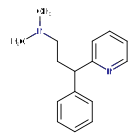
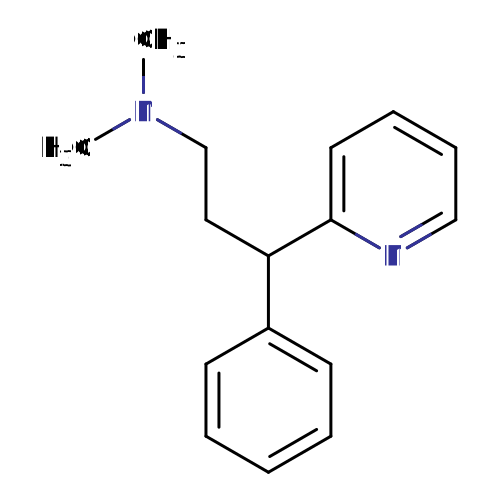
Structure for Pheniramine (DB01620)
- Weight
- Average: 240.3434
Monoisotopic: 240.16264865 - Chemical Formula
- C16H20N2
- Synonyms
- Feniramina
- Pheniramine
- Pheniraminum

Pharmacology
- Indication
Pheniramine is commonly used in over-the-counter products to treat seasonal allergies or cold and flu symptoms.10,11
 Reduce drug development failure ratesBuild, train, & validate machine-learning modelswith evidence-based and structured datasets.Build, train, & validate predictive machine-learning models with structured datasets.
- Associated Conditions
Indication Type Indication Combined Product Details Approval Level Age Group Patient Characteristics Dose Form Used in combination for symptomatic treatment of Allergic conjunctivitis Combination Product in combination with: Naphazoline (DB06711) ••• ••• •••••••••• Symptomatic treatment of Allergic skin reaction •••••••••••• Treatment of Allergic urticaria •••••••••••• •••••••••• •••••••••• ••••••••• •••••• •••••• Treatment of Anaphylaxis •••••••••••• •••••••••• •••••••••• ••••••••• •••••• •••••• Treatment of Angioedema •••••••••••• •••••••••• •••••••••• ••••••••• •••••• •••••• - Contraindications & Blackbox Warnings
 Prevent Adverse Drug Events TodayTap into our Clinical API for life-saving information on contraindications & blackbox warnings, population restrictions, harmful risks, & more.Avoid life-threatening adverse drug events with our Clinical API
- Pharmacodynamics
Pheniramine acts as an antagonist to allergic symptoms stemming from inappropriate histamine release to reduce edema, itching, and redness. The same antihistamine effect also produces sedation by acting in the central nervous system.1,9
- Mechanism of action
Pheniramine competes with histamine for the histamine H1 receptor, acting as an inverse agonist once bound.1 The reduction in H1 receptor activity is responsible for reduced itching as well as reduced vasodilation and capillary leakage leading to less redness and edema.9 This can be seen in the suppression of the histamine-induced wheal (swelling) and flare (vasodilation) response. Inverse agonism of the H1 receptor in the CNS is also responsible for the sedation produced by first-generation antihistamines like pheniramine.9 The binding of pheniramine to H4 receptors, and subsequent inverse agonism, may also contribute to reduced itching by antagonizing inflammation.2
Target Actions Organism AHistamine H4 receptor inverse agonistHumans AHistamine H1 receptor inverse agonistHumans UNuclear receptor subfamily 1 group I member 3 Not Available Humans - Absorption
The administration of 30.5 mg of free base pheniramine resulted in a Cmax of 173-294 ng/L with a Tmax of 1-2.5 h.4
- Volume of distribution
Not Available
- Protein binding
Not Available
- Metabolism
Pheniramine undergoes N-dealkylation to N-didesmethylpheniramine and N-desmethylpheniramine.3
Hover over products below to view reaction partners
- Route of elimination
Pheniramine is eliminated by metabolism and via renal excretion.3 24.3% of pheniramine is present in the urine as the parent drug.
- Half-life
The terminal half-life of pheniramine administered via IV is 8-17 h.4
- Clearance
Not Available
- Adverse Effects
 Improve decision support & research outcomesWith structured adverse effects data, including: blackbox warnings, adverse reactions, warning & precautions, & incidence rates. View sample adverse effects data in our new Data Library!Improve decision support & research outcomes with our structured adverse effects data.
- Toxicity
Case reports involving pheniramine overdosage mention the rare possibility of arrythmias, cutaneous eruptions, and rhabdomyolysis with acute kidney injury.5,6,7 The administration of activated charcoal effectively prevents the absorption of pheniramine as it largely adsorbs to the charcoal, therefore this may be of benefit in cases of overdose if provided early after ingestion.8
- Pathways
Pathway Category Pheniramine H1-Antihistamine Action Drug action - Pharmacogenomic Effects/ADRs
- Not Available
Interactions
- Drug Interactions
- This information should not be interpreted without the help of a healthcare provider. If you believe you are experiencing an interaction, contact a healthcare provider immediately. The absence of an interaction does not necessarily mean no interactions exist.
Drug Interaction Integrate drug-drug
interactions in your softwareAcrivastine The risk or severity of QTc prolongation can be increased when Pheniramine is combined with Acrivastine. Adenosine The risk or severity of QTc prolongation can be increased when Pheniramine is combined with Adenosine. Ajmaline The risk or severity of QTc prolongation can be increased when Ajmaline is combined with Pheniramine. Albuterol The risk or severity of QTc prolongation can be increased when Salbutamol is combined with Pheniramine. Alfuzosin The risk or severity of QTc prolongation can be increased when Alfuzosin is combined with Pheniramine. - Food Interactions
- No interactions found.
Products
 Drug product information from 10+ global regionsOur datasets provide approved product information including:dosage, form, labeller, route of administration, and marketing period.Access drug product information from over 10 global regions.
- Product Ingredients
Ingredient UNII CAS InChI Key Pheniramine maleate NYW905655B 132-20-7 SSOXZAQUVINQSA-BTJKTKAUSA-N - International/Other Brands
- AVIL
- Mixture Products
Name Ingredients Dosage Route Labeller Marketing Start Marketing End Region Image Alahist D Pheniramine maleate (17.5 mg/1) + Phenylephrine hydrochloride (10 mg/1) Tablet Oral Poly Pharmaceuticals, Inc. 2020-04-01 Not applicable US 
Alahist DM Pheniramine maleate (12.5 mg/5mL) + Dextromethorphan hydrobromide monohydrate (10 mg/5mL) + Phenylephrine hydrochloride (5 mg/5mL) Liquid Oral Poly Pharmaceuticals, Inc. 2023-06-08 Not applicable US Allergy Eye Drops Pheniramine maleate (0.315 % w/v) + Naphazoline hydrochloride (0.02675 % w/v) Solution / drops Ophthalmic Bausch & Lomb Inc 2013-02-27 2017-08-03 Canada 
Allergy Eye Drops Pheniramine maleate (3 mg/1mL) + Naphazoline hydrochloride (0.25 mg/1mL) Solution / drops Ophthalmic Chain Drug Consortium 2014-01-10 Not applicable US Allergy Eye Drops Pheniramine maleate (3 mg/1mL) + Naphazoline hydrochloride (0.25 mg/1mL) Solution / drops Ophthalmic CVS Health 2013-01-25 Not applicable US - Unapproved/Other Products
Name Ingredients Dosage Route Labeller Marketing Start Marketing End Region Image Alahist D Pheniramine maleate (17.5 mg/1) + Phenylephrine hydrochloride (10 mg/1) Tablet Oral Poly Pharmaceuticals, Inc. 2020-04-01 Not applicable US Alahist DM Pheniramine maleate (12.5 mg/5mL) + Dextromethorphan hydrobromide monohydrate (10 mg/5mL) + Phenylephrine hydrochloride (5 mg/5mL) Liquid Oral Poly Pharmaceuticals, Inc. 2023-06-08 Not applicable US FENAMED 45,5 MG/2 ML IM/IV ENJ. COZ. ICEREN 50 AMPUL Pheniramine (45.5 mg/2ml) Injection Intramuscular; Intravenous AVİCENNA FARMA DIŞ TİC. VE PAZ. A.Ş. 2019-11-26 Not applicable Turkey 
Categories
- ATC Codes
- R06AB05 — Pheniramine
- R06AB — Substituted alkylamines
- R06A — ANTIHISTAMINES FOR SYSTEMIC USE
- R06 — ANTIHISTAMINES FOR SYSTEMIC USE
- R — RESPIRATORY SYSTEM
- Drug Categories
- Anti-Allergic Agents
- Antihistamines for Systemic Use
- Antihistamines for Topical Use
- Antipruritics
- Antipruritics, Incl. Antihistamines, Anesthetics, Etc.
- Dermatologicals
- Histamine Agents
- Histamine Antagonists
- Histamine H1 Antagonists
- Histamine H1 Inverse Agonists
- Potential QTc-Prolonging Agents
- Pyridines
- QTc Prolonging Agents
- Chemical TaxonomyProvided by Classyfire
- Description
- This compound belongs to the class of organic compounds known as pheniramines. These are compounds containing a pheniramine moiety, which is structurally characterized by the presence of a 2-benzylpyridine linked to an dimethyl(propyl)amine to form a dimethyl[3-phenyl-3-(pyridin-2-yl)propyl]amine skeleton.
- Kingdom
- Organic compounds
- Super Class
- Organoheterocyclic compounds
- Class
- Pyridines and derivatives
- Sub Class
- Pheniramines
- Direct Parent
- Pheniramines
- Alternative Parents
- Aralkylamines / Benzene and substituted derivatives / Heteroaromatic compounds / Trialkylamines / Azacyclic compounds / Organopnictogen compounds / Hydrocarbon derivatives
- Substituents
- Amine / Aralkylamine / Aromatic heteromonocyclic compound / Azacycle / Benzenoid / Heteroaromatic compound / Hydrocarbon derivative / Monocyclic benzene moiety / Organic nitrogen compound / Organonitrogen compound
- Molecular Framework
- Aromatic heteromonocyclic compounds
- External Descriptors
- Not Available
- Affected organisms
- Humans and other mammals
Chemical Identifiers
- UNII
- 134FM9ZZ6M
- CAS number
- 86-21-5
- InChI Key
- IJHNSHDBIRRJRN-UHFFFAOYSA-N
- InChI
- InChI=1S/C16H20N2/c1-18(2)13-11-15(14-8-4-3-5-9-14)16-10-6-7-12-17-16/h3-10,12,15H,11,13H2,1-2H3
- IUPAC Name
- dimethyl[3-phenyl-3-(pyridin-2-yl)propyl]amine
- SMILES
- CN(C)CCC(C1=CC=CC=C1)C1=CC=CC=N1
References
- General References
- Schulze FR, Buschauer A, Schunack W: Combined histamine H1/H2 receptor antagonists: part I. Pharmacological hybrids with pheniramine- and roxatidine-like substructures. Eur J Pharm Sci. 1998 Jul;6(3):177-86. [Article]
- Wade L, Bielory L, Rudner S: Ophthalmic antihistamines and H1-H4 receptors. Curr Opin Allergy Clin Immunol. 2012 Oct;12(5):510-6. doi: 10.1097/ACI.0b013e328357d3ba. [Article]
- Kabasakalian P, Taggart M, Townley E: Urinary excretion of pheniramine and its N-demthylated metabolites in man--comparison with chlorpheniramine and brompheniramine data. J Pharm Sci. 1968 Apr;57(4):621-3. doi: 10.1002/jps.2600570416. [Article]
- Witte PU, Irmisch R, Hajdu P: Pharmacokinetics of pheniramine (Avil) and metabolites in healthy subjects after oral and intravenous administration. Int J Clin Pharmacol Ther Toxicol. 1985 Jan;23(1):59-62. [Article]
- Venugopal K, Reddy MM, Bharathraj MY, Jaligidad K, Kushal DP: Pheniramine Maleate-Induced Rhabdomyolysis and Aki: Is it Fatal? Toxicol Int. 2014 Sep-Dec;21(3):319-21. doi: 10.4103/0971-6580.155384. [Article]
- Bobik A, McLean AJ: Cardiovascular complications due to pheniramine overdosage. Aust N Z J Med. 1976 Feb;6(1):65-7. [Article]
- Gupta A, Arora P, Malhotra P, Sardana K: Pheniramine maleate: an apparently safe drug causing bullous fixed drug eruption. Dermatol Online J. 2018 Aug 23;24(6). [Article]
- Boehm JJ, Brown TC, Oppenheim RC: Reduction of pheniramine toxicity using activated charcoal. Clin Toxicol. 1978;12(5):523-30. doi: 10.3109/15563657809150026. [Article]
- Brunton LL, Hilal-Dandan R, Knollmann BC. eds (2018). Goodman & Gilman's: The Pharmacological Basis of Therapeutics (13th ed.). McGraw-Hill Education. [ISBN:978-1-25-958473-2]
- Pheniramine/Naphazoline Eye Drop Monograph [Link]
- Acetaminophen/Pheniramine/Phenylephrine Solution Monograph [Link]
- Cameo Chemicals: Pheniramine maleate [Link]
- External Links
- Human Metabolome Database
- HMDB0015557
- PubChem Compound
- 4761
- PubChem Substance
- 46505932
- ChemSpider
- 4597
- BindingDB
- 50017656
- 8132
- ChEBI
- 91591
- ChEMBL
- CHEMBL1193
- Therapeutic Targets Database
- DAP001063
- PharmGKB
- PA164744506
- Wikipedia
- Pheniramine
- FDA label
- Download (852 KB)
- MSDS
- Download (116 KB)
Clinical Trials
- Clinical Trials
Phase Status Purpose Conditions Count 4 Unknown Status Treatment Allergic Conjunctivitis (AC) 1 3 Completed Treatment Allergic Disorder of Respiratory System / Cold / Flu caused by Influenza 1 3 Withdrawn Treatment Respiratory Tract Infections (RTI) 2
Pharmacoeconomics
- Manufacturers
- Not Available
- Packagers
- Not Available
- Dosage Forms
Form Route Strength Tablet Oral Injection, solution Intravenous 45.5 g Injection, solution Intravenous Tablet Oral 25 MG Ointment Topical 1.25 % Syrup Oral 15 mg/5ml Tablet Oral 22.7 mg Injection Intramuscular; Intravenous 45.5 mg/2ml Injection, solution Intramuscular; Intravenous 45.5 mg/2ml Capsule, extended release Oral Spray Nasal Powder, for suspension Oral Kit; powder Oral Injection, solution Intramuscular; Intravenous Tablet Oral Solution / drops Ophthalmic Solution Ophthalmic Solution Ophthalmic 0.25 mg/ml Solution Conjunctival; Ophthalmic Syrup Oral Liquid Oral Solution / drops Conjunctival Granule Oral Powder Oral Powder, for solution Oral Granule, for solution Oral Tablet, extended release Oral Suspension Oral - Prices
- Not Available
- Patents
- Not Available
Properties
- State
- Solid
- Experimental Properties
Property Value Source melting point (°C) 107 Cameo Chemicals boiling point (°C) 181 °C at 1.30E+01 mm Hg PhysProp - Predicted Properties
Property Value Source Water Solubility 0.377 mg/mL ALOGPS logP 2.85 ALOGPS logP 2.98 Chemaxon logS -2.8 ALOGPS pKa (Strongest Basic) 9.48 Chemaxon Physiological Charge 1 Chemaxon Hydrogen Acceptor Count 2 Chemaxon Hydrogen Donor Count 0 Chemaxon Polar Surface Area 16.13 Å2 Chemaxon Rotatable Bond Count 5 Chemaxon Refractivity 76.05 m3·mol-1 Chemaxon Polarizability 28.41 Å3 Chemaxon Number of Rings 2 Chemaxon Bioavailability 1 Chemaxon Rule of Five Yes Chemaxon Ghose Filter Yes Chemaxon Veber's Rule Yes Chemaxon MDDR-like Rule No Chemaxon - Predicted ADMET Features
Property Value Probability Human Intestinal Absorption + 0.9719 Blood Brain Barrier + 0.9657 Caco-2 permeable + 0.9034 P-glycoprotein substrate Substrate 0.6248 P-glycoprotein inhibitor I Non-inhibitor 0.9048 P-glycoprotein inhibitor II Non-inhibitor 0.966 Renal organic cation transporter Inhibitor 0.7942 CYP450 2C9 substrate Non-substrate 0.7957 CYP450 2D6 substrate Substrate 0.7888 CYP450 3A4 substrate Substrate 0.5421 CYP450 1A2 substrate Non-inhibitor 0.9442 CYP450 2C9 inhibitor Non-inhibitor 0.9071 CYP450 2D6 inhibitor Inhibitor 0.5302 CYP450 2C19 inhibitor Non-inhibitor 0.7433 CYP450 3A4 inhibitor Non-inhibitor 0.9034 CYP450 inhibitory promiscuity Low CYP Inhibitory Promiscuity 0.9161 Ames test Non AMES toxic 0.9132 Carcinogenicity Non-carcinogens 0.9375 Biodegradation Not ready biodegradable 0.9876 Rat acute toxicity 2.9748 LD50, mol/kg Not applicable hERG inhibition (predictor I) Weak inhibitor 0.9031 hERG inhibition (predictor II) Non-inhibitor 0.516
Spectra
- Mass Spec (NIST)
- Not Available
- Spectra
- Chromatographic Properties
Collision Cross Sections (CCS)
Adduct CCS Value (Å2) Source type Source [M-H]- 168.9531687 predictedDarkChem Lite v0.1.0 [M-H]- 149.86632 predictedDeepCCS 1.0 (2019) [M+H]+ 169.7823687 predictedDarkChem Lite v0.1.0 [M+H]+ 152.22432 predictedDeepCCS 1.0 (2019) [M+Na]+ 169.5487687 predictedDarkChem Lite v0.1.0 [M+Na]+ 158.31746 predictedDeepCCS 1.0 (2019)
Targets

- Kind
- Protein
- Organism
- Humans
- Pharmacological action
- Yes
- Actions
- Inverse agonist
- General Function
- Histamine receptor activity
- Specific Function
- The H4 subclass of histamine receptors could mediate the histamine signals in peripheral tissues. Displays a significant level of constitutive activity (spontaneous activity in the absence of agoni...
- Gene Name
- HRH4
- Uniprot ID
- Q9H3N8
- Uniprot Name
- Histamine H4 receptor
- Molecular Weight
- 44495.375 Da
References
- Wade L, Bielory L, Rudner S: Ophthalmic antihistamines and H1-H4 receptors. Curr Opin Allergy Clin Immunol. 2012 Oct;12(5):510-6. doi: 10.1097/ACI.0b013e328357d3ba. [Article]
- Kind
- Protein
- Organism
- Humans
- Pharmacological action
- Yes
- Actions
- Inverse agonist
- General Function
- Histamine receptor activity
- Specific Function
- In peripheral tissues, the H1 subclass of histamine receptors mediates the contraction of smooth muscles, increase in capillary permeability due to contraction of terminal venules, and catecholamin...
- Gene Name
- HRH1
- Uniprot ID
- P35367
- Uniprot Name
- Histamine H1 receptor
- Molecular Weight
- 55783.61 Da
References
- Imming P, Sinning C, Meyer A: Drugs, their targets and the nature and number of drug targets. Nat Rev Drug Discov. 2006 Oct;5(10):821-34. [Article]
- Leurs R, Bast A, Timmerman H: High affinity, saturable [3H]mepyramine binding sites on rat liver plasma membrane do not represent histamine H1-receptors. A warning. Biochem Pharmacol. 1989 Jul 1;38(13):2175-80. [Article]
- Yanni JM, Stephens DJ, Parnell DW, Spellman JM: Preclinical efficacy of emedastine, a potent, selective histamine H1 antagonist for topical ocular use. J Ocul Pharmacol. 1994 Winter;10(4):665-75. [Article]
- Nath C, Gupta MB: Role of central histaminergic system in lorazepam withdrawal syndrome in rats. Pharmacol Biochem Behav. 2001 Apr;68(4):777-82. [Article]
- Karadag CH, Ulugol A, Dokmeci D, Dokmeci I: The role of histamine H1-receptors in the anticonvulsive effect of morphine against maximal electroconvulsive shock in mice. Jpn J Pharmacol. 1996 Jun;71(2):109-12. [Article]
- Nosal R, Drabikova K, Jancinova V, Moravcova J, Lojek A, Ciz M, Macickova T, Pecivova J: H1-antihistamines and oxidative burst of professional phagocytes. Neuro Endocrinol Lett. 2009;30 Suppl 1:133-6. [Article]
- Gepdiremen A, Buyukokuroglu ME, Hacimuftuoglu A, Suleyman H: Contribution of the histaminergic receptor subtypes to histamine-induced cerebellar granular neurotoxicity. Pol J Pharmacol. 2003 May-Jun;55(3):383-8. [Article]
- Chen X, Ji ZL, Chen YZ: TTD: Therapeutic Target Database. Nucleic Acids Res. 2002 Jan 1;30(1):412-5. [Article]
- Kind
- Protein
- Organism
- Humans
- Pharmacological action
- Unknown
- Curator comments
- Agonist at the canonical form of the receptor. Likely an antagonist at isoform 3 of the receptor.
- General Function
- Zinc ion binding
- Specific Function
- Binds and transactivates the retinoic acid response elements that control expression of the retinoic acid receptor beta 2 and alcohol dehydrogenase 3 genes. Transactivates both the phenobarbital re...
- Gene Name
- NR1I3
- Uniprot ID
- Q14994
- Uniprot Name
- Nuclear receptor subfamily 1 group I member 3
- Molecular Weight
- 39942.145 Da
References
- Dring AM, Anderson LE, Qamar S, Stoner MA: Rational quantitative structure-activity relationship (RQSAR) screen for PXR and CAR isoform-specific nuclear receptor ligands. Chem Biol Interact. 2010 Dec 5;188(3):512-25. doi: 10.1016/j.cbi.2010.09.018. Epub 2010 Oct 20. [Article]

Drug created at August 29, 2007 20:15 / Updated at February 02, 2024 22:54