Identification
- Summary
Thioproperazine is an antipsychotic indicated for the management of acute and chronic schizophrenia, including cases that are refractory to more common neuroleptics. May also be used to treat manic syndromes.
- Brand Names
- Majeptil
- Generic Name
- Thioproperazine
- DrugBank Accession Number
- DB01622
- Background
Thioproperazine is a potent neuroleptic with antipsychotic properties. Thioproperazine has a marked cataleptic and antiapomorphine activity associated with relatively slight sedative, hypothermic and spasmolytic effects. It is virtually without antiserotonin and hypotensive action and has no antihistaminic property. It is used for the treatment of all types of acute and chronic schizophrenia, including those which did not respond to the usual neuroleptics; manic syndromes.
- Type
- Small Molecule
- Groups
- Experimental
- Structure

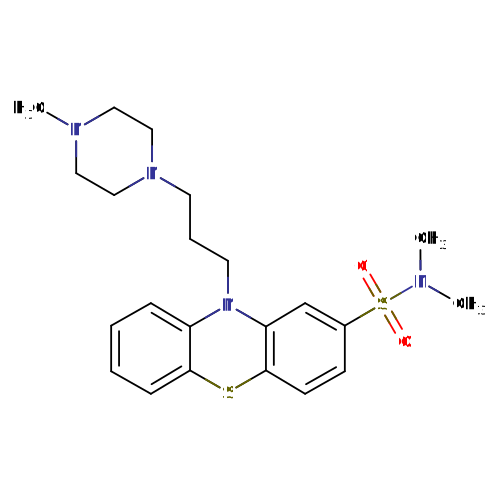
Structure for Thioproperazine (DB01622)
- Weight
- Average: 446.629
Monoisotopic: 446.181017604 - Chemical Formula
- C22H30N4O2S2
- Synonyms
- (Thioproperazine)-2-dimethylsulfamido-(10-(3-1-methylpiperazinyl-4)propyl)-phenothiazine
- 2-dimethylsulfamido-(10-(3-1-methylpiperazinyl-4)propyl)-phenothiazine
- N,N-Dimethyl-10-[3-(4-methyl-1-piperazinyl)propyl]-10H-phenothiazine-2-sulfonamide
- N,N-Dimethyl-10-[3-(4-methyl-1-piperazinyl)propyl]phenothiazine-2-sulfonamide
- Thioperazine
- Thioproperazin
- Thioproperazine
- Thioproperazinum
- Tioproferazina
- Tioproperazina

Pharmacology
- Indication
For the treatment of all types of acute and chronic schizophrenia, including those which did not respond to the usual neuroleptics; manic syndromes.
 Reduce drug development failure ratesBuild, train, & validate machine-learning modelswith evidence-based and structured datasets.Build, train, & validate predictive machine-learning models with structured datasets.
- Associated Conditions
Indication Type Indication Combined Product Details Approval Level Age Group Patient Characteristics Dose Form Management of Schizophrenia •••••••••••• Management of Manic syndromes •••••••••••• - Contraindications & Blackbox Warnings
 Prevent Adverse Drug Events TodayTap into our Clinical API for life-saving information on contraindications & blackbox warnings, population restrictions, harmful risks, & more.Avoid life-threatening adverse drug events with our Clinical API
- Pharmacodynamics
Thioproperazine is a potent neuroleptic with antipsychotic properties. Thioproperazine has a marked cataleptic and antiapomorphine activity associated with relatively slight sedative, hypothermic and spasmolytic effects. It is virtually without antiserotonin and hypotensive action and has no antihistaminic property.
- Mechanism of action
Thioproperazine acts as an antagonist (blocking agent) on different postsysnaptic receptors -on dopaminergic-receptors (subtypes D1, D2, D3 and D4 - different antipsychotic properties on productive and unproductive symptoms), on serotonergic-receptors (5-HT1 and 5-HT2, with anxiolytic, antidepressive and antiaggressive properties as well as an attenuation of extrapypramidal side-effects, but also leading to weight gain, fall in blood pressure, sedation and ejaculation difficulties), on histaminergic-receptors (H1-receptors, sedation, antiemesis, vertigo, fall in blood pressure and weight gain), alpha1/alpha2-receptors (antisympathomimetic properties, lowering of blood pressure, reflex tachycardia, vertigo, sedation, hypersalivation and incontinence as well as sexual dysfunction, but may also attenuate pseudoparkinsonism - controversial) and finally on muscarinic (cholinergic) M1/M2-receptors (causing anticholinergic symptoms like dry mouth, blurred vision, obstipation, difficulty/inability to urinate, sinus tachycardia, ECG-changes and loss of memory, but the anticholinergic action may attenuate extrapyramidal side-effects).
Target Actions Organism ADopamine D2 receptor antagonistHumans AAlpha-1A adrenergic receptor antagonistHumans AAlpha-1B adrenergic receptor antagonistHumans UDopamine D1 receptor antagonistHumans - Absorption
Not Available
- Volume of distribution
Not Available
- Protein binding
Not Available
- Metabolism
- Not Available
- Route of elimination
Not Available
- Half-life
Not Available
- Clearance
Not Available
- Adverse Effects
 Improve decision support & research outcomesWith structured adverse effects data, including: blackbox warnings, adverse reactions, warning & precautions, & incidence rates. View sample adverse effects data in our new Data Library!Improve decision support & research outcomes with our structured adverse effects data.
- Toxicity
Overdosage may result in severe extrapyramidal symptoms with dysphagia, marked sialorrhea, persistent and rapidly increasing hyperthermia, pulmonary syndrome, state of shock with pallor and profuse sweating, which may be followed by collapse and coma. LD50 in mice is 70 mg/kg I.V., 120 mg/kg I.P., 500 mg/kg S.C. and 830 mg/kg P.O.
- Pathways
- Not Available
- Pharmacogenomic Effects/ADRs
- Not Available
Interactions
- Drug Interactions
- This information should not be interpreted without the help of a healthcare provider. If you believe you are experiencing an interaction, contact a healthcare provider immediately. The absence of an interaction does not necessarily mean no interactions exist.
Drug Interaction Integrate drug-drug
interactions in your software1,2-Benzodiazepine The risk or severity of CNS depression can be increased when Thioproperazine is combined with 1,2-Benzodiazepine. Acebutolol The serum concentration of Acebutolol can be increased when it is combined with Thioproperazine. Aceclofenac The risk or severity of hypertension can be increased when Thioproperazine is combined with Aceclofenac. Acemetacin The risk or severity of hypertension can be increased when Thioproperazine is combined with Acemetacin. Acenocoumarol The risk or severity of adverse effects can be increased when Thioproperazine is combined with Acenocoumarol. - Food Interactions
- Avoid alcohol.
- Take with food. Food decreases irritation.
Products
 Drug product information from 10+ global regionsOur datasets provide approved product information including:dosage, form, labeller, route of administration, and marketing period.Access drug product information from over 10 global regions.
- International/Other Brands
- Majeptil
- Brand Name Prescription Products
Name Dosage Strength Route Labeller Marketing Start Marketing End Region Image Majeptil Tab 10mg Tablet 10 mg Oral Erfa Canada 2012 Inc 1962-12-31 Not applicable Canada 
Categories
- ATC Codes
- N05AB08 — Thioproperazine
- Drug Categories
- Adrenergic alpha-1 Receptor Antagonists
- Adrenergic alpha-Antagonists
- Adrenergic Antagonists
- Agents that produce hypertension
- Antidepressive Agents
- Antipsychotic Agents
- Antipsychotic Agents (First Generation [Typical])
- Central Nervous System Depressants
- Dopamine Antagonists
- Dopamine D2 Receptor Antagonists
- Heterocyclic Compounds, Fused-Ring
- Nervous System
- Neurotoxic agents
- Phenothiazines
- Phenothiazines With Piperazine Structure
- Psycholeptics
- Serotonin 5-HT1 Receptor Antagonists
- Serotonin 5-HT2 Receptor Antagonists
- Serotonin Agents
- Serotonin Receptor Antagonists
- Sulfur Compounds
- Chemical TaxonomyProvided by Classyfire
- Description
- This compound belongs to the class of organic compounds known as phenothiazines. These are polycyclic aromatic compounds containing a phenothiazine moiety, which is a linear tricyclic system that consists of a two benzene rings joined by a para-thiazine ring.
- Kingdom
- Organic compounds
- Super Class
- Organoheterocyclic compounds
- Class
- Benzothiazines
- Sub Class
- Phenothiazines
- Direct Parent
- Phenothiazines
- Alternative Parents
- Alkyldiarylamines / Diarylthioethers / N-methylpiperazines / Organosulfonamides / Benzenoids / 1,4-thiazines / Aminosulfonyl compounds / Trialkylamines / Azacyclic compounds / Organopnictogen compounds show 2 more
- Substituents
- 1,4-diazinane / Alkyldiarylamine / Amine / Aminosulfonyl compound / Aromatic heteropolycyclic compound / Aryl thioether / Azacycle / Benzenoid / Diarylthioether / Hydrocarbon derivative show 19 more
- Molecular Framework
- Aromatic heteropolycyclic compounds
- External Descriptors
- phenothiazines, sulfonamide, N-alkylpiperazine, N-methylpiperazine (CHEBI:59120)
- Affected organisms
- Humans and other mammals
Chemical Identifiers
- UNII
- YJ050AQ56X
- CAS number
- 316-81-4
- InChI Key
- VZYCZNZBPPHOFY-UHFFFAOYSA-N
- InChI
- InChI=1S/C22H30N4O2S2/c1-23(2)30(27,28)18-9-10-22-20(17-18)26(19-7-4-5-8-21(19)29-22)12-6-11-25-15-13-24(3)14-16-25/h4-5,7-10,17H,6,11-16H2,1-3H3
- IUPAC Name
- N,N-dimethyl-10-[3-(4-methylpiperazin-1-yl)propyl]-10H-phenothiazine-2-sulfonamide
- SMILES
- CN(C)S(=O)(=O)C1=CC2=C(SC3=CC=CC=C3N2CCCN2CCN(C)CC2)C=C1
References
- General References
- Not Available
- External Links
- Human Metabolome Database
- HMDB0015559
- KEGG Drug
- D08585
- PubChem Compound
- 9429
- PubChem Substance
- 46507111
- ChemSpider
- 9058
- BindingDB
- 81793
- 10498
- ChEBI
- 59120
- ChEMBL
- CHEMBL609109
- ZINC
- ZINC000022446685
- PharmGKB
- PA164754875
- Wikipedia
- Thioproperazine
Clinical Trials
- Clinical Trials
Phase Status Purpose Conditions Count Not Available Completed Not Available Bipolar Disorder (BD) / Psychosis / Schizoaffective Disorders / Schizophrenia / Type 2 Diabetes Mellitus 1
Pharmacoeconomics
- Manufacturers
- Not Available
- Packagers
- Not Available
- Dosage Forms
Form Route Strength Tablet Oral 10 mg - Prices
Unit description Cost Unit Majeptil 10 mg Tablet 0.6USD tablet DrugBank does not sell nor buy drugs. Pricing information is supplied for informational purposes only.- Patents
- Not Available
Properties
- State
- Solid
- Experimental Properties
Property Value Source melting point (°C) 140 °C PhysProp - Predicted Properties
Property Value Source Water Solubility 0.0569 mg/mL ALOGPS logP 3.09 ALOGPS logP 2.83 Chemaxon logS -3.9 ALOGPS pKa (Strongest Basic) 7.96 Chemaxon Physiological Charge 1 Chemaxon Hydrogen Acceptor Count 5 Chemaxon Hydrogen Donor Count 0 Chemaxon Polar Surface Area 47.1 Å2 Chemaxon Rotatable Bond Count 5 Chemaxon Refractivity 126.95 m3·mol-1 Chemaxon Polarizability 49.62 Å3 Chemaxon Number of Rings 4 Chemaxon Bioavailability 1 Chemaxon Rule of Five Yes Chemaxon Ghose Filter Yes Chemaxon Veber's Rule No Chemaxon MDDR-like Rule No Chemaxon - Predicted ADMET Features
Property Value Probability Human Intestinal Absorption + 0.996 Blood Brain Barrier + 0.9629 Caco-2 permeable - 0.6568 P-glycoprotein substrate Substrate 0.7908 P-glycoprotein inhibitor I Inhibitor 0.8563 P-glycoprotein inhibitor II Inhibitor 0.7979 Renal organic cation transporter Non-inhibitor 0.5396 CYP450 2C9 substrate Non-substrate 0.7704 CYP450 2D6 substrate Non-substrate 0.8194 CYP450 3A4 substrate Substrate 0.5366 CYP450 1A2 substrate Non-inhibitor 0.8243 CYP450 2C9 inhibitor Non-inhibitor 0.8758 CYP450 2D6 inhibitor Inhibitor 0.6293 CYP450 2C19 inhibitor Non-inhibitor 0.7713 CYP450 3A4 inhibitor Inhibitor 0.6338 CYP450 inhibitory promiscuity Low CYP Inhibitory Promiscuity 0.6663 Ames test Non AMES toxic 0.7056 Carcinogenicity Non-carcinogens 0.8109 Biodegradation Not ready biodegradable 0.9934 Rat acute toxicity 2.6623 LD50, mol/kg Not applicable hERG inhibition (predictor I) Weak inhibitor 0.7265 hERG inhibition (predictor II) Non-inhibitor 0.5303
Spectra
- Mass Spec (NIST)
- Download (11 KB)
- Spectra
- Chromatographic Properties
Collision Cross Sections (CCS)
Adduct CCS Value (Å2) Source type Source [M-H]- 221.5260247 predictedDarkChem Lite v0.1.0 [M-H]- 225.2888247 predictedDarkChem Lite v0.1.0 [M-H]- 202.94759 predictedDeepCCS 1.0 (2019) [M+H]+ 222.4744247 predictedDarkChem Lite v0.1.0 [M+H]+ 226.2688247 predictedDarkChem Lite v0.1.0 [M+H]+ 205.3056 predictedDeepCCS 1.0 (2019) [M+Na]+ 222.4530247 predictedDarkChem Lite v0.1.0 [M+Na]+ 224.8821247 predictedDarkChem Lite v0.1.0 [M+Na]+ 212.09517 predictedDeepCCS 1.0 (2019)
Targets

- Kind
- Protein
- Organism
- Humans
- Pharmacological action
- Yes
- Actions
- Antagonist
- General Function
- Potassium channel regulator activity
- Specific Function
- Dopamine receptor whose activity is mediated by G proteins which inhibit adenylyl cyclase.
- Gene Name
- DRD2
- Uniprot ID
- P14416
- Uniprot Name
- D(2) dopamine receptor
- Molecular Weight
- 50618.91 Da
References
- Oades RD, Rao ML, Bender S, Sartory G, Muller BW: Neuropsychological and conditioned blocking performance in patients with schizophrenia: assessment of the contribution of neuroleptic dose, serum levels and dopamine D2-receptor occupancy. Behav Pharmacol. 2000 Jun;11(3-4):317-30. [Article]
- Seeman P: Atypical antipsychotics: mechanism of action. Can J Psychiatry. 2002 Feb;47(1):27-38. [Article]
- Wu S, Xing Q, Gao R, Li X, Gu N, Feng G, He L: Response to chlorpromazine treatment may be associated with polymorphisms of the DRD2 gene in Chinese schizophrenic patients. Neurosci Lett. 2005 Mar 7;376(1):1-4. Epub 2004 Dec 2. [Article]
- Wu SN, Gao R, Xing QH, Li HF, Shen YF, Gu NF, Feng GY, He L: Association of DRD2 polymorphisms and chlorpromazine-induced extrapyramidal syndrome in Chinese schizophrenic patients. Acta Pharmacol Sin. 2006 Aug;27(8):966-70. [Article]
- Chen X, Ji ZL, Chen YZ: TTD: Therapeutic Target Database. Nucleic Acids Res. 2002 Jan 1;30(1):412-5. [Article]
- Seeman P: Dopamine D2 receptors as treatment targets in schizophrenia. Clin Schizophr Relat Psychoses. 2010 Apr;4(1):56-73. doi: 10.3371/CSRP.4.1.5. [Article]
- Kind
- Protein
- Organism
- Humans
- Pharmacological action
- Yes
- Actions
- Antagonist
- General Function
- Protein heterodimerization activity
- Specific Function
- This alpha-adrenergic receptor mediates its action by association with G proteins that activate a phosphatidylinositol-calcium second messenger system. Its effect is mediated by G(q) and G(11) prot...
- Gene Name
- ADRA1A
- Uniprot ID
- P35348
- Uniprot Name
- Alpha-1A adrenergic receptor
- Molecular Weight
- 51486.005 Da
References
- Cahir M, King DJ: Antipsychotics lack alpha 1A/B adrenoceptor subtype selectivity in the rat. Eur Neuropsychopharmacol. 2005 Mar;15(2):231-4. [Article]
- Kind
- Protein
- Organism
- Humans
- Pharmacological action
- Yes
- Actions
- Antagonist
- General Function
- Protein heterodimerization activity
- Specific Function
- This alpha-adrenergic receptor mediates its action by association with G proteins that activate a phosphatidylinositol-calcium second messenger system. Its effect is mediated by G(q) and G(11) prot...
- Gene Name
- ADRA1B
- Uniprot ID
- P35368
- Uniprot Name
- Alpha-1B adrenergic receptor
- Molecular Weight
- 56835.375 Da
References
- Cahir M, King DJ: Antipsychotics lack alpha 1A/B adrenoceptor subtype selectivity in the rat. Eur Neuropsychopharmacol. 2005 Mar;15(2):231-4. [Article]
- Kind
- Protein
- Organism
- Humans
- Pharmacological action
- Unknown
- Actions
- Antagonist
- General Function
- G-protein coupled amine receptor activity
- Specific Function
- Dopamine receptor whose activity is mediated by G proteins which activate adenylyl cyclase.
- Gene Name
- DRD1
- Uniprot ID
- P21728
- Uniprot Name
- D(1A) dopamine receptor
- Molecular Weight
- 49292.765 Da
References
- Kanba S, Suzuki E, Nomura S, Nakaki T, Yagi G, Asai M, Richelson E: Affinity of neuroleptics for D1 receptor of human brain striatum. J Psychiatry Neurosci. 1994 Jul;19(4):265-9. [Article]
Carriers
- Kind
- Protein
- Organism
- Humans
- Pharmacological action
- Unknown
- General Function
- Toxic substance binding
- Specific Function
- Serum albumin, the main protein of plasma, has a good binding capacity for water, Ca(2+), Na(+), K(+), fatty acids, hormones, bilirubin and drugs. Its main function is the regulation of the colloid...
- Gene Name
- ALB
- Uniprot ID
- P02768
- Uniprot Name
- Serum albumin
- Molecular Weight
- 69365.94 Da
References
- Kitamura K, Omran AA, Nagata C, Kamijima Y, Tanaka R, Takegami S, Kitade T: Effects of inorganic ions on the binding of triflupromazine and chlorpromazine to bovine serum albumin studied by spectrometric methods. Chem Pharm Bull (Tokyo). 2006 Jul;54(7):972-6. [Article]
- Rukhadze MD, Bezarashvili GS, Sidamonidze NS, Tsagareli SK: Investigation of binding process of chlorpromazine to bovine serum albumin by means of passive and active experiments. Biomed Chromatogr. 2001 Oct;15(6):365-73. [Article]
- Silva D, Cortez CM, Louro SR: Quenching of the intrinsic fluorescence of bovine serum albumin by chlorpromazine and hemin. Braz J Med Biol Res. 2004 Jul;37(7):963-8. Epub 2004 Jun 22. [Article]


Drug created at August 29, 2007 20:17 / Updated at November 02, 2022 09:01